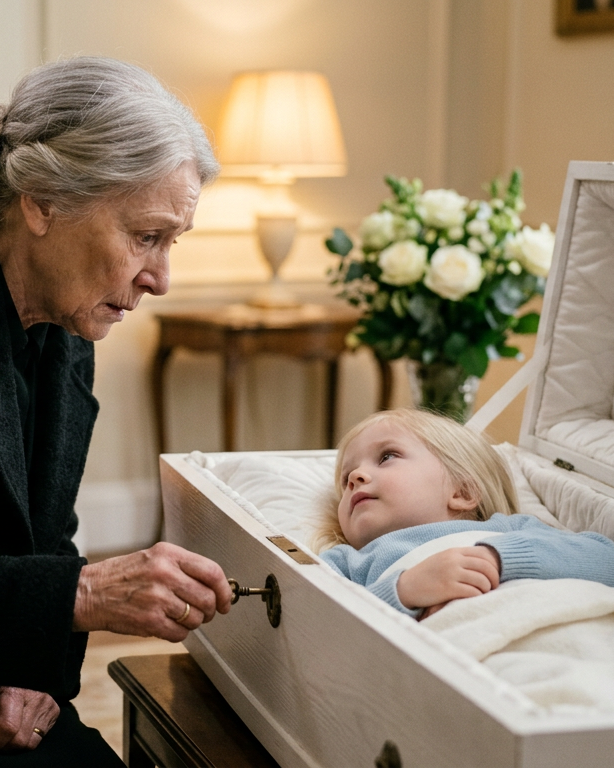
At my 6-year-old granddaughter’s funeral, I leaned over her casket to say a final goodbye. Then I heard a faint, desperate scrape from inside. “Daddy said if I woke up, I would ruin everything,” she whispered. I froze. My son and his wife had told everyone she died from a sudden contagion. I pried the lid open. As I lifted my breathing grandchild, heavy footsteps rushed down the stairs…
Julian hit the laundry-room door so hard the frame shook.
“Mom!”
I pressed my back against the dryer and held Chloe against my chest.
She flinched at his voice.
Not startled.
Terrified.
That frightened me more than anything I had seen inside that casket.
“Mom, open the door.”
I said nothing.
The dispatcher was still on the telephone.
“Ma’am, officers and paramedics are on the way. Do not unlock the door if you believe you or the child are in danger.”
Julian struck it again.
“Mom!”
Chloe buried her face against my shoulder.
Then she whispered four words.
“Daddy has the needle.”
Every part of me went cold.
“What needle?” I whispered.
Her fingers tightened around my shawl.
“The sleepy one.”
Outside the door, Julian suddenly became quiet.
Too quiet.
Then his voice changed.
No more panic.
No more frightened son calling for his mother.
Now he sounded calm.
Controlled.
“Mom, Chloe is confused.”
I stared at the door.
“You knew she was alive.”
Silence.
For one long second, neither of us spoke.
Then Julian said quietly, “Open the door.”
“No.”
“You don’t understand what’s happening.”
“I understand enough.”
“Chloe is sick.”
“She was locked inside a coffin.”
“She was supposed to remain sedated.”
The words came out before he could stop them.
I stopped breathing.
So did he.
The dispatcher heard it.
“Ma’am,” she said sharply, “stay where you are.”
I looked down at Chloe.
Her eyes were barely open, but she had heard him too.
“Sedated?” I called through the door.
Julian didn’t answer.
Then Victoria’s footsteps crossed the hallway.
Her voice came next.
“What did you tell her?”
“Nothing.”
“You always do this,” Victoria hissed. “You panic.”
“I said nothing.”
“You just said sedated!”
“Would you lower your voice?”
Their argument was only a few feet away.
And suddenly I understood something.
They weren’t united.
Not completely.
Whatever they had done to Chloe, whatever nightmare had been happening inside that beautiful house, fear was starting to split them apart.
I needed to keep them talking.
“The police are coming,” I shouted.
Silence.
Then Victoria laughed.
A strange little laugh.
“You called the police?”
“Yes.”
“For what?”
I looked at the trembling child in my arms.
“For attempted murder.”
The hallway exploded.
Victoria cursed.
Julian slammed his palm against the door.
“Mom, listen to me. Do not use words like that.”
“What should I call putting a living six-year-old in a casket?”
“She wasn’t going to die!”
Chloe whimpered.
Julian heard her.
“Chloe?”
She stiffened.
“Sweetheart?”
“No,” she whispered.
His voice softened instantly.
The same voice he had used when he was a little boy asking me to forgive him for breaking a window.
“Chloe, Daddy needs you to open the door.”
She began shaking.
“Chloe, sweetheart, Grandma doesn’t know the whole story.”
I felt something inside me break.
Not because I believed him.
Because I finally understood how he had done it.
The gentle voice.
The reasonable explanations.
The careful smile.
Julian had always hated conflict.
That was what I told myself.
Now I wondered if I had mistaken something darker for weakness.
“Don’t answer him,” I whispered.
Chloe nodded against my shoulder.
Then we heard sirens.
Distant at first.
Then louder.
Julian stopped knocking.
Victoria moved fast.
I heard running.
A drawer opening.
Glass breaking.
Then Julian shouted, “What are you doing?”
“Cleaning this up!”
“You can’t clean it up now!”
“They can’t find those.”
A cabinet door slammed.
I turned toward the tiny laundry-room window.
Red and blue light flashed across the backyard.
“They’re here,” I whispered.
Chloe started crying.
Not loudly.
Just tiny exhausted tears sliding down her face.
I kissed her forehead.
“You’re safe.”
She looked at me.
Children know when adults are lying.
So I corrected myself.
“I’m going to do everything I can to keep you safe.”
The front doorbell rang.
Nobody answered.
Then came pounding.
“Police!”
Victoria shouted something upstairs.
Julian moved away from the laundry room.
“Police! Open the door!”
Seconds later, I heard the front door open.
Julian’s voice transformed again.
Calm.
Confused.
Concerned.
“Officers? What’s going on?”
I almost screamed.
But the dispatcher spoke first.
“They know where you are. Stay behind the locked door until officers identify themselves.”
A man’s voice thundered through the house.
“Where is the child?”
Julian answered immediately.
“My daughter died yesterday.”
My knees nearly gave out.
A second voice shouted, “Sir, step away.”
Then Victoria said, “There’s been a misunderstanding.”
I heard footsteps running toward us.
“Chicago-area police! Ma’am, are you inside the laundry room?”
“Yes!”
“Are you the caller?”
“Yes!”
“Is Chloe with you?”
“Yes!”
“Keep the door locked until I tell you.”
Julian shouted from somewhere behind them.
“My mother is hysterical!”
Another officer snapped, “Sir, stay where you are.”
Then came a struggle.
Furniture scraped.
Victoria screamed.
“Don’t touch him!”
“Hands where I can see them!”
Chloe covered her ears.
I crouched beside the washing machine with her in my lap.
The officer outside spoke calmly.
“My name is Officer Daniel Reyes. Paramedics are with me. I need you to unlock the door and step back.”
I looked at Chloe.
“Are you ready?”
She shook her head.
Neither was I.
But I opened the door.
Three people stood outside.
Officer Reyes.
A female officer.
Two paramedics behind them.
And farther down the hallway, Julian was on his knees with his hands behind his head.
Victoria stood near the staircase.
Her face had turned completely white.
The moment Julian saw Chloe, his expression changed.
Not relief.
Not joy.
Not the face of a father seeing his supposedly dead daughter alive.
Fear.
Pure fear.
Officer Reyes saw it too.
The paramedics took Chloe from me.
She cried and grabbed my collar.
“No!”
“I’m coming.”
“Don’t let Daddy come.”
Julian looked as if she had slapped him.
“Chloe, honey—”
“Stop talking to her,” Officer Reyes ordered.
The paramedics laid her on a portable stretcher.
One checked her breathing.
Another attached a small monitor to her finger.
Her heart rate was too slow.
Her temperature was elevated.
Her pupils reacted sluggishly.
“Possible sedative exposure,” one paramedic said.
Julian jumped to his feet.
“That’s her prescription!”
Officer Reyes turned.
“What prescription?”
Julian froze.
Victoria closed her eyes.
And for the second time that night, my son had spoken too quickly.
The paramedic looked at him.
“What medication is she prescribed?”
Julian didn’t answer.
Victoria did.
“Anxiety medication.”
“What medication?”
“I don’t remember the name.”
“You don’t remember the medication your six-year-old daughter takes?”
“It’s new.”
The female officer stepped closer.
“Where’s the bottle?”
Nobody answered.
Then Chloe lifted one trembling hand.
“The blue room.”
We all looked at her.
“What blue room?” Officer Reyes asked gently.
Chloe pointed upstairs.
Victoria’s face changed.
“No.”
It was the first truly uncontrolled reaction I had seen from her.
Officer Reyes noticed immediately.
“What’s upstairs?”
“Nothing.”
“Then you won’t mind us looking.”
“You need a warrant.”
Officer Reyes stared at the living room.
At the flowers.
At the candles.
At the open casket.
At the indentation where a child had been lying.
Then he looked back at Victoria.
“We have an allegedly deceased child alive inside your home, showing signs of possible drug exposure. We’re securing the scene.”
Victoria said nothing.
The paramedics wheeled Chloe toward the front door.
I followed.
As I passed Julian, he looked up at me.
“Mom.”
I stopped.
I wish I could say I saw my little boy.
The toddler who used to fall asleep on my shoulder.
The teenager who called me when he got his first flat tire.
The young man who cried when Chloe was born.
But I didn’t.
I saw a stranger wearing my son’s face.
“What did you do?” I whispered.
His eyes filled with tears.
“You don’t know what Victoria did.”
Victoria turned so sharply her hair swung across her face.
“You coward.”
And just like that, the first crack opened.
At the hospital, the doctors worked on Chloe for nearly two hours.
I sat outside the pediatric treatment room with my hands locked together so tightly they hurt.
A detective named Mara Chen arrived shortly after midnight.
She was small, calm, and spoke in a voice that never seemed hurried.
That made me trust her.
People who are pretending usually rush.
Detective Chen didn’t.
She sat beside me.
“Tell me everything from the beginning.”
So I did.
The sudden illness.
Julian’s phone call three days earlier.
His broken voice telling me Chloe had developed a highly contagious respiratory infection.
The claim that she declined within hours.
The private doctor.
The closed casket.
The instruction that nobody touch her.
The strange decision to hold the viewing at home.
The funeral director who supposedly arranged everything privately.
The fact that I had never actually seen paperwork from a hospital.
Detective Chen stopped me.
“You never saw a death certificate?”
“No.”
“Did you see a doctor pronounce her dead?”
“No.”
“Did anyone outside Julian or Victoria confirm the death?”
I thought.
Then my stomach tightened.
“No.”
Not one person.
Every fact had come from them.
Friends had sent flowers because Julian told them Chloe was dead.
The school had been informed by Victoria.
Family members stayed away because they were warned Chloe had died from a contagious illness.
Even I had been told not to come until the evening before the funeral.
Detective Chen wrote something down.
“Why were you allowed inside tonight?”
“I insisted.”
“And they let you remain alone with the casket?”
“They tried to make me leave.”
“Why didn’t they force the issue?”
I looked at her.
“Because they thought she wouldn’t wake up.”
Detective Chen didn’t respond.
She didn’t need to.
A doctor appeared twenty minutes later.
Dr. Patel.
He pulled down his mask.
“Chloe is stable.”
I started crying before he finished the sentence.
“She’s dehydrated and has medication in her system that would explain the extreme drowsiness and slowed responses. We’re still waiting on toxicology, so I don’t want to speculate about exactly what she was given.”
“Will she be all right?”
“We’re optimistic.”
I pressed both hands against my mouth.
Then he added something that changed the investigation.
“There’s something else.”
Detective Chen stood.
“What?”
Dr. Patel lowered his voice.
“Based on initial examination, this does not look like a child who became ill yesterday.”
“What does that mean?”
“Chloe has evidence of prolonged poor nutrition and repeated adhesive marks consistent with medical patches or monitoring devices. Nothing immediately life-threatening now, but enough that I’ve contacted the child protection team.”
I closed my eyes.
Months.
This had been going on for months.
All those times Julian said she was sleeping.
All those canceled visits.
All those excuses.
Dr. Patel continued.
“She also keeps asking whether she’s allowed to wake up.”
I broke.
I leaned forward and sobbed into my hands.
Detective Chen waited.
Then she asked one question.
“What exactly did Chloe say when you found her?”
I lifted my face.
“Daddy said if I woke up, I would ruin everything.”
Detective Chen’s expression hardened.
“Everything,” she repeated.
At 2:14 in the morning, the blue room was opened.
Detective Chen came back to the hospital herself.
She didn’t call.
She wanted to see my face when she told me.
The room was a study at the rear of Julian’s second floor.
I had been inside it once, years earlier, when it was painted cream and filled with books.
Now it had been painted dark blue.
The police found a folding examination table.
Medical tubing.
Unused syringes.
Sedative medication belonging to an adult patient who did not live in the house.
Disposable gloves.
A pulse oximeter.
A locked metal case.
And a stack of documents.
But the most important discovery was inside Julian’s desk.
A file labeled:
LIFE SETTLEMENT — CHLOE M.
I stared at Detective Chen.
“What is that?”
She placed a photocopy on the table.
Eight months earlier, Julian and Victoria had taken out a life insurance policy connected to Chloe.
Not a normal small policy.
A policy worth three million dollars.
I almost laughed because the number was so insane.
“Who insures a six-year-old for three million dollars?”
Detective Chen didn’t answer directly.
“The policy alone doesn’t prove criminal intent.”
“But?”
“But there was a contestability period.”
I waited.
“And?”
“If Chloe died under certain conditions before a specified date, there could be complications.”
“When was that date?”
“Tomorrow.”
My blood stopped.
The funeral was tomorrow.
The date mattered.
The timing mattered.
Everything mattered.
Detective Chen continued.
“There’s more.”
There always was.
Julian’s business was collapsing.
I knew he owned part of a healthcare software company.
I knew he had complained about investors.
I did not know he had personally guaranteed nearly two million dollars in loans.
I did not know Victoria had taken money from Chloe’s education account.
I did not know their home had a foreclosure notice temporarily suspended by legal action.
I did not know they were drowning.
But bankruptcy still didn’t explain the casket.
Not completely.
Detective Chen slid another paper toward me.
“This was found in Victoria’s locked case.”
It was a printed email.
From a private clinic in Wisconsin.
Six months earlier.
Chloe had undergone genetic testing after recurrent fevers.
The results did not show a fatal disease.
They showed something else.
A treatable immune disorder.
Not easy.
Not trivial.
But treatable.
Julian and Victoria had told family she had a mysterious degenerative condition.
That had been a lie too.
“So they made her sick?”
“We don’t know that yet.”
“Detective—”
“We have to prove every part.”
I hated her patience.
And I was grateful for it.
Because patience was going to put them in prison.
Then she showed me the photographs.
Not photographs of Chloe.
Photographs of paperwork.
Draft death certificates.
Funeral forms.
Insurance documents.
A blank prescription pad.
A doctor’s signature.
The signature belonged to Dr. Nathan Ellison.
A physician who had treated Julian years ago.
There was only one problem.
Dr. Ellison had been dead for eleven months.
Someone had been using a dead doctor’s identity.
My hands went numb.
“The funeral home?”
“Doesn’t exist.”
I stared at her.
“What?”
“The company name on the documents is registered to a virtual office. No licensed funeral establishment operates under that name.”
“The casket?”
“Purchased online.”
I thought I was going to be sick.
There had never been a funeral director.
Never been a doctor.
Never been a death confirmation.
Only Julian.
Victoria.
And a house full of grieving people who trusted them.
Detective Chen leaned forward.
“We also recovered security-camera footage from the home system.”
I didn’t want to ask.
But I did.
“What does it show?”
“It shows Julian carrying Chloe downstairs at 8:37 this evening.”
I covered my mouth.
“Was she conscious?”
“Barely.”
“And Victoria?”
“She prepared the casket.”
I shut my eyes.
For several seconds, the room disappeared.
When I opened them again, Detective Chen was still there.
“There’s one other thing,” she said.
“What?”
“Julian asked for an attorney.”
I nodded.
“Victoria didn’t.”
That made me look up.
“She’s talking.”
Victoria talked for three hours.
And by sunrise, she had blamed everything on Julian.
She said the insurance was his idea.
The fake illness was his idea.
The forged doctor documents were his idea.
The casket was his idea.
According to Victoria, she wanted to stop.
According to Victoria, Julian controlled the money.
According to Victoria, Julian had convinced her they were only going to make Chloe appear dead temporarily.
Then, after the insurance and financial arrangements were settled, they would take Chloe away under a new identity.
A new identity.
I stared at Detective Chen.
“That doesn’t even make sense.”
“No.”
“So she’s lying.”
“Parts of it appear inconsistent.”
Then Julian started talking too.
Not officially.
Not intelligently.
But he couldn’t tolerate the idea that Victoria was blaming him.
He told an officer she had “planned the medical side.”
He claimed Victoria had access to medication through her mother’s old prescriptions.
He claimed she invented the contagion story.
He claimed she was the one who convinced Chloe that waking up would hurt the family.
Each one blamed the other.
Both insisted they never intended to kill her.
And that was when Chloe gave the detectives the truth.
Not all at once.
Children rarely tell terrifying stories in perfect order.
They tell you about the purple cup.
Then a cartoon.
Then a locked door.
Then the sentence that destroys you.
A child specialist sat beside her.
I remained in the room because Chloe refused to speak unless she could see me.
She held a stuffed dog the hospital had given her.
“Do you know why you were inside the box?” the specialist asked.
Chloe nodded.
“Mommy said we were playing sleeping princess.”
My nails dug into my palms.
“What were the rules?”
“I had to drink the purple cup.”
“What was in it?”
“I don’t know.”
“What happened after you drank it?”
“My arms got sleepy.”
The specialist waited.
“What else?”
“Daddy put the sticker on me.”
“What sticker?”
“On my back.”
A medication patch.
Probably one of the marks the doctor had found.
“What did Daddy tell you?”
Chloe looked at me.
I smiled even though I could barely breathe.
She turned back.
“He said Grandma might come.”
“And if Grandma came?”
“I couldn’t wake up.”
“Why?”
“Because then the people would know.”
“What people?”
“The money people.”
Detective Chen, watching through the glass, went completely still.
The specialist continued gently.
“What would the money people know?”
“That I wasn’t in heaven.”
I closed my eyes.
There it was.
Simple enough for a six-year-old to understand.
Horrifying enough for every adult in the room to understand too.
Then Chloe said something nobody expected.
“Daddy was going to wake me up tomorrow night.”
The specialist paused.
“How do you know?”
“He told Mommy.”
“You heard them?”
Chloe nodded.
“I was behind the couch.”
“What did he say?”
“He said after Grandma goes home and after the hole is covered, they would get me.”
My stomach turned.
The burial.
They were going to bury an empty casket?
Or remove her afterward?
The specialist asked carefully, “Did Daddy say where you would go?”
Chloe rubbed the stuffed dog’s ear.
“To the cabin.”
Detective Chen immediately left the observation room.
Within an hour, police were searching for a cabin.
They found it before noon.
Northern Wisconsin.
Purchased under a corporation connected to Victoria’s brother.
Inside were children’s clothes in Chloe’s size.
Food.
Medication.
Cash.
Two prepaid phones.
Hair dye.
A box containing temporary hair-color spray.
And identification documents for a seven-year-old girl named Emma Lawson.
The photograph was Chloe.
That was their plan.
Not murder.
At least not at first.
They intended to fake Chloe’s death.
Collect whatever money they could.
Let the family mourn.
Then hide her under another name until they decided what to do next.
It was monstrous.
But there was still one question.
Why risk putting her in the casket while family members were inside the house?
Why not hide her somewhere else?
The answer came from Victoria.
Because Julian had become paranoid.
He believed police or insurance investigators might arrive unexpectedly.
He wanted Chloe physically present in case someone demanded to see the body before the funeral.
Sedated.
Hidden in plain sight.
Nobody would open the casket because everyone had been warned about “contagion.”
Nobody except me.
I was never supposed to stay.
I was supposed to kiss the wooden lid, cry, and leave.
But Victoria had made one mistake.
She underestimated a grandmother who needed to see the child she loved one final time.
By afternoon, Chloe was awake enough to eat half a banana.
I sat beside her bed.
“Grandma?”
“Yes, sweetheart?”
“Am I in trouble?”
My heart cracked.
“No.”
“Daddy said everybody would lose the house if I was bad.”
“You were never bad.”
She stared at the blanket.
“Mommy cried.”
I swallowed.
“I know.”
“She said I had to help.”
“You’re six years old, Chloe. Grown-ups are supposed to help you. You are never supposed to save grown-ups from their own choices.”
She thought about that.
Then looked at me.
“Is Daddy mad?”
“I don’t know.”
“Are you mad?”
I wanted to lie.
Instead I said, “Yes.”
“At me?”
“Never at you.”
She reached for my hand.
I gave it to her.
She fell asleep holding two of my fingers.
That was when Julian called.
Not me directly.
His attorney contacted Detective Chen and said Julian wanted to speak to his mother.
I refused.
For twenty minutes.
Then I changed my mind.
Not because I wanted answers.
Because there was one question I needed him to hear.
The call was recorded.
Julian’s voice came through a phone in a small consultation room at the hospital.
“Mom?”
I said nothing.
“I know what you think.”
“No, Julian. You don’t.”
“We weren’t going to hurt her.”
“You drugged your daughter.”
“I was going to wake her.”
“You locked her inside a casket.”
“For a few hours.”
“She thought she was dead.”
“No. No, we explained—”
“She thought if she woke up she would destroy the family.”
His breathing changed.
“That was Victoria.”
“There it is.”
“What?”
“The thing you’ve done your entire life.”
“What are you talking about?”
“Whenever you break something, you find someone standing nearby and point at them.”
“That’s not fair.”
“You’re forty years old.”
“Mom—”
“You told your six-year-old daughter she had to pretend to be dead because you were afraid of losing your house.”
“It wasn’t only the house.”
“I don’t care.”
“You don’t understand what was happening.”
“You’re right. I don’t understand.”
My voice started shaking.
“I don’t understand how the son I raised could watch his little girl stop moving and decide the next step was to close the lid.”
Silence.
Then Julian cried.
A broken sound.
The kind of crying that would once have destroyed me.
It didn’t.
“I panicked.”
“No.”
“What?”
“You planned.”
He stopped.
“Panic is running a red light because your child can’t breathe. Panic is forgetting your wallet at the hospital. Panic is making one terrible decision in one terrible second.”
I stared through the glass wall at Chloe sleeping down the corridor.
“You bought a casket.”
Julian said nothing.
“You forged documents.”
Silence.
“You created another identity.”
Still nothing.
“You purchased a cabin.”
His breathing grew heavier.
“You insured your daughter.”
“Mom—”
“You didn’t panic, Julian.”
My voice became steady.
“You built this.”
And I hung up.
The investigation lasted eleven months.
By the time it ended, the story had become national news.
Reporters camped outside the courthouse.
Commentators argued about motive.
Strangers online invented theories.
But the truth was uglier than any conspiracy.
It was greed mixed with fear.
Debt mixed with entitlement.
Two parents who kept crossing lines until the lines disappeared.
Julian pleaded guilty after prosecutors recovered messages between him and Victoria.
The worst one had been sent six weeks before Chloe’s fake death.
Victoria:
What happens if she wakes up during the viewing?
Julian:
She won’t.
Victoria:
You can’t guarantee that.
Julian:
Then we make sure nobody opens it.
Another message came later.
Victoria:
Your mother will want to see her.
Julian:
I’ll handle Mom.
He had known.
He knew exactly what I would want.
And he built the plan around manipulating me.
Victoria eventually accepted a plea too.
Neither of them could convincingly claim the other had acted alone.
There were too many messages.
Too many purchases.
Too many shared decisions.
The fake doctor.
The medication.
The cabin.
The insurance.
The forged documents.
The false death announcement.
The casket.
The sedation.
The threats that made Chloe believe her family’s survival depended on her silence.
They went to prison.
Not forever.
No sentence could ever feel long enough to me.
But long enough for Chloe to grow up without them controlling every room she entered.
I became her temporary guardian first.
Then permanent.
The first few months were difficult.
She slept with the hallway light on.
She refused to close her bedroom door.
If she woke and couldn’t see me, she screamed.
She hated flowers.
Especially white lilies.
She couldn’t watch cartoons with sleeping princesses.
And for almost a year, she panicked anytime someone whispered around her because she believed whispering meant adults were planning something.
We found a therapist she trusted.
A pediatrician who explained every medicine before giving it to her.
A school counselor who never forced her to talk.
Slowly, Chloe came back.
Not the exact child she had been before.
Trauma doesn’t return what it takes in perfect condition.
But something else appeared.
Strength.
At seven, she joined an art class.
At eight, she learned to swim.
At nine, she stood on a school stage and forgot half her lines in a play, then laughed so hard the audience laughed with her.
That night, after the performance, she ran into my arms.
“Grandma!”
“You were wonderful.”
“I forgot everything!”
“You remembered enough.”
She smiled.
Then she asked me something I never expected.
“Do you still have the key?”
I knew immediately which key.
The tiny metal key I had pulled from beneath the casket lining.
The one that opened the restraint.
Police had kept it as evidence.
After the case ended, it had been returned to me inside a sealed property envelope.
“Yes.”
“Can I see it?”
I hesitated.
Then I brought it to her.
Chloe held it in her palm.
It looked impossibly small.
A cheap piece of metal.
Nothing special.
Yet once, it had been the difference between a child being trapped and a child being carried into the light.
“What should we do with it?” I asked.
She stared at it for a long time.
Then she closed her hand.
“Keep it.”
“Why?”
“So we remember.”
My throat tightened.
“Remember what?”
She looked at me.
Her face was older now.
Not old.
Just no longer six.
“That somebody opened it.”
I couldn’t speak.
So I hugged her.
And for years, that little key stayed in a wooden box in my bedroom.
Not as a reminder of Julian.
Not of Victoria.
Not of the insurance policy.
Not even of that terrible casket surrounded by white lilies.
It reminded me of one moment.
A sound so faint I almost dismissed it.
A tiny scrape.
A whisper from a place where nobody expected life.
Because sometimes evil does not announce itself with screaming.
Sometimes it sits inside a beautiful house.
It wears expensive clothes.
It signs funeral cards.
It tells relatives not to ask questions.
It says everything is under control.
And sometimes the difference between tragedy and rescue is one person refusing to walk away when something feels wrong.
Twelve years after that night, Chloe graduated from high school.
I sat in the front row.
She was eighteen.
Healthy.
Tall.
Nervous.
Alive.
When her name was called, she crossed the stage in a blue graduation gown and accepted her diploma.
I cried harder than I had at any graduation in my life.
Afterward, families crowded the football field with balloons and flowers.
Chloe found me near the bleachers.
She hugged me.
Then she slipped something into my hand.
Metal.
Cold.
Small.
I opened my fingers.
The key.
I stared at her.
“I thought this was in my bedroom.”
“It was.”
“You took it?”
“Borrowed it.”
She smiled.
Then she turned the key over.
Something had been engraved on one side.
Three tiny words.
I OPENED MY EYES.
I looked at her.
“Chloe…”
She hugged me again.
For a moment, I couldn’t see anything through the tears.
Then she whispered beside my ear.
“Daddy said waking up would ruin everything.”
I held her tighter.
Around us, hundreds of people were laughing.
Taking photographs.
Calling names.
Celebrating children stepping into their futures.
Chloe pulled back and smiled at me.
“He was wrong.”
I closed my fingers around the key.
“Yes,” I said.
“He was.”
Because the night Chloe opened her eyes did ruin something.
It ruined Julian’s lies.
It ruined Victoria’s plan.
It ruined the future they had built on fear, money, and the belief that a six-year-old child could be controlled forever.
But it did not ruin Chloe.
It saved her.
And every birthday after that, every school picture, every scraped knee, every laugh from the kitchen, every ordinary Tuesday morning when I heard her running down the stairs was proof of the same thing.
The casket had never been the end of her story.
It was the place where the truth finally woke up.