My father had a rule: he would match whatever his children saved for their first house, dollar for dollar.
He announced it at a Thanksgiving table when I was eleven and my sister Robin was fourteen, and he said it the way he said everything — once, flatly, as though it were a law of physics he’d just happened to mention. Dad was a boiler mechanic for the county school district for thirty-one years. He was not a warm man. He was a man who fixed things and considered the fixing to be the affection, and if you needed it said out loud, that was a deficiency in you, not in him.
Robin saved $40,000. It took her six years, and Dad wrote the check the same week she asked. She bought a beautiful home — three bedrooms on a corner lot with a maple in front that turns the color of a traffic light in October.
I saved $60,000.
It took me ten years. I want to put those ten years down properly, because the number is the easy part. Ten years of a studio apartment above a dry cleaner where the floor was warm in July. Ten years of the same navy coat. No vacations except the one, to see Robin’s first baby. I picked up Saturday shifts for four years running. I ate the same eleven meals. I got very, very good at wanting things later.
The morning I hit sixty thousand I sat in my car in the credit union parking lot and looked at the balance on my phone for probably ten minutes. Then I called my father.
“I’m ready,” I said.
He was quiet.
I’ve replayed that quiet a hundred times. It went on too long. It had a texture to it.
“I don’t have it,” he said.
“What do you mean?”
“What do you mean?” — both of us saying it at once, both of us stalling, both of us already knowing.
He said, “Your sister’s match cleaned me out. I didn’t think you’d actually save that much.”
I was silent.
I need you to understand that I wasn’t angry in that moment. Anger came later, in the shower, three days on. In the parking lot what I felt was something much worse and much simpler: he didn’t believe I would do it. Ten years of a navy coat, and the whole time, the man had been quietly certain I’d fold. He’d made a promise he could afford because he’d priced in my failure.
Then he said, “But there’s something else I can give you.”
And I almost hung up on him. God, I came close. I thought: here it comes, the speech, the character-building, the thing about how nobody gave him anything.
He drove to my apartment the next day. Forty minutes each way, and my father did not drive to my apartment; in six years he’d been there twice. He stood in the doorway in his work jacket and wouldn’t sit down and handed me a manila envelope, soft at the corners, the flap gone brittle.
Inside was a document I didn’t understand.
Two pages, typed on a typewriter, with a raised seal and a county recorder’s stamp from 1961 and a hand-drawn plat on the back in fountain pen. Language like heirs and assigns forever and metes and bounds and a description of a boundary that ran “to the iron pin at the fence corner, thence south forty-two degrees east along the Kessler line to the creek.”
He said, “Your grandfather left this to me thirty years ago. I’ve never used it. I was saving it for the right moment.”
Then, because he is who he is, he said, “The right moment kept not showing up,” and looked at the floor, and left.
I read it twice. Then a third time. What I understood was roughly this: my grandfather Wendell had owned land. Farmland, north of town, in the direction where nothing had been for a hundred years and where, in the last decade, the interchange had gone in and the medical campus had gone up and a developer had put four hundred houses in a field. He’d sold the farm in 1961 — but the deed in my hands wasn’t for the farm. It was for a strip. A remainder parcel he had carved out and kept, running along the eastern edge, described in feet and rods and a creek that may or may not still exist.
Nobody had recorded a transfer of it since Eisenhower. Nobody had paid attention to it. My father had carried it in a drawer under his tax folders for thirty years because he had absolutely no idea what to do with two typewritten pages, and because — I found this out much later — he was afraid it was worthless and that finding out would take away the one thing he had left to give.
Then I called a real estate attorney. Her name was Priya Raman and she took the meeting as a favor to a friend of a friend and she expected, I am certain, to spend fifteen minutes gently telling a woman in a navy coat that her family heirloom was a curiosity.
She read it. She went very still. She read it again with a ruler under the lines.
She said, “Is this real?”
I said, “I think so.”
She said, “Then you don’t need $60,000. You need a surveyor.”
Here is what the surveyor found, over five weeks, with a GPS rig and a metal detector and a great deal of walking.
The iron pin was still there. That’s the part I still can’t get over. A rod of iron my grandfather’s surveyor drove into the dirt in 1961, sixty-four years ago, under what is now a hedgerow behind a dental office, and it was still there, and a woman named Deb found it in an afternoon and put an orange flag next to it and called me.
The parcel was eleven acres. Long and narrow, about ninety feet wide at the road and widening as it went back toward the creek. And it had been sitting inside the boundary of what everyone — the county, the developer, the appraiser, the title company — had assumed for decades was one continuous piece of ground.
It wasn’t. There was a hole in the middle of the map, and my grandfather had left it there on purpose.
The title company’s original 1961 examiner had made a transcription error: the exception language describing my grandfather’s retained strip had been dropped from the buyer’s deed, and every deed after that had copied the one before it. The mistake propagated for sixty years, the way mistakes do, until it was a fact simply because everyone had agreed on it for so long.
And running the length of that eleven acres — this is the part where Priya put her pen down and laughed out loud in her own office — was the access road that the medical campus’s overflow parking used to reach the county highway.
They had built it in 2014. Across my grandfather’s strip. Without an easement, because they had no idea they needed one.
It was not simple after that. I want to be truthful, because the version of this where a girl finds a deed and becomes rich on Tuesday is not the version I lived.
It was fourteen months. It was a quiet title action. It was two depositions and a title insurer with a great deal at stake and a stretch of about six weeks where I genuinely believed I was going to lose and be out both the sixty thousand and my legal fees. I spent $19,000 of my down payment on lawyers. I aged, I think, more than fourteen months’ worth.
But an iron pin is an iron pin, and the recorder’s stamp was real, and in the end the arithmetic was very simple for everyone involved: the campus needed that road, and I owned the ground under it.
They bought nine of the eleven acres. I kept two — the far end, down by the creek, where the ground drops away and there’s a stand of sycamores my grandfather would have known.
I don’t say the number. My sister asked once and I told her, and I’m not going to write it down. It is enough that I paid the lawyers, and I bought a house outright, and there’s a sum sitting in an account that means I will never again be a person who is one bad month from the edge.
Here’s the part that actually matters, though.
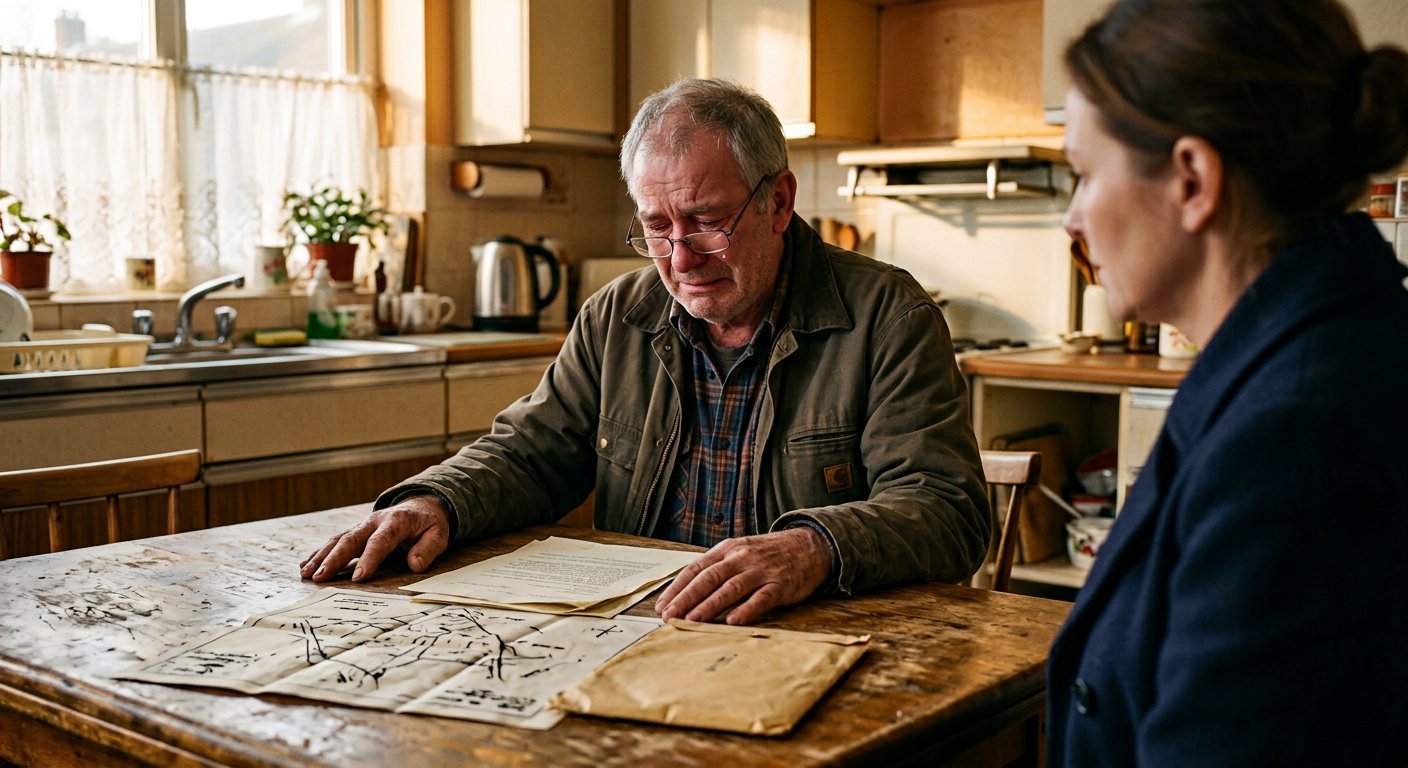
I drove out to my father’s house afterward with the closing documents, because he wouldn’t have believed a phone call. He read them at his kitchen table with his glasses down his nose and his hands flat on the wood, and he didn’t say anything for a long time, and I thought — here we go again, the silence, the thing he does instead of feeling.
Then I realized he was crying. My father. Sixty-eight years old, thirty-one years of boilers, crying at a kitchen table over a plat map.
He said, “I was so ashamed on that phone call.”
He told me the whole thing then, in the disjointed way of a man who has never once practiced saying anything. That he’d meant the rule sincerely. That he’d matched Robin without thinking, and then done the math afterward and understood, sitting in that same chair, that he had promised the same money twice. That for four years he’d been quietly hoping I’d buy something small and cheap and ask for less. That he had watched me wear that navy coat through four winters and known exactly what it meant and been unable to say a word.
And that he’d never had the deed appraised, in thirty years, because as long as he didn’t know, it was still a gift.
“I couldn’t give you money,” he said. “I gave you the only thing I had left. I thought you’d open that envelope and think your old man was handing you a piece of scrap paper because he couldn’t keep his word.”
I said, “You did keep your word.”
He shook his head. “Your grandfather kept it. I just didn’t lose the envelope.”
Which is, I’ve decided, its own kind of inheritance — three generations of people holding onto something they didn’t understand the value of, on the chance that someone down the line might.
The house I bought has a bad roof and good bones and a kitchen I’m slowly ruining and repairing by turns. My father comes on Saturdays. He fixes things and does not say he loves me and I have stopped needing him to, because I have finally understood the language.
The two acres by the creek aren’t for sale. Ever. There’s a footpath in now, and a bench, and last spring I had a small brass plate made and bolted to the back of it.
WENDELL J. MERRICK — 1908–1994 HE KEPT THE STRIP. THENCE SOUTH FORTY-TWO DEGREES EAST, ALONG THE KESSLER LINE, TO THE CREEK.
And the iron pin is still out there under the hedgerow behind the dental office. Deb offered to pull it once the survey was recorded — it’s not needed anymore, everything’s in GPS coordinates now.
I told her to leave it exactly where it is.