A text story — 15 minute read
My aunt raised me after my parents died in a car accident. I was four.
Her name is Delia. She was twenty-six when a state trooper knocked on her door on a Sunday, and by the following Friday she had a preschooler, a funeral bill, and a one-bedroom apartment she gave up so we could afford a two-bedroom in a worse part of town.
She worked two jobs for fourteen years. $13 an hour at Walmart, days. $11 at a cleaning company, nights — office buildings downtown, eleven to four, home in time to make me breakfast and then sleep three hours before her shift.
She never bought herself anything. I mean that with total literalness. She had one winter coat for the entire span of my childhood, a gray thing with a broken zipper she safety-pinned closed. Her glasses were eight years out of prescription. I wore Goodwill clothes and ate rice and beans most nights, and I was not a gracious child about it — I remember being twelve and crying because a girl at school asked if my sweater used to be her cousin’s.
I remember Delia standing in the kitchen while I said that. I remember she didn’t answer. She just went and got a bowl down.
When I turned eighteen, I found out my parents had a $750,000 life insurance policy. I was the sole beneficiary.
I found out from a bank letter. Not from her. A statement addressed to me, forwarded from an old address, for a custodial account I’d never heard of — and I sat on the front step of that apartment and read the balance line eleven times.
$12,047.15.
Fourteen years of safety-pinned coats. Fourteen years of rice and beans. Fourteen years of a woman falling asleep sitting up at the kitchen table with her cleaning-company polo still on. And three-quarters of a million dollars had been sitting there the entire time.
I want to tell you I walked in calmly. I didn’t. I came through that door like weather.
She was in her recliner. She didn’t look up from her crossword.
“I spent it,” she said. “On you.”
“There’s twelve thousand dollars left.” My voice cracked on it. “Where did seven hundred and thirty-eight thousand dollars go?”
She put her pen down.
And she looked at me — really looked at me, the way you look at someone when you have decided to stop protecting them — for what felt like the first time in my life.
“I didn’t spend it on you,” she said. “I spent it on your brother.”
I don’t have a brother.
I said that out loud. Flat. Like correcting a stranger’s directions.
She said, “Yes you do. He lives with your mother’s cousin Ruth, in Sharon, Pennsylvania, and his name is Peter, and he is two years older than you, and he has been in a wheelchair since the accident.”
The car accident that killed my parents did not only kill my parents.
There were four people in that car. My mother, my father, me — four years old, rear passenger side, the side that didn’t take the impact — and my brother Peter, six, behind my father.
I have no memory of any of it. Not the crash, not the hospital, not him. Four-year-olds don’t retain much, and trauma sands off what’s left. I had a whole brother for four years of my life and I have never once been able to produce a single image of his face from before.
He survived. Spinal cord injury at T4, a traumatic brain injury, eleven weeks in a pediatric ICU in Pittsburgh. He came out of it alive and permanently changed — he uses a chair, he has significant cognitive impairment, he needs help with most of the ordinary business of a day. He was six years old and he needed round-the-clock care for the rest of his life.
And Delia was twenty-six, with no savings, no partner, and no idea what she was doing.
She told me she tried. For five months she had both of us in that two-bedroom. She told me about it in detail, sitting in that recliner, in a voice with nothing in it — the flat voice of someone describing the worst thing they ever did. Peter needed suctioning, repositioning, catheter care, therapy three times a week in a city forty minutes away. I needed a mother. She had one body.
She said, “I dropped him. Getting him out of the bathtub. He wasn’t hurt. But I sat on that floor with him in my arms and I understood that I was going to fail one of you, and that whichever one I failed, it was going to be permanent.”
My mother’s cousin Ruth was fifty-one, a retired hospice nurse in Sharon, married, no kids at home, a ranch house with no stairs and a bathroom she could modify. Ruth said yes. Ruth said yes in under a day.
And the money followed him.
Delia got up out of that recliner and went to the hall closet and came back with a plastic file box. Not hidden. Not locked. Sitting on a shelf in a closet I’d opened ten thousand times.
Every receipt. Fourteen years of them, in labeled folders, in order.
POWER WHEELCHAIR (2011) …………. $ 26,400 VAN CONVERSION / LIFT (2013) …….. $ 48,900 HOME MODIFICATIONS — RUTH ……… $ 61,200 ramp, roll-in shower, doorway widening, ceiling track lift, generator PHYSICAL THERAPY, 14 YRS ………… $137,000 SPEECH & OCCUPATIONAL THERAPY ……. $ 94,500 UNCOVERED MEDICAL / SURGICAL …….. $211,300 two spinal rod revisions, pressure sore surgery, dental under anesthesia RESPITE & AIDE HOURS ……………. $ 82,600 SPECIAL NEEDS TRUST — PRINCIPAL …. $ 76,100 ——— $738,000
She had never taken a dollar of it. Not for the coat. Not for the glasses. Not for a car that started reliably. The lawyer who set up the custodial account had told her, in 2011, that she was legally within her rights to use a portion for my household expenses — food, rent, clothing. She never did.
I asked her why not, and she said the thing I still can’t repeat without stopping partway:
“Because it was your money, and I was already spending it on him. I wasn’t going to spend it on you too and call it even. The rice and beans were mine to give you. The money was his to need.”
“Why didn’t you tell me?”
“Ruth and I agreed to tell you at eighteen.” She looked at the box. “You found out at eighteen. I was going to do it in September. I’d been writing it out.” She had, too. There was a legal pad in the bottom of the box with four false starts, all of them beginning Dear Nora, there is something about your family.
“Fourteen years, Delia.”
“What was I supposed to say to a six-year-old?” she said. “‘You had a brother and I gave him away’? You’d have hated me. You’d have been right to. And then you’d have spent your whole childhood on the fact of him instead of having a childhood.” Her hands were shaking. “I made a decision at twenty-six and I have never once been sure it was the right one. I’m still not sure. I just knew that if I told you early, you’d carry it, and I could carry it instead.”
I drove to Sharon eleven days later. Three hours. I threw up in a gas station bathroom outside Youngstown.
Ruth met me at the door. She’s seventy-eight now, small, still stands like a nurse. She said, “He knows who you are. He’s known since he was ten. He asks about you on your birthday.”
That’s the sentence that took my legs out. He asks about you on your birthday. Somewhere out there, for fourteen years, a person had been keeping track of me in the dark, the same way I hadn’t been keeping track of him.
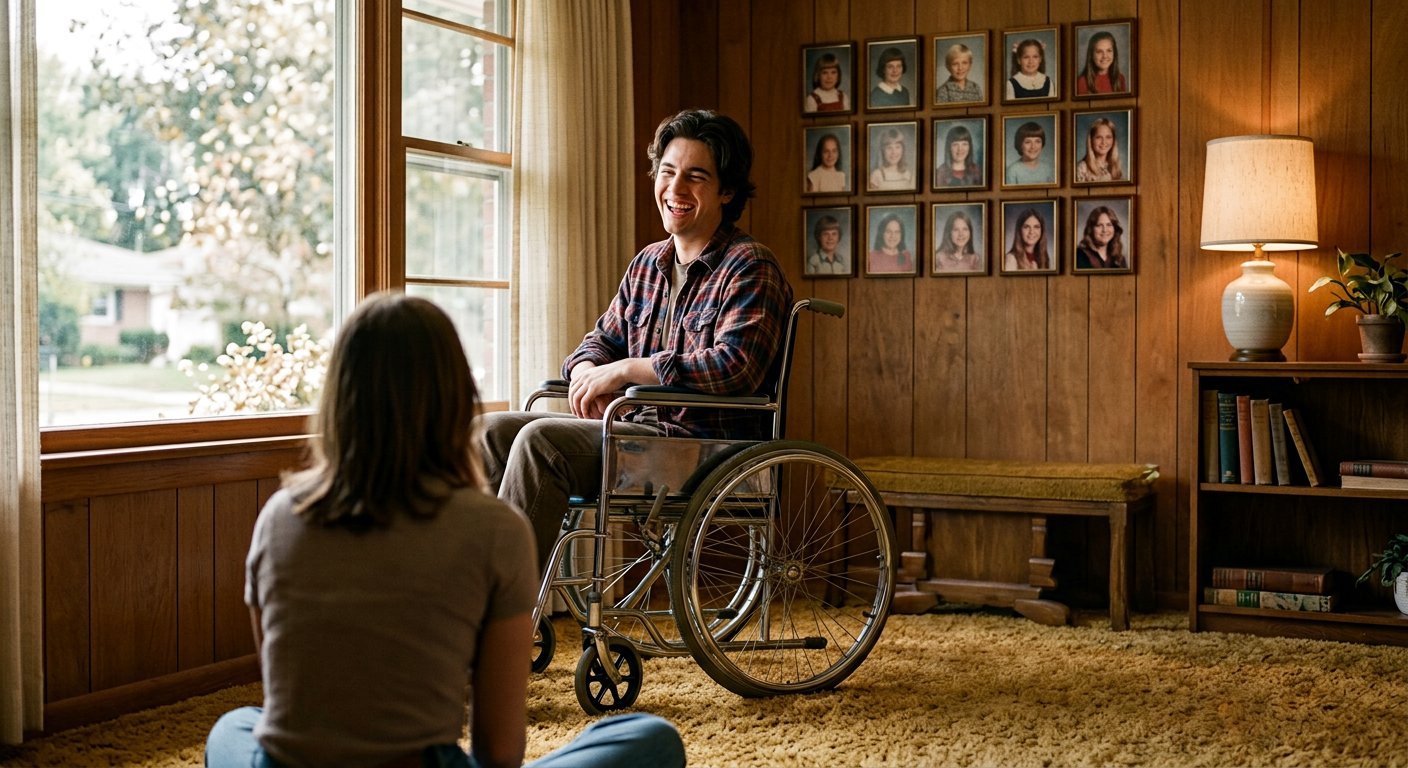
Peter was in the front room by the window. Twenty years old. He has our father’s jaw — I know this from photographs, and I recognized it instantly, and that recognition arrived in my body before it arrived in my head.
His speech is limited and effortful. He gets maybe four or five words out at a time and it costs him. He needs a moment between them.
He looked at me a long time. Ruth started to explain who I was.
He said, “Nora.”
Then he said, “You. Got. Big.”
And then he laughed — a real one, loud, delighted with himself for landing the joke — and I sat down on the floor of that living room, in front of the wheelchair of a man I did not know I had, and I lost it completely.
On the wall above his bed: nineteen school photographs of me. Every single year, kindergarten through senior. Delia mailed them to Ruth each October. He’d picked the frames.
I had spent fourteen years thinking nobody was on my side. And the whole time there were three of us in a triangle across two states, and I was the only one who didn’t know the shape of it.
That was five years ago.
I go to Sharon one weekend a month. I’ve learned his rhythm — how long to wait, when he’s building a sentence and when he’s done. He is funny in a dry, patient, extremely deliberate way. He beats me at gin rummy with a consistency I find genuinely insulting. He calls me “Big” now, permanently, which started as a joke about that first sentence and has become my name.
Ruth is failing a little. We’ve started the conversations. There’s a plan, and the trust Delia funded is the reason a plan is even possible — that $76,100 line item, the one that seemed so abstract on a receipt, is the thing that means my brother will not go into a state facility when the woman who raised him can no longer lift him.
Twenty-six years old, no money, two children, one body. Delia made an impossible call and then spent fourteen years paying for it in coats and glasses and rice, and never once asked either of us to say she’d chosen right.
I bought her a coat that first Christmas. Wool, navy, a zipper that works. She cried and then got angry about crying and then said it was too expensive and tried to give it back.
She still has the gray one. It’s in the hall closet, on the shelf, next to the box.
I’ve stopped asking her to throw it out. Some things you keep because of what they cost.