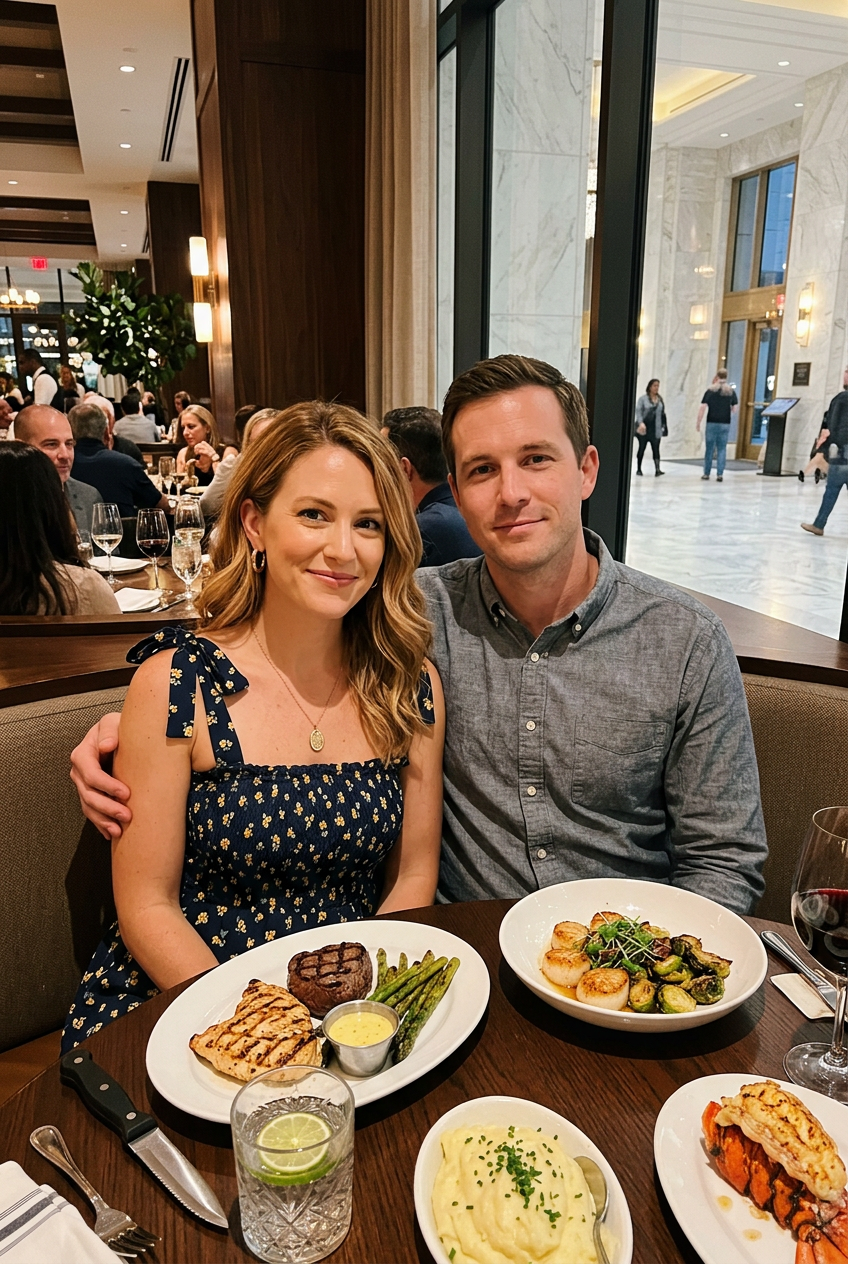
A couple ordered a $400 dinner and snuck out without paying, so my manager made me cover their bill — the next morning, he handed me something they’d left behind and said, “I think you need to see this.”
Chapter 1 — Four Hundred Dollars
Have you ever really thought about how the same four hundred dollars can be one person’s forgettable dinner and another person’s whole month, their groceries and their electric bill and the thin margin that keeps the roof over their head?
I think about it all the time, because I live on the second side of that equation.
At the time all of this happened, I was still in school, carrying a full course load and trying to build some kind of future for myself, and I was also helping to support my younger sister, Chloe, whose own future depended on the two of us not going under.
Our mother was gone; she had died a few years before, after an illness that took her far too soon, and losing her had turned our small family of three into a smaller family of two, with me, the older sister, sliding without discussion into the role of the one who held things together.
It was just us.
And the way I kept the whole fragile arrangement standing, the tuition and the rent and the groceries and Chloe’s books, was by waiting tables at an upscale restaurant downtown, the kind of place where a single dinner could cost more than I made in two shifts.
There is a particular strangeness to that work, to spending your nights carrying four-hundred-dollar meals to people for whom four hundred dollars is nothing, while four hundred dollars is very nearly everything to you.
You learn to smile through it.
You learn to be gracious and quick and invisible, to anticipate needs, to fold yourself into the background of other people’s celebrations.
And every night you go home with an envelope of tips that is not abstract money, not fun money, but the actual difference between making it and not making it, counted out in fives and tens and the occasional generous twenty.
That envelope was my family’s survival, and I guarded it the way you guard the only thing standing between you and the dark.
I did not know, the night this story begins, that four hundred dollars was about to nearly destroy me, and then, in a twist I could never have imagined, save my entire life.
There is a kind of arithmetic that only poor people do, a constant background calculation that never fully switches off.
How many hours is that.
If I pick up the Saturday double, does that cover the utility bill or only most of it.
If the car needs a repair this month, what comes out of the budget to pay for it, the groceries or the textbooks.
People who have never lived close to the edge do not understand that being poor is not just having less money; it is a kind of full-time unpaid job, a ceaseless mental labor of triage and anxiety that runs underneath everything else you do.
I did that arithmetic in my sleep.
I did it while I smiled at tables and carried trays and took my exams.
And the number at the center of all of it, the number that could tip the whole delicate balance one way or the other in a single night, was almost always something close to four hundred dollars.
That was the size of the wave that could capsize us.
I lived my life with one eye always on the water, watching for it.
Chapter 2 — All Kinds of People
When you wait tables long enough, you meet every kind of person there is, and you learn to read them fast, because your livelihood depends on it.
Some customers are absolute sweethearts, the kind who look you in the eye and thank you by name and tip like they remember what it is to work for a living.
Those tables are a gift, and not only for the money; on a hard night, a little genuine warmth from a stranger can carry you through to the end of your shift.
I want to say something in defense of the good customers, the sweethearts, because they do not get enough credit and because their kindness taught me something I built my whole later life around.
The difference between a person who treats a server as a human being and a person who treats them as furniture is not really about money; I served plenty of wealthy people who were lovely and plenty who were monstrous, and the same across every income I encountered.
It is about whether a person is in the habit of seeing the people who serve them.
Some people move through the world genuinely noticing the humanity of everyone in it, the waitress, the busser, the person cleaning the restroom, and some people have trained themselves, or been trained, to see only the people who are useful or important to them and to let everyone else blur into background.
The kind ones, the ones who looked me in the eye and asked how my night was going and meant it, were not necessarily richer or poorer than the cruel ones.
They had simply kept the basic human habit of seeing.
And when I finally had power of my own, that was the thing I most wanted to build into everything I touched: a refusal to let anyone blur into the background, a stubborn insistence on seeing the people the world is designed to overlook.
And then there are the others.
The ones who never once look at your face.
The ones who speak to you as though you are a vending machine that has inconveniently developed the power of speech, who snap their fingers, who let their eyes slide right past you as if the uniform makes you disappear.
You learn, in this work, exactly how it feels to be treated as invisible, to stand two feet from a person and be less real to them than the centerpiece on their table.
I had made a kind of peace with all of it, the good tables and the bad, because the good ones made the bad ones bearable and the whole thing, on balance, kept us afloat.
I was good at the job.
I was fast and attentive and I could carry a heavy tray and a heavy heart at the same time and let neither of them show.
What I had not yet learned, on the night of the couple in the corner booth, was that the feeling of being invisible, the thing I thought was just the background hum of the work, was about to become the entire center of my story, first as the wound and then, much later, as the thing I would spend my new life making sure no one else had to feel.
I have thought a great deal since about what invisibility actually does to a person, because I lived inside it for years without quite having a word for it.
It is not only that people do not see you.
It is that, over time, being unseen starts to make you doubt your own solidity, your own right to take up space.
You become an apology for existing.
You learn to make yourself small, to absorb slights without reacting, to accept that your time and your dignity and even your money are somehow worth less than other people’s, because everyone around you seems to treat them that way and it is exhausting to keep insisting otherwise.
I did not realize, in those years, how much of that I had internalized, how thoroughly I had come to accept my own invisibility as simply the natural order of things.
It would take a leather binder behind a booth, and a check with too many zeros, and eventually a foundation with my name on it, to teach me that the invisibility had never been the truth about me.
It had only ever been other people’s failure to look.
Chapter 3 — The Well-Dressed Couple
They came in a little after eight, a well-dressed couple, the kind who wear money quietly, in the cut of a jacket and the shine of good shoes rather than anything flashy, and they were seated in one of my sections, in the deep velvet corner booth.
They ordered like people who had never once in their lives looked at the right side of a menu, which, I would realize much later, was itself a small tell, because it was slightly too perfect a performance of careless wealth, the kind of thing people do when they are playing a part rather than living it.
Real regulars at a place like ours had their habits, their usual bottle, their little particularities.
These two ordered lavishly and generically, the way you order when the point is not the food but the cover story the food provides.
They did not glance at a single price.
They ordered appetizers to start, then steaks, then an expensive bottle of wine that I had to go check the cellar list to confirm we even carried, and cocktails on top of that, the whole lavish architecture of a dinner built without any reference at all to what it cost.
I did my job the way I always did, attentive and warm and efficient, refilling water, timing the courses, being the smooth invisible machinery that makes an expensive evening feel effortless.
They were not rude to me, exactly.
But they were not warm either.
They had a curious quality I noticed without being able to name, a kind of watchfulness under the surface, a way of paying attention to the room that did not quite match two people out for a romantic dinner.
I filed it away as nothing.
Rich people are often strange, and a good server learns not to wonder about it too hard, because curiosity about the customers is a distraction from the actual work and, more to the point, because the customers do not want to be wondered about.
Your job is to be smooth and unobtrusive and to let people be exactly as odd as they wish to be without ever letting your face register it.
So I registered nothing.
It is not my job to wonder why.
I have replayed that dinner in my memory more times than I can count, looking for the moment I should have known something was wrong, and the truth is that there was no such moment, not really.
They were good at it.
That is what professionals are, after all: good at being unremarkable, at blending into the ordinary texture of a room, at watching without appearing to watch.
The only thing my instincts snagged on all night was that faint quality of attention, that sense that their focus was not quite where it should have been, not on each other, not on the food, but somewhere in the periphery, on the doors, on the room, on me.
And even that I explained away, because you have to explain such things away to do this job; you cannot treat every strange customer as a threat or you would go mad.
So I brought them their wine and their steaks and their check, and I never once suspected that the odd couple in my section had come not to dine but to confirm, with their own eyes, that the waitress serving them was the woman a downtown law firm had spent six months and a small fortune trying to find.
When the plates were cleared, the man caught my eye and made the small universal gesture for the check, the little scribble in the air, and I nodded and went to ring it out.
The total came to just over four hundred dollars.
I printed it, tucked it into the leather check presenter, walked it back to their booth, and set it down at the man’s elbow with a warm thank-you and the usual line about no rush, whenever you’re ready.
Then I turned and went to tend to another table that needed me, a party of four across the room, and I did not think anything of it, because in all my time waiting tables, in all the thousands of checks I had dropped, I had never once had what happened next happen to me.
Chapter 4 — The Empty Booth
It could not have been more than a few minutes.
I refilled the water glasses at the party of four, took a dessert order, laughed at something one of them said, and then I made my way back across the dining room toward the velvet corner booth to collect the payment.
The booth was empty.
For a second my mind simply refused to process it, the way your mind refuses the first instant of any small disaster.
I stood there looking at the empty booth, at the cleared table, at the two crumpled napkins, and I thought, absurdly, that they must have moved, that I had the wrong table, that they had stepped out for air.
And then my eyes went to the check presenter sitting on the edge of the table, and I flipped it open, and it was empty.
No cash.
No card.
No signature.
Just the printed bill I had left, and nothing beside it, and two people who were no longer anywhere in the restaurant.
They had walked out.
They had eaten four hundred dollars of food and wine, waited for the moment my back was turned, and gotten up and left, out through the front doors and gone, dumping the entire bill onto me.
I felt the floor drop out of my stomach.
Because I already knew, even before I went to find my manager, exactly how this was going to go, and exactly whose money was about to disappear to cover a debt I had not incurred.
Not the restaurant’s.
Not the wealthy strangers who had actually eaten the meal.
Mine.
The thin envelope of tips in the back that was standing between my sister and the dark.
I knew the shape of what was coming so precisely because I had watched it happen to other servers, in other sections, on other nights.
A walkout is one of the oldest injustices in the restaurant world, and the way it usually resolves is depressingly consistent: the loss rolls downhill until it lands on the person least able to absorb it and least able to fight back.
Never the restaurant, which has insurance and margins and a lawyer on retainer.
Never the wealthy customers, who are long gone.
Always the server, the hourly worker, the one whose whole month is balanced on a knife’s edge, told that it was their table and therefore their fault and therefore their bill.
I had seen good coworkers cry in the walk-in cooler over exactly this.
I had comforted them, and been quietly grateful it was not me, and told myself that someday, somehow, someone would do something about a system so casually cruel.
I did not yet know that the someone was going to be me.