I started noticing my four-year-old son becoming terrified whenever my mother-in-law came over to babysit.
Then one evening he burst into tears and clung to my leg, crying, “I don’t want Grandma to stay with me!”
It started small, the way these things do. Theo would go quiet when I said her name. He’d suddenly need water, need the bathroom, need me to lie down with him for “one more minute” at exactly the hour her car pulled in. I chalked it up to a phase. Four-year-olds invent fears the way other people breathe — the vacuum, the drain, the shadow of a coat on a door.
My heart sank. I’m a nurse. I had a twelve-hour on the cardiac floor starting at seven, we were already short two people, and there was no sitter in a forty-mile radius on that kind of notice. So I knelt down on the hallway floor in my scrubs with my bag still on my shoulder and I held his face.
Through his sobs, he whispered, “Because Grandma acts strange.”
“Strange how, baby?”
And before he could answer, the front door opened — she has a key, she’s had a key for six years — and Marguerite came in with her tote bag and her reading glasses pushed up in her white hair, calling out something cheerful about the weather. Theo went up those stairs like something was behind him. No goodbye. No look back.
I want to be honest about what went through my head in the eleven seconds that followed, because I’ve thought about it every day since. I looked at this woman I had known for nine years — who taught me to make her son’s birthday cake, who sat with me through two miscarriages before Theo, who was the first person besides my husband to hold him — and some cold, ancient part of my brain said: what are you doing to my child.
She saw it on my face. I know she did. She just said, softly, “Long shift tonight?”
I said yes. I said thank you. I drove to work with my hands too tight on the wheel and told myself I’d get to the bottom of it in the morning.
It didn’t make sense. That was the thing I kept circling all night between rounds. We’d always had a good relationship. She’d always seemed devoted to her grandson — not performative-devoted, actually devoted, the kind that shows up as a laminated list of his allergies on her own refrigerator.
But there had been things. I made myself count them at 3 a.m. in the break room, and once I started, the list got long fast.
She’d stopped driving at night in March, and blamed her eyes. She’d called me Ellen twice, which is her sister’s name. In April she brought two identical bags of the same groceries three days apart. In June she stood in my kitchen holding the kettle for a long moment with a look on her face I had, at the time, decided was tiredness. She’d stopped hosting Sunday dinner — “the oven’s acting up” — and my husband and I had actually joked about it, about how his mother had finally gotten lazy after forty years.
And the spare room at her house. The door was always closed now. I’d noticed it at Easter and thought nothing of it. Marguerite, who had never closed a door in her life, who kept her sewing room open so the cat could get to the window.
I’m a nurse. I assess people for a living. I missed every single one of these, because when it’s your family you don’t assess, you just love them and assume the shape of them will hold.
The moment I came home that night, I knew something was terribly wrong.
The house was too quiet. Every light was on downstairs. My son was sitting silently at the top of the stairs, in his pajamas, at eleven forty at night, clutching his favorite teddy bear. Marguerite’s car was still in the driveway.
When he saw me, he looked me straight in the eyes and whispered:
“Mom… Grandma finally showed me what she keeps in the room with the closed door.”
I went up those stairs so fast I don’t remember touching them.
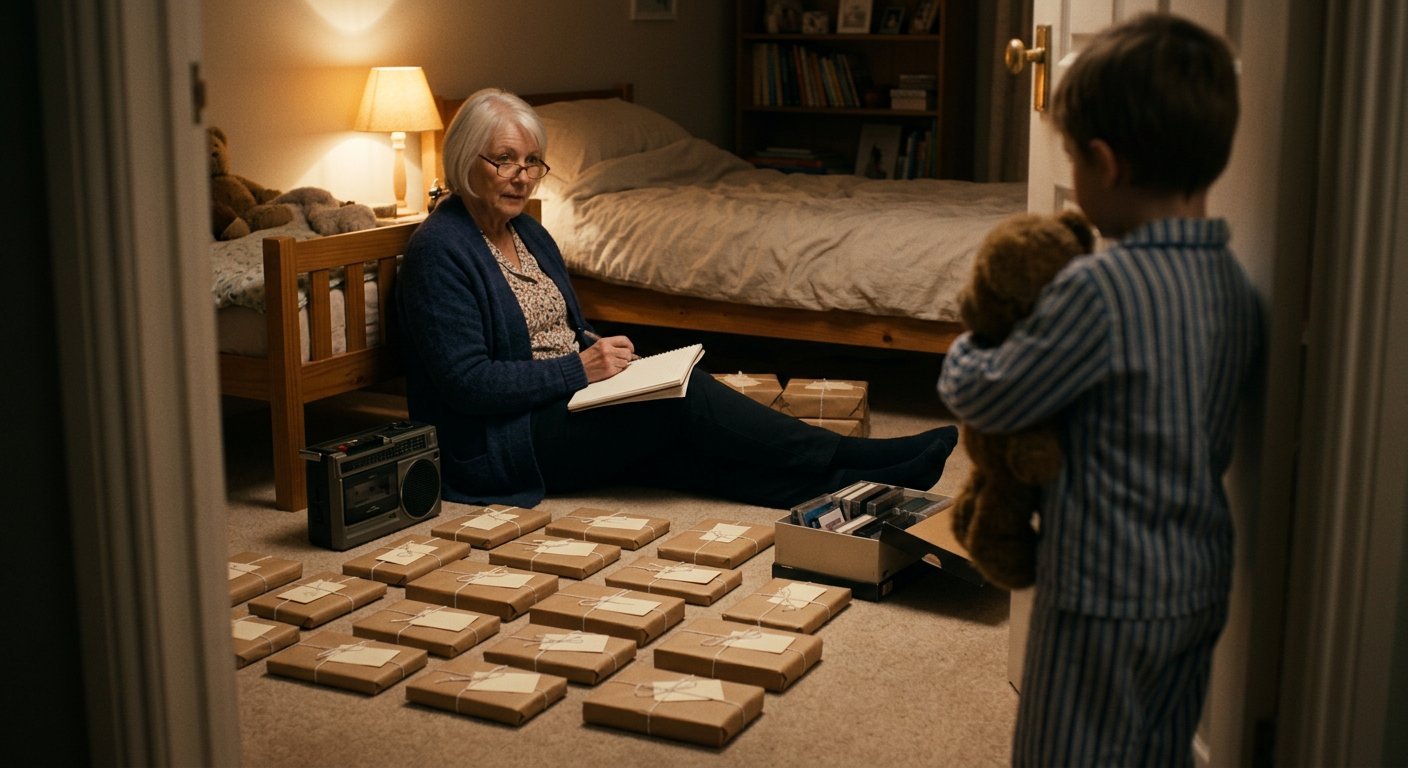
Marguerite was sitting on the floor of Theo’s bedroom with her back against the bed, legs straight out in front of her like a child, and around her, spread across the carpet in careful rows, were twenty-six wrapped packages.
Small ones. Brown paper, each tied with kitchen string, each with a card taped to the front in her looping schoolteacher handwriting.
THEO — 5. THEO — 6. THEO — 7. All the way to THEO — 30.
There was an old cassette recorder next to her, the kind she used to use for grocery lists, and a shoebox of labeled tapes, and a spiral notebook open on her knee.
She looked up at me and her eyes were completely clear, and she said, “I got the diagnosis in February. I’m so sorry, Nora. I didn’t know how to tell you and then I couldn’t remember whether I had.”
Early-onset Alzheimer’s. Confirmed by two neurologists. She’d been going to appointments alone since Valentine’s Day, taking the bus because she’d already quietly given up driving after dark. Her older sister Ellen had it. Her mother had it. She had known, she said, the way you know weather is coming, since the first time she couldn’t find the word for ladle.
And what my son had been seeing — what “acting strange” meant — was this: she froze. Mid-sentence, mid-story, mid-song. She would stop and go somewhere behind her own eyes for ten or fifteen or forty seconds, and to a four-year-old, that is the single most frightening thing a person can do. She called him by his father’s name. Twice she started a story about a dog he’s never met as though he’d been there. Once, he told me later, she asked him where his mother was while she was holding his hand in the kitchen, and then a minute later she was fine, and she never mentioned it, so he never mentioned it either.
He wasn’t scared of her. He was four years old and he had no words for the fact that his grandmother kept leaving and coming back.
That night she’d frozen again, and this time Theo hadn’t run. He’d stood there and asked her, in the flat, terrible directness of small children, “Grandma, why do you go away?”
And Marguerite decided she was done hiding it.
So she took him to the closed room. She showed him the folding table with the brown paper and the string. She showed him the tapes — twenty-six of them, one for every birthday she is going to miss, recorded now while her voice still sounds like her voice and her sentences still arrive whole. She’d been doing it since March. She’d been getting up at five in the morning to do it, because she said mornings are when she’s still all the way here.
She played him the one labeled THEO — 5, because his birthday is in three weeks, and she wanted him to hear it from her while she could still watch his face.
Then she brought all of it here, to our house, and laid it out on his bedroom floor, and told a four-year-old the truth in the only language a four-year-old can hold:
“I have a sickness that eats memories. It’s going to eat mine. So I’m putting them somewhere it can’t reach — in these boxes, in that bear, on those tapes. And when I forget you, sweetheart, you won’t have to forget me. You’ll have me right here, saying your name, twenty-six more times.”
That’s why he was on the stairs. He wasn’t hiding. He was waiting up for me — he’d refused to go to bed — because he had something to tell me and he had decided it couldn’t wait until morning.
And here’s the part that took my legs out from under me. The teddy bear. His favorite, the one he’s had since he was one, that he’d been carrying everywhere for weeks and would not let me wash.
She’d had it for two days back in May. “Repairing the seam,” she’d said.
There’s a recorder sewn into it now, into the little zippered pocket in the back that I always assumed was factory. One button. Her voice, forty seconds long, recorded in March.
“Hello, my Theo. It’s Grandma. I love you more than all the numbers there are. Go back to sleep now, sweetheart. I’m right here.”
He’d known for weeks. He’d been sleeping with it every night and never said a word, because she told him it was theirs.
She lives with us now. We moved her in six weeks after that night, and my husband cried in the driveway for twenty minutes before he could go inside and carry the first box.
It’s hard. I’m not going to pretend the wrapped packages make it soft. There are days she asks me who I am, in my own kitchen, politely, the way you’d ask a hospital receptionist. There are nights she looks for a front door that hasn’t existed since 1987.
But Theo isn’t frightened anymore. That’s the whole miracle of it, and it happened for the simplest reason in the world: somebody told him the truth. Now when she goes away mid-sentence, he doesn’t run. He climbs up next to her and waits, and when she comes back he says, “You went away, Grandma. You’re back now,” and she says, “So I am.”
He’s five in three weeks. The package that says THEO — 5 is on the top shelf of my closet, and I have already listened to it once, alone, at two in the morning, with a dish towel over my mouth.
She was right. It sounds exactly like her.