Some secrets don’t announce themselves. They don’t knock. They don’t leave a note. They simply wait, folded inside an envelope at the bottom of a junk drawer, patient as a held breath, until the day your hand finds them by accident. That is how it happened to me — by accident, on an ordinary Tuesday, with a spare key I never did find.
When our daughter Lily turned three, I started touring preschools the way other mothers plan weddings. I made spreadsheets. I read parent reviews at two in the morning. I booked tours at schools I knew we couldn’t afford, because somewhere along the way I had convinced myself that the right school was a promise I was making to my daughter’s entire future, and that any mother who loved her child enough would find a way to keep it.
So I cut back. I stopped buying the good coffee and the organic berries. I froze my gym membership. I took on extra freelance work after Lily went to bed, hunched over a laptop in the dark kitchen, trading sleep for invoices that never quite added up. And I told myself it would all be worth it.
When I finally brought it up with Greg, I had everything laid out on the kitchen table — tuition numbers, payment plans, a pros-and-cons list I’d rewritten three times.
“We can’t afford that,” he said, not looking up from the bills.
“We could,” I said, keeping my voice level. “If we prioritized it.”
He snapped. “No. End of discussion.”
That wasn’t like him. Greg was the man who folded laundry without being asked, who got up at five in the morning with a feverish toddler so I could sleep, who remembered the anniversary of the day we met. But on this one subject he was a brick wall, and nothing I said could move it. So I let it go — because that’s what you do in a marriage sometimes. You let a thing go so it doesn’t grow teeth.
Three weeks later, I was digging through the junk drawer looking for a spare key. It was the drawer where dead batteries and dried-up pens and old twist ties went to die, the drawer nobody in our house ever fully organized. My fingers brushed against something unfamiliar: an envelope, cream-colored, made of paper so heavy it felt important.
The return address was a property management company I’d never heard of.
Inside was a receipt.
$3,400 — Rent, Unit 504B. Addressed to Greg.
I remember the way my hands went cold before my mind caught up. Three thousand four hundred dollars. That was more than our mortgage. That was, give or take, the exact cost of the preschool I’d been begging him for. And it was a receipt, which meant it wasn’t a one-time thing. It meant there had been a “before.”
I didn’t sleep that night. I lay in the dark listening to Greg breathe, and my mind ran through every terrible possibility on a loop. Who lives in that unit? Is Greg cheating? Is he keeping a second family somewhere? Why is he paying someone’s rent — someone I’ve never met, in a building I didn’t even know he knew about?
By morning I had convinced myself of everything and nothing. So I did the only thing a reasonable, sleep-deprived woman could do.
I drove to the address.
It was a luxury high-rise, the kind with a doorman in a wool coat who asked who I was visiting as if I might be there to case the place. The lobby was marble and hushed, and my reflection in the polished elevator doors looked like a woman who hadn’t slept in a week. My heart was a drum in my throat the whole ride up.
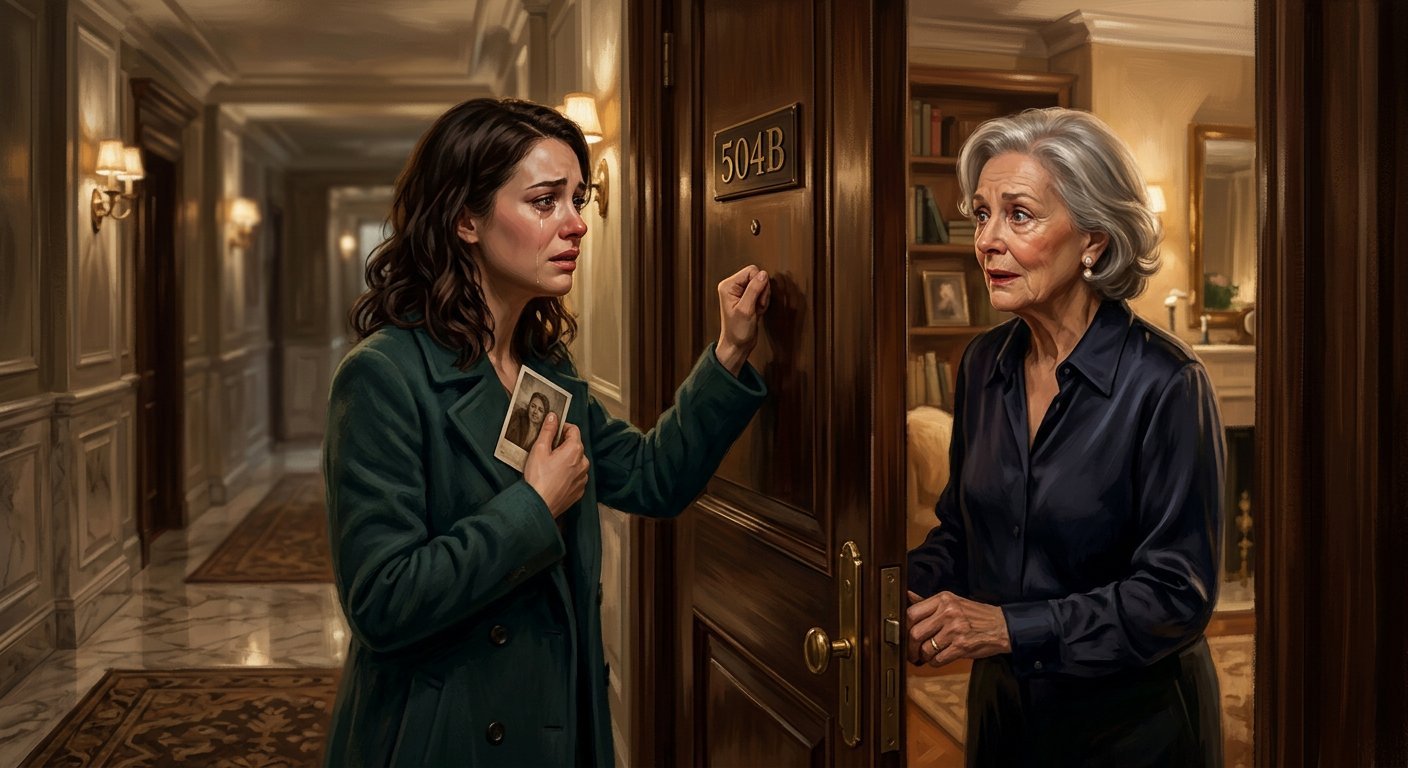
I knocked on 504B, heart racing.
The door opened, and my world crumbled.
Standing there was my mother.
My mother. Rose. Sixty-eight years old, wearing a pressed blouse and the pearl earrings my father gave her on their thirtieth anniversary, standing in the doorway of a luxury apartment my husband had been paying for in secret.
For a long moment, neither of us said a word. Then she said my name the way she used to when I came home late as a teenager — half relief, half dread.
“Mara.”
“Mom?” My voice cracked. “What are you doing here?”
And then it all came out. Not neatly. It never comes out neatly.
A year and a half earlier, my mother had lost almost everything. It started with a fall, then a hospital stay, then a cascade of bills that her insurance wouldn’t fully cover. She was too proud to tell me — she had always been too proud — so she downsized quietly. She sold the house I grew up in. She moved into a small apartment on the wrong side of town and told me she was “downsizing by choice.” Then the rent went up. Then the building changed owners. Then the eviction notice arrived, and still she said nothing. Every Sunday phone call, she’d tell me she was fine. “Don’t worry about me, honey. Focus on your family.”
Greg found out by accident. He’d gone to visit her one afternoon — he did that sometimes, without me, because she loved him like a son — and found the eviction notice taped to her door. She begged him not to tell me. She said she’d figure it out. She said I had enough on my plate.
So Greg did the only thing he could think to do. He found her a safe building near the hospital, near her doctors, near us. He signed the lease. He paid the rent. And he told her they would tell me together, when the time was right.
But the time was never right. The time is never right for news that will break someone’s heart.
And that was why he’d said we couldn’t afford preschool. Every dollar of that tuition money — and then some — was already going to my mother.
I don’t remember exactly what I said next. I remember crying in the hallway of that beautiful building — angry and grateful and humiliated all at once. Angry at Greg for lying. Angry at my mother for hiding. Angry at myself for not noticing, for not asking the right questions, for being so wrapped up in preschool tours that I had missed the truth of my own mother’s life.
But underneath all of it — underneath the shock and the anger — there was something else, something quieter, like a light under a door.
My husband had been carrying a secret the size of a rent payment for eighteen months. He had been the one sitting beside my mother at doctor’s appointments while I scheduled school tours. He had been the one answering her frightened three-a.m. phone calls. He had chosen her over our daughter’s school — and he had chosen me, too, by deciding it was better that I not know, better that I not worry, better that he carry the weight alone.
It was wrong. The secrecy was wrong. But the love underneath it was so enormous I could hardly look at it straight on.
That night, I sat across from Greg at the kitchen table — the same table where he’d said “end of discussion” — and I made him tell me everything. All of it. The numbers. The lease. The late fees he’d quietly covered. The thousand small lies, and the one enormous one.
“Why didn’t you tell me?” I asked.
“Because you would have tried to fix it,” he said. “And you would have given up everything to do it. The preschool. Your work. Yourself. I know you, Mara. I’ve watched you do it for twelve years.”
He was crying by then. Greg, who never cried.
“I didn’t want you to have to choose between your mother and our daughter,” he said. “So I chose for you. I know that was wrong. But I didn’t know how to choose any other way.”
I looked at him for a long time. At the gray starting to show at his temples. At the lines around his eyes that I’d been too busy to notice. And I understood, finally, that we had both been trying to carry our family alone — me with my spreadsheets and my frozen gym membership, him with a receipt he kept folded in his wallet so I wouldn’t find it. We had both been so afraid of letting the other one down that we forgot we were supposed to be a team.
“I don’t need you to choose for me,” I said quietly. “I need you to choose with me.”
He nodded, and something in his shoulders finally let go. It was the first honest breath our marriage had taken in a year and a half.
The repair took months. Months of hard conversations at that same kitchen table. Months of my mother slowly learning to let us help her without flinching, like a woman unlearning a lifetime of pride. We moved her out of the high-rise — it was too much, and too far from real life — and into a small, bright apartment ten minutes away, where she could walk to the market and we could drop in for dinner without a doorman asking our names.
We found a preschool, too. Not the one from my spreadsheets. A small cooperative with a teacher who knew every child’s name and a tuition we could actually afford. Lily loved it. In her first week she painted a picture of a house with a lopsided roof and told everyone it was Grandma’s.
And Greg and I started over — the way you do after a storm. Not by pretending it never happened, but by rebuilding on the other side of it, one honest conversation at a time.
I still think about the junk drawer sometimes. About how the biggest secret in our marriage was buried under dead batteries and old twist ties. About how the worst thing I ever imagined — the thing that kept me up all night, the thing I drove to that building certain I would find — turned out to be something else entirely.
It turned out to be love.
Hidden. Clumsy. Stubborn and prideful and infuriating.
The kind of love that pays a stranger’s rent in a high-rise so a woman’s mother never has to be afraid again. The kind that says “we can’t afford that” because it already spent everything on something you didn’t even know needed saving.
We keep the receipt now, framed in the kitchen, next to Lily’s painting of Grandma’s house. Not to remember the lie.
To remember the reason for it.