The first sound my son ever made was not a cry but a small, offended grunt, as though birth had interrupted an important dream.
I laughed when I heard it. Elena laughed too, exhausted and shining with sweat, and for one perfect minute the three of us belonged to one another without question.
Then a nurse carried him beneath the warmer. She fastened a white band around his ankle and read the name aloud.
“Baby Boy Mercer.”
Elena’s smile faded.
“What?” I asked.
“Nothing.” She watched the nurse wheel him toward the nursery. “I thought the card on the bassinet said something else.”
She had been awake for twenty-one hours. I kissed her forehead and told her to rest.
That was the first warning. There would be others, but I was very good at seeing only the evidence that agreed with my fear.
We named him Noah.
He had a serious face, a crown of black hair, and a crescent-shaped birthmark near his left shoulder. At six weeks, he began to smile whenever I whistled. At four months, he slept only if I paced the hallway with his cheek against my chest. I knew the warm weight of him better than I knew my own body.
Yet the older Noah grew, the more comments arrived.
“Where did those dark eyes come from?” my mother asked.
“He doesn’t have your chin,” said a coworker studying a photograph on my desk.
Most people meant nothing by it. My mother did.
She had never trusted Elena. She thought my wife was too private, too quick with dry jokes, too unwilling to arrange her life around other people’s approval. Over Sunday dinner, my mother mentioned a television program about men raising children who were not theirs.
“Imagine discovering that after years,” she said. “A man deserves certainty.”
The thought lodged in me like a splinter.
I began comparing photographs. I enlarged Noah’s face on my phone and held it beside mine. I counted dates on a calendar. I remembered a conference Elena had attended eleven months before the birth and turned it into a secret in my mind.
One night, while she rocked Noah beside the window, I asked whether she had ever been unfaithful.
She stopped moving.
“What did you say?”
“I’m asking a simple question.”
“No, Adam. You’re setting fire to our home and calling it a question.”
Her anger felt, to me, like proof.
By the time Noah was seven months old, I had bought a paternity kit. I placed it on the kitchen table between us.
“I want a test,” I said.
Elena stared at the box. There were shadows beneath her eyes. Noah had been waking every two hours with an ear infection, and neither of us had slept.
Then her mouth twisted into an expression I called a smirk for years afterward.
“And what if he’s not?” she asked.
“Then I divorce you. I won’t raise another man’s kid.”
The color drained from her face.
She did not shout. She looked toward the living room, where Noah was sleeping in a portable crib, and said, “You already are his father.”
“Then prove it.”
We used an accredited laboratory because I wanted results no one could dispute. A technician swabbed my cheek, then Noah’s. The report arrived nine days later.
Probability of paternity: 0.00 percent.
Excluded.
That one word erased seven months of midnight feedings, songs, bathwater splashed across my shirt, and small fingers curled around mine. Or rather, I allowed it to.
I confronted Elena in the kitchen. She read the report twice.
“No,” she whispered. “No, this is what I was afraid of.”
I heard a confession where there was terror.
“Who is he?”
“I never cheated on you.”
“His name.”
“There is no name!” She pressed both hands to her temples. “At the hospital, another bassinet was beside mine. The card said Mercer, but the mother wasn’t me. I told the nurse. She said the medication had confused me.”
It sounded impossible, and impossible was easier to reject than my own cruelty.
“You expect me to believe they gave us the wrong baby?”
“I expect you to remember who I am.”
I did not.
I packed a suitcase that night. Noah woke as I crossed the living room. He stood gripping the rail of his crib, unsteady on his bare feet.
“Da,” he said.
It was his first word.
I kept walking.
In the divorce, I waived parental rights after a second test returned the same result. I instructed my lawyer to route every message through his office. When Elena sent photographs, I deleted them unopened. When she left a voicemail saying, “There is more to this, Adam,” I blocked her number.
I told myself I was protecting my dignity.
For three years, I built a life around being wronged. It was a neat life, polished and quiet. I moved into a condominium with pale walls. I worked late. I told friends the marriage had ended because of infidelity, although I had no name, date, or fact beyond the test.
Anger gave me somewhere to live so I would not have to visit grief.
Then, on a rainy Thursday in October, an official envelope arrived by registered mail.
The return address belonged to the State Department of Health.
Inside was a notice concerning an investigation of St. Matthew’s Hospital maternity ward. Archived blood-spot cards from several births had been retested after a former nurse admitted falsifying infant-identification records to conceal medication theft and staffing violations.
Two male infants born within eleven minutes of each other had apparently been sent home with the wrong families.
The names printed on the page were Noah Mercer and Theodore Ruiz.
My hands went numb.
A caseworker answered on the second ring. Her voice was gentle, which frightened me more than official language would have.
“Mr. Mercer, preliminary testing indicates that Theodore Ruiz is the biological child of you and Elena Mercer. Noah is the biological child of Benjamin and Sofia Ruiz. All four parents are being offered confirmatory testing and family support.”
I sat on my immaculate floor with the letter beside me.
My biological son was alive.
The boy I had loved was not biologically mine.
Both facts were enormous. Neither was the horror.
The horror was remembering Noah’s fingers around the crib rail as I walked away.
I called Elena from a new number. She answered after five rings.
“Hello?”
I could not speak.
“Adam?” she said.
“I got the letter.”
Silence stretched between us. I heard a child laughing in the background, followed by the tumble of wooden blocks.
“I did a maternity test after you left,” she said at last. “It excluded me too. The hospital dismissed it as contamination. I tried to tell you.”
“I know.”
“No. You know now. Then, you decided there was nothing I could say.”
There was no defense, so I did not offer one.
“May I see him?” I asked.
Her breath caught. “Which one?”
The question broke something open in me.
“Both,” I whispered. “If that can be safe for them. And for you.”
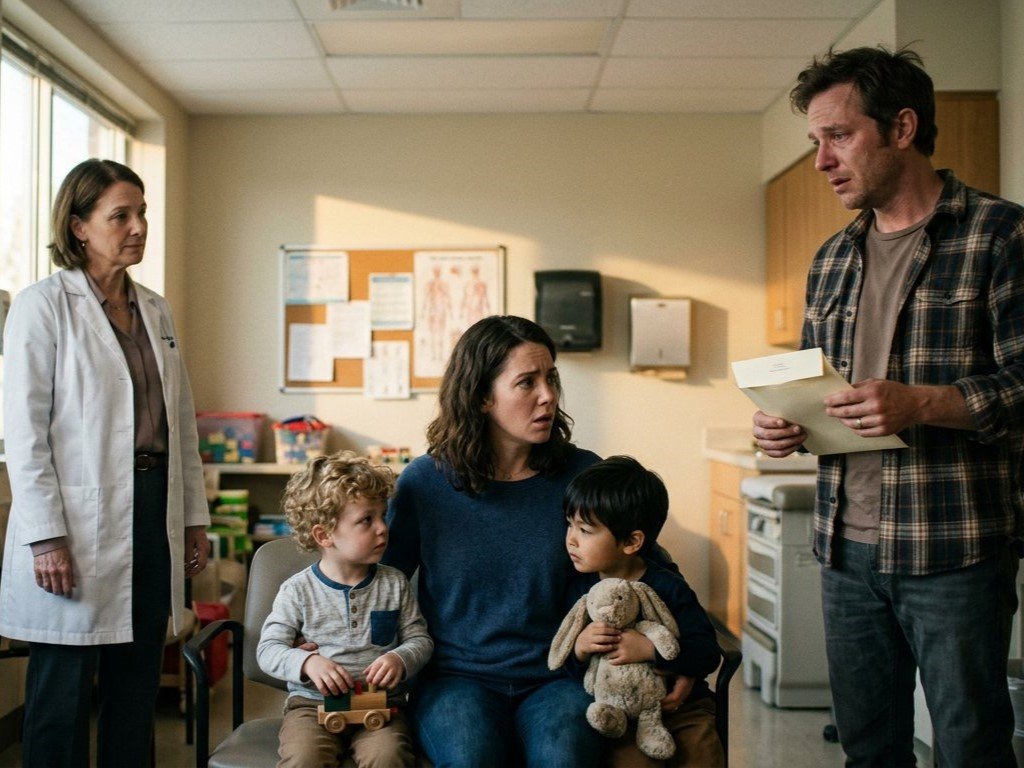
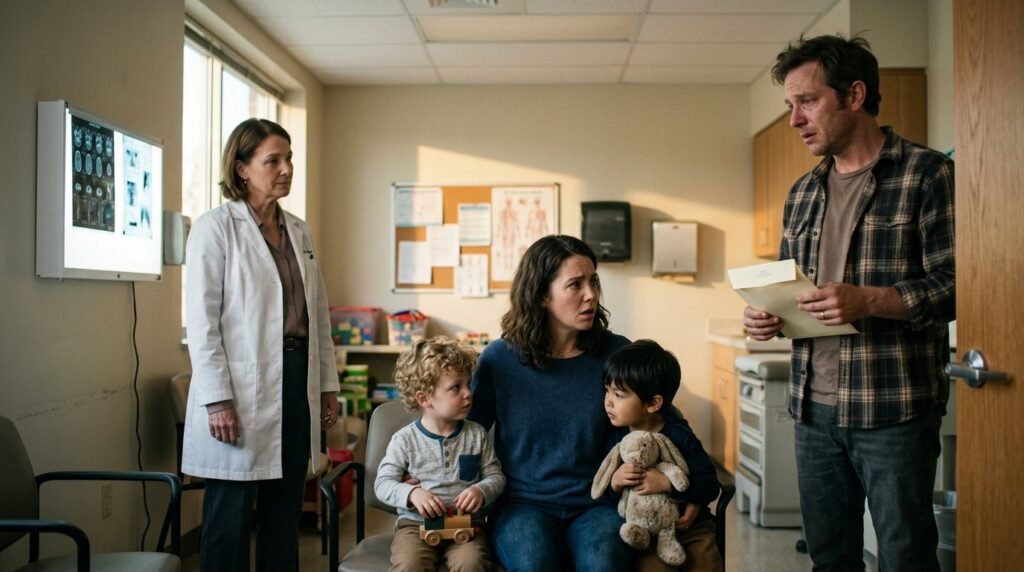
The first meeting took place in a pediatric family center with soft lamps and shelves of toys. A therapist named Dr. Han warned us that biology did not entitle any adult to burst into a child’s life.
“The children’s attachments are real,” she said. “No one will be exchanged like misplaced luggage. We move slowly, truthfully, and together.”
Elena was already there when I arrived. She sat on a rug between two boys.
I recognized Noah immediately. He was taller, with the same solemn dark eyes. He pushed a wooden train along a track, making a low humming sound I had forgotten until it entered the room and struck me in the chest.
Beside him sat Theo, my biological son. He had my ears and Elena’s dimple. He held a stuffed rabbit by one leg.
Benjamin and Sofia Ruiz stood near the window, close enough that their shoulders touched. Sofia’s eyes were swollen from crying. Benjamin watched me with a guarded expression I understood. I was a stranger whose blood had become a threat to his family.
Noah glanced up.
“Who’s that?”
Elena’s face tightened, but her voice remained calm. “That’s Adam. He knew you when you were a baby.”
Not Dad. I had surrendered that word.
I crouched several feet away. “Hello, Noah.”
He studied me, then returned to his train.
Theo walked over and offered me the rabbit.
“His name is Pickle,” he said.
My son’s voice. A stranger’s voice.
I took the rabbit carefully. “That’s a good name.”
For the next hour, we spoke about allergies, sleep routines, favorite foods, and the impossible map of our lives. The Ruiz family had photographs of Theo’s first steps. Elena had Noah’s hospital bracelet in a memory box. Every treasure belonged to the wrong story and the right child.
Before leaving, I asked Elena if we could speak privately.
In the hallway, I said the apology I had rehearsed in the car.
“I was afraid, and I turned fear into accusation. I punished you for something you did not do. Worse, I punished Noah for a result he could not understand. I am sorry.”
She looked at me for a long time.
“I believe you’re sorry,” she said. “That is not the same as forgiving you.”
“I know.”
“You don’t get to come back because the story changed.”
“I know.”
Her eyes filled, but no tears fell. “He cried for you for months.”
I leaned against the wall because my legs would no longer hold me.
“I know,” I said, although I never could.
The months that followed were governed by schedules, therapists, and humility. Confirmatory tests proved the switch. The hospital offered settlements. Lawyers discussed custody, but the four of us refused any plan that tore the boys from the only parents they remembered.
Instead, we created something no court form had a proper box for.
At first, we met every other Saturday at the family center. Then we tried parks, museums, and shared dinners. Elena learned that Theo hated peas but loved thunder. Sofia discovered that Noah needed the hallway light left on. Benjamin taught both boys to ride balance bikes. I stayed at the edge until invited closer.
I began therapy alone. I learned that jealousy had not appeared from nowhere, but its origins did not excuse what I had done. My father had left when I was twelve after accusing my mother of betrayal. I had spent my life promising I would never be made a fool, never noticing that terror of humiliation could make a man foolish and cruel.
My mother asked when “our real grandson” would come to visit.
I told her both boys were real and that she would meet neither until she understood that. It was the first honest boundary I had ever set with her.
A year after the letter, Elena allowed me to take Noah and Theo to the aquarium with Benjamin. Noah held Benjamin’s hand through the crowded entrance. Theo held mine for exactly twelve seconds before running toward the jellyfish.
In the blue light of the exhibit, Noah came to stand beside me.
“Mom says you used to whistle,” he said.
“I did.”
“Can you?”
My throat tightened. I whistled the first few notes of the lullaby I had used during those endless hallway nights.
He stared at the glowing water. “I know that song.”
“Maybe some part of you remembers.”
He slipped his hand into mine, not because a test said he should, but because in that moment he wanted to.
I did not squeeze too tightly.
Years passed. The boys grew up knowing the truth in words suited to their age: a hospital mistake had placed each baby in the other family’s arms, but love had grown in both homes. They became less like symbols and more like themselves. Noah loved machines and quiet mornings. Theo talked to everyone and feared moths. They called each other brothers long before the adults knew what to call one another.
Elena never remarried. Neither did I, though that was not a penance I imposed. Our relationship became careful, respectful, and sometimes even warm. Forgiveness came not as a door swinging open, but as a path made by many small crossings.
On the boys’ eighth birthday, both families gathered beneath strings of lights in Sofia and Benjamin’s garden. There were two cakes, one shaped like a train and one covered in clumsy sugar planets.
Noah found me near the gate, untangling balloons.
“Dad,” he said, “Theo says he gets the first piece of both cakes because he was born first. That’s not a rule, right?”
I froze with the ribbon between my fingers.
He had called me Adam for four years. I never asked for anything else.
Noah noticed my face and shifted uncertainly. “Is it okay if I call you that? I call Ben Dad too.”
I knelt so we were eye to eye.
“Love doesn’t run out because you use the same word twice,” I said. “And yes. It’s more than okay.”
He nodded, satisfied. “Good. Now tell Theo he’s wrong.”
I laughed, and from across the garden Elena looked toward us. She understood. Her smile was small and a little sad, but it was not the bitter smirk I had once imagined. It was the expression of someone who knew that joy and grief could share the same face.
The first paternity report told the truth about blood. I had used it to tell lies about loyalty, parenthood, and love.
The later tests corrected the names on our family tree, but no laboratory could repair what I had broken. That work required time, accountability, and the grace of people who owed me nothing.
Once, I believed a father was a man proven by a percentage on a page.
Now I know a father is the one who remains after certainty fails—the one who listens, protects, apologizes, and returns tomorrow without demanding to be welcomed today.
Blood revealed my sons.
Love taught me how to deserve them.