The video began before anyone in the ballroom could stop it.
A faint electronic hiss filled the darkness, followed by the unmistakable image of Lady Victoria Sterling standing beside the marble fireplace in the private bridal chamber.
Across from her sat my mother.
Margaret Bennett looked smaller than I remembered seeing her that morning, almost swallowed by the enormous velvet chair beneath her, but there was nothing frightened about the way she held herself.
She was wearing the plain navy coat she used whenever she wanted to disappear into a crowd.
Her gray-streaked brown hair was pinned neatly behind her head.
On the table between them rested a thick envelope sealed with red wax.
Victoria’s voice came through the ballroom speakers.
“You should never have brought those records here.”
My mother’s answer was quiet.
“I brought them because Claire deserves the truth.”
A murmur swept across the ballroom.
Alexander’s hand tightened around my wrist, not painfully, but as though he feared that if he released me, I might disappear.
Oliver remained pressed against my chest.
The little prince had stopped crying.
His fingers were wrapped around my locket.
On the enormous screen, Victoria paced toward the window.
“She has had twenty-six years of peace.”
“She has had twenty-six years of lies,” my mother replied.
“And sometimes lies are the only reason people survive.”
My mother looked at her for a long moment.
“That is what I told myself too.”
Something inside me seemed to break silently.
Not because my mother sounded guilty.
Because she sounded tired.
The kind of tiredness that came from carrying something heavy for far too many years.
Victoria stopped pacing.
“If Alexander sees those documents today, everything changes.”
“It should.”
“You don’t understand what that will do to Oliver.”
At the sound of his name, the baby stirred in my arms.
My mother lowered her eyes.
“I understand better than you think.”
The recording abruptly froze.
A spinning symbol appeared in the center of the ballroom screen.
Someone had interrupted the feed.
Guests immediately began whispering.
Alexander turned sharply toward the security officers gathered near the doors.
“Restore it.”
One of the officers shook his head.
“The palace network has been disconnected, Your Highness.”
Victoria drew a shaky breath.
“That should be the end of this.”
Alexander looked at her.
Something in his expression had changed.
Until that moment, I had seen him as the composed man whose face appeared on magazine covers and charity broadcasts.
Now I saw a husband who had spent two years grieving.
A father trying to understand why his son had recognized a stranger.
And beneath both of those things, a man realizing that someone standing beside him knew more than she had admitted.
“What did Margaret bring you?” he asked.
Victoria straightened.
“Alexander, this is hardly the place.”
“What did she bring you?”
Her gaze moved toward the hundreds of guests watching us.
“Private medical documents.”
“Whose?”
She hesitated.
That hesitation answered more than words could have.
I shifted Oliver carefully against my shoulder.
“Where is my mother?”
Victoria looked at me.
For the first time since I had approached the royal table, she no longer seemed angry.
She seemed afraid of saying the wrong thing.
“I don’t know.”
“You were with her four hours ago.”
“She left.”
“Where?”
“I don’t know.”
Alexander turned toward his chief security officer.
“Find Margaret Bennett.”
The officer nodded and quietly began issuing instructions into his earpiece.
Victoria reached for Alexander’s arm.
“Please.”
He looked down at her hand.
Today was supposed to have been their wedding day.
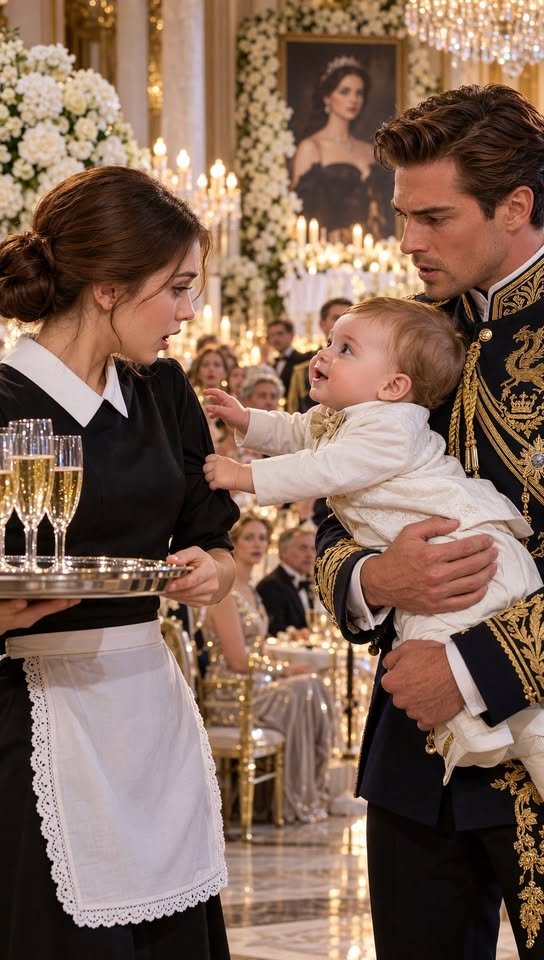
Only minutes earlier, the ballroom had been filled with music, flowers, champagne, and expectation.
Now Victoria was standing beneath the portrait of Alexander’s dead wife while another woman with the same face held his son.
Whatever future she had imagined that morning had vanished.
Alexander’s voice softened.
“I am not accusing you of anything.”
Victoria swallowed.
“Then stop looking at me as though you are.”
“I am looking at you as though I no longer understand what is happening.”
“Neither do I.”
That sounded almost convincing.
Almost.
Then my phone vibrated again.
I looked down.
Another message from the unknown number.
The envelope is still in the bridal chamber.
I raised my eyes.
Victoria saw my expression.
“What?”
I didn’t answer.
Instead, I showed Alexander the message.
He read it once.
Then again.
“Come with me.”
Victoria stepped forward.
“Alexander.”
He faced her.
“You should come too.”
For several seconds she did not move.
Finally, she nodded.
The ballroom remained under emergency lighting as Alexander’s private security team escorted us through a side corridor.
Oliver stayed in my arms.
Whenever I tried to hand him back to his father, he clung to my collar.
Alexander noticed.
Neither of us mentioned it.
The deeper we traveled into the palace, the quieter everything became.
The public rooms gave way to long hallways lined with family portraits and antique mirrors.
Everywhere I looked, the golden dragon crest appeared.
On doors.
On carpets.
On silver wall sconces.
The symbol my mother had spent my childhood teaching me to fear.
I remembered being eight years old and seeing the crest for the first time on television.
I had pointed toward it excitedly.
“Look, Mom, a dragon.”
She had turned off the television so quickly that the screen went black before I could finish speaking.
I had thought she hated fairy tales.
Now I understood there had never been anything childish about her fear.
We reached the bridal chamber.
Two guards opened the doors.
The room smelled faintly of roses and expensive perfume.
Victoria’s wedding veil lay across a chaise lounge.
A silver tray containing untouched tea sat beside the fireplace.
On the table was the red envelope.
Alexander stopped.
Victoria closed her eyes.
“You knew it was here,” I said.
“I knew Margaret left something.”
“Why didn’t you tell us?”
“Because I wanted one hour.”
Her answer surprised me.
“One hour for what?”
Victoria looked toward the wedding veil.
“To decide whether I was capable of walking downstairs and marrying a man whose entire life might change before the ceremony ended.”
There was no sharpness in her voice now.
Only exhaustion.
Alexander stared at the envelope.
“Open it.”
Victoria did not move.
So I did.
Inside were hospital records from twenty-six years earlier.
Two infant footprints.
Two identification bracelets.
Two birth reports.
One was labeled ELEANOR ROSE WHITMORE.
The second was labeled CLAIRE ELIZABETH WHITMORE.
I forgot how to breathe.
Alexander leaned closer.
“Whitmore?”
I picked up the second record.
The mother’s name had been partially obscured by a faded stamp.
The father’s line was blank.
A handwritten note appeared beneath both records.
Twin girls delivered at 2:13 a.m. and 2:21 a.m.
I whispered the words aloud.
“Twin girls.”
Victoria looked away.
Alexander picked up another page.
His expression changed.
“What is this?”
It was a transfer order.
One infant had remained under royal protection.
The second had been released into the care of a hospital nurse.
The nurse’s name was Margaret Bennett.
My mother.
I felt the room tilt.
“She wasn’t my mother.”
No one answered.
I pressed one hand against the table.
Oliver made a soft sound against my shoulder.
Alexander stepped toward me.
“Claire.”
“She raised me.”
“That still makes her your mother.”
His words were so simple that they pierced through the panic.
I looked at him.
He seemed startled by his own certainty.
“I mean,” he continued quietly, “whatever happened that night, twenty-six years of loving someone cannot be erased by a document.”
I looked down at Oliver.
For the first time since the screen had turned on, my breathing steadied.
Victoria slowly approached the table.
“There is more.”
Alexander looked at her.
“What do you mean?”
She removed a folded page from the inner pocket of her wedding gown.
My pulse jumped.
“You kept something?”
“I found it beneath the envelope after Margaret left.”
She placed it on the table.
It was a letter.
The handwriting belonged to my mother.
I recognized the narrow slant immediately.
Claire, if you are reading this, then the secret I hoped would protect you has finally failed.
My hands trembled.
I kept reading.
I did not steal you.
I was asked to save you.
The woman who gave birth to you believed one of her daughters would not survive the night if both remained inside the Whitmore family.
Alexander inhaled sharply.
Victoria whispered, “Keep reading.”
I did.
I was twenty-four years old and working the maternity wing at St. Catherine’s.
Before dawn, a woman entered the nursery carrying royal authorization papers.
She placed you in my arms.
She told me your sister would grow up as Eleanor Whitmore, but you must never carry that name.
She made me promise to raise you beyond the reach of the palace.
My eyes filled with tears.
I reached the final paragraph.
For years, I believed separating you saved your life.
Then Eleanor died.
That was when I realized someone had been searching for the wrong sister.
The room became perfectly silent.
Alexander took the letter from my hands.
His face had gone colorless.
“What does that mean?”
Victoria looked toward Eleanor’s portrait visible through the open doorway at the far end of the corridor.
“It means perhaps Eleanor didn’t die because of who she was.”
I understood before she finished.
“She died because someone thought she was me.”
Oliver suddenly lifted his head.
He looked past my shoulder.
Toward the open door.
A woman was standing there.
My mother.
Margaret Bennett had tears running down her face.
“Claire.”
I couldn’t move.
She stepped inside.
“I can explain.”
“You’re not my mother.”
Pain crossed her face.
But she didn’t defend herself.
“No,” she whispered.
Then she looked at the child in my arms.
“But you are still my daughter.”
For a moment, twenty-six years rushed through me at once.
Birthday cakes made from boxed mix.
Her sitting beside my bed whenever thunderstorms frightened me.
The day she taught me to drive.
The old apartment in Baltimore where she worked double shifts so I could attend college.
The envelopes of emergency cash hidden inside kitchen drawers.
Every ordinary memory seemed more precious because none of it had been required.
I crossed the room.
My mother opened her arms.
I fell into them carefully, Oliver between us.
She held both of us.
“I am so sorry.”
“Who gave me to you?”
Margaret closed her eyes.
“That is the question I’ve been afraid you would ask.”
“Why?”
“Because I never knew her real name.”
Alexander stepped closer.
“You said she had royal authorization.”
“She did.”
“Then someone inside my family arranged it.”
Margaret nodded.
“She wore a veil.”
Victoria asked the question none of us wanted answered.
“Would you recognize her voice?”
Margaret’s face changed.
“Yes.”
A strange silence passed through the room.
Alexander glanced toward the corridor.
“Then perhaps we should begin with everyone who had access to the maternity wing that night.”
My mother shook her head.
“There is one other thing.”
She reached inside her coat.
From her pocket she removed a small velvet pouch.
Inside was a key.
Not a modern keycard.
An old brass key.
Stamped into the metal was the Whitmore crest.
“I was told to give this to Claire only if the truth ever came out.”
I took it.
“What does it open?”
“I don’t know.”
Alexander stared at it.
“I do.”
He turned the key over.
Beneath the dragon crest was a tiny engraved number.
“There are old family vaults beneath the east wing.”
Victoria frowned.
“I thought those were sealed.”
“They are.”
Alexander looked directly at me.
“Vault seventeen belonged to Eleanor.”
I stared at the key resting in my palm.
“But Eleanor was twenty-six.”
“She didn’t inherit it.”
His voice dropped.
“She was given it the night before she died.”
My skin prickled.
“By whom?”
Alexander didn’t answer immediately.
Then he looked toward my mother.
“Do you still remember the voice of the woman who gave Claire to you?”
Margaret nodded.
“Perfectly.”
From the corridor came the measured sound of footsteps.
An elderly woman appeared in the doorway.
She wore a dark blue dress and a single strand of pearls.
Every guard immediately straightened.
Alexander’s expression changed.
“Grandmother.”
Queen Mother Beatrice Whitmore stopped when she saw Margaret.
The blood drained from Margaret’s face.
Oliver twisted in my arms.
The old woman looked at me.
Then at the brass key.
And for the first time that day, someone in the Whitmore family looked at me not with confusion, but recognition.
Margaret whispered beside me.
“That was her voice.”
Queen Mother Beatrice did not deny it.
That frightened me more than denial would have.
She simply stood in the doorway while the silence gathered around her.
Alexander took one step toward her.
“You were at St. Catherine’s twenty-six years ago?”
Beatrice’s gaze remained on me.
“Yes.”
My mother gripped my arm.
“That was the woman.”
Victoria slowly lowered herself into a chair.
Alexander looked as though someone had removed the floor beneath him.
“You separated Eleanor from her twin.”
Beatrice finally looked at him.
“I saved Claire.”
The certainty in her voice made the words land differently.
Not proudly.
Not defensively.
Simply as a fact she had carried for decades.
“From whom?” I asked.
Her expression softened.
“That is why we must open the vault.”
Alexander’s jaw tightened.
“No more secrets.”
“I agree.”
He gave a bitter laugh.
“You agree now?”
Beatrice accepted the question without flinching.
“Now that the secret has failed, yes.”
For the first time, I saw how old she was.
Not fragile.
But tired in the same way my mother had looked in the video.
I wondered how many people in this family had mistaken silence for protection.
Alexander looked at the brass key.
“We go now.”
The vaults lay beneath the oldest section of Whitmore Palace.
The route required two elevators, a narrow stone staircase, and a security door so old that its hinges seemed to belong to another century.
Beatrice dismissed the guards once we reached the underground corridor.
Only Alexander, Victoria, my mother, Oliver, Beatrice, and I continued.
The passage smelled faintly of limestone and cedar.
Numbers had been carved above seventeen wooden doors.
Alexander stopped at the final one.
I inserted the key.
For a moment it wouldn’t turn.
Then something shifted inside the lock.
The door opened.
The room beyond was smaller than I expected.
There were no jewels.
No gold.
No hidden crowns.
Only shelves.
Boxes.
Letters.
Photographs.
And a wooden desk.
I stepped inside.
A coat hung across the back of the chair.
Black wool.
A silver scarf tucked into one pocket.
I had seen that coat before.
In photographs.
Eleanor had been wearing it on the evening of her final public appearance.
Alexander reached toward it.
Then stopped.
He didn’t touch it.
Grief moved across his face so quietly that I almost looked away.
Instead I stood beside him.
“You can touch it.”
He glanced at me.
“I haven’t touched anything that belonged to her in two years.”
“Why?”
“Because everything became a memorial.”
His voice was barely audible.
“And memorials feel as though they belong to everyone except the person who loved them.”
I didn’t know what to say.
So I said nothing.
He finally lifted the scarf.
He held it for a few seconds.
Then placed it carefully back.
It was such a small act.
But something in his shoulders relaxed afterward.
At the desk, Victoria opened a leather folder.
“There are financial records.”
Beatrice moved toward her.
“From which company?”
“Whitmore Protection Holdings.”
Alexander frowned.
The security company was the foundation of his family’s fortune.
“What division?”
Victoria scanned the page.
“Special archives.”
“I’ve never heard of it.”
Beatrice had.
Her silence betrayed her.
Alexander turned.
“Grandmother?”
“It was created by your grandfather.”
“For what purpose?”
“To store information that should never become public.”
Victoria looked down the shelves.
“That sounds reassuring.”
Under different circumstances, I might have laughed.
Instead, my mother found a small cassette recorder.
Beside it sat a single tape.
A handwritten label read:
FOR CLAIRE.
My stomach tightened.
Alexander found an old player in a cabinet.
He inserted the tape.
Static filled the room.
Then a woman’s voice spoke.
I froze.
It sounded like mine.
Not exactly.
But close enough that I understood immediately.
Eleanor.
“If you’re hearing this, Claire, then either I finally found you or something happened before I could.”
My hand flew to my mouth.
Alexander sat down.
Oliver looked toward the machine.
Eleanor continued.
“I have known about you since I was seventeen.”
I stared at Beatrice.
She closed her eyes.
“I found Grandmother’s letters by accident.”
A faint smile entered Eleanor’s recorded voice.
“I suppose that makes curiosity a family trait.”
Alexander released a breath that sounded almost like a laugh.
Tears stood in his eyes.
“I spent years wondering where you were.”
The recording crackled.
“I didn’t look for you at first because Grandmother made me promise I wouldn’t.”
Beatrice sat slowly on the nearest chair.
“She said keeping us apart was the only way to keep you safe.”
I looked toward her.
“Safe from what?” I whispered.
The tape continued.
“Then I met Alexander.”
He lowered his head.
“And eventually I understood something Grandmother never did.”
Eleanor paused.
“You cannot build a life entirely out of fear.”
Alexander covered his mouth.
I moved closer to him.
Not because I knew what he needed.
Because suddenly neither of us felt like strangers.
“I began searching for you after Oliver was born.”
I looked down at the baby.
“Having a child changes the shape of every question.”
The recorded voice softened.
“I wanted him to know his aunt.”
Oliver touched my locket.
“I found Margaret Bennett six weeks before my accident.”
My mother gasped.
“She found me?”
Beatrice turned toward her.
“You never told me.”
“I didn’t know.”
Eleanor continued.
“Margaret refused to tell me where Claire was.”
My mother began crying.
“I thought I was protecting you.”
I reached for her hand.
The tape hissed again.
“But she gave me something more important.”
We all leaned closer.
“She gave me proof that Claire’s separation was not ordered because of a threat from outside the family.”
Beatrice stiffened.
“It came from inside Whitmore Protection Holdings.”
Alexander stood.
“What?”
“I don’t know who authorized it.”
Eleanor’s voice trembled for the first time.
“But I know why.”
The room seemed to shrink.
“The night we were born, doctors discovered something unusual.”
I glanced instinctively toward my mother.
She knew.
I saw it.
“What?” I asked.
Margaret looked down.
The tape answered.
“One of us carried a rare hereditary marker.”
Alexander frowned.
Eleanor continued.
“The marker proves something everyone believed impossible.”
Static interrupted several words.
Then her voice returned.
“Claire and I were not daughters of the man listed in the private Whitmore family records.”
Beatrice whispered, “Eleanor.”
“We were daughters of someone else.”
The tape stopped.
Alexander stared at the player.
“No.”
He pressed the button again.
Nothing.
Victoria picked up the cassette.
“The tape ended.”
“Then where is the rest?”
No one knew.
I turned toward Beatrice.
“You know who my father was.”
She looked at me.
“Yes.”
“Tell me.”
She struggled with the answer.
For several seconds I thought she would retreat into silence again.
Then she said, “Thomas Vale.”
Alexander stepped backward.
Victoria looked confused.
“Who was Thomas Vale?”
Beatrice’s eyes remained on me.
“The son of Henry Vale.”
Margaret sat down abruptly.
Alexander seemed to understand.
I didn’t.
“Who is Henry Vale?”
Alexander answered.
“He founded Vale International.”
I still didn’t understand.
Victoria did.
Her expression changed.
“The Whitmores’ largest business rival.”
Beatrice nodded.
“Thirty years ago, the Vale and Whitmore companies were competing for the same federal security contracts.”
I stared at her.
“So someone hid me because of corporate rivalry?”
“No.”
Beatrice shook her head.
“They hid you because your existence proved that the Whitmore and Vale families were connected in a way both boards believed could destabilize control of the companies.”
“That’s absurd.”
“It was.”
Her answer came immediately.
“It was also the world we lived in.”
“Who was my mother?”
Beatrice stood.
“My daughter.”
Alexander froze.
I looked at him.
Then at Beatrice.
“Your daughter?”
“Princess Caroline.”
I knew the name.
Everyone did.
Caroline Whitmore had died when Eleanor and I were infants.
Official histories described her as brilliant, private, and troubled by poor health.
“She loved Thomas Vale,” Beatrice said.
“They intended to marry.”
“What happened?”
“Thomas died before you were born.”
My heart sank.
Beatrice’s voice grew quieter.
“Caroline died six months after giving birth.”
I looked around the vault.
“Then why was Eleanor raised as a Whitmore princess?”
“Because after Thomas died, Caroline returned home.”
“And why was I sent away?”
Beatrice closed her eyes.
“Because someone discovered that Thomas had left controlling shares in a trust.”
Alexander understood first.
“For his child.”
“For his children,” Beatrice corrected.
Victoria stood very still.
“Meaning Claire and Eleanor inherited part of Vale International.”
“Yes.”
“How much?”
Beatrice looked at me.
“Together, enough to determine who controls it.”
I almost laughed.
The entire idea seemed impossible.
That morning I had worried whether temporary serving work would cover next month’s rent.
Now an elderly queen was telling me that my existence could influence a corporation worth billions.
“This is exactly the kind of thing my mother warned me about,” I murmured.
Margaret squeezed my hand.
Beatrice gave a faint, sad smile.
“She was right.”
Alexander began searching the desk.
“If Eleanor knew this, she would have documented it.”
“She did,” Beatrice said.
He stopped.
“How do you know?”
“Because she confronted me.”
“Before she died?”
“Three days before.”
The grief returned to his face.
“You never told me.”
“She asked me not to.”
“Why?”
“She said she needed time to understand who she could trust.”
Alexander stared at her.
“And then she died.”
Beatrice nodded.
My mother rose.
“What exactly happened to Eleanor?”
I knew the public story.
A late-night car accident.
Rain.
A coastal road.
A barrier struck at high speed.
But Alexander’s silence told me something was missing.
“I never saw her body,” he said.
I turned.
“What?”
Victoria looked at him.
“I thought you did.”
“No.”
He sat down slowly.
“The car burned after the crash.”
Beatrice’s hands tightened.
“Identification was based on personal effects and medical records.”
My pulse accelerated.
“Medical records belonging to whom?”
No one answered.
I suddenly remembered the text message.
She died two years ago.
Then another.
Victoria knows exactly who you are.
I looked at Victoria.
“Why did the message say you knew me?”
“I don’t know.”
“You recognized me downstairs.”
“I recognized the resemblance.”
“You looked terrified before anyone mentioned twins.”
Victoria’s eyes filled with something complicated.
“Because I had already seen your photograph.”
Alexander turned toward her.
“When?”
She hesitated.
“Three months ago.”
“Where?”
Victoria reached into her handbag.
She removed a photograph.
It showed Eleanor standing outside a café.
Beside her was my mother.
And taped to the back was another image.
Me.
Walking across the campus where I worked at the university library.
My breath caught.
“Who gave you this?”
Victoria looked toward Beatrice.
“Not her.”
“Then who?”
“A private investigator.”
“Whose investigator?”
“My father’s.”
Alexander’s expression hardened with confusion.
“Why was your father investigating Claire?”
Victoria swallowed.
“Because he believed Eleanor was still alive.”
A chill moved through me.
“That doesn’t make sense.”
“I know.”
“Why would he think I was Eleanor?”
“Because someone sent him photographs of you.”
“Who?”
Victoria slowly unfolded a note that had been tucked behind the photograph.
The handwriting was elegant.
Only one sentence appeared.
You buried the wrong sister.
Alexander read it.
His face changed.
“My God.”
Then a sound came from behind the shelves.
A click.
Everyone turned.
Part of the wooden wall shifted open.
A hidden compartment.
Inside sat another cassette.
Alexander removed it.
The label was newer.
The handwriting belonged to Eleanor.
He inserted it into the player.
Her voice filled the vault again.
This time there was no introduction.
Only five words.
“Alexander, I survived the crash.”
Alexander did not move.
The words seemed to pass through him without finding somewhere to land.
Victoria stood beside the desk with one hand pressed against her lips.
My mother whispered Eleanor’s name.
Beatrice closed her eyes.
I stared at the cassette player.
The recording continued.
“If this tape reaches you, something has prevented me from coming home.”
Alexander gripped the edge of the desk.
“I know what everyone believes.”
Eleanor’s recorded voice remained calm.
“The accident happened.”
“My car went over the barrier.”
“There was a fire.”
“But I was not inside when the vehicle burned.”
Alexander lowered himself into the chair.
I could almost see the last two years rearranging themselves inside him.
Every anniversary.
Every night he had stood beside Oliver’s crib alone.
Every moment he had learned to live beside an absence that might never have been real.
“I was injured.”
The tape hissed softly.
“A passing driver found me before the fire spread.”
“The person took me to a private clinic rather than a hospital.”
Beatrice opened her eyes.
“Why?”
Eleanor answered.
“At first, I thought it was luck.”
“It wasn’t.”
“The driver knew my name.”
Alexander looked toward Beatrice.
She shook her head.
“I knew nothing about this.”
“For several days, I drifted in and out of consciousness.”
“When I woke properly, a woman told me the palace had announced my death.”
Alexander whispered, “Who?”
The recording continued.
“I asked to contact Alexander.”
“They told me it was too dangerous.”
“I didn’t believe them.”
“Then they showed me copies of the files I had discovered.”
My throat tightened.
“They knew about Claire.”
“I realized the accident might not have been an accident.”
Margaret began to cry silently.
“I agreed to remain hidden until I understood what was happening.”
Eleanor paused.
“That was my first mistake.”
Alexander looked devastated.
The tape continued.
“By the time I understood that the people protecting me had their own reasons for keeping me away, I no longer knew who inside the palace I could contact.”
“Except one person.”
Beatrice whispered, “Margaret.”
But Eleanor said another name.
“Victoria Sterling.”
Every face turned toward Victoria.
She looked as startled as the rest of us.
Alexander stood.
“You knew?”
“No.”
The tape continued before she could say more.
“I met Victoria years before Alexander did.”
Victoria stared at the player.
“We served on the same children’s foundation board.”
“I knew her only slightly.”
Victoria closed her eyes.
“That was true.”
“But I remembered something she once told me.”
Eleanor’s voice softened.
“She said the surest way to know someone’s character was to see what they did with a secret that offered them nothing.”
Victoria sat down.
I watched her carefully.
Three months earlier, she had received my photograph.
Perhaps that had not been the beginning of her involvement.
Perhaps it had been a test.
“I sent Victoria a message eleven months after the crash.”
Alexander stared at her.
“You received something from Eleanor?”
“No.”
Victoria shook her head desperately.
“I swear I didn’t.”
“I never heard back,” the recording continued.
“Either she chose not to answer or someone intercepted it.”
Victoria covered her face.
“I never received anything.”
Alexander looked at her for several seconds.
Then he nodded.
“I believe you.”
The relief in her eyes nearly broke my heart.
Their wedding morning had transformed into something no one could have prepared for, yet beneath all the confusion there remained obvious affection between them.
Not the fairy-tale affection displayed for cameras.
Something quieter.
Something tested.
The tape continued.
“If Alexander has moved on by the time he hears this, do not blame him.”
Alexander closed his eyes.
“He believed I was dead.”
“He had every right to live.”
Victoria began crying.
“I never wanted to take your place,” she whispered toward the machine.
Of course Eleanor could not hear her.
Still, the words mattered.
The recording shifted.
“I have spent the last year trying to locate Claire.”
“I finally did.”
My heartbeat quickened.
“I watched her from across the street once.”
I thought about ordinary days that suddenly seemed different.
Walking home from work.
Buying coffee.
Standing at the bus stop.
Had Eleanor been somewhere nearby?
“She laughs like our mother.”
Beatrice made a quiet sound.
I looked at her.
“She does,” Beatrice whispered.
It was the first thing she had said that made me feel connected to the woman who had given birth to me.
Not through inheritance.
Not through secrets.
Through laughter.
“I wanted to speak to Claire.”
“I didn’t.”
“Because by then, I had learned someone else was watching her too.”
The room chilled.
Alexander’s voice became barely audible.
“Who?”
“I don’t know.”
Eleanor’s recording crackled.
“But whoever it is has access to both Whitmore and Vale security databases.”
Alexander immediately reached for his phone.
“I need the security division audited.”
Beatrice stopped him.
“Not from here.”
“Why?”
“If Eleanor was right, any message you send through official channels could alert the person.”
Alexander stared at her.
Then slowly lowered the phone.
It was strange seeing powerful people discover the same helplessness ordinary people had always known.
Having authority did not mean knowing whom to trust.
Sometimes it merely meant there were more doors behind which secrets could hide.
The tape continued.
“There is one thing I need you to understand.”
“My accident was not caused by someone trying to hurt me.”
Alexander looked up.
“What?”
“I believe someone wanted me frightened.”
“The brake line had been tampered with, but not enough to guarantee failure.”
“They wanted me to stop investigating.”
I exhaled.
That distinction mattered.
Whoever had hidden Eleanor afterward might have been trying to control the situation rather than harm her.
The mystery became less frightening and somehow more human.
Fear.
Money.
Loyalty.
People making decisions because they believed they knew what was best.
“I think the person responsible is connected to our father.”
The tape stopped again.
Alexander nearly shouted in frustration, then caught himself.
He removed the cassette.
“That cannot be all.”
Victoria examined it.
“The tape is damaged.”
My mother looked toward the shelves.
“There may be another copy.”
We searched for nearly an hour.
Oliver eventually fell asleep against my shoulder.
Alexander took him carefully, and for the first time the baby allowed the transfer without protest.
I smiled.
“Maybe he’s getting used to me.”
Alexander looked at his son.
“Or maybe he’s decided you’re not going anywhere.”
Something warm moved through me.
I didn’t know what I was to Oliver.
Biologically, his aunt.
Emotionally, a stranger whose face reminded him of the mother he might barely remember.
Babies were not supposed to remember faces from infancy.
Yet perhaps recognition was not always memory.
Perhaps sometimes it was familiarity without explanation.
Victoria found the next clue inside Eleanor’s coat.
A hotel key card.
The name printed across it was THE HARBOR HOUSE.
Alexander recognized it.
“A small hotel in Annapolis.”
Beatrice frowned.
“Why would Eleanor keep this?”
There was handwriting on the back.
Room 214.
Beneath it was a date.
Three weeks ago.
Everyone stared.
I felt my pulse in my throat.
“If Eleanor wrote this three weeks ago—”
“She is alive,” Alexander said.
There was no uncertainty in his voice.
The palace wedding was officially postponed.
Publicly, the family released a brief statement explaining that an unexpected medical concern required privacy.
Privately, we left through an underground garage in two unmarked vehicles.
No motorcade.
No ceremonial guards.
No press.
Only Alexander, Victoria, my mother, Oliver, Beatrice, two trusted security officers, and me.
By late afternoon, rain had begun falling over Maryland.
The road toward Annapolis blurred beyond the windows.
I sat beside my mother.
For nearly twenty minutes neither of us spoke.
Finally I asked, “Did you ever want to tell me?”
“Every birthday.”
“Why didn’t you?”
“Because each year that passed made the truth feel harder to explain.”
I looked at her.
“You could have tried.”
“I should have.”
There was no excuse in her answer.
No attempt to make herself innocent.
That honesty made my anger harder to hold.
She touched my hand.
“I was terrified that if you learned who you were, you would go looking for them.”
“The Whitmores?”
“Yes.”
“And now?”
“Now I realize I was also afraid you might discover a life so extraordinary that mine would seem small.”
I turned fully toward her.
The confession surprised me.
She smiled sadly.
“I know that sounds selfish.”
“It sounds human.”
Her eyes filled.
I squeezed her hand.
“You gave me a good life.”
“I wanted to give you more.”
“You gave me everything you had.”
For the first time that day, the distance between us became smaller.
Not gone.
But smaller.
The Harbor House was not royal.
It was a quiet brick hotel near the waterfront with flower boxes beneath the windows and a handwritten sign advertising crab soup.
Room 214 was on the second floor.
Alexander stood before the door.
For the first time since I met him, his hands were shaking.
Victoria noticed.
She stepped beside him.
“You don’t have to do this alone.”
He looked at her.
A thousand complicated emotions passed silently between them.
“You were supposed to become my wife today.”
Victoria smiled through her sadness.
“And somehow that is no longer the most complicated part of the day.”
He gave a breath of laughter.
Then knocked.
No answer.
He knocked again.
“Eleanor?”
Nothing.
The hotel manager opened the room with a master key.
The room was empty.
But someone had been there recently.
A cup of tea sat beside the window.
Still warm.
On the bed lay a folded newspaper from that morning.
Across the front page was a photograph of Alexander and Victoria preparing for their wedding.
The headline read:
ROYAL FAIRY TALE BEGINS TODAY.
Someone had circled the picture.
Beside it was a note.
I am happy for you.
Alexander sat down on the edge of the bed.
I thought the message would destroy him.
Instead, he touched the handwriting gently.
“She was here.”
Victoria looked toward the window.
“There.”
A woman was walking along the harbor.
Dark coat.
Brown hair.
Even from the second floor, I recognized the shape of her face.
My face.
Alexander ran from the room.
We followed.
By the time we reached the waterfront, the woman had disappeared among umbrellas.
“Eleanor!” Alexander called.
People turned.
No Eleanor.
Then my phone rang.
Unknown number.
I answered.
For several seconds, all I heard was rain.
Then a woman’s voice said, “Claire?”
My knees weakened.
“Yes.”
A quiet breath.
“Oh, thank God.”
I couldn’t speak.
The voice sounded almost exactly like mine.
“Eleanor?”
“Yes.”
Alexander grabbed my arm.
I put the phone on speaker.
His face became still.
“Eleanor.”
There was silence.
Then she whispered his name.
“Alexander.”
He closed his eyes.
Victoria turned away to give him privacy, even though there was nowhere private to go.
“Where are you?” he asked.
“I can’t tell you yet.”
“Why?”
“Because I was wrong about who was watching Claire.”
I looked across the rain-soaked harbor.
“Who is it?”
Eleanor’s voice lowered.
“It isn’t someone from the Whitmore family.”
“Then who?”
A pause.
“The person who arranged my disappearance was trying to protect both of us.”
“From what?”
“Not what.”
Eleanor took a breath.
“Who.”
Alexander leaned closer to the phone.
“Eleanor, please.”
Her answer changed everything again.
“Our father isn’t dead.”
We returned to the hotel room because none of us could stand in the rain pretending the world had not changed again.
Alexander placed my phone on the small table.
Eleanor remained connected.
No one spoke for several seconds.
Finally Beatrice stepped closer.
“Eleanor.”
The silence on the other end changed.
“Grandmother.”
Beatrice lowered her head.
“I am sorry.”
Eleanor’s answer was unexpectedly gentle.
“I know.”
That seemed to hurt Beatrice more than anger would have.
Alexander pulled a chair toward the phone.
“Tell us about Thomas.”
Eleanor exhaled.
“The official story is false.”
Beatrice looked toward me.
I saw guilt return to her face.
“You knew?” I asked.
“Not all of it.”
Eleanor continued.
“Thomas Vale did not die before we were born.”
Alexander frowned.
“His aircraft disappeared.”
“Yes.”
“Wreckage was recovered.”
“Parts of the aircraft were recovered.”
Eleanor’s voice became careful.
“No body was ever found.”
I looked at Beatrice.
“Did Caroline know?”
“No.”
Her answer came quickly.
“She believed he was dead.”
Eleanor spoke.
“That part is true.”
A strange sadness filled me for the mother I had never known.
Caroline had apparently lost the man she loved, given birth to twins, surrendered one daughter for safety, and died months later.
Whatever wealth surrounded her had not protected her from grief.
“Thomas survived,” Eleanor continued.
“He discovered that someone inside Vale International had arranged the aircraft failure because they wanted control of his shares.”
Victoria leaned toward the phone.
“Who?”
“He never proved it.”
“Then why disappear?”
“Because he believed returning would put Caroline in danger.”
Beatrice closed her eyes.
“He should have trusted us.”
Eleanor replied softly, “Perhaps he believed the same thing about you that you believed about everyone else.”
Beatrice had no answer.
That sentence seemed to describe the entire tragedy.
People hiding the truth to protect one another.
People making enormous decisions alone.
People mistaking secrecy for love until secrecy became the thing that separated them.
I sat beside the window.
“Where is Thomas now?”
Eleanor hesitated.
“With me.”
My heart seemed to stop.
“My father is with you?”
“Yes.”
“Can I speak to him?”
Another silence.
Then Eleanor said, “He is afraid you won’t want to.”
I almost laughed.
“He’s afraid?”
“He has had twenty-six years to imagine this moment.”
“So have I, except I didn’t know I was imagining it.”
Eleanor became quiet.
Then I heard movement.
A man’s voice came through the phone.
“Claire.”
I gripped the chair.
The voice was older.
Warm.
Unsteady.
“Hello.”
It was the only word I could manage.
“I’m Thomas.”
“I know.”
“I don’t know where to begin.”
“Neither do I.”
For some reason, that helped.
We were strangers connected by biology and absence.
Neither of us had the right words.
So we didn’t pretend.
Thomas asked, “Did Margaret raise you well?”
I looked at my mother.
“She raised me wonderfully.”
Margaret covered her mouth.
“I’m glad.”
His voice broke slightly.
“That was all Caroline wanted.”
I swallowed.
“You knew about me?”
“Not until years later.”
I glanced at Beatrice.
“She arranged everything without telling you?”
“Yes.”
“Does that make you angry?”
“It did.”
“Does it still?”
Thomas paused.
“No.”
Beatrice lifted her head.
“I spent many years being angry at decisions made by frightened young people.”
His voice softened.
“Then I became an old man who had made just as many frightened decisions.”
Beatrice sat very still.
Something passed between two people separated by decades of misunderstanding.
Not forgiveness exactly.
But the possibility of it.
Alexander leaned forward.
“Why did Eleanor stay hidden?”
Thomas answered.
“Because she found me.”
“How?”
“By following the ownership records.”
Eleanor returned to the phone.
“I discovered a trust registered under an old name connected to Thomas.”
“And then?”
“I found him living in Maine.”
“Why didn’t you call me?”
Pain entered her voice.
“I was going to.”
Alexander looked away.
“I swear I was.”
“Then the accident happened.”
Eleanor continued.
“Thomas had been monitoring the same internal security network I was investigating.”
Thomas spoke again.
“When Eleanor crashed, one of my associates reached her before palace security.”
Beatrice’s eyes widened.
“You arranged her disappearance.”
“I arranged her protection.”
Alexander rose.
“You let me believe she was dead.”
Thomas’s voice remained calm.
“I believed someone had tried to kill her.”
“But you were wrong.”
“Yes.”
The word came immediately.
“I was wrong.”
Alexander stopped.
Thomas continued.
“I regret that more than anything I can explain.”
“Why didn’t you correct it when you realized?”
“Because by then Eleanor had discovered Claire.”
Eleanor spoke.
“And someone was tracking her.”
I looked toward the rain-streaked window.
“Who?”
“We finally know.”
The entire room seemed to lean toward the phone.
Thomas said, “A former executive named Jonathan Mercer.”
Alexander recognized the name.
“He worked for both companies.”
“Yes.”
Beatrice frowned.
“He left Whitmore Protection fifteen years ago.”
“He never truly left,” Thomas replied.
“He retained access through consulting agreements.”
Victoria asked, “What does he want?”
“Control.”
Thomas’s answer was almost weary.
“Not revenge.”
“Not violence.”
“Control of information.”
He explained that Mercer had spent decades managing private disputes between the Whitmore and Vale families.
He knew which scandals could damage contracts.
Which inheritances could alter voting rights.
Which relationships had been hidden.
When Eleanor began asking questions, Mercer feared the truth would expose years of unauthorized decisions he had made in the name of protecting both companies.
“So he tampered with her car?” I asked.
“No,” Thomas said.
“That was another employee trying to frighten her into abandoning the investigation.”
Alexander looked stunned.
“Then Mercer hid her afterward?”
“Yes.”
“Why?”
“Because a dead princess generated fewer questions than a living one investigating corporate records.”
Victoria shook her head.
“This whole disaster happened because everyone kept choosing secrecy.”
“No one wanted a scandal,” Thomas said.
“And instead you created a tragedy,” Alexander replied.
There was no anger in his tone now.
Only sadness.
Thomas accepted it.
“Yes.”
Eleanor spoke.
“Mercer knows we’re together now.”
My pulse quickened.
“Does that put you in danger?”
“I don’t believe so.”
“Why not?”
“Because he contacted me yesterday.”
Alexander stood straighter.
“What did he say?”
“That he wants to end this.”
No one spoke.
“He has offered to turn over every record he kept.”
Beatrice looked suspicious.
“In exchange for what?”
“Privacy.”
Victoria frowned.
“That sounds convenient.”
“It is.”
Eleanor continued.
“But the records could prove everything.”
Alexander asked, “Where is the meeting?”
“Tomorrow morning.”
“Where?”
“Whitmore Palace.”
I stared at the phone.
“He wants to come here?”
“Yes.”
“Why?”
“Because there is one file he says cannot leave the building.”
Alexander looked toward Beatrice.
“What file?”
Beatrice seemed suddenly uneasy.
Eleanor answered.
“Caroline’s private journal.”
Beatrice’s face collapsed.
I saw the truth immediately.
“You have it.”
She nodded.
“Where?”
“In my rooms.”
“Why did you hide it?”
“Because Caroline asked me to.”
I thought I had become accustomed to secrets.
Apparently not.
We returned to Washington that evening.
The palace was strangely quiet.
Wedding flowers still filled the ballroom, though the guests were gone.
Hundreds of candles had burned down to pools of wax.
At the altar, Eleanor’s portrait remained.
I stood before it.
Alexander joined me.
For a while we simply looked at her.
“She seems happy,” I said.
“She was.”
“Were you?”
He smiled.
“Yes.”
The answer held no hesitation.
Then he looked toward the empty ballroom.
“I was supposed to marry Victoria here today.”
“She loves you.”
“I know.”
“And you love her.”
“Yes.”
There was guilt in his voice.
I turned toward him.
“Loving Eleanor does not make loving Victoria a betrayal.”
He looked at me.
“Did Eleanor teach you that?”
“No.”
I smiled faintly.
“My mother did.”
Across the ballroom, Margaret was showing Oliver how the chandelier crystals reflected light.
The baby laughed.
Alexander watched them.
“Everything feels impossible.”
“Maybe because you’re trying to understand the rest of your life before understanding tomorrow.”
He smiled.
“That sounds annoyingly sensible.”
“I work in a library.”
“Is that where librarians keep all the sensible answers?”
“No.”
“We hide them so people keep coming back.”
For the first time that day, he laughed freely.
It transformed his face.
And I understood why Eleanor must have loved him.
The following morning, Jonathan Mercer arrived alone.
He was seventy-two, silver-haired, thin, and far less intimidating than the mystery surrounding him.
We met inside Beatrice’s private sitting room.
No cameras.
No press.
No grand confrontation.
Only people exhausted by too many years of hidden decisions.
Mercer placed a leather case on the table.
“I owe all of you an apology.”
Alexander looked at him.
“That seems insufficient.”
“It is.”
Mercer nodded.
“But insufficient things can still be true.”
He opened the case.
Inside were decades of records.
Memos.
Security reports.
Private correspondence.
Evidence of every decision that had slowly created the maze we were trapped inside.
Mercer looked at me.
“You were never in physical danger, Claire.”
“Then why was I hidden?”
“Because your existence complicated ownership.”
“So adults rearranged children’s lives because of shares in companies?”
His expression tightened with shame.
“Yes.”
The answer was so ordinary that it was almost unbearable.
No grand villain.
No monstrous conspiracy.
Just ambitious, fearful people convincing themselves that institutions mattered more than honesty.
Mercer turned toward Beatrice.
“Caroline understood that before any of us.”
Beatrice retrieved the journal.
It was bound in green leather.
The final pages had been written shortly before Caroline died.
Beatrice handed it to me.
My hands trembled as I opened it.
Caroline wrote about Eleanor.
About me.
About Margaret.
About Thomas.
One passage had been underlined.
If my daughters ever learn what happened, I hope they do not spend their lives deciding who deserves blame.
Blame is easy.
Understanding is harder.
I stopped reading.
Tears blurred the page.
Then I noticed something tucked inside the back cover.
A sealed letter.
On the front was a name.
Not mine.
Alexander’s.
He opened it.
Inside, Caroline had written only one page.
Alexander read silently.
His expression changed.
“What is it?” Victoria asked.
He looked toward Beatrice.
“This letter says Caroline created a legal trust.”
Beatrice nodded.
“I know.”
“But not for Claire and Eleanor.”
Everyone stared.
Alexander continued.
“She created it for any children either daughter might have.”
I looked at Oliver.
Mercer nodded.
“That is the final complication.”
“What complication?” I asked.
“The trust controls thirty-eight percent of voting shares in both Whitmore Protection and Vale International.”
Alexander stared at him.
“And Oliver inherits it?”
Mercer looked at me.
“Not alone.”
My stomach tightened.
“What does that mean?”
He opened another document.
“Caroline’s trust divides control between the descendants of both daughters.”
I almost laughed.
“I don’t have children.”
Mercer’s face became strangely careful.
“No.”
He pushed the document toward me.
“But according to a sealed hospital record filed eight months ago, someone legally designated you as the second guardian of Prince Oliver.”
Alexander stood.
“What?”
I stared at the page.
There was my full legal name.
Claire Elizabeth Bennett.
Guardian designation signed eight months earlier.
The signature beneath it belonged to one person.
Princess Eleanor Whitmore.
I looked at the date.
The day Oliver was born.
Eleanor had signed it before her supposed death.
And beneath the guardian designation was another line.
In the event of my absence, Claire Elizabeth Bennett is to be informed of the child’s true parentage.
My blood turned cold.
Alexander read the sentence twice.
Then looked at Oliver.
“What true parentage?”
Mercer lowered his eyes.
And from the doorway behind us, a woman’s voice answered.
“That is why I finally came home.”
We turned.
Eleanor stood there.
Alive.
For several seconds, no one crossed the room.
Eleanor stood beneath the doorway exactly as she had appeared in the portrait, and yet completely different from it.
The painted woman had been royal.
Perfect.
Untouchable.
The woman standing before us looked real.
Her hair was shorter.
A faint scar crossed one eyebrow.
Her dark coat was damp from the morning rain.
She looked tired.
Nervous.
Alive.
Alexander moved first.
He stopped halfway toward her.
Perhaps he wanted to run.
Perhaps he wanted to demand answers.
Perhaps two years of grief were too large to cross in a few steps.
Eleanor solved the distance for him.
She walked forward.
Alexander touched her face.
Only then did he seem to believe her.
“You’re alive.”
She nodded.
“I am.”
His eyes filled.
“You’re alive.”
This time the words broke.
He pulled her into his arms.
Eleanor held him.
No one interrupted.
Victoria quietly moved toward the window.
I saw tears on her face.
The sight of them reminded me that miracles could still hurt.
Eleanor eventually stepped back.
She looked at Victoria.
“I’m sorry.”
Victoria gave a sad smile.
“So am I.”
There was no hostility between them.
Only the terrible awkwardness of two good people who had been placed into a situation neither had chosen.
Eleanor approached her.
“You loved him when I couldn’t be here.”
Victoria swallowed.
“I didn’t know.”
“I know.”
“You were supposed to be dead.”
“I know that too.”
For one impossible second, both women laughed.
Not because anything was funny.
Because sometimes emotion grew so large that the body had to find somewhere else to put it.
Then Eleanor turned toward me.
The room disappeared.
For twenty-six years, I had never known I was missing someone.
Now there she was.
My sister.
My mirror.
My opposite.
She stopped in front of me.
“I’ve imagined this so many times.”
“So have I.”
She smiled.
“You didn’t know I existed.”
“No.”
“But apparently my life was strange enough that imagining impossible relatives might have been useful practice.”
She laughed.
It was my laugh.
Beatrice had been right.
I started crying before I could stop myself.
Eleanor did too.
We embraced.
It felt unfamiliar.
And familiar.
Neither feeling canceled the other.
“I wanted to find you sooner,” she whispered.
“You found me.”
“I watched you buy coffee once.”
I pulled back.
“That was you?”
“You ordered something with six words in the name.”
“It was winter.”
“It was absurd.”
“You’re criticizing my coffee thirty seconds after meeting me?”
She smiled through tears.
“I’ve waited twenty-six years.”
Oliver suddenly squealed.
Eleanor froze.
Alexander was holding him.
The baby’s eyes widened.
He looked from me to Eleanor.
Then back to me.
Confusion wrinkled his tiny forehead.
I laughed.
“This could take some explaining.”
Eleanor approached him slowly.
“Hello, Ollie.”
Oliver stared.
Then reached toward her.
Eleanor took him.
The moment he settled against her, her composure vanished.
She pressed her face into his hair.
“My baby.”
Alexander turned away.
Victoria covered her mouth.
My mother began crying.
Even Beatrice lowered her head.
Oliver touched Eleanor’s scar.
Then he smiled.
Eleanor kissed his tiny fingers again and again.
“I am so sorry.”
Alexander stepped closer.
“He doesn’t need apologies.”
She looked at him.
“He needs you.”
The words seemed to release something inside her.
She nodded.
Then I remembered the document.
“Eleanor.”
She looked at me.
“What did you mean by Oliver’s true parentage?”
Her expression changed.
Alexander stiffened.
Victoria turned from the window.
Eleanor looked toward Mercer.
“You brought the file?”
“Yes.”
She took Oliver toward the sofa.
Alexander sat beside her.
Eleanor held his hand.
“Oliver is your son.”
Alexander exhaled.
“Then what does the document mean?”
“His biological parentage isn’t the secret.”
She looked at me.
“His legal inheritance is.”
Mercer opened another folder.
Eleanor continued.
“When Oliver was born, I discovered Caroline’s trust.”
Beatrice looked surprised.
“You knew?”
“I found the journal before the accident.”
“Then why designate Claire?”
“Because the trust has a safeguard.”
Mercer explained.
Caroline had feared that one branch of the family might eventually control both companies.
So she created a peculiar condition.
No single descendant could exercise the trust’s voting power alone.
Two independent family guardians had to agree.
One from Eleanor’s line.
One from Claire’s.
“But Claire has no children,” Alexander said.
Eleanor nodded.
“Which means Claire herself became the second guardian once her identity was legally confirmed.”
I stared.
“So this has nothing to do with me inheriting a fortune?”
“Not primarily.”
Eleanor smiled.
“It means no one person can control everything.”
Mercer nodded.
“Caroline designed the trust to force cooperation.”
I looked down at the papers.
After decades of secrecy, the final inheritance was not really money.
It was dependence.
People who had spent years building walls were legally required to speak to one another.
Somewhere in the irony, I imagined Caroline laughing.
Beatrice seemed to think the same thing.
“That sounds like her.”
Alexander’s attention remained on Eleanor.
“Why didn’t you come home?”
The room became quiet.
Eleanor shifted Oliver in her arms.
“Because I was ashamed.”
He looked stunned.
“Of what?”
“Of staying away.”
She struggled to continue.
“At first I believed I was protecting everyone.”
“Then months passed.”
“I learned the truth about Mercer.”
“I learned the accident wasn’t an attempt on my life.”
“I learned Claire was safe.”
“And every day after that made returning harder.”
Alexander’s eyes filled.
“You thought I would hate you.”
“Yes.”
“I thought you were dead.”
“I know.”
“I buried an empty coffin.”
Tears ran down her face.
“I know.”
He looked away.
For the first time, there was anger between them.
Not explosive anger.
Something sadder.
The anger of love injured by absence.
Eleanor whispered, “You don’t have to forgive me today.”
Alexander looked at her.
“I don’t know what I feel today.”
“That is fair.”
“I loved you.”
“I know.”
“I still love you.”
Victoria closed her eyes.
Alexander noticed.
He stood.
For a moment, the complicated geometry of their lives seemed impossible.
Then Victoria spoke.
“You don’t have to decide anything because everyone is standing in the same room.”
Alexander stared at her.
She continued.
“Today is not our wedding day anymore.”
Her voice shook, but she remained steady.
“Today is the day Oliver got his mother back.”
Eleanor looked at her.
Victoria smiled through tears.
“Everything else can wait.”
It was the wisest sentence anyone had spoken since the ballroom went dark.
Alexander nodded.
He reached for Victoria’s hand.
She allowed him to hold it.
There was no promise in the gesture.
No decision.
Only respect.
Sometimes relationships survived not because people knew the ending, but because they refused to force one before they were ready.
Thomas arrived that afternoon.
He entered through a private entrance.
When I saw him, I understood immediately where my eyes came from.
He had mine.
Or I had his.
For a few seconds we stood awkwardly opposite each other.
Then he smiled.
“Hello again.”
“Hello.”
“You look like Caroline.”
“Everyone keeps telling me who I look like.”
He laughed.
“Then let me tell you something else.”
“What?”
“You stand like Margaret.”
I looked toward my mother.
She was crying again.
I went to her.
Thomas followed.
He held out his hand.
“You gave my daughter a life.”
Margaret shook it.
“She gave me one too.”
Thomas’s eyes filled.
There were no speeches after that.
No dramatic declarations.
Only three adults standing together with twenty-six years between them.
Over the following weeks, the truth emerged carefully.
Not all of it became public.
The Whitmores released a statement confirming that Princess Eleanor had survived the accident and spent two years recovering privately while family matters were addressed.
The details about corporate records remained confidential while independent auditors reviewed both companies.
Jonathan Mercer resigned from every advisory position he still held.
He cooperated with investigators.
There were consequences.
But no spectacle.
Beatrice commissioned an independent review of every security decision made during her late husband’s administration.
For the first time in decades, Whitmore Palace began opening doors instead of closing them.
My life changed more slowly.
I returned to my apartment in Baltimore.
I went back to the library.
I kept my surname.
Reporters waited outside for several days, but eventually the public discovered newer things to discuss.
I visited the palace every weekend.
Oliver began calling me something that sounded like “Cair.”
Eleanor insisted it was his version of Claire.
Alexander insisted it was simply baby nonsense.
I chose to believe Eleanor.
Sisters were supposed to support one another.
Even irrationally.
Our relationship did not become magical overnight.
We disagreed.
We discovered we hated the same television shows for completely different reasons.
Eleanor loved mornings.
I considered mornings a design flaw.
She drank tea.
I drank the six-word coffee she continued insulting.
But there were also strange moments of recognition.
We both hummed when reading.
We both touched our left ear when nervous.
We both folded towels the same way, despite having been raised in different homes.
Those small similarities moved me more than the portrait ever had.
They belonged to no inheritance.
No royal title.
No company.
They simply belonged to us.
Alexander and Eleanor attended counseling together.
They did not resume their marriage immediately.
Too much had happened.
Trust required something slower than reunion.
Victoria moved temporarily to her family’s home in Virginia.
She and Alexander remained close.
What their relationship would eventually become was a question none of us tried to answer quickly.
Eleanor wrote Victoria a letter.
Victoria answered.
Neither ever told me what they said.
I was glad.
Not every secret was harmful.
Some belonged to privacy.
There was a difference.
Three months later, the family gathered at Whitmore Palace for Oliver’s first birthday.
No chandeliers went dark.
No secret videos appeared.
No hidden documents interrupted the cake.
The celebration was small.
Eleanor stood beside Oliver as he destroyed the frosting with both hands.
Alexander laughed.
Victoria attended.
So did Thomas.
Beatrice sat beside Margaret.
That sight would have been unimaginable months earlier.
The queen mother and the retired nurse who had carried the same secret for twenty-six years were arguing about whether Oliver needed another sweater.
“He’ll catch cold,” Beatrice insisted.
“It is seventy-four degrees,” Margaret replied.
“Children get cold.”
“Royal children apparently have exactly the same body temperature as everyone else.”
I laughed so hard that Eleanor looked across the room.
There it was again.
Our mother’s laugh.
Later, when the others were outside in the garden, Beatrice asked me to walk with her.
We stopped beneath an old magnolia tree.
“I owe you more apologies than I could ever give.”
“You do.”
She looked surprised.
Then smiled faintly.
“I appreciate your honesty.”
“I inherited it from someone.”
“Not from me.”
“No.”
We stood quietly.
Finally she said, “Would you ever consider using your title?”
After the truth became public, lawyers had confirmed I could legally be recognized as Princess Claire Whitmore.
I had declined.
“I already have a name.”
“Claire Bennett.”
“Yes.”
“Margaret’s name.”
“My mother’s name.”
Beatrice nodded.
There was no correction.
Only acceptance.
“You know,” she said, “Caroline would probably have liked that.”
“I wish I had known her.”
“So do I.”
“You did know her.”
Beatrice looked toward the palace.
“I knew who she was.”
Then she looked at me.
“I am no longer certain I knew who she wanted to become.”
There was wisdom in that regret.
I took her arm.
We walked back together.
That evening, after everyone left, Eleanor found me in Vault Seventeen.
The room had changed.
It no longer felt like a tomb.
The shelves were being catalogued.
Copies of family letters would eventually enter a private historical archive.
Eleanor leaned against the desk.
“I thought I’d find you here.”
“I wanted to hear the tapes again.”
“Why?”
“To remember how strange my life is.”
She smiled.
“Fair.”
I looked around.
“Do you regret coming back?”
She thought carefully.
“No.”
“Do you regret staying away?”
“Yes.”
I appreciated the distinction.
She sat beside me.
“For years I thought courage meant finding the truth.”
“And now?”
“Now I think sometimes courage means staying after the truth arrives.”
I looked at her.
“That sounds annoyingly sensible.”
“Alexander told me you said something similar to him.”
“He steals my material.”
We laughed.
Then Eleanor reached into her pocket.
“I found something.”
She placed the diamond-shaped locket on the desk.
My locket.
Except mine was around my neck.
I touched it.
“What is that?”
“Mine.”
She opened hers.
Inside was a tiny photograph of Caroline.
I opened mine.
For my entire life, the inside had appeared empty.
Eleanor studied it.
“May I?”
I handed it to her.
She pressed a nearly invisible catch along the edge.
A second compartment opened.
Inside was a tiny folded paper.
My breath caught.
I unfolded it.
The handwriting was Caroline’s.
Only one sentence appeared.
To whichever daughter finds this first, please find the other.
I looked at Eleanor.
She was crying.
“So Mom knew.”
“She hoped.”
I smiled through my tears.
“We took a while.”
“Twenty-six years.”
“Some families are complicated.”
Eleanor rested her head against my shoulder.
Outside the vault, footsteps approached.
Alexander entered carrying a sleepy Oliver.
“There you are.”
Oliver immediately reached toward both of us.
Alexander laughed.
“I think he’s confused again.”
Eleanor took one of his hands.
I took the other.
Oliver looked between our faces.
Then he smiled.
For years, powerful people had tried to decide what family meant.
Blood.
Names.
Titles.
Inheritance.
Control.
But standing there beneath the palace, I finally understood something none of those documents could explain.
Margaret was my mother because she had chosen me every day.
Caroline was my mother because she had loved me before she had to let me go.
Eleanor was my sister because we were learning each other rather than assuming blood would do the work for us.
Thomas was my father because, after decades of absence, he had returned willing to begin with nothing but truth.
And Oliver was simply Oliver.
A child who had recognized something familiar in me before any adult understood why.
Alexander looked toward the two lockets.
“What did you find?”
I handed him Caroline’s note.
He read it.
Then smiled.
“She got her wish.”
“Eventually.”
We left the vault together.
At the top of the stairs, Eleanor paused.
“Claire.”
I turned.
“There is something I haven’t asked you.”
“What?”
“When you first saw my portrait, what did you think?”
I remembered the ballroom.
The chandeliers.
The flowers.
The baby reaching for me.
The impossible painted face.
“I thought someone had stolen my face.”
Eleanor smiled.
“And now?”
I looked at her.
“Now I think I finally found where part of it came from.”
She linked her arm through mine.
We stepped into the palace corridor.
Sunlight poured through the tall windows.
For once, nothing waited behind us in darkness.
No hidden message.
No sealed record.
No secret that could rearrange our lives.
At least that was what I believed.
Until Oliver suddenly pointed toward a portrait at the end of the corridor.
It showed Princess Caroline standing beside a young Thomas Vale.
Between them stood another woman.
Neither Eleanor nor I had ever seen her before.
Yet around the woman’s neck hung a diamond-shaped locket identical to ours.
I stopped walking.
Eleanor stared.
Alexander read the small brass plaque beneath the portrait.
His expression changed.
“What?” I asked.
He looked at us.
“The inscription says she was Caroline’s sister.”
Eleanor frowned.
“Grandmother never had another daughter.”
Behind us, Beatrice’s voice answered quietly.
“No.”
We turned.
The queen mother stood at the end of the corridor.
Her eyes were fixed on the portrait.
“But my husband did.”
Eleanor and I looked at each other.
Beatrice approached.
For one second, I thought another enormous secret was about to begin.
Then she smiled.
“That story, however, belongs to another day.”
I groaned.
Eleanor laughed.
Alexander shook his head.
And Oliver, delighted by sounds he could not understand, laughed louder than all of us.
Some mysteries deserve answers.
Others simply remind us that every family existed long before we entered it.
There would always be another photograph.
Another story.
Another imperfect decision made by someone who believed they were doing the right thing.
But this time, none of us had to face those discoveries alone.
I touched the locket at my throat.
Eleanor slipped her hand into mine.
Together, we walked toward the sunlight.