A text story
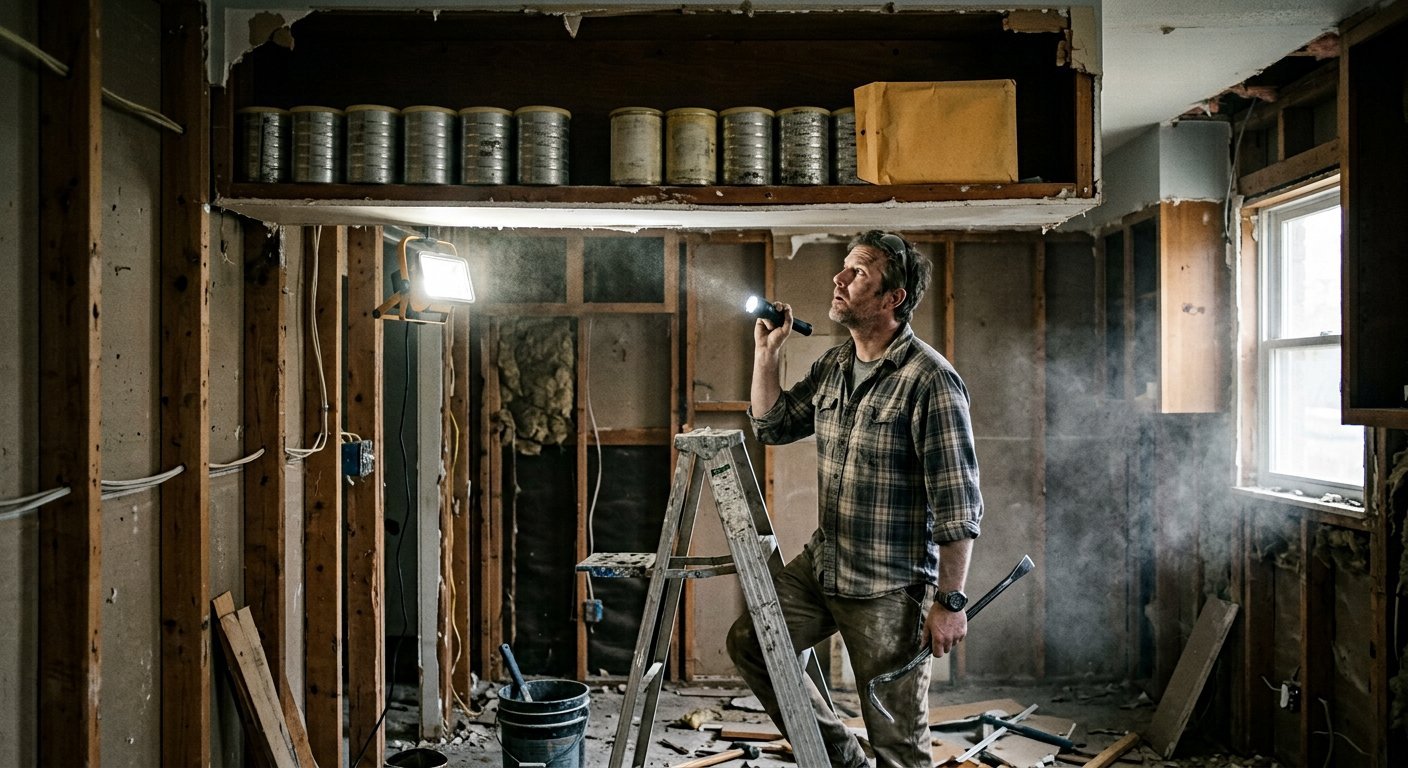
Three days into gutting the kitchen of a house I’d bought to flip in Greensboro, North Carolina, I climbed the ladder to knock out the bulkhead soffit above the cabinets — and that’s where the whole job came to a dead stop.
The place had belonged to an old widower who’d lived there alone for decades before he died, every room frozen somewhere around 1985. Harvest gold appliances. A wall phone with a cord long enough to reach the back door. Curtains that had gone the color of weak tea.
The realtor had been upfront about it. “He never let anybody in to fix a thing,” she’d said, handing me the keys and a stack of Home Depot coupons. “Family’s scattered all over the country, nobody wanted the house. Sold it as-is just to be done with it. Whatever’s tucked away in there is your business now.”
I punched my pry bar through the drywall of that soffit, expecting dead wiring and mouse nests.
My flashlight caught something instead — a row of coffee cans and a fat envelope, lined up neat on the top plate of the wall, set up there by a man who’d have needed a ladder of his own to reach them. He’d sealed them inside the ceiling and cooked his dinner under them every night for thirty years.
I reached in and lifted the first can down, lighter than I expected, and when I pried the plastic lid off and looked inside, I nearly came off that ladder, because it was full of teeth.
Baby teeth. Dozens of them, small and yellowed, rattling around loose in a 1970s Maxwell House can.
I want to tell you I handled that with composure. I did not. I got down that ladder faster than I’ve moved in a decade and stood in the middle of that kitchen with my heart going like a hammer drill, doing the math that anybody would do, which is: eleven cans. A man who lived alone. Nobody allowed inside for thirty years.
I called the police.
I’m not embarrassed about that and I’d do it again. Two officers came out, and then a sergeant, and by four in the afternoon there was a forensic tech in my gutted kitchen with the eleven cans lined up on a folding table.
She was maybe thirty, with a very calm way about her, and she went through them one at a time while I stood in the doorway feeling my stomach go up and down like a boat.
Can one: teeth. Human, deciduous, she said — baby teeth — and from the wear patterns, more than one child.
Can two: hair. Locks of it, each one tied with a bit of thread, some blonde, some brown, some so fine it had to be from an infant.
Can three: hospital bracelets. The little plastic ones they snap on a newborn’s ankle.
By then the sergeant had stopped taking notes and was just watching her hands.
Can four was where it turned, and I remember the exact moment because the tech let out a breath and sat back on her heels.
Can four was full of paper. Folded receipts, ticket stubs, a hospital wristband for an adult, and on top, a photograph of a woman in a floral dress holding a baby on a front step — that same front step, the concrete one I’d been tracking mud across for three days.
She turned it over. On the back, in ballpoint:
Ruth & Danny, June 1961. First one home.
Eleven cans. Here’s what was in them, in the order he’d put them up there, because he had — and this is the part that undid me — he had numbered them on the bottom with a marker.
1 baby teeth (4 children) 2 hair, tied with thread 3 hospital ID bracelets, 1961-1969 4 photographs & papers — Ruth 5 photographs & papers — the children 6 school report cards, 1966-1981 7 drawings, folded small 8 letters, unsent 9 letters, returned unopened 10 wedding rings (2), watch, locket 11 empty
Can eleven was empty. Lid on. Numbered. Waiting.
The fat envelope had his will in it, a handwritten one from 1994, and a bank passbook, and a list of four names and four addresses in four states, the addresses crossed out and rewritten over the years in different pens as people moved.
His name was Wendell Pryor. He was ninety-one when he died on a Tuesday in a recliner about twelve feet from where I was standing.
His wife Ruth died in 1983. Their four children scattered, and I mean genuinely scattered — Oregon, Maine, Texas, Florida — and the family broke apart over what the police report would eventually describe, with beautiful bureaucratic understatement, as “a dispute regarding the mother’s estate.”
What actually happened was uglier and dumber, the way these things are. There’d been a fight at the funeral about a piece of land. Words were said by people who were out of their minds with grief. Two of the four stopped speaking to their father entirely. The other two tapered off over about a decade the way you do when every phone call is heavy.
Can nine. Letters returned unopened. There were thirty-one of them.
Can eight. Letters he wrote and never sent, because after enough came back, you stop putting stamps on them. There were more than two hundred.
He kept writing them. That’s the thing. Thirty years, a man alone in a frozen house, writing letters to four people who wouldn’t open them, and then climbing a ladder in his own kitchen to put them in a coffee can inside the ceiling.
Why the ceiling? The lawyer I eventually talked to had a theory that I think is right. He didn’t hide them because he was ashamed. He put them where a house gets taken apart. A man who worked construction his whole life knows exactly one thing about kitchens: eventually somebody knocks out the soffit.
He wasn’t hiding it. He was mailing it. He just used a building instead of a post office, and thirty years instead of three days.
The will was three paragraphs and it held up, more or less, though it took a probate attorney and eight months to sort out because I’d already bought the house from an estate that had been settled on the assumption there was nothing in it.
The passbook had $61,000 in it. A man who never fixed a faucet, never replaced an appliance, never let a soul in the door.
The will split it four ways.
And the last paragraph, which I have a photocopy of because the attorney gave me one, said this:
“To whoever is holding this: I am sorry for the mess and for the ladder. The cans are not mine, they were only ever in my keeping. Please see that they go to the names on the list. If the names have gone too, then throw the whole business in the dumpster with the rest of the kitchen and think nothing of it. I have made my peace with either outcome, though I confess I have made it better with one than the other.”
Three of the four were alive.
The eldest, Danny — the baby on the step in June of 1961 — had died in 2011. His daughter Renata, in Portland, was the first person I got on the phone.
I have made a lot of phone calls in twenty years of flipping houses. That one took me three tries to get through because I kept starting with the wrong sentence.
She thought it was a scam for the first ninety seconds. Then she went quiet, and then she said, “He kept our teeth?”
They came in October. All three surviving children — two brothers and a sister, in their sixties and seventies now — and Renata, and two grandchildren nobody in that house had ever met.
I hadn’t finished the flip. I’d stopped work entirely, actually, which cost me a carrying month I couldn’t really afford. But it felt obscene to put new cabinets in before they’d stood in that kitchen.
They sat on the subfloor, because there was no furniture, and they opened the cans one at a time.
I left. I went and sat in my truck for two hours. It was not mine to watch.
When I came back in, the sister — her name is Paulette, she’s seventy-four, she was the one who’d sent back the most letters — was sitting against the wall holding can seven, the folded drawings, and she looked up at me and said, “I made this one. I was six. I don’t remember making it and I remember making it, both at once. Does that make sense?”
I said it did.
She said, “I sent back thirty-one letters. He answered every one of them anyway. He just answered them into a can.”
I finished the house in February. Sold it in April, for less than I’d projected, because eight months of carrying costs on a flip will do that to you. I made about four thousand dollars, which for that job is a loss when you count the labor.
The family offered to pay me out of the estate. I turned it down, and then Paulette went behind my back and had a check sent anyway, and I cashed it, because I’ve learned a few things about what it costs people to be allowed to give you something.
Can eleven — the empty one — is on the shelf in my shop over the miter saw.
Paulette gave it to me. She said her father clearly meant to keep going and ran out of time, and that I should have it, and I said that was too much, and she said, “It’s an empty coffee can, sweetheart. Take the can.”
I’ve put a few things in it. My daughter’s kindergarten graduation program. A key to a house I don’t own anymore. It’s not full and I hope it doesn’t get full for a long while.
But here’s what I actually took from that job, and it’s changed how I work, which I did not expect from a soffit.
Every house I gut now, I go slower on the demo. Not for the money — you don’t find $61,000 in a ceiling twice in a lifetime. I go slow because Wendell Pryor spent thirty years quietly betting that somebody someday would be careful enough with his house to find what he’d left in it.
He was right. Barely. I’d swung that pry bar a foot to the left, I’d have put it through can four and never known.
So now I look before I swing. That’s the whole thing. That’s what I got out of it.
You never know what a man has been keeping in the dark above his own dinner.