Four days before Thanksgiving, my mother called with a new rule. “No children this year,” she said, the way she announced all of her rules, as if the decision had already been made and my only job was to agree. “We want a quiet dinner. Just the adults.”
I stood in my kitchen with the phone against my ear and felt the old machinery start up again, the part of me that had spent a lifetime doing what a good son does. Agree. Accommodate. Apologize. So that is what I did. I said of course, Mom, no problem, and I hung up, and I started calling babysitters.
My son is eight. His name is Leo, and he is the best thing I have ever done, and he had been talking about Thanksgiving at Grandma’s for weeks. He wanted to show his cousins the dinosaur he got for his birthday — a green T-rex with a mouth that opens, the kind of thing an eight-year-old carries everywhere for six months and then forgets about forever. I told him the night before that there had been a change of plans. I told him Daddy would be back before bedtime. I apologized the whole way to the car, and he just nodded, the way kids nod when they are deciding whether to be sad, and when I pulled out of the driveway he was at the window, waving, the dinosaur under his arm.
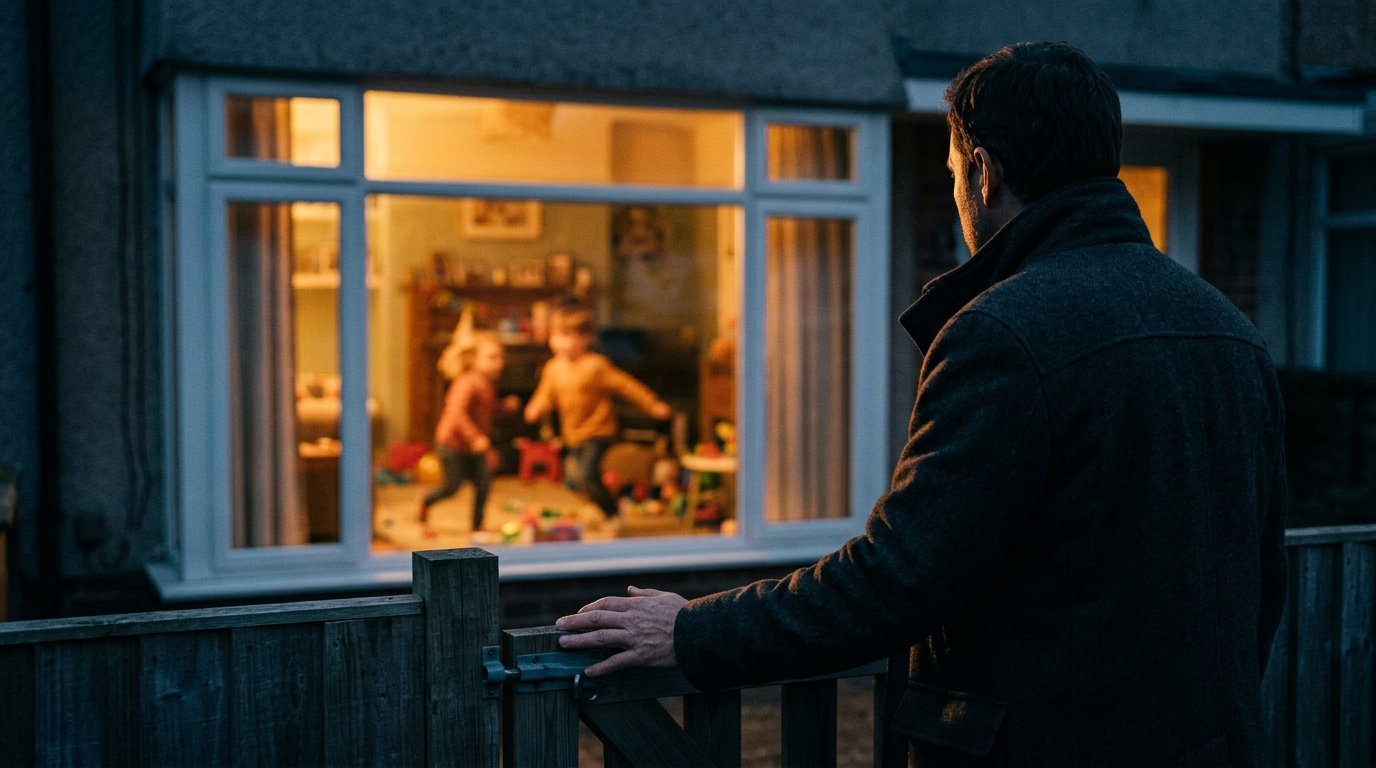
I could hear them before I even opened my parents’ gate. Children. Shrieking. The sound hit me like a bucket of cold water, and I stopped with my hand on the latch, because I knew that sound. I knew those voices. My sister’s three kids were racing around the living room like it was a playground, toys scattered across the carpet, one of them shrieking with laughter as he jumped off the couch. The house my mother had just declared a child-free zone was full of children. Full of my sister’s children.
My mother hugged my sister first, the way she always did, and then she looked at me — and I will never forget this, not if I live to be a hundred — she looked at the empty space where my son should have been, and she did not flinch. Not a flicker of guilt. Not a word of explanation. Just a glance at the space beside me, and then her eyes back on me, clean and calm, like I had simply failed to bring a side dish.
“Her kids know how to behave,” my mother said. “Yours doesn’t.”
That was it. That was the whole explanation. My son — my quiet, gentle, dinosaur-carrying son — was too much for her quiet dinner, while my sister’s three tornadoes turned her living room into a war zone six feet away. And I understood, standing there in my coat with the cold still on my cheeks, that this had never been about behavior. It had never been about noise. It had been about the same thing it had always been about, for thirty-three years.
“Her kids know how to behave,” Mom said. “Yours doesn’t.”
Let me tell you what thirty-three years looks like. It looks like pizza after my high school graduation, while my sister got balloons and a cake and a rented hall. It looks like being called “the independent one” so often that I started to believe it was a compliment, when really it was their way of giving me less — less attention, less help, less money, less love — and dressing the subtraction up as respect. It looks like every birthday where her gift was wrapped and mine was in a bag, every holiday where the conversation turned to her achievements while mine were nodded at and moved past. I had spent thirty-three years being the one who understood, the one who didn’t need anything, the one who was easy. And I had been rewarded for it with a mother who looked at the empty space where my son should have been and felt nothing at all.
Not anymore, I thought. Not with my son.
I did not make a scene. That is not who I am, and besides, a scene would have given them exactly what they wanted — proof that I was the difficult one, the dramatic one, the one who couldn’t be reasonable about a simple request for a quiet dinner. So I did something quieter, and in its way, louder. I picked up my coat, which I had never even taken off, and I said, “I hope you have a lovely, quiet dinner.” And I said it sincerely. That was the part that surprised me. I meant it. I wanted them to have the dinner they wanted, the dinner without us in it. Because I finally understood that I wanted a dinner without them in it, too.
I drove home. The roads were quiet, the way they are on a holiday weekend afternoon, and I let myself feel it — all of it, the grief and the relief tangled together. When I got home, Leo was still awake, which I had expected, and he was still holding the dinosaur, which I had also expected. He asked me how Grandma’s was, and I told him the truth, in the way you tell an eight-year-old the truth. I said it was loud, and that I missed him, and that we were going to have our own Thanksgiving this year. His face did something complicated — a little sad, a little curious — and then he said, “Can we have macaroni and cheese?” And I said yes. And just like that, the first brick of a new life was laid.
I never went back. Not to Thanksgiving, not to Christmas, not to any of it. I did not announce it. I did not write a letter. I simply stopped showing up, and I stopped answering the phone on Sunday afternoons, and I let the space where I used to stand close over, like water over a stone. There were moments when the old machinery kicked in, when guilt rose up and told me I was being cruel, that a good son would forgive, that family is family. And every time, I looked at Leo, and I asked myself a single question: what do I want him to learn from this? That love is something you beg for? That a seat at the table is something you earn by being small and quiet and grateful for scraps? No. Not from me. Not ever.
The part nobody tells you about walking away is that it does not feel like freedom at first. It feels like a door slamming in an empty house. But grief has a way of turning into something else if you let it, and a year later, in my own warm kitchen, with steam on the windows and Leo at the counter licking the spoon from the macaroni pot, I finally understood what I had done.
I had not lost my seat at their table. I had stopped begging for one — and I had built a better table of my own.
I didn’t lose my seat at their table. I stopped begging for one — and I built a better table of my own.
That table is nothing fancy. It is secondhand, and it wobbles if you lean on it, and it has a burn mark from the year Leo wanted to light the candles himself. But it is ours. Around it sits a boy who never has to wonder whether he is wanted, and a father who finally stopped measuring himself by the space other people made for him. We have our own traditions now. Macaroni and cheese at Thanksgiving, because he asked and I said yes. Pancakes burned on the first Sunday of every month. A dinosaur that still sits on the windowsill, watching over the kitchen like a small green guardian.
Sometimes, late at night, when Leo is asleep and the house is quiet — genuinely quiet, the kind of quiet you choose, not the kind that is imposed on you — I think about that afternoon. The gate. The shrieking. My mother’s calm, unblinking face. And I feel a strange thing: gratitude. Not toward her. Toward the version of me who finally put on his coat and walked out. The version of me who decided, at thirty-three, that his son would never have to earn a seat at anyone’s table.
You do not have to keep loving people who make you feel like a burden. You do not have to keep showing up for people who only notice you when you finally stop showing up. Some tables are not worth a seat at, and some mothers are not worth the apology you keep rehearsing. The day I stopped begging was the day I started building. And the table I built — wobbling, burnt, crowded with one boy and his dinosaur and a father learning to be enough — is the best table I have ever sat at.