A text story
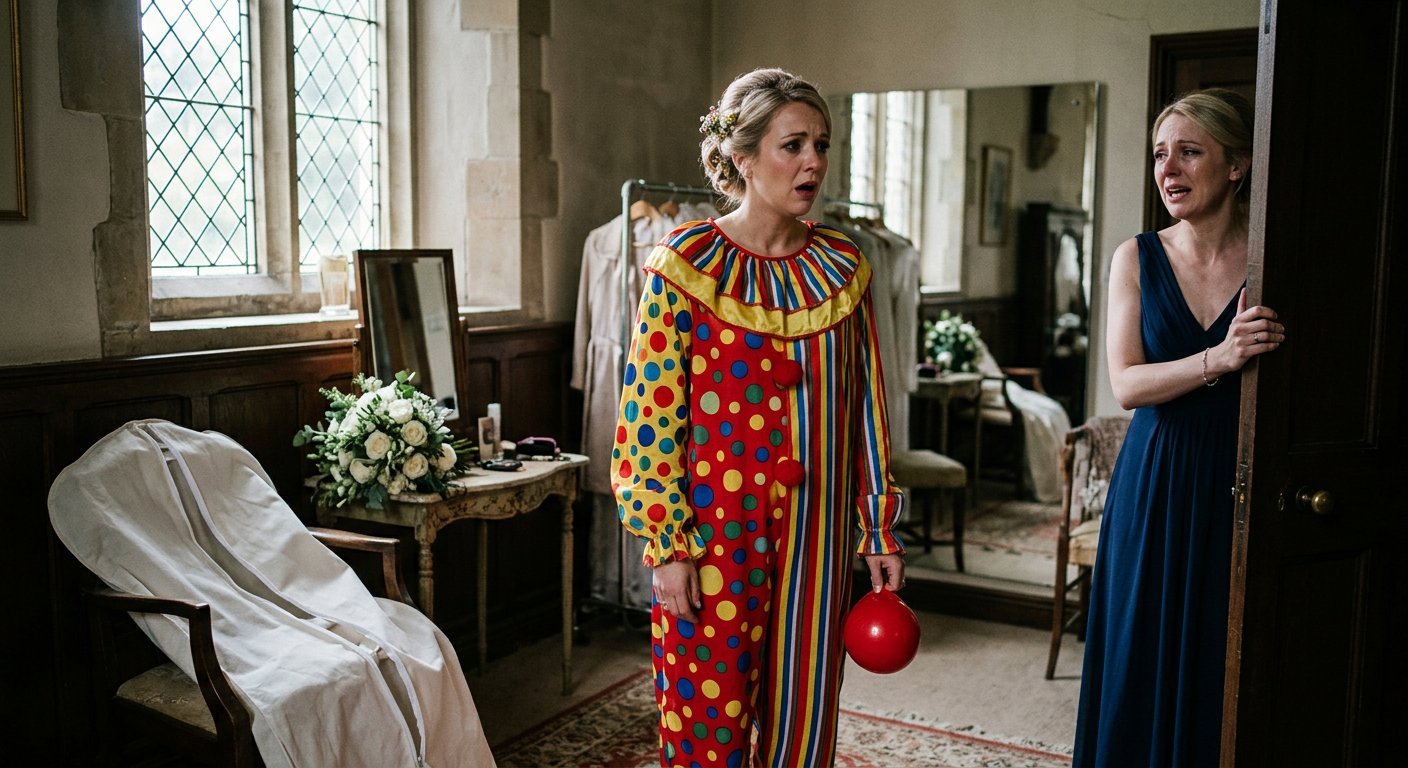
My future mother-in-law swapped out my wedding gown for a clown suit, so I decided to wear it anyway.
On the morning of my wedding I carefully unzipped the garment bag holding the dress I’d spent eight months selecting. The dress I’d budgeted for, dreamed about, imagined wearing as I walked toward Ethan.
What I found inside wasn’t a wedding gown.
It was a clown costume. Bright colors, baggy fabric, and a shiny red nose sitting in the bottom of the bag like a full stop.
My maid of honor Olivia stood frozen beside me. “What is that?”
For several moments I simply stared at it.
Then I burst out laughing.
Because I knew exactly who was responsible. Victoria Montgomery — the woman who’d spent a year working on Ethan, who’d told me at a Thanksgiving table that I “read as regional,” who believed I’d somehow damage a surname attached to a plumbing supply fortune from Delaware.
She thought a clown suit would send me running. She thought I’d cry, panic, call it off, and prove every single thing she’d been telling her son about me for eleven months.
So I put it on.
I want to be honest about the laughing, because it’s the load-bearing detail and everyone gets it wrong.
It wasn’t defiance. It was the specific hysterical laugh of a woman who has been managing an unwinnable situation for a year and has just been handed proof that she wasn’t imagining it. For eleven months I’d been told I was sensitive. That Mom’s a lot but she means well. That I was reading into things.
And here was a clown suit. In a garment bag. Unambiguous.
I laughed because I’d been right, and being right felt so good that I made a decision in about ninety seconds that I would spend the next four years unpacking.
Olivia said, “We can fix this. My cousin has a bridal shop in Newark, we can be there and back in two hours, we push the ceremony to four.”
And I said no. I said: I’m wearing it.
Because I could already see it. I could see Victoria’s face. I could see the guests’ faces. I could see the story getting told at every Montgomery gathering for thirty years — remember when Vic tried it on with Nora and Nora walked down the aisle in the clown suit. I could see myself winning, permanently, in front of two hundred people.
I put on the suit. I put on the nose. Olivia did my hair up properly, which somehow made it worse, and we stood in that room and laughed until we couldn’t breathe.
Then Ethan’s sister Margaux knocked on the door.
Margaux Montgomery is thirty-eight and I had understood her at that point as cold and slightly bored, which is what I’d been told to understand.
She came in, looked at me, looked at the garment bag, and went the color of the wall.
She said, “Where did you get that.”
I said her mother had put it there, obviously, and I was going to wear it, and she should tell her mother to make sure she had a good seat.
And Margaux said: “Nora, my mother didn’t do this. That’s my costume. That’s my costume from 2004 and it’s been in the attic in Wilmington for twenty-one years and there are four people alive who know it exists.”
Here’s what I learned in that room in the eleven minutes before I was supposed to walk down an aisle.
In 2003, Margaux was seventeen and she wanted to go to circus school. Not as a joke — there’s a real one, in Montreal, and she’d been doing aerial silks for six years and had been invited to audition.
Victoria said no. Victoria said it in a way that ended it, and Margaux went to Penn and then into the family company and has been the CFO of a plumbing supply concern for fourteen years.
She kept the costume from her last student showcase. In a garment bag. In an attic.
And in April of that year — two months before my wedding — Victoria Montgomery had a fall, and then a scan, and was diagnosed with a glioma, and had not told anyone except her daughter, and had spent the eight weeks since doing a series of things that everyone in that family had been quietly filing under Mom being difficult.
She’d rewritten a will. She’d sold a car for nothing. She’d called Ethan’s ex-girlfriend.
And on the Thursday before the wedding she’d driven to Wilmington alone, gone up into the attic, taken her daughter’s twenty-one-year-old costume out of a bag, brought it back, and swapped it for my dress.
Margaux said, “She isn’t trying to humiliate you. She doesn’t have the sequencing for that anymore.” She was crying by then and furious about crying. “Nora, if you walk out there in that, you’re not going to humiliate my mother. You’re going to humiliate a sick woman in front of two hundred people who don’t know she’s sick, and I am going to have to watch, and so is my brother.”
I stood there in a clown suit and understood that I had been about thirty seconds from doing the worst thing I have ever done.
And here’s the part I make myself say: I hadn’t wanted justice. I’d wanted an audience.
Everything I’d imagined in those ninety minutes had a crowd in it. Not one frame of it involved Victoria and me in a room alone. That’s how I know what it actually was.
I’d been handed a year’s worth of vindication and I’d immediately started planning how to spend it publicly.
The dress was in the trunk of Victoria’s car in the church lot, in a Hertz rental she’d hired because her own car was gone, folded, not damaged. She had no clear account of how it got there. She had a lot of clear accounts of 1987.
We were fifty minutes late. Olivia told two hundred people it was a zipper.
I got married in my own dress with my hair falling down because we’d redone it twice.
And in the receiving line Victoria Montgomery took both my hands and said, with total warmth and total conviction:
“You’re the one Ethan brought to the lake house. I remember. You didn’t take your shoes off in the water — you were the only one who asked first.”
That happened in 2019. It was the first weekend I ever met her, and she was, that day, generous and funny and interested, and then something turned in her about six months later and I spent four years believing I’d done something.
She died in the following February.
Now — I’ve told this story out loud maybe five times, and there’s always somebody who says so she was never cruel, it was the tumor all along.
That’s not true and I won’t have it.
The tumor was eight weeks. The eleven months before it were a woman who genuinely thought her son had married beneath the family, and who said so, repeatedly, in language she chose. “Regional.” A snowman ornament at Christmas when everyone else got jewelry. The seating chart in Cape May.
All of that was Victoria, sober and well and deliberate. I’ve had to hold both things at once, and it took a therapist and about two years: she was unkind to me for a year, and then she got sick, and the sickness didn’t cancel the year, and the year didn’t make her deserve the sickness.
People want one or the other. You don’t get one or the other.
What I have from it.
Margaux. She was my maid of honor’s equivalent at nothing and now she’s the person I call. We speak weekly. She knocked on that door and stopped me and she did it for her mother, but she saved me too and she knows it and she has never once said so.
The suit. I have it. Margaux gave it to me the week after the funeral, in the same garment bag, and said, “You should have it. You’re the only person in this family who ever wanted to wear it.”
What we did with it. This is the part I actually like. Margaux and I put four thousand dollars into a small annual thing at a community arts center in Wilmington — one kid, one year of circus arts tuition, application is three sentences long. It’s called the Montgomery Award, which was Margaux’s decision and which she made with a completely straight face.
Two recipients so far. The second one, a fifteen-year-old named Delphine, sent a photograph in June of herself six feet off the ground on a silk.
THE MONTGOMERY AWARD one year, circus arts tuition Wilmington Community Arts Ctr. est. 2026, in memory of VICTORIA MONTGOMERY “who said no” – inscription, as submitted by M. Montgomery, and approved without comment by the board
The nose is on a shelf in our hallway. Ethan puts it on the newel post sometimes and I put it back and neither of us has ever discussed it.
People ask what I’d have done if Margaux hadn’t knocked, and I always say the same thing, which is the truest sentence I’ve got out of any of this:
I’d have walked out there in that suit, and it would have been the funniest thing that ever happened at a Montgomery wedding, and I would have been telling it for the rest of my life, and it would have been a story about the day I won.
Instead I was fifty minutes late because of a zipper.
Nobody tells that one. There’s nothing in it.
That’s how I know it was the right one.