Part 1
My sister gave me the ugliest dress at her wedding. Then the groom’s grandmother took my hand.
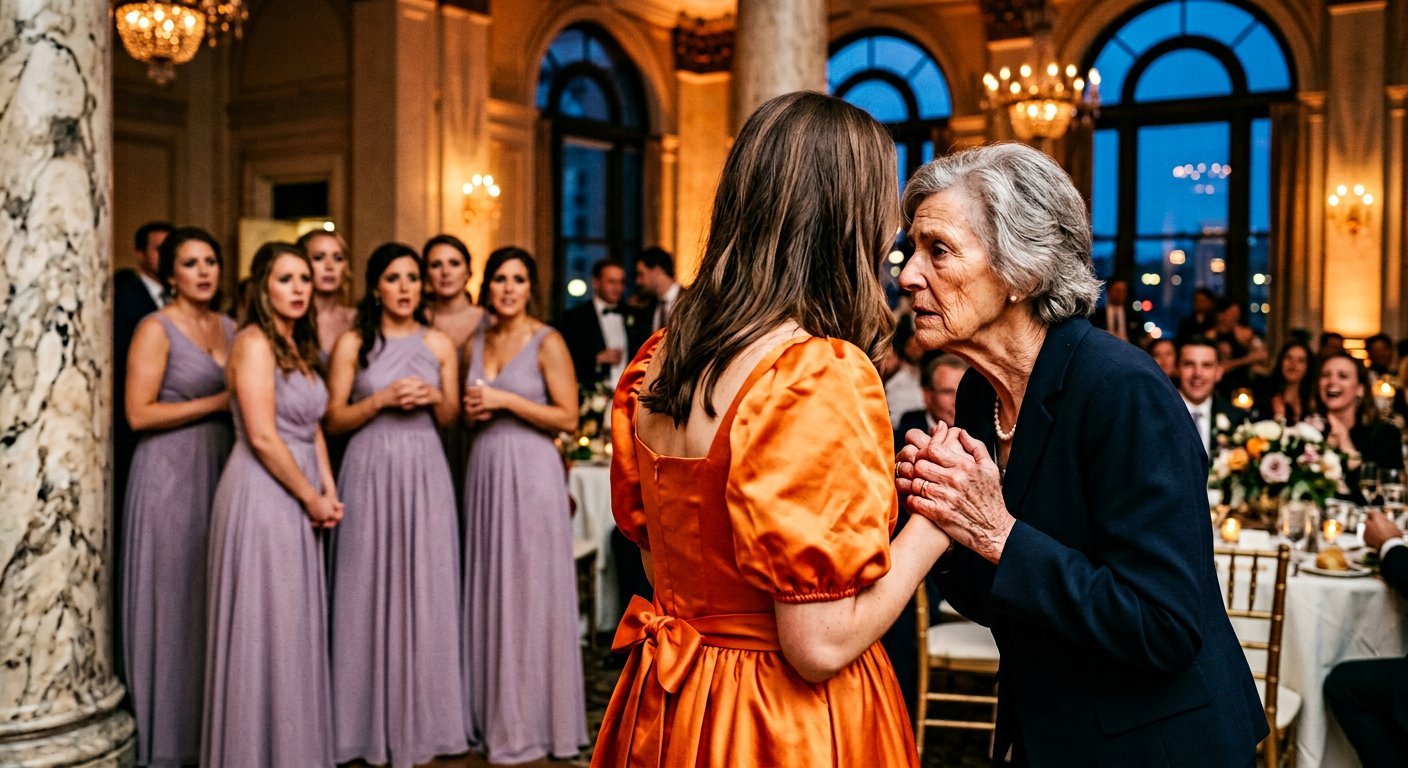
All seven bridesmaids wore elegant lavender gowns. I was given a bright-orange, size 2XL dress.
“It was the only one left,” my sister smiled.
When I protested, my parents told me to stop being dramatic.
Then, during the reception, the groom’s grandmother walked straight toward me.
She took my hand, looked into my eyes, and whispered six words:
“You are the engineer, aren’t you?”
My heart stopped.
Then my mother dragged me behind a marble column.
What she confessed next changed everything.
And it made my sister leave her own wedding.
Part 2
My mother’s grip on my wrist was the grip she used when I was twelve and about to touch a hot stove. She pulled me out of the sightline of two hundred guests, into the cold shadow of the marble, and said, “Don’t say her name. Don’t say his. Listen to me.”
Behind us the string quartet kept playing. Through the gap between the column and the wall I could see Chloe watching us, one hand on her bouquet, doing the math on how this would look in the photographs.
“I’m listening,” I said, in the voice that gets called dramatic.
“I knew his name,” she said. “Before the engagement party. I googled him the week Chloe brought him home, the way I google anyone, and I found the docket. I saw his signature on the reports, and I saw your memos in the same file. I told myself names are common. I told myself that for eleven months.”
Eleven months. The number landed on me like a step missed in the dark. Because eleven months ago was not when the balcony fell. It was when Chloe first brought Brandon to Sunday dinner, and he carved the chicken, and I thought his face was familiar the way a waiter’s face is familiar — and I let it go. I had been in the room with him. I had shaken his hand. The docket held my memos and his signature, and the two of them had passed each other across my mother’s table with the potatoes.
“He put thirty-eight thousand dollars down on this room,” my mother said. “Your father’s company still holds two contracts with his family’s firm. When I looked at that docket, I didn’t see a crime, Maya. I saw a roof. We needed you to be wrong. That is what dramatic meant. It meant: we needed you to be wrong.”
There it was. Not that I was too much. That they had needed me to be less.
Then the light shifted, and the groom’s grandmother was standing on the far side of the column with a canvas tote, held the way some women hold a purse and the way she, I would learn, had held it through four years of hearing rooms. Mrs. Galloway. I knew her face from the same docket my mother had found. Exhibit list, page nine: victim impact statement, E. Galloway, deceased, represented by her grandmother.
“You are the engineer, aren’t you,” she said again, out loud this time. “Six words. I practiced them in the car.”
She set the tote on a champagne cooler and opened it.
ENGINEERING MEMOS — M. REED, PROJECT ENGINEER CORBIN POINT TOWER, BALCONY SYSTEM MEMO 01 03 MAR 2021 REBAR SPACING, LEVELS 9-12 MEMO 02 22 MAR 2021 CONCRETE CURE TIMES, WINTER POURS MEMO 03 09 APR 2021 REQUEST: INDEPENDENT LOAD TEST SIGNATURE ON FINAL REPORT: WITHHELD REPLACEMENT SIGNATORY: B. HALE, 41 REPORTS
“Forty-one reports,” she said. “His signature on every one. The state reopened the file last month because of a crack on the ninth floor that keeps growing. My lawyer says a witness who wrote three memos and refused to sign is worth more than anything I own.” She put a single photograph on top of the stack: a girl in a graduation gown, squinting into sun. “But I didn’t come for the file. I came so you would know the memos get read. Every year, on the hearing date, I read your memos. You were the only one who wrote it down.”
I should have felt tall. Instead I heard my own voice say, “I took the settlement.” Sixty thousand dollars and a confidentiality clause, signed at twenty-six, in a conference room with a view I couldn’t see. “Eleven months after I signed, the balcony fell. I was quiet and a girl died, and I have done the arithmetic every year since.”
Mrs. Galloway didn’t blink. “You were twenty-six. They had a building and a law firm, and you had a car payment. You wrote it down. That is the part I keep.”
She said it the way priests say things, without needing to be believed. I loved her a little for it. I hated the room a little less.
We walked back into the reception three abreast: the grandmother, the mother, and the bridesmaid in orange. I handed my sister one page — the signature page, and under it the photograph of the girl in the graduation gown. Chloe read it twice. She looked at Brandon laughing with his best man near the cake, and then she looked at me, and I watched the math rearrange her whole face, the way a level line rearranges a wall.
She took the veil off first. Then the ring. She left through the kitchen in lavender, carrying her own shoes.
She didn’t look at our parents on the way out. She had learned, in the last thirty seconds, which of us had been doing the looking and which had been doing the not-looking, and she was done being the one who didn’t.
Part 3
The state board reopened the Corbin Point file on a Tuesday. I know because I was in the room when the vote was read, sitting between Mrs. Galloway and a court reporter who kept mispronouncing my name until the grandmother corrected her, twice, gently, like tuning an instrument. By spring the order listed: 212 units inspected, nine balconies shored, one stop-work notice, and B. Hale, licensed engineer, suspended pending a hearing he will not enjoy. His family’s firm paid for the shoring. The hotel ballroom with the marble columns was quietly renamed.
On the courthouse steps afterward, Mrs. Galloway took my hand one more time and said a seventh word: “Thank you.”
My first act as a witness was to break the confidentiality clause I had signed at twenty-six. Our lawyer quoted the penalty; I wrote the check anyway.
SETTLEMENT RETURN — ITEMIZED PRINCIPAL, SIGNED 2021 ………. $60,000.00 INTEREST, 5 YRS @ 4.6% SIMPLE … $13,800.00 TOTAL RETURNED TO FIRM ………. $73,800.00 MEMO LINE: “FOR THE RECORD”
Mrs. Galloway offered to lend me the difference. I said no. Quiet had cost sixty thousand; it should cost me that much to unbuy it.
My father lost both contracts in the same season the file reopened. He told me at the diner, without looking up from his eggs, the way he delivers weather. Then, at the end, he said, “I’d lose them again.” A pause. “I’d lose them earlier.” That was the apology. I took it the way you take a handrail that’s a little loose: gratefully, and holding on anyway.
He paid for the eggs. He always pays for the eggs. It is the only liturgy we have left, and we keep it.
My mother and I did not hug for a while. What we did was read. Sundays, at my table, she read the docket’s questions and I read the answers, two people learning a language we should have spoken years earlier. One Sunday she said we needed you to be wrong out loud, unprompted, and then said I’m sorry in the same breath, like two halves of one sentence. I believed both halves. She brings tulips when the docket gets hard and doesn’t mention them; I put them in the good glass and don’t mention them either.
Chloe did not speak to me for five months. Then a text: I told him to leave the apartment. I kept the cat. The cat’s name is Beam. She named him after a load-bearing wall, Chloe says, because he holds the apartment up. I laughed at that alone in my kitchen, longer than I expected to.
Then, in March, on the hearing date, a box at my door: the orange dress, dry-cleaned, tissue-stuffed, with a note folded into the bodice.
I ordered it two sizes too big on purpose. That is the ugliest thing I have ever done, and I have done some things. I don’t need an answer. I needed you to have it back. — C.
I haven’t answered the dress yet. I will. It hangs in my closet with the tag still pinned where the alterations never happened, bright as a flare, and some mornings I look at it the way you look at a crack that kept growing until someone finally measured it.
Some people keep a wedding photo. I keep a signature page.
Mrs. Galloway sends me a card every March, on the hearing date. She signs them “to the engineer.” I keep them all.