The House He Never Owned
The morning Daniel gave me six hours to disappear, sunlight lay across the kitchen floor in long golden bars, catching the dust that drifted above our son’s abandoned cereal bowl.
It was such an ordinary kind of beauty that, for one confused second, I thought I had misunderstood him.
“Say that again,” I said.
Daniel stood beside the marble island, still wearing the navy suit he used for important meetings. His car keys rested in one palm. He rolled them over and over, making a soft metallic scrape that I had learned to recognize as a warning.
“My parents are moving in tonight,” he said. “You will pack your things, take Eli, and be gone before six.”
I looked toward the hall. Our eight-year-old son had gone quiet in the den. The cartoon on television kept chattering, too bright and cheerful for the room.
“Your parents are visiting?”
“Moving in.” Daniel gave a short, impatient laugh. “This is my house, Lauren. I decide who lives here.”
The kitchen seemed to contract around me. “And where do you expect your wife and child to go?”
“That isn’t my problem.” He leaned closer, his aftershave sharp in my throat. “You have no say here.”
For six years, I had measured Daniel’s temper the way people measure a rising river. I knew the warning signs: the tightening jaw, the clipped syllables, the sudden stillness before the flood. I had convinced myself that anger was not danger as long as he never struck me. I had ignored the cabinet doors torn from their hinges, the glass shattered beside my head, the bruises on my wrist that he called proof I was dramatic.
That morning, something inside me became very quiet.
“All right,” I said.
He blinked. He had expected pleading. I could see it in the little lift at the corner of his mouth.
“Six hours,” he repeated, pleased with himself. “Don’t make this ugly.”
Then he picked up his briefcase and left.
I waited until the garage door groaned shut. My hands began to shake so violently that I had to grip the edge of the counter. From the den came a small voice.
“Mom?”
Eli stood in the doorway in dinosaur pajamas, his dark hair sticking up at the crown. He was trying to look brave, and that hurt more than anything Daniel had said.
I crossed the room and knelt before him. “Go put on your blue jeans and your green sweatshirt. Pack your school backpack with three things you love most.”
“Are we going somewhere?”
“Yes.” I smoothed his hair. “Somewhere safe.”
He studied my face and did not ask another question.
Upstairs, I pulled a canvas folder from beneath the winter blankets in the linen closet. It held Eli’s birth certificate, our passports, bank records, photographs of broken doors, printed messages, and the original deed to the house.
The deed bore one name.
Mine.
My grandmother Ruth had left me the house two years before I met Daniel. Back then it was a faded bungalow with green carpet and pipes that coughed rust. I had spent every weekend for three years restoring it with my mother. We sanded the oak floors on our knees, painted the kitchen twice because the first yellow looked “too much like mustard,” and planted the maple tree by the porch.
When Daniel and I married, he moved in with two suitcases and big plans. Gradually, he began calling it our house, then his investment, and finally simply his. I stopped correcting him because every correction cost me a night of shouting.
But I had never placed him on the deed.
And three weeks earlier, after he punched a hole through Eli’s bedroom door because a toy blocked the hallway, I had finally called an attorney.
Her name was Priya Shah. Her first words to me had not been about property or divorce.
“Are you safe enough to speak?” she had asked.
No one had asked me that before. I had gone into the laundry room, sat on a basket of towels, and cried without making a sound.
Priya helped me build a plan. I opened a bank account. I documented the damage. I arranged a temporary apartment near Eli’s school. Most of all, I stopped hoping Daniel would become the man he pretended to be at dinner parties.
I had thought I would need another week.
Daniel’s six-hour deadline made the decision for me.
I called Priya.
“He ordered us out,” I said.
“Did he threaten you?”
I repeated his words. I told her his parents were arriving that evening.
There was a pause, then the brisk sound of pages turning. “Lauren, the expedited closing documents came through this morning. The buyers can sign today if you’re certain.”
I looked around my grandmother’s kitchen. For years, I had believed saving the house meant saving the life inside it. Now I understood that a house could be both shelter and cage.
“I’m certain.”
The next five hours moved with the strange clarity of an emergency.
My mother arrived first. At sixty-eight, she was five feet two inches tall and afraid of almost nothing. She took one look at me, wrapped both arms around my shoulders, and whispered, “You do not have to be strong every minute. Just long enough to get through the next one.”
Then came Priya, a locksmith, a court-approved property inventory service, and two moving crews. The buyers, the Alvarez family, agreed through their agent to take possession immediately after the electronic closing. They had sold their old home and had been living out of a hotel with three children and a sleepy golden retriever. They knew only that the seller needed a fast, private transfer.
We separated everything carefully. My belongings and Eli’s went to the new apartment. Daniel’s clothes, tools, golf clubs, and boxes were photographed, labeled, and moved to a climate-controlled storage unit paid through the end of the month. Priya taped the access documents and formal notices inside a bright red envelope.
Every few minutes, I expected Daniel’s car to turn into the drive.
Eli sat on the porch steps with my mother, drawing our maple tree in a spiral notebook. When his bed frame came through the front door, he looked up at me.
“Is Dad mad at me?” he asked.
The question nearly folded me in half.
“No, sweetheart.” I sat beside him. “None of this is because of you. Grown-ups are responsible for what they say and do. Your father made choices, and I’m making choices to keep us safe.”
“Will he know where we live?”
“Not yet.”
His shoulders loosened by the smallest degree.
At four thirty-seven, I signed the last page on Priya’s tablet. The house passed from my hands with a soft electronic chime.
I expected grief. Instead, I felt the first clean breath I had taken in years.
The Alvarezes arrived just after five. Their children rushed through the empty rooms, calling dibs on bedrooms while their dog skidded across the polished floor. Mrs. Alvarez stopped in the kitchen and pressed her fingertips to the counter.
“It feels loved,” she said.
“It was,” I answered. And that was true. Love had lived there. It simply was not the same thing as ownership, and it had never required me to remain afraid.
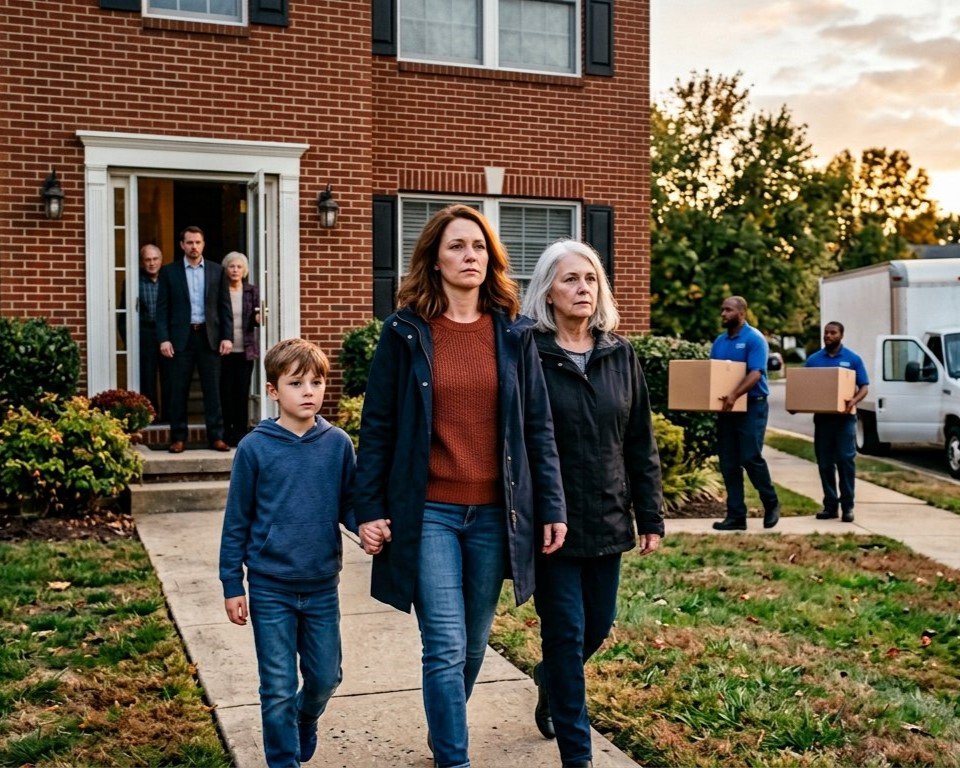
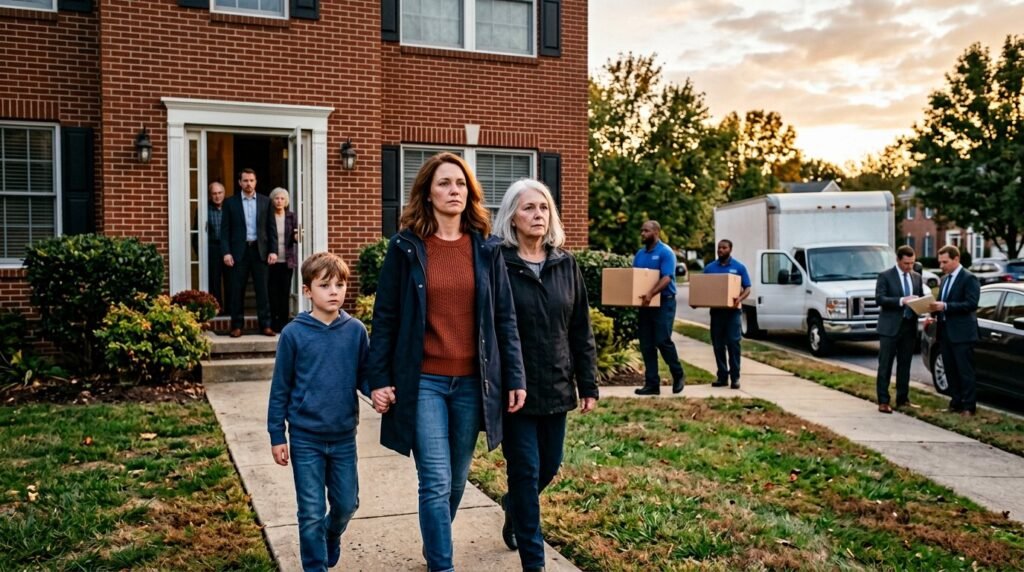
Priya wanted us gone before Daniel returned. We had almost reached my mother’s car when a black sedan swept into the drive, followed by a rented moving truck.
Daniel climbed out smiling. His father emerged from the passenger side, and his mother waved from the back seat as if arriving at a resort.
Daniel’s smile vanished when he saw the Alvarez children through the front window.
“What is this?” he demanded.
The last of his boxes rolled down the ramp on a dolly. A mover asked him to step aside. Daniel stared at the labeled carton—DANIEL: OFFICE—then at the new brass lock on the front door.
His jaw dropped.
He strode toward me. “What did you do?”
My body remembered fear before my mind did. My pulse raced; my vision narrowed. Then my mother’s hand settled between my shoulder blades, and Priya stepped beside me.
“I left,” I said. “Exactly as you ordered.”
“You sold my house?” His shout bounced off the neighboring homes. Curtains shifted in windows.
“It was never your house.”
His face darkened. “You can’t do this to me.”
Priya held out the red envelope. “Mr. Mitchell, these documents include the deed history, closing record, storage inventory, temporary protective order, and instructions for communication through counsel. Do not approach Ms. Mitchell or her son.”
He ignored her. “Lauren, tell these people to get out.”
Behind him, his mother had gone pale. His father studied the driveway as if he wished it would open beneath him.
I could feel six years of swallowed words crowding my throat. I could have humiliated him. I could have shouted every cruelty back at him while the neighbors watched.
Instead I said, quietly, “You told me I had no say. You were wrong.”
The front door opened, and Mr. Alvarez stepped onto the porch with the closing agent. He was not threatening, merely certain.
“Sir,” he said, “this is our home now.”
For once, Daniel found no one willing to rearrange reality around his anger.
Eli squeezed my fingers. “Can we go, Mom?”
“Yes,” I said. “We can.”
As we drove away, I did not look back at Daniel. I looked at the maple tree. Its leaves flashed copper in the lowering sun, and I remembered planting it as a sapling with my mother, both of us laughing because the hole was too shallow and the roots refused to fit.
“Roots need room,” she had said then, reaching for the shovel.
So did we.
Our apartment was small enough that night sounds seemed to overlap. The refrigerator hummed beside the sofa. Pipes knocked when the upstairs neighbor showered. Eli’s room held only a mattress, a lamp, and the three beloved things from his backpack: a stuffed triceratops, a photograph of us at the beach, and a jar of smooth stones.
We ate noodles from paper cartons on the floor.
“This place doesn’t have a yard,” Eli said.
“No.”
“Or stairs.”
“No.”
He considered that. “I like that I can hear you from my room.”
I put down my fork. “I’m right here.”
That night, he fell asleep with his door open.
I did not sleep. Freedom, I discovered, did not arrive as instant peace. It came with phantom footsteps in the hallway, with my hand reaching for a phone at every engine outside, with shame that whispered I should have left sooner.
Priya had warned me about that voice.
“You survived by adapting,” she said at our next meeting. “Do not punish yourself for the skills that kept you alive.”
The weeks that followed were not a triumphant montage. Daniel contested the sale, though the title was clear. He sent apologies through relatives, then accusations, then promises that he had changed. The protective order became permanent after the court reviewed his messages and the photographs I had hidden among the towels.
At the custody hearing, Daniel wore a gray suit and the wounded expression he saved for audiences. He said I had acted impulsively and poisoned Eli against him.
My knees shook under the table, but my voice did not.
I described the hole in Eli’s door. I described Daniel gripping my wrist. I described the morning he told his child to leave home as casually as he might cancel a delivery.
Then Eli’s court-appointed advocate spoke. She said he loved his father, feared his anger, and wanted any visits supervised until he felt safe.
The judge ordered counseling and supervised contact. It was not a perfect ending. It was a boundary written in ink.
Afterward, in the courthouse restroom, I locked myself in a stall and wept. My mother waited outside without asking me to hurry.
Months passed. Eli began sleeping with his door closed. I found work restoring old houses for a small design firm, a skill I had once treated as a hobby because Daniel called it “cute.” My first assignment was a neglected craftsman with water-damaged floors. The owner watched me test the boards and asked if they could be saved.
“Some can,” I said. “Some need replacing. The important thing is knowing the difference.”
On the anniversary of the day we left, my mother and I took Eli to a community garden. We planted a young maple at the edge of our assigned plot. It was no taller than he was.
Eli loosened the root ball with careful fingers. “More room?” he asked.
“More room,” I said.
We filled the hole together. The afternoon smelled of soil and rain. Around us, strangers tended tomatoes, marigolds, basil, and things newly begun. They were strangers only at first. A woman from the next plot lent us a watering can. A little boy invited Eli to inspect a ladybug. My mother sat on an overturned bucket, sunlight silvering her hair.
I had spent years thinking courage would feel like a slammed door, a perfect speech, or a moment when fear disappeared forever. I know better now.
Courage was a canvas folder hidden under blankets. It was telling the truth to an attorney. It was signing my name while my hand trembled. It was eating noodles on the floor and calling that room home. It was allowing my son to love his father without teaching him to excuse cruelty. It was choosing not revenge, but safety.
Daniel had given me six hours to pack my life.
What he never understood was that my life was not the furniture, the marble counters, or the house he claimed in a voice loud enough to drown out facts. My life was the boy holding my hand. It was my mother at my back. It was my own name on documents I had finally found the courage to read.
I pressed the last ring of earth around the sapling, stood, and looked at its thin branches reaching into the open sky.
For the first time in years, there was room for all of us to grow.