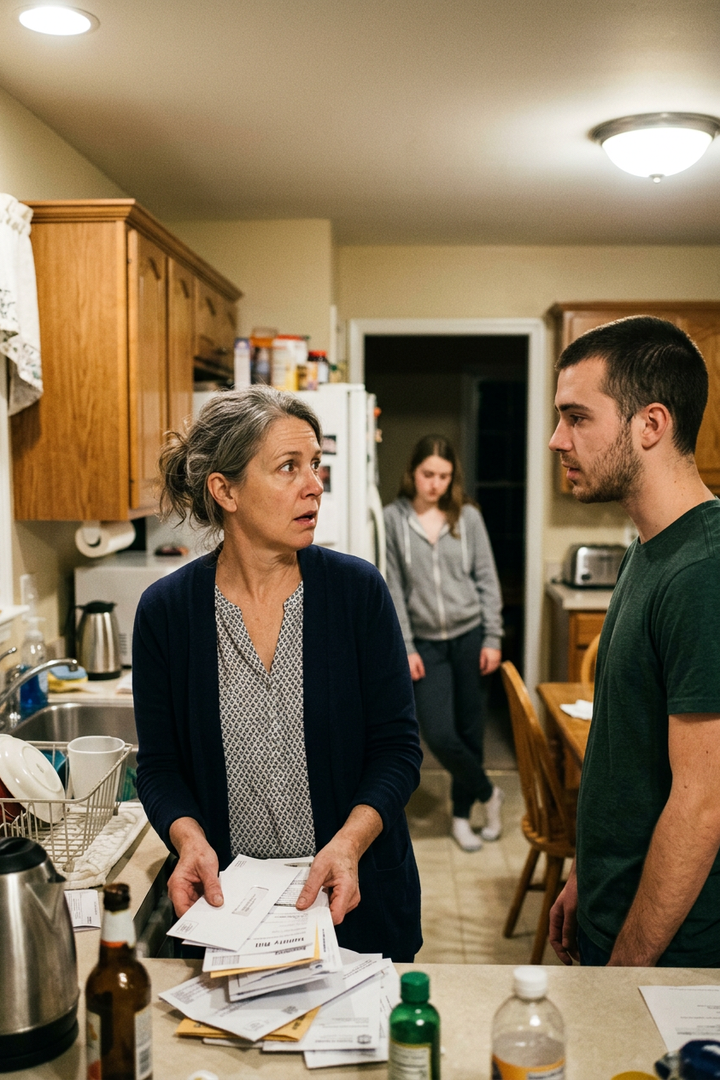
My son is twenty-two, and his girlfriend just moved in with us. Her name is Priya. She is kind, and tidy, and she laughs easily, and for the first two weeks I told myself this was going to be fine. A full house is a happy house, I said. We’d save on her rent, she’d save on groceries, we’d all sit around the table like a proper family. It would be good for everyone.
Then the bills started arriving, and the small, mean voice in the back of my head began to whisper.
I tried to be fair. I really did. I made a list in my head of everything she used — the hot water for her long showers, the extra load of laundry, the food disappearing from the fridge, the electricity for the laptop that never seemed to close. I watched the grocery total creep up at the register and the utility bill climb a little higher each month, and I felt it, that old familiar tightening in my chest. I am not a rich woman. I raised my son alone on a bookkeeper’s salary, and I have spent my whole adult life doing the math in my head, making sure the numbers add up, making sure there is enough. When you live that way for long enough, the worry becomes a part of you, a low hum under everything, and a new mouth to feed turns the hum into a roar.
I started to feel like a hotel manager. That is exactly the phrase I used, and I am not proud of it. A hotel manager. There were mornings I found dishes in the sink that I had not dirtied, and towels in the bathroom I had not used, and the feeling that my house — my house, the one I had paid for with twenty years of doing other people’s math — was quietly no longer mine. I know how ungrateful that sounds. Priya never did anything wrong. She was never rude, never lazy, never anything but lovely. But resentment does not need a villain. It only needs a quiet kitchen and a rising bill and a woman too tired to say what she really feels.
So one evening, when my son came into the kitchen while I was paying bills at the table, I finally said it. I had rehearsed it for a week, and it still came out harder than I meant. “If she’s going to live here,” I said, not looking up from the checkbook, “she has to pay.”
The words hung in the air. I felt the weight of them the moment they left my mouth, and I braced myself for the argument — for my son to tell me I was being unfair, that she was his girlfriend, that this was supposed to be her home too. I was ready for him to be angry. I was not ready for what actually happened.
He looked at me strangely. Not hurt. Not defensive. Strange, the way you look at someone when they have said something that does not fit the facts, something so far from what you know to be true that you can’t immediately find the words to correct it. The kitchen went very still. And then, quietly, in a voice I had never quite heard from him before, he said:
“Mom, didn’t she tell you that… she’s been paying half the mortgage since the day she moved in?”
I froze.
“Mom, didn’t she tell you that… she’s been paying half the mortgage since the day she moved in?”
I want to tell you that I said something graceful. The truth is that I just sat there with the pen in my hand, staring at my son, while the words rearranged themselves in my head. Half the mortgage. Since the day she moved in. I did not understand. If she had been paying, where was the money? Why had the grocery bill gone up? Why did the utility bill climb? Why had I been standing in the kitchen at midnight, doing the math, feeling the house slip out of my name?
My son saw my face and sat down across from me, and he explained it the way you explain something to a person who has been wrong for months and is only now finding out. Priya, he said, had tried to tell me. The first week she moved in, she had sat down with me and offered to pay her share, and I — distracted, exhausted, already three emails deep into my own head — had waved her off. “We’ll figure it out later,” I’d said. And she had taken “later” literally, but not the way I imagined. She had not waited for me to hand her a bill. She had quietly set up a monthly transfer, half the mortgage, into the household account, starting the very first month. She paid for groceries every other week without being asked. She had called the electric company and put her name on the utilities. She had done everything I was about to demand of her, and she had done it so quietly that I never noticed.
And here is the part that undid me. The account she was transferring into was the one I never checked. The household account. I checked the checking account for the bills, and I balanced the checkbook, and I watched the total at the grocery store, but I had not opened the household account’s monthly statement in months — because the transfers into it were automatic, because I trusted it to be steady, because I had been too busy feeling like a hotel manager to notice that the hotel was already paying for itself.
I opened my laptop at that kitchen table, with my son beside me, and I pulled up the statements. And there it was. Month after month, a deposit I had somehow never registered. Half the mortgage. Her name on it, neat and regular, like a heartbeat. I sat there and stared at the screen, and I felt the resentment I had been carrying for weeks drain out of me, and in its place came something much harder to sit with: shame.
I had been so ready to feel taken advantage of. I had been so certain that I was being used, that my home was being consumed, that the natural order of things was me against her. I had turned a generous young woman into a line item. I had reduced a person to a share of a bill. And all the while, she had been quietly, steadily, paying her way — and more — without ever once asking me for credit.
When Priya came home that evening, I was waiting in the kitchen. I apologized. I told her what I had said to my son, and what I had almost said to her, and I did not dress it up, because she deserved the plain truth. “I almost demanded rent from you,” I said, “and you’ve been paying half the mortgage since the day you got here. I’m sorry. I got so scared about the money that I forgot to look at the person.”
She did the most generous thing a person can do. She forgave me before I had finished apologizing. “You raised him alone,” she said. “You’ve been doing the math for twenty years. I know what that does to a person. I watched my own mother do it.” And then she told me something I did not know: that her own mother had worked two jobs to keep a roof over their heads, and that she had grown up vowing that she would never be the kind of person who takes without giving. “I didn’t want you to feel like a hotel,” she said. “I wanted you to feel like I was supposed to be here.”
We cried a little. The three of us, in the kitchen, the way families do when something real has finally been said. My son put his arm around both of us, and I looked at this girl — this woman — who had been quietly holding up half the roof over my head, and I understood that I had not gained a tenant. I had gained a daughter.
The part nobody tells you about living alone for a long time is that you forget how to let people in. You get so used to carrying everything yourself that when someone offers to carry half of it, you don’t recognize the offer. You mistake it for absence, or for taking, because you have spent so long expecting to be the only one doing the carrying. I had been waiting, my whole life, for the math to stop adding up. And all the while, someone had been quietly adding to the household account, and to the groceries, and to the light in the kitchen, and I had been too busy worrying to notice that I was no longer doing it alone.
It has been six months since that night. Priya still lives with us. She still transfers half the mortgage, and I have stopped checking for it the way I used to, because some things you learn to trust. We split the grocery runs, and she taught me to cook a curry that my son now requests every Sunday, and on Friday nights we sit at the table and do the math together — not because anyone is keeping score, but because it turns out that the math is easier, and kinder, when three people do it in the light instead of one person doing it alone in the dark.
I no longer feel like a hotel manager. I feel like a mother with a full house, the way I always hoped the house would be. And the low hum that lived under everything for twenty years has quieted, a little more each month, because I finally understood the thing I could not see from inside my own worry. The money was never the point. The point was the girl who showed up, and paid her share without being asked, and made a house into a home.
If she was going to live here, I had decided, she had to pay. And it turned out she had been paying all along — not because I demanded it, but because she wanted to. That is the difference, I think, between a tenant and family. A tenant pays because they have to. Family pays because they want to be part of the roof over your head.
She already paid. And in every way that matters, she still does.