PART 1
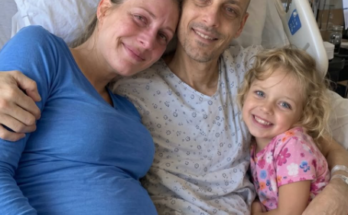
My wife secretly opened a savings account the day we got married. She deposited $100 a month from her paycheck. I never noticed. She did it for twenty-seven years. When she was diagnosed with terminal cancer, she sat me down and said, “I need to show you something.” She opened her laptop and showed me the account. Balance: $62,000 with interest. I stared at the screen. “Why?” I whispered. She said, “Because I knew one of us would get sick first. And I didn’t want the other one to suffer.” She handed me a folder. Inside were prepaid funeral arrangements, a life insurance policy I didn’t know about, a letter to our children, and a note to me that said, “I loved every day. Even the hard ones. Especially the hard ones.” She died three months later. At the funeral, our son read her letter to the family. When he got to the last paragraph, he stopped, looked at me, and asked, “Dad, did you know about this?” I shook my head. The room fell silent as he continued reading. “There is one thing I never told anyone—not even your father.” Everyone looked up. “Before I met him, when I was nineteen years old, I gave birth to a baby girl.” Gasps echoed through the church. My son’s voice trembled as he continued. “I was young, scared, and alone. Believing I couldn’t give her the life she deserved, I placed her for adoption. Not a single day passed that I didn’t think about her.” My heart pounded. I had been married to this woman for twenty-seven years, and I had never known. Then came the next sentence. “Three years ago, she found me.” A woman sitting quietly in the back row burst into tears. Heads turned. She slowly stood up. “Her name is Emily,” my son read. “And she is here today.” The woman walked forward. She looked so much like my wife that for a moment I couldn’t breathe. Emily took the letter from my son’s shaking hands and continued reading herself. “I wanted to tell all of you, but I was afraid. Then I became sick, and time suddenly felt very short. I spent the last three years getting to know the daughter I lost and praying that one day she would know the family she came from.” Tears streamed down every face in the room. Emily looked at me and smiled sadly. “Your wife talked about you every day,” she said. “She said you taught her what unconditional love looked like.” Then she unfolded another page hidden inside the envelope. “There’s one final surprise,” she read. “The savings account wasn’t only for medical bills and funeral expenses. There’s another account.” My eyes widened. Another account? Emily handed me a document. The balance was nearly $180,000. My wife had quietly saved even more over the years through investments and bonuses. “Use this money to bring the family together,” the letter said. “Take the trip we always talked about. Don’t spend your remaining years mourning me. Spend them living.” Months later, we followed her wishes. Our children, grandchildren, Emily, and I traveled together. At first it felt strange having someone new in the family. But every story she told about her conversations with my wife filled in pieces of a puzzle we never knew existed. One evening, while we watched the sun set over the ocean, Emily handed me a small envelope. “Mom wanted you to have this when the time felt right,” she said. Inside was an old photograph of my wife at nineteen, holding a newborn baby. Written on the back were words that brought me to tears: “I spent years believing I had lost the most important part of my life. Then I met you, and somehow I was given the chance to find it again. If you’re reading this, remember something: love is never truly lost. Sometimes it simply takes the long way home.”
PART 2
My wife had always been the steadier one between us. I was the one who talked things through, worried out loud, made lists after the problem had already arrived. She handled fear differently. She prepared for it before anyone else even saw it coming. I just never understood the scale of that until the day she sat me down in front of her laptop and opened a savings account I had never seen before.
Sixty-two thousand dollars.
For a few seconds I honestly thought I was misreading the screen. We had lived an ordinary life, the kind built on routines so familiar they become invisible. Mortgage. Groceries. Family birthdays. A dinner rotation we had repeated for years. The occasional repair bill that always seemed to arrive at the wrong time. She had deposited a hundred dollars a month from her paycheck for twenty-seven years, and I had not noticed it once.
“What is this?” I asked.
She answered me with the same calm she used for everything difficult. Not cold. Not detached. Just settled. She said she had opened the account the day we got married because she knew one of us would get sick first, and she did not want the other one to suffer. That sentence landed harder than the diagnosis had. The diagnosis had terrified me. This terrified me and humbled me at the same time. While I had been promising we would face whatever came together, she had already spent nearly three decades quietly building the cushion that would keep me standing after she was gone.
I asked why she had never told me.
She gave me a small smile and said if she had told me, I would have found reasons to spend it on something else for the family. College. Repairs. Emergencies. A better car when ours started making sounds we both pretended not to hear. She was right, which somehow made the secret harder and easier at the same time. Harder because she had kept an entire future hidden from me. Easier because I knew exactly why she had done it.
Then she handed me the folder.
It was thick, organized, labeled, and devastating. Prepaid funeral arrangements. A life insurance policy I had never known existed. A letter to our children. A note to me. There was no chaos in it. No last-minute panic. She had arranged death with the same competence she brought to ordinary life, as if she refused to leave a mess behind for the people she loved.
I read her note twice before I could speak. “I loved every day. Even the hard ones. Especially the hard ones.” It was the kind of line only she could write without sounding false. She had never been sentimental for effect. If she said she loved the hard days too, she meant the days when the bills stretched us thin, when the children were teenagers and angry at the world, when we took turns pretending we were not exhausted. She meant the years that were not graceful from the outside but mattered anyway because they were ours.
For the next three months, I lived in two times at once. In one version, she was still in the room with me, still asking whether I had eaten, still reminding me where things belonged. In the other, everything she touched had already begun turning into something I would one day remember instead of reach for.
She never dramatized her fear. She talked about medications, appointments, insurance, and timing. Now and then, when the house went quiet, I would catch her staring at nothing in particular, and I knew she was measuring time in a way I could not bear to imitate. But when she noticed me noticing, she always came back with a practical question.
I told myself the folder and the savings account were the whole secret. I did not yet understand that she had been preparing something else too. Not just an ending. A reunion.
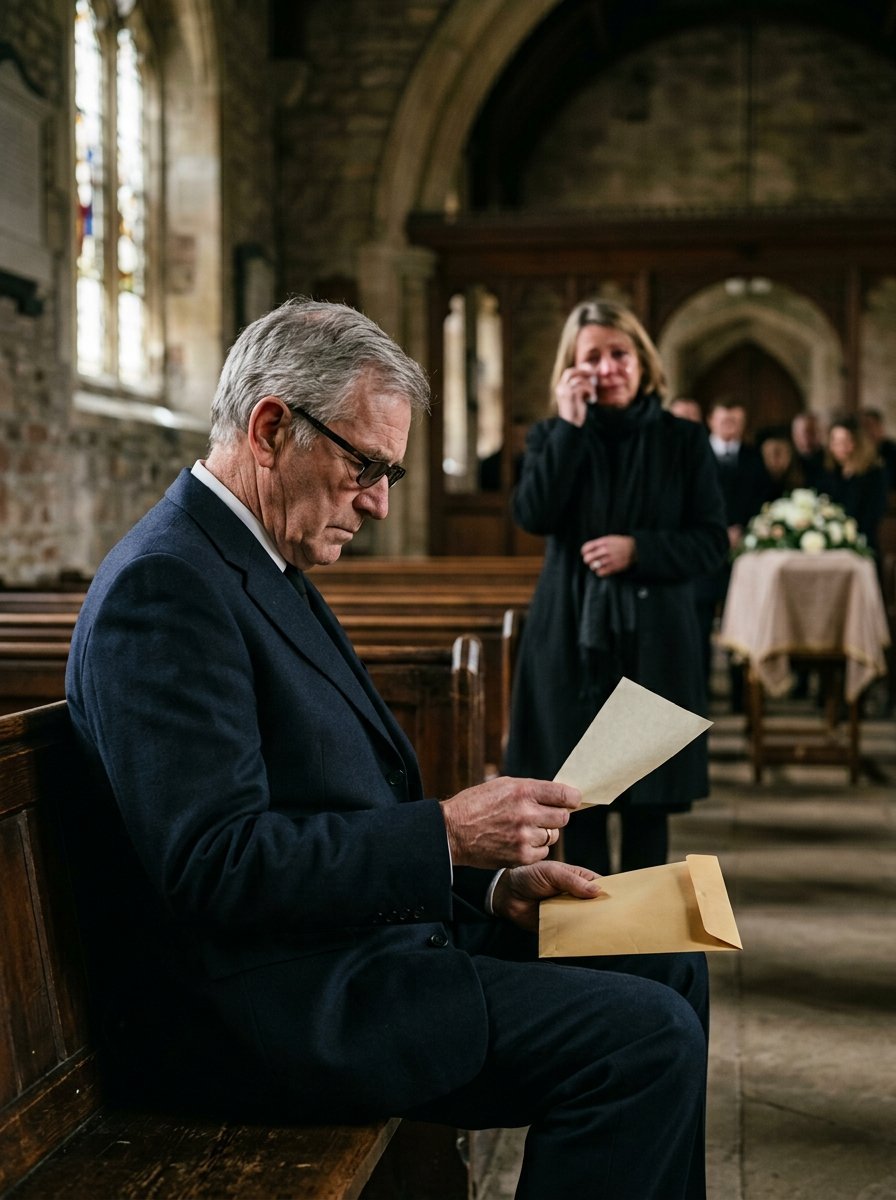
At the funeral, our son stood at the front of the church with her letter in his hands. He had the same expression I had seen on his face when he was a boy trying not to cry at school assemblies: jaw locked, voice steady only because he had decided it had to be. The family sat in pews on both sides. Friends filled the back. Every person in that room believed the shock had already happened. We thought the hardest part was that she was gone.
Then he reached the final paragraph, stopped reading, and looked at me.
“Dad,” he asked, “did you know about this?”
I said no.
And the whole room changed.
PART 3
There are silences that feel respectful, and then there are silences that feel as if the floor has been taken out from under everyone at once. The one that settled over the church after my son asked me that question belonged to the second kind. It was not the hush of mourning anymore. It was the hush of a room realizing the dead still had the power to alter the living.
My son looked back down at the page and kept reading because there was nothing else he could do. His voice trembled on the line, but he did not stop.
“There is one thing I never told anyone—not even your father.”
For twenty-seven years I had believed there were no corners of my wife’s life left in darkness. Not because I thought marriage made two people fully transparent, but because long marriages teach you the shape of what remains unsaid. You know where the old hurts are. You know which memories make them go quiet. You know which stories begin with laughter and end with a look that says enough. I had assumed the things I did not know were ordinary omissions, not a whole daughter.
“Before I met him, when I was nineteen years old, I gave birth to a baby girl.”
You could hear people breathing. Someone near the back let out a sound that was almost a gasp and almost a sob. Our daughter put her hand over her mouth. One of the grandchildren shifted on the pew and looked up, confused by the adults suddenly turning to stone around him. I sat there with my hands locked together so tightly my knuckles hurt, trying to understand how a sentence could make the last twenty-seven years reorganize themselves around a fact I had never seen.
My son kept going.
She wrote that she had been young, scared, and alone. She wrote that she believed she could not give the baby girl the life she deserved, so she placed her for adoption. She wrote that not a single day passed that she did not think about her.
That was the moment my shock split in two.
Part of me felt blindsided in the most intimate way possible. I had slept beside this woman, raised children with her, built a life with her, and buried her without knowing the oldest wound she carried. But another part of me could suddenly see the shape of the silence she must have lived inside at nineteen. Young. Scared. Alone. Whatever judgment the room might have been tempted to reach was crushed under the weight of those words. She had not hidden some careless chapter. She had hidden a grief that had followed her into every decade of her life.
Then my son read the line that changed the air in the room again.
“Three years ago, she found me.”
Every head lifted. It happened almost in unison, as if the entire church had been pulled by a single string. The past was no longer buried in the abstract. It had a present tense now. Somewhere in that room—or somewhere just outside it—there was a living person who had once been a secret and was no longer one.
A woman sitting quietly in the back row burst into tears.
I turned with everyone else.
She did not look dramatic. She did not make a scene. She simply folded inward for one second, hand to her face, as if the effort of remaining still had finally failed her. Then she stood. I do not think I breathed at all while she was walking forward.
My son’s voice shook harder on the next line.
“Her name is Emily,” he read. “And she is here today.”
She looked so much like my wife that the resemblance was almost cruel. Not exact. Not theatrical. Just enough in the eyes and mouth to make time collapse for a moment. I had the strange sensation of seeing someone familiar and unknown at once, a face I had never met carrying echoes of the woman I had loved for most of my adult life.
When Emily reached the front, my son handed her the letter with hands that were no steadier than hers. She looked at him first, then at me. There was apology in her face, and fear, and something else I would only understand later: the exhaustion of a person who has waited years to be allowed into a room that should have been hers all along.
No one moved. No one interrupted. Whatever discomfort, anger, sorrow, or confusion existed in that church had to stand aside for the simple fact that my wife had chosen this moment, this letter, and this witness. She had arranged the order of revelation as carefully as she had arranged the funeral, and we were all inside it now.
Emily unfolded the page fully.
Then she began to read.
PART 4
Her voice was quiet, but it carried. Maybe that is what happens when an entire room knows it has no right to miss a word. She read that my wife had wanted to tell all of us, but she had been afraid. She read that the illness had made time suddenly feel short. She read that the last three years had been spent getting to know the daughter she lost and praying that one day the daughter would know the family she came from.
By then there was almost no one in that church without tears in their eyes. Not because the letter excused everything. Not because shock had disappeared. But because the motive behind the silence had stepped into view. Fear. Shame. Lost time. A private reunion happening alongside ordinary family life while my wife was deciding if she could survive telling us the truth.
Emily lowered the page for a moment and looked at me.
“Your wife talked about you every day,” she said. “She said you taught her what unconditional love looked like.”
It should have comforted me immediately. Instead it broke me in a different place. If she believed that, why had she not trusted me with this sooner? If she knew I loved her, why had she carried the whole burden alone until death cornered her into confession? It is possible to feel honored and shut out at the same time. That was the sharpest edge of the moment for me. The room saw a reunion. I also saw twenty-seven years of a marriage that had been real and loving and still incomplete in a way I had never imagined.
Emily seemed to understand that without my saying it. She did not rush toward me. She did not ask for instant acceptance or try to smooth the discomfort away with words that would have been too soon. She simply unfolded another page from inside the envelope.
“There’s one final surprise,” she read.
For a second, the sentence sounded almost impossible. We had already crossed grief, confession, adoption, and reunion in the span of a few minutes. What could possibly remain that would not feel excessive? But my wife had always been deliberate. If she had hidden another page, she had hidden it for a reason.
“The savings account wasn’t only for medical bills and funeral expenses,” Emily continued. “There’s another account.”
I heard murmurs then, soft and involuntary. Not greed. Not curiosity alone. It was the sound people make when they realize a person they loved had been planning far beyond the point any of them understood.
Emily reached into the envelope and withdrew a document.
She looked down at it before she handed it to me, and whatever she saw there changed her expression. Not alarm. Not confusion. Just the stunned recognition that my wife had once again managed to think farther ahead than everyone else in the room. Emily stepped closer. My son moved aside. The paper shook once between her fingers before she steadied it.
I took it, but for one suspended beat I did not look down.
Because by then I understood that every page my wife had hidden carried the power to rearrange the family I thought I knew.
And I was not yet sure what this last one would ask us to become.
PART 5
The balance was just under one hundred eighty thousand dollars.
For a moment the number meant nothing to me because my mind was still catching up to the fact of the account itself. Then the details began to land. Investments. Bonuses. Years of discipline layered on top of the first savings plan I had already failed to notice. My wife had not only prepared for medical bills and funeral expenses. She had built something larger and more intentional than that. A fund for the living.
Emily handed me the rest of the page, and I read my wife’s instructions with tears blurring the words. Use this money to bring the family together. Take the trip we always talked about. Don’t spend your remaining years mourning me. Spend them living.
It was exactly like her to turn money into direction. Not control from beyond the grave, but care with structure. She knew that grief can make people freeze. She knew I was the kind of man who could spend years guarding loss if no one gave me permission to move. So she had written the permission down.
The weeks after the funeral were awkward in ways I do not need to romanticize. Emily was not a miracle fix dropped into a broken family. She belonged with us, but belonging does not erase time. Our children were grieving their mother and learning they had a sister at the same time. I was sorting insurance forms and thank-you cards while also trying to understand how my wife had lived three years with a restored daughter she loved and still could not bring herself to announce.
But Emily never arrived demanding a place. She came carefully. That mattered. She answered questions when we had them. She stayed quiet when we did not. And when she spoke about my wife, she did so with the tenderness of someone who knew she had been given too little time and treasured it anyway.
That was how the puzzle began filling in.
She told us about the first message three years earlier. Not in dramatic detail, just enough for us to understand what those years had meant. She told us they began slowly, with letters and calls and careful visits. She told us my wife cried after the first one and said she had spent decades imagining that daughter as a permanent absence, only to discover absence could knock on the door and ask to be let in.
Our children listened to those stories with the confusion grief allows. They missed their mother. They wished she had trusted them sooner. They also wanted to know the sister she had spent three final years trying to fold back into the family.
Months later, we followed her wishes and took the trip we had always talked about. Children. Grandchildren. Emily. Me. At first it felt almost wrong to call it a family vacation when the person who made it possible was missing from every photo. But little by little the strangeness softened into something else. Not replacement. Continuation.
On that trip, Emily stopped feeling like an announcement and started feeling like what she actually was: part of the family my wife had been trying to hand back to us. She told stories from those last three years when the two of them had been building something fragile and precious in private. Every story hurt a little. Every story healed a little too.
One evening we all watched the sun slide down over the ocean. The grandchildren were in the sand. The others were talking nearby. Emily came over and handed me a small envelope.
“Mom wanted you to have this when the time felt right,” she said.
Inside was an old photograph of my wife at nineteen, holding a newborn baby.
It was the first time I had seen her inside that missing chapter. She looked impossibly young, and not ready, and deeply attached all at once. Nothing in the photo suggested indifference. Everything in it suggested loss before the loss had even happened.
On the back, she had written the words that finally gave the whole story its shape.
“I spent years believing I had lost the most important part of my life. Then I met you, and somehow I was given the chance to find it again. If you’re reading this, remember something: love is never truly lost. Sometimes it simply takes the long way home.”