PART 1
With emergency lights flashing outside, Mason leaned close and told me he knew of one more thing I had to locate before Brian returned.
The words landed differently because of everything already sitting in that kitchen.
My eight-year-old granddaughter was burning with fever in my arms.
My ten-year-old grandson had just come out of a closet where his own father had ordered him to stay.
An orange prescription bottle stood on the counter even though the name printed on it did not belong to Lily and the medication had not been prescribed for a child.
Beside it were Brian’s house keys and a handwritten note telling me, his own father, not to call anyone.
And somewhere inside Mason’s dead tablet was a recording he was terrified to let his father know existed.
At that moment, I understood only one thing clearly.
Whatever Brian and Marissa expected to find when they came home, they had not expected me to be standing there with both children awake, together, and able to speak.
But none of that was on my mind when my phone rang at exactly 1:58 that morning.
My bedroom was dark except for the blue numbers on the clock, and I nearly let the call ring a second time before I saw Lily’s name on the screen.
Lily was eight, still young enough to decorate birthday cards with purple hearts and still faithful about calling me every Sunday because my late wife, Carol, had once told her that grandpas needed checking on too.
Carol had been gone long enough for me to know the difference between remembering someone and expecting them to walk back through a door.
Still, there were nights when I would reach toward her side of the bed before remembering.
That night, I reached for my phone instead.
When I answered, Lily did not speak immediately.
I heard her breathing first.
It was thin and uneven, the kind of breathing that makes every protective instinct in you wake up before your mind has caught up.
Then she whispered, “Grandpa, I feel so hot.”
I sat up so fast I knocked my glasses off the nightstand.
“Lily, where are you?”
“At home.”
That answer made no sense.
As far as I knew, Lily was supposed to be staying with Marissa’s sister for two nights because she had a minor cold.
Brian and Marissa had told everyone they were taking Mason to Florida for his birthday.
It was supposed to be a simple family trip.
Mason got his birthday away from home, Lily rested with her aunt, and everyone came back Sunday.
That was the version I had been given.
So I asked the obvious question.
“Where’s your mom? Where’s Brian?”
Lily stopped talking.
That silence frightened me more than if she had started crying.
Finally she said, “They left.”
I was already getting out of bed.
I pulled on jeans with one hand while keeping the phone pressed to my ear with the other.
“Are the doors locked?”
“I don’t know. My head hurts. The kitchen light is on.”
Her words were slow, as if even forming them required effort.
I told her to stay with me.
She whispered that she was scared.
“I’m coming,” I said.
There are promises you make because they are comforting.
There are others your body begins keeping before your mouth has finished saying them.
I was out the door almost immediately.
Brian’s subdivision normally took about fourteen minutes from my house.
I don’t remember much of the drive in order, but I remember the dashboard reading 2:06 a.m. when I turned onto his street.
I remember my fingers aching from how tightly I held the steering wheel.
I remember repeatedly checking that Lily was still connected to the call.
And I remember speaking to Carol under my breath.
Not praying exactly.
Not expecting an answer.
Just saying her name because she had always been the person who could hear danger inside an ordinary sentence before anyone else did.
The street looked almost insultingly normal when I arrived.
Dark windows.
Parked cars.
Quiet driveways.
Brian’s driveway was empty.
No SUV.
No luggage stacked near the garage.
No sign that two adults had simply run out for something and intended to return in a few minutes.
I got out and went to the emergency key hidden near the porch.
Brian had shown me the spot years earlier for exactly the kind of boring family problem everyone expects emergency keys to solve: a lockout, a lost key, a kid coming home early.
Not this.
I pushed the door open and immediately smelled something sweet and medicinal.
Cough syrup was the first thing that came to mind, mixed with stale warm air that made the whole hallway feel closed up.
“Lily!”
The kitchen light was on exactly as she had told me.
A half-empty glass of water sat near the sink.
One of Mason’s sneakers lay on its side in the hallway.
At the time, I barely registered the shoe.
Later it would become one of those details my mind kept returning to because it had been telling me something before I understood the question.
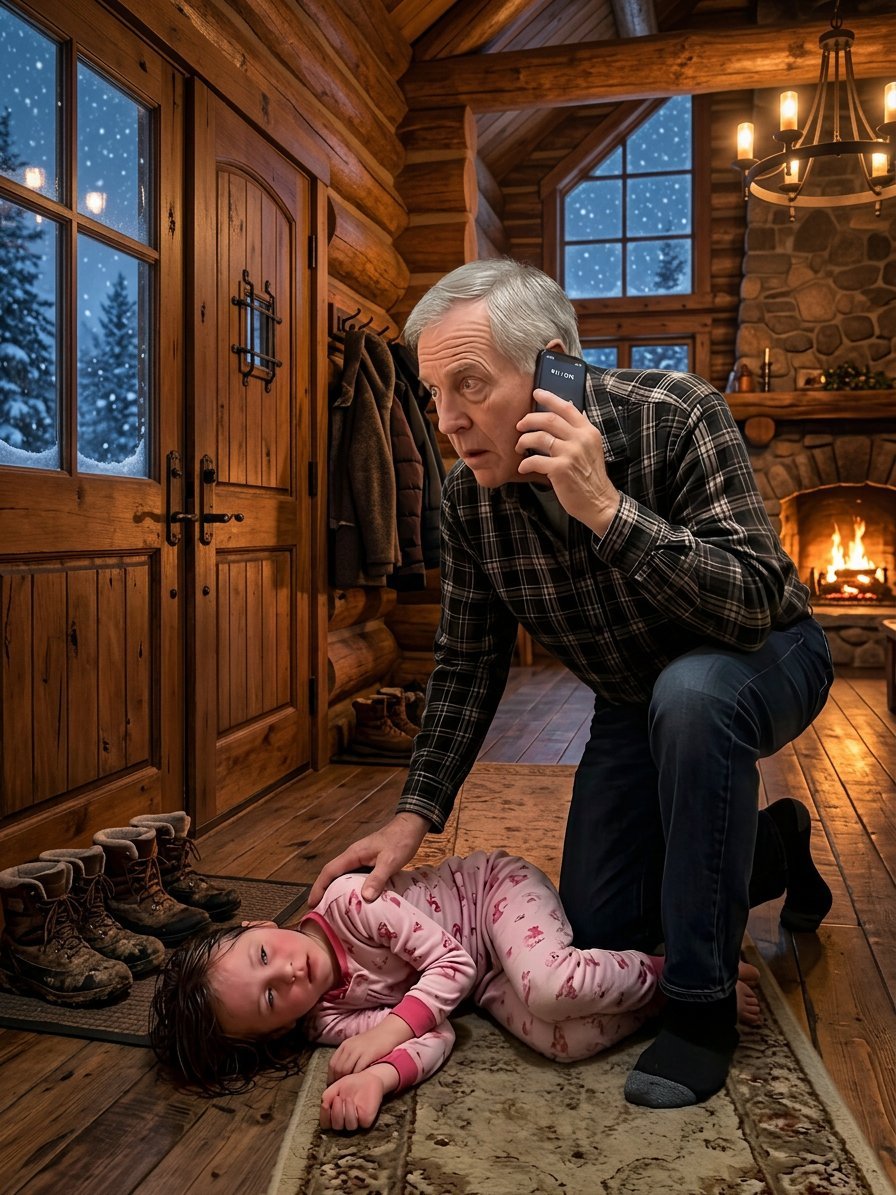
Then I saw Lily.
She was curled on the hardwood floor in pink pajamas.
One cheek rested against the floorboards.
Her hair was damp and stuck to her forehead, and her face was flushed a deep red that made my stomach tighten before I even touched her.
Her hands were drawn weakly toward her chest.
She looked as if she had tried to crawl somewhere and run out of strength.
“Grandpa…”
I dropped beside her.
When my palm touched her forehead, the heat shocked me.
I called 911.
Then I lifted her against my chest while the dispatcher began asking questions.
Her head sagged against my shoulder.
That was when fear stopped being an idea and became something physical.
My mouth went dry.
My hands felt too large and clumsy.
I kept answering the dispatcher’s questions because answering questions was something I could still control.
Address.
Age.
Condition.
Breathing.
Whether she was awake.
I held Lily tighter and looked around the kitchen, trying to understand how an eight-year-old child had ended up on a hallway floor in an empty house while the adults responsible for her were supposedly on a birthday trip.
That was when I noticed the prescription bottle.
Orange plastic.
Ordinary pharmacy shape.
Sitting on the counter like it belonged there.
I looked at the label.
The name was not Lily’s.
More importantly, the medication was not prescribed for a child.
Beside the bottle were Brian’s house keys.
Then I saw the folded note.
My name was not written on the outside, but the first word inside was enough.
Dad.
Brian had written it for me.
He told me not to overreact.
He said Lily became dramatic when she was sick.
He admitted they had given her something to make her sleep so she would not ruin Mason’s birthday trip again.
He said they would be back Sunday.
Then came the instruction that made my hand tighten around the paper.
Please don’t call anyone.
I read it twice.
My own son had apparently anticipated the possibility that I might find Lily sick enough to need help, and his concern had been preventing me from making that call.
Help was already coming.
So Brian’s request had arrived too late.
Then I reached the final line.
“And whatever she tells you, don’t believe her about the closet.”
There are sentences that explain something.
That one created a second emergency.
The hallway closet was only about ten feet away.
I looked at it.
Lily’s fingers suddenly tightened around my shirt.
Then I heard a knock from behind the door.
Soft.
Almost careful.
The dispatcher continued talking, but the rest of the house seemed to fall away.
A second knock came.
Weaker.
Then a scrape.
I carried Lily toward the closet.
She whispered, “Grandpa.”
I looked down.
Her eyes were barely open.
“Don’t open it.”
That frightened me more than the medicine bottle.
More than the empty driveway.
More than the note.
Because Lily was the one on fire with fever, barely able to hold her head up, and yet something behind that closet door scared her enough that she was warning me away from it.
I stood there holding her while staring at the knob.
Then it began to turn from the inside.
Slowly.
I shifted Lily behind me as much as I could without putting her down.
“Mason?”
The knob stopped.
For one second there was nothing.
Then a small, dry voice answered.
“Grandpa?”
I opened the door.
Mason sat on the closet floor with his knees pulled against his chest.
His tablet lay beside him, dead and black-screened.
One of his feet was missing a sneaker.
The shoe in the hallway suddenly made sense.
Mason blinked against the kitchen light, but he did not ask why I was there.
He looked immediately at Lily.
“Is she okay?”
That question told me plenty about what the children had been thinking about while the adults were gone.
“Help is coming,” I said.
Then I asked why he had been locked in the closet.
His expression changed before he answered.
It wasn’t the look of a kid caught breaking a rule.
It was fear.
He picked up the dead tablet and hugged it against his chest as if the powerless device still needed protecting.
“Dad said I had to stay until I learned not to lie.”
I felt anger rise so fast I had to force myself to keep my voice level.
The dispatcher heard the word I muttered under my breath and reminded me that responders were nearly there.
I crouched as much as I could while still supporting Lily.
Mason’s hands were trembling around the tablet.
“What did he say you lied about?”
Mason looked toward the kitchen counter.
His eyes moved over the prescription bottle.
The note.
The keys.
Then he looked at his sister.
“I recorded them before they left.”
For a moment, the tablet stopped looking like a child’s dead piece of electronics.
It became the reason Mason had been behind that door.
I asked what he had recorded.
He shook his head.
“Not here.”
Then he told me why.
Brian had warned him that if anybody heard the recording, he would tell people the children were not supposed to be living with him anymore.
Mason was ten years old.
Ten-year-olds understand more than adults sometimes want to admit, but they do not hear a threat like that in legal or procedural terms.
They hear one thing.
You could lose your home.
You could lose your family.
You could be sent away.
And if you think telling the truth might make that happen, silence can start to feel safer than help.
That was the part of the night that changed what I believed I was looking at.
Until then, terrible as it was, I could still imagine a reckless chain of decisions.
A sick child.
A medication that should not have been given to her.
Adults leaving when they should have stayed.
A boy punished in a way that made my skin crawl.
But Mason’s warning suggested something more deliberate.
Brian had not only told the children what to do.
He had apparently tried to shape what they believed would happen if they talked.
And the note on the counter showed he had tried to shape what I would believe too.
Don’t overreact.
She’s dramatic.
Don’t call anyone.
Don’t believe her about the closet.
Those instructions had one thing in common.
Every one of them asked someone else to doubt the children before hearing them.
Lily shifted weakly in my arms.
Mason watched her with the frightened concentration of a brother who had been listening to something happen from the other side of a door and had not been able to reach her.
Outside, red emergency light began moving across the front window.
It washed over the wall, disappeared, then returned.
The help Lily needed had arrived at the house.
But Mason did not relax.
He moved closer to me.
That was when he told me Brian’s attempt to control the story had started before I ever entered the house.
The recording was one part of it.
The threat about where the children could live was another.
And the handwritten note suddenly looked less like an explanation left by careless parents and more like an instruction manual for how they expected me to react.
Dismiss Lily.
Ignore the closet.
Keep outsiders away.
Wait until Sunday.
I looked again at the dead tablet in Mason’s arms.
Its screen showed nothing.
No proof.
No recording.
No convenient answer.
Just fingerprints on dark glass and a terrified child refusing to let it go.
I thought about the ordinary story I had been told earlier: Florida, Mason’s birthday, Lily’s cold, two nights with an aunt.
Every part of it had sounded reasonable when considered separately.
That was what bothered me now.
The trip story had not failed because it was wildly unbelievable.
It had failed because Lily called me herself.
One frightened eight-year-old making one phone call at 1:58 a.m. had pulled the first loose thread.
Then came the empty driveway.
The medicinal smell.
The glass of water.
The orange bottle.
The note.
The line about the closet.
Mason’s missing sneaker.
The knocks.
The dead tablet.
The threat.
Nothing had arrived as one dramatic revelation.
It came in small household pieces.
That somehow made it worse.
These were the kinds of objects families see every day without thinking twice.
Keys.
Medicine.
A child’s shoe.
A tablet.
A handwritten note.
But by the time the emergency lights reached the front window, every ordinary object in that house seemed to be pointing in the same direction.
I looked at Brian’s keys on the counter and thought about how casually they had been left there.
He was my son.
That fact did not disappear because I was horrified by what I had found.
If anything, it made the moment harder to process.
Parents spend years learning the small versions of their children.
The kid who needs a night-light.
The teenager who insists he didn’t dent the car.
The young man who calls asking how long chicken lasts in the refrigerator.
Memory does not automatically update itself when the adult standing at the end of those years does something you cannot reconcile with the boy you remember.
I wanted an explanation that could make the room less real.
But Lily was still burning against my chest.
Mason had still been behind a locked door.
Brian had still written the note.
Those facts did not care what I wanted.
The emergency lights continued flashing across the window.
Mason leaned toward me instead of toward the front door.
His voice dropped again.
He wasn’t finished.
There was another thing inside the house, he said, something I needed to locate before his father got back.
And with Lily in my arms, Brian’s note still open on the counter, and Mason clutching the dead tablet against his chest, I realized the most frightening part of that night might not have been what I had already found.
It was that a ten-year-old boy clearly believed we were running out of time to find the rest.
PART 2
“The charger,” Mason whispered. “Dad hid it after he saw the tablet.”
The words came out in a rush, low and urgent, as if even now Brian might hear him from the driveway. Mason pointed toward the small desk near the hall where Brian kept unopened mail, batteries, and the drawer every family eventually fills with spare cords. He said his father had yanked the charger free, told him the tablet was dead anyway, and shoved both him and the device into the closet when he would not stop crying about Lily.
Then the pounding at the front door started.
Not Brian. Paramedics.
I opened the door with Lily still against my chest and Mason pressed close to my side. Two paramedics came in fast, followed by an officer who took one glance at the scene—the child in my arms, the child in the hallway, the bottle on the counter, the note in my hand—and understood this was not a routine fever call.
They moved Lily to the kitchen floor only long enough to assess her safely. One paramedic took her temperature, another checked her pulse and asked me what she had been given. I handed over the orange bottle instead of answering with guesses. The officer asked who else was supposed to be in the home. I said my son and his wife. I said they had left. I said they told the family the children were somewhere else entirely.
Mason tugged my sleeve.
“The charger,” he said again.
There are moments when an adult has to split himself in half. One half keeps pace with the emergency everyone can already see. The other listens to the smaller terrified voice insisting there is danger nobody else has understood yet. I asked the officer to stay with the kids for one minute. Then I went to the hall desk, pulled open the middle drawer, and found a white charging cord shoved beneath a stack of unopened envelopes and rubber bands.
When I held it up, Mason nodded so hard his shoulders jumped.
“It’s that one.”
The paramedic carrying Lily toward the stretcher looked back at me and said they needed to move now. I bent over Lily, told her I was coming, and promised again that I was not leaving either of them. She opened her eyes for half a second, enough to know I was there, then let them close again.
The officer plugged Mason’s tablet into a kitchen outlet while I followed the stretcher to the ambulance and then turned back when Mason froze at the threshold. He would not step outside without the tablet. He was ten years old, exhausted, scared half hollow, and still thinking more clearly than the adults who had put him in that position. Whatever was on that device, he believed it was the only thing standing between the truth and the story his father wanted everyone to swallow.
So I told the paramedics to take Lily and start treatment. I told them I would be directly behind them with Mason. Then I walked back inside with him.
The house looked different now that strangers were in it. Emergency light cut across the refrigerator. A medical bag sat open on the counter beside Brian’s note. The prescription bottle had already been set apart. The closet door remained open, dark and accusing, with the single missing sneaker no longer seeming like a detail but a witness.
The tablet stayed black for what felt like an unforgivable amount of time.
Mason’s breathing shortened with every second.
“What if he deleted it?” he asked.
“Then we tell them everything anyway.”
He nodded, but only because children nod when they know you are trying to help, not because they believe you yet.
Then the screen flickered.
A battery icon appeared.
Mason swallowed so hard I could see it in his throat.
He held the tablet with both hands while it crawled awake, and I understood that the device mattered to him for a reason larger than evidence. He had been trapped in a closet with his father’s threat still hanging over him. That tablet was the one thing he had managed to keep from being fully controlled.
When it finally opened, there was a single recent audio file near the top.
Time-stamped before 2:00 a.m.
Mason did not press play.
Not yet.
He looked at me first, then at the officer, then toward the open front door where the ambulance lights still strobed red across the lawn.
“There’s one more thing,” he said.
I thought he meant another file.
He shook his head.
“No. Marissa’s sister. Dad said if anybody called her, she’d lie too. You have to do it before he talks to her.”
That was when I understood just how far ahead Brian had been trying to move the story.
Not just a note. Not just a threat. A whole chain of people who might already be prepared to repeat the cover version if the wrong adult called them first.
I picked up my phone.
And while the tablet warmed in Mason’s hands, I dialed the one person in the family story who was supposed to have had Lily all along.
PART 3
Marissa’s sister answered on the fourth ring with the hoarse confusion of someone dragged awake in the middle of the night.
At first she did not understand who I was. Then she heard the strain in my voice and sat up fast enough that I could hear bedding shift on her end.
“Is Lily okay?” she asked.
That one question told me she had not had my granddaughter.
“No,” I said. “And she was never with you, was she?”
Silence.
Then a sharp breath.
“No. Marissa told me they were all in Florida. She asked if I could maybe check on the cat tomorrow afternoon if they got stuck in traffic coming back.”
The officer wrote that down without looking up.
I asked if she had spoken to them tonight.
She said not since early evening. She sounded frightened now, not defensive, which was the distinction I needed. She was not protecting them. She was realizing, in real time, that she had been used to make the lie sound ordinary.
When I ended the call, the officer asked for her number. I gave it to him. He asked to see the note again. I handed it over. He read it more slowly this time, eyes catching on the same lines that had caught on mine.
Don’t overreact.
Don’t call anyone.
Don’t believe her about the closet.
The more official the room became, the smaller Brian’s instructions started to look. Not less ugly. Just more obviously what they were. Not calm explanations from competent parents. Preemptive excuses written by someone trying to get ahead of what a child might say once another adult started asking questions.
Mason still had not played the recording.
He sat at the kitchen table now, bare foot tucked under him, the missing sneaker finally found and set beside the chair without him bothering to put it back on. He kept staring at the audio file as if touching it might set something irreversible in motion.
I knelt beside him.
“You don’t have to listen alone,” I said.
He did not look at me.
“He said if anybody heard it, they’d think we couldn’t stay there anymore.”
The officer stopped writing.
That was the first moment someone outside the family heard the threat from Mason’s own mouth.
“He told you that?” the officer asked.
Mason nodded.
“And he put you in the closet after that?”
Another nod.
I saw the officer’s face change in the way people’s faces change when they finally stop assuming there must be some adult logic hidden behind a child’s fear. There wasn’t. There was only what had happened.
The tablet speaker was small. The room was quiet enough to make it seem louder than it was.
Mason hit play.
At first there was only the muffled scrape of movement, as though the device had been set down on a counter or table. Then voices.
Brian’s.
Marissa’s.
No room left for doubt.
The first clear sentence was Marissa saying Lily was “already too warm” and would only get worse in the car. Brian answered that they were not canceling Mason’s birthday trip “because of another one of Lily’s episodes.” Then came the sharper sounds: Lily crying that she did not want the medicine, Mason asking what they were giving her, Brian snapping at him to stop recording, Marissa saying they just needed Lily asleep and quiet for a few hours.
I closed my eyes for one second.
Only one.
Because if I let myself stay inside the rage fully, I would not be useful to either child.
The recording kept going.
Mason’s own voice said, higher and shakier, “You can’t leave her.”
Then Brian: “You be quiet, or I’ll give them a reason to say neither of you should stay here.”
Marissa again, lower this time, telling Brian to take the tablet.
Then a dragging sound.
A door.
Mason crying.
Brian’s voice, close to the speaker now: “Sit in there until you learn not to lie.”
The file ended in a scrape and silence.
Nobody in the kitchen moved.
The officer asked for the tablet.
Mason’s grip tightened instinctively.
“You keep it,” the officer said. “I just need to hear it again and make sure it gets copied.”
That choice mattered. It let the first authority figure Mason heard that night sound nothing like his father.
Outside, tires rolled over gravel.
Not the ambulance.
A car.
The officer went to the window.
So did I.
Brian’s SUV turned into the driveway with Marissa in the passenger seat.
The moment their headlights hit the front of the house, I knew two things at once.
They had not gone to Florida.
And whatever story they had practiced on the way back, they had not expected to find police already inside.
PART 4
Brian braked so hard the front of the SUV dipped.
For one suspended moment nobody got out. They just sat there in the wash of their own headlights, staring at the ambulance, the police cruiser, and the open front door of the house they had expected to remain empty except for whatever version of events they planned to retrieve on Sunday.
Then Brian came to the door fast.
He still had the stride I remembered from his teenage years when he used speed to make certainty look natural. But he lost some of it the second he crossed the threshold and saw Mason at the kitchen table with the tablet lit in front of him.
Marissa stopped behind him.
Her face found Lily’s missing cup near the sink, the note in the officer’s hand, the open closet, and then me.
No one had to explain the sequence to her. The room did that on its own.
“What happened?” Brian asked.
Not to Lily.
Not to Mason.
Not is she all right.
What happened.
I have never forgotten that.
The officer answered before I could.
“You can start with why these children were in the house alone.”
Brian’s eyes shifted to me in an instant, trying to locate whatever version of me he thought still existed—the father who might hesitate, soften, protect him from the first hard consequence. He did not find him.
“I left a note,” he said.
“You left instructions,” I replied.
Mason looked down at the tablet as if even now he was bracing for the room to decide that the note mattered more than his voice. Brian noticed the device then, and something brief and raw moved across his face before he could hide it.
“Give me that,” he said.
He was talking to Mason.
The officer stepped between them.
“No.”
Brian stopped, but only because another adult had said it. That landed where I knew Mason would feel it.
Marissa tried a different route. She said Lily had a cold. She said they made a mistake. She said Mason frightened easily and misunderstood punishment. She said the closet door had not even been fully latched when they left. Every sentence was an attempt to shrink the facts without actually denying the objects sitting in front of us.
The bottle.
The note.
The dead-of-night call.
The recording.
Because once a lie has been forced to share a room with evidence, it usually starts sounding like what it is.
The officer asked where they had really been.
Brian said driving.
To where?
He did not answer immediately.
The hesitation was louder than if he had.
Mason’s fingers hovered over the tablet screen.
Brian saw that too.
I watched father and son look at the same object from opposite sides of the same fear. Brian looked at it like a fuse he still hoped to pinch out before it reached the charge. Mason looked at it like the only adult in the room that could not be argued with.
Then Brian turned to me and said my name in the tone he used as a boy whenever he wanted help escaping the consequences of his own choices.
“Dad.”
No apology.
No explanation.
Just that single word, trying to recruit blood back to his side.
I did not raise my voice.
I only answered him with the truth already sitting there.
“Lily called me at 1:58 in the morning,” I said. “Mason came out of a closet you locked from the outside. Whatever story you thought you were coming home to is over.”
He stared at me.
The officer held out a hand toward the tablet, not to take it away this time, but to hear it with them standing there.
Mason looked at me.
I nodded once.
And as Brian finally understood what his son had managed to keep from him, Mason touched the screen and the recording began to play again.
PART 5
The kitchen went still enough that even the speaker’s tiny crackle sounded sharp.
No one interrupted it this time.
Not Brian.
Not Marissa.
Not even the officer.
We all stood there and listened to the room they had left behind for themselves hours earlier: Lily crying, Mason protesting, Marissa saying they needed Lily asleep and quiet, Brian threatening what would happen if anyone heard the truth, the drag of movement, the closet door, the command to stay there until he learned not to lie.
When the file ended, nothing dramatic happened.
That was what made it final.
No one had to shout to win the room after that. The room was already gone from them.
The officer asked for the note, the bottle, and a copy of the recording. This time Mason let the tablet go long enough for that to happen because the proof no longer lived only in his hands. Another officer had arrived by then. One of them stepped outside with Brian. The other stayed near Marissa, who had stopped trying to explain and started crying in the thin, angry way people cry when the story they prepared is collapsing faster than they can rebuild it.
I did not comfort either of them.
Lily was already on her way to the hospital. That was where my mind belonged.
A paramedic came back to the doorway long enough to tell me they had started bringing Lily’s fever down and wanted me there as soon as possible. Mason looked at me the second he heard the word hospital. I told him he was coming with me. No closet. No locked door. No waiting in that house another minute.
Brian started to step toward us from the porch.
The officer stopped him before I had to.
That was enough for Mason to finally stand up.
He put on the missing sneaker with hands that still shook, then took my hand without pretending he was too old to need it. Ten is old enough to know humiliation. It is also young enough to need a safe adult more than pride.
I will not pretend the source gives me a courtroom ending before dawn. It does not. It gives me what that night actually earned and no more: emergency lights, a sick child receiving care, a frightened boy finally being believed, and two adults who could no longer control the first story anyone heard.
Marissa’s sister arrived before we left for the hospital. She looked horrified when she saw the officers and realized her name had been used to hold up the lie. She asked where Lily was. I told her the truth. Then I kept moving.
At the hospital, Lily was still feverish but no longer alone on a hallway floor. She was in a bed with monitors and cold cloths and people who did not ask whether she was being dramatic. Mason sat in the plastic chair beside her until exhaustion finally took him sideways. At some point before sunrise, he fell asleep with his shoes still on and one hand curled around the edge of her blanket.
I sat there and watched them both breathe.
That was the first real quiet of the night.
Not the false quiet of an empty house built on instructions and fear. Real quiet. The kind that comes only after the danger has been dragged fully into view and can no longer pretend to be ordinary.
My son was still my son.
Nothing about that sentence had become easy.
But before dawn broke, one truth had taken hold harder than blood, excuses, or habit.
Lily had called.
Mason had held on to the proof.
And the first voices believed that night were the children’s.