PART 1
My mother-in-law called military police to ARREST me at a formal Army ball—then the black identification card I handed them made an entire ballroom of officers stand in SILENCE. So why was my husband pale as death?
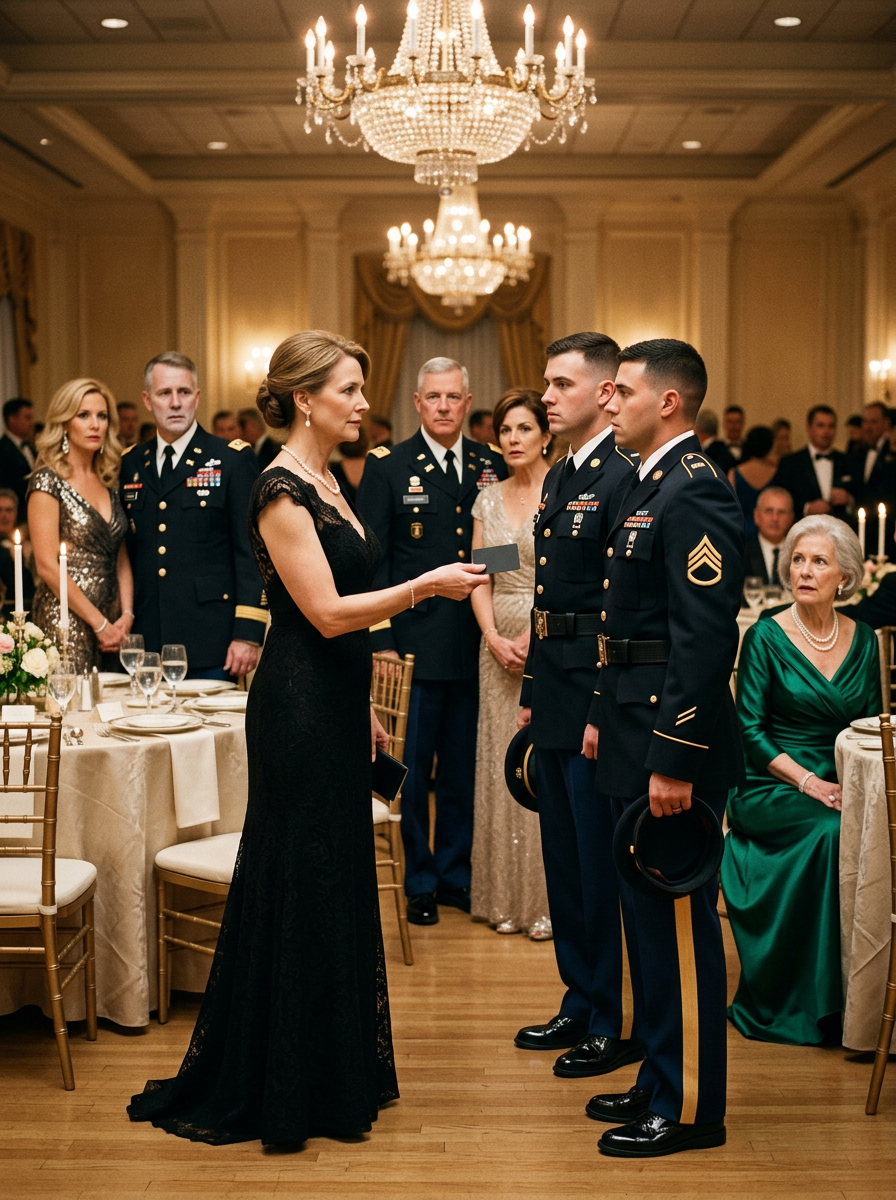
The ballroom at Fort Kingston looked like something out of a political drama. Crystal chandeliers glowed overhead. Polished medals flashed beneath soft golden light.
Officers in dress uniforms moved through the crowd with rehearsed smiles.
Everything looked elegant.
Everything except Table Nine.
Because my seat had disappeared.
I stood beside the table in a black evening gown, holding my clutch in one hand while staring at the empty space where my name card should have been.
My husband noticed immediately.
“Rachel…” he muttered.
Captain Daniel Whitmore looked uncomfortable enough to stop breathing. Tall. Sharp-jawed. Decorated.
But beside his mother?
He always looked twelve years old again.
Victoria Whitmore sat at the center of the table wearing emerald silk and pearls, smiling like a queen surveying her kingdom.
“Oh dear,” she said sweetly. “There must’ve been some confusion with seating arrangements.”
Across from her sat Caroline Hayes. The beautiful daughter of Lieutenant General Hayes. Blonde hair. Flawless posture. Diamonds catching the light every time she moved.
There was a name card in front of Caroline.
One in front of Daniel.
One in front of Victoria.
Mine had been removed.
Daniel cleared his throat nervously. “Mom… where is Rachel supposed to sit?”
Victoria blinked slowly. “I assumed she’d sit with the civilian spouses in the overflow section. This table is reserved for family and command guests.”
Nearby conversations quieted.
Not fully.
Just enough for people to hear the insult.
Daniel’s face reddened. “Mom…”
That was all.
Not “She’s my wife.”
Not “Put her seat back.”
Just “Mom.”
I placed my clutch on the table.
Victoria’s smile tightened. “Rachel, please don’t make a scene tonight.”
I smiled calmly. “Then stop creating one.”
Caroline glanced between us with barely concealed amusement.
Daniel touched my elbow, trying to guide me away.
That small gesture hurt more than the humiliation itself.
Because thirty minutes earlier, in the parking lot, he had told me:
“Please don’t bring up your old government work tonight. My mother gets weird about rank.”
Old government work.
That was his phrase for twelve years of classified military operations. Two overseas deployments. An extraction mission in Syria that nearly killed me.
And the scar beneath my ribs that still burned whenever it rained.
I laughed when he said it.
If I hadn’t, I might have told him truths he clearly wasn’t prepared to hear.
Victoria leaned back in her chair.
“Daniel,” she said smoothly, “why don’t you escort Caroline to the receiving line? General Hayes specifically asked about you earlier.”
Caroline stood before Daniel answered.
Then she touched his sleeve.
“Only if Rachel doesn’t mind,” she said politely.
I looked directly at my husband.
He hesitated.
At me.
At Caroline.
At his mother.
“I’ll only be a minute,” he said quietly.
Then he walked away beside another woman while his mother watched with open satisfaction.
That was the exact moment my marriage cracked permanently.
Victoria never hated me because I was rude.
I was never rude.
She hated me because I didn’t fit the future she imagined for her son.
So she made the mistake that destroyed everything.
She flagged down two military police officers.
“This woman doesn’t belong here,” she announced loudly enough for half the ballroom to hear. “I want her escorted out immediately.”
The room froze.
The MPs approached cautiously.
“Ma’am,” one officer said, “we’ll need to verify your credentials.”
I nodded calmly.
Reached into my clutch.
And handed him my black identification card.
His entire expression changed.
Color drained from his face.
He straightened so fast it startled the second MP beside him.
Then both officers stepped back simultaneously.
And one by one, every senior officer near our table slowly rose to their feet.
The orchestra stopped playing.
General Hayes turned toward me with visible shock.
Victoria’s confident smile disappeared completely.
And in a voice barely above a whisper, the MP asked:
“Ma’am… why didn’t anyone tell us Deputy Director Rachel Monroe was attending tonight?”
Even the general stopped talking.
My husband went completely pale.
And I stood in the middle of the silence, knowing the battle had only just begun.
What else had Victoria already taken from me before I ever walked into that room?
Type CARD and you’ll see the FULL Story in the c0mments.
PART 2
The military police officer scanned Rachel’s black identification card twice.
The first scan verified her identity. The second opened a restricted protocol notice that only appeared for a handful of senior intelligence officials.
Deputy Director Rachel Monroe, Defense Clandestine Operations.
General Hayes rose first. The officers nearest him followed—not because Rachel demanded ceremony, but because they recognized a woman whose work had brought soldiers home alive.
Victoria remained seated.
“This is absurd,” she said. “Rachel decorates houses for diplomats.”
“I advise them on secure facilities,” Rachel replied. “The decorating story was the version Daniel’s command was permitted to hear.”
Daniel stood beside Caroline, white-knuckled and silent.
The MP returned the card. “Ma’am, we received an automated security notification when your credential was scanned. General Hayes needs to see it.”
Rachel already knew what the alert would say. That was why she had come.
At 2:13 that morning, a classified NIGHTGLASS annex had been accessed using Daniel’s credentials. NIGHTGLASS was an extraction program Rachel had supervised overseas. The annex contained protected names, safe locations, and technical details that could endanger people still in the field.
Daniel had no official reason to open it.
General Hayes read the screen. “Captain Whitmore, surrender your phone and access token.”
The orchestra had stopped. Conversations collapsed into silence.
Victoria rose so abruptly her chair struck the floor. “My son has done nothing. Rachel is humiliating him because I corrected a seating mistake.”
“You called military police on an invited federal official,” Hayes said. “This is no longer about your table.”
Caroline moved one step away from Daniel.
Rachel saw it. So did Daniel.
The general ordered the ballroom doors monitored while investigators verified who had accessed the military network. Guests were asked to remain calm. The band resumed playing, but no one danced.
An investigator escorted Rachel, Daniel, Victoria, and Caroline into a conference room off the ballroom.
On the table sat a sealed evidence sleeve containing three photographs. Each showed pages from the NIGHTGLASS annex displayed on a laptop screen. The images had been recovered from an encrypted message sent to an account linked to a defense consulting firm.
Caroline worked for that firm.
“I’ve never seen those,” she said.
Daniel stared at the photographs. “Neither have I.”
Rachel watched her husband carefully. He had always touched his wedding ring when anxious. Now both hands remained flat on the table.
The lead investigator asked where Daniel’s access token had been overnight.
“In my uniform case at home.”
“Who could enter your home?”
Daniel looked at Rachel, then at his mother.
Victoria had a key.
Rachel had asked Daniel to take it back months earlier after Victoria entered their house while they were away and searched Rachel’s office. Daniel called that incident a misunderstanding.
Victoria lifted her chin. “I went to their home yesterday. Daniel forgot his dress gloves.”
“Did you enter Rachel’s office?”
“No.”
The investigator placed a fourth photograph on the table. It showed Victoria in Rachel’s office holding a black document folder.
Rachel’s security camera had captured it at 4:42 p.m.
Victoria’s face changed.
“I was protecting my son,” she said.
“From what?” Rachel asked.
Victoria looked at Caroline.
Caroline had told her that Rachel’s secret work was blocking Daniel’s promotion. She said one file in Rachel’s office could prove Rachel had used her influence to keep him at captain. Victoria took the folder and delivered it to Caroline at the ball hotel.
Daniel closed his eyes.
Rachel understood his terror then. He had known his mother took something from the house. He had chosen not to warn his wife.
But the folder Victoria stole had contained only a decoy briefing.
The real NIGHTGLASS annex could be opened only through a secure military terminal.
Someone had used Daniel’s credentials after Victoria delivered the folder—and Daniel had just lied about never seeing the pages.
PART 3
The ball ended without speeches or dancing.
Daniel was placed on administrative restriction and ordered to surrender his access credentials. Caroline’s phone and laptop were seized. Victoria was questioned for three hours, then released pending investigation.
Rachel returned home alone.
At 1:00 a.m., she stood inside her office and looked at the empty shelf where the black folder had been. Daniel had dismissed every violation that led to it. His mother’s key. Her unannounced visits. The questions she asked about Rachel’s deployments. The way she opened drawers and called it tidying.
He had treated boundaries as insults to Victoria instead of protection for his marriage.
The next morning, Daniel arrived with an escort to collect uniforms and medication.
“I didn’t give Caroline that file,” he said.
“You knew your mother took my folder.”
“She called me from the hotel. She said she found proof you were damaging my career.”
“And you believed her?”
“I didn’t know what to believe.”
“You knew enough not to call me.”
Daniel admitted that Caroline had been messaging him for months. She said General Hayes could recommend him for a competitive assignment. She also told him Rachel’s classified position made him look weak—an officer whose wife held more power than he did.
He insisted their relationship was not physical.
Rachel remembered Caroline’s hand on his sleeve and his willingness to walk away beside her.
“Betrayal doesn’t begin in a hotel room,” she said. “It begins when you protect a secret at home.”
The investigators recovered deleted messages from Daniel’s phone. He had sent Caroline his work schedule, training reports, and internal briefing notes. Most were unclassified. One message was not.
At 1:58 on the morning of the ball, Caroline asked him to verify a NIGHTGLASS code printed in the stolen folder.
Daniel responded: I can check when I get to headquarters. Then this ends.
At 2:13, he inserted his token into a secure terminal and opened the real annex.
He claimed he only viewed the first page. The access log showed the file remained open for four minutes—long enough for three photographs to be taken.
A hallway camera showed Daniel entering the secure room alone. No camera covered the terminal itself.
Caroline said Daniel sent her the pictures. Daniel said someone remotely captured his screen.
Then investigators found a hidden messaging application on Victoria’s tablet.
The account had transmitted the photographs.
Victoria denied knowing the application existed. Caroline had installed it while helping her “organize family pictures.” Device data showed the images arrived from a nearby phone and were forwarded automatically to the consulting firm’s encrypted address.
Caroline’s phone had been near the secure building at 2:13 a.m.
General Hayes was devastated. His daughter had used his name, his position, and his access to military social events to cultivate officers who wanted his approval.
The consulting firm employed a former intelligence broker already under federal investigation. NIGHTGLASS technical details could have been sold to a foreign buyer.
Caroline was arrested for conspiracy and unlawful retention of defense information.
Daniel was charged under military law with mishandling classified material, false official statements, and conduct unbecoming an officer.
Victoria still defended him.
She told investigators Rachel had emasculated Daniel by hiding her rank. She claimed any husband would seek proof if his wife secretly controlled his career.
Rachel had never touched his promotions.
In fact, she had declined two opportunities to recommend him because she wanted his record to stand without her influence.
Then the review board found a memorandum in Daniel’s personal cloud storage.
It accused Rachel of abusing her office, suffering from combat-related instability, and using classified authority to intimidate her family. Daniel had drafted it six weeks earlier.
The document listed Victoria and Caroline as witnesses.
It ended with a request that Rachel’s clearance be suspended.
PART 4
Rachel read Daniel’s memorandum in a secure interview room.
He described her nightmares, the scar beneath her ribs, and the nights she checked the locks twice. Private wounds she had trusted him to hold had become evidence in a campaign to remove her.
If the complaint had been filed before the NIGHTGLASS breach, Rachel could have been suspended while Daniel and Caroline framed every objection as instability.
Daniel insisted the memorandum was only insurance.
“Against what?” Rachel asked.
“Against you ending my career.”
“I protected your career from my name for twelve years.”
He looked away.
Caroline’s attorney offered investigators a different story. Caroline admitted cultivating Daniel but claimed he acted willingly. She said he resented Rachel and wanted access to the consulting firm’s wealthy clients. In exchange for NIGHTGLASS information, the firm would arrange a private-sector position after Daniel left the Army.
She produced messages in which Daniel wrote: Once Rachel is under review, she cannot touch either of us.
Daniel said the message referred to his promotion complaint, not the stolen file.
The case moved toward an Article 32 preliminary hearing. Rachel was both a witness and the official responsible for NIGHTGLASS damage assessment. To avoid any appearance of influence, she recused herself from Daniel’s prosecution.
Victoria used that restraint against her.
She gave interviews to military-family blogs, portraying Daniel as a devoted officer destroyed by an ambitious wife. She said Rachel had staged the ballroom humiliation and used “a mysterious black card” to frighten everyone into obedience.
The Army issued a narrow statement confirming that Rachel’s credentials were valid. It could not reveal her missions or explain why officers respected her.
Secrecy protected the country and left Rachel undefended in public.
Then a retired colonel named Owen Price contacted her attorney.
Price had chaired Daniel’s promotion review the previous year. Victoria approached him twice, asking whether Rachel had interfered. When he said no, Victoria offered him private information that could “neutralize” Rachel’s influence.
Price had documented both conversations.
His statement proved Victoria’s campaign began long before the ball. It did not prove who photographed the NIGHTGLASS pages.
At the hearing, prosecutors presented access logs, device records, and Daniel’s deleted messages. Daniel’s defense argued that Caroline exploited him and transmitted the images without his knowledge.
Then Daniel took the stand.
He admitted opening the annex. He admitted violating protocol. But he claimed Rachel had ordered him to verify the code through an unofficial conversation at home.
The hearing room went still.
“Deputy Director Monroe told me the file was safe to access,” he said. “When it became a problem, she protected herself.”
His attorney produced an audio recording.
Rachel’s voice said, Open NIGHTGLASS and check the identification sequence. Do it before the ball.
The recording sounded clear, calm, and unmistakably hers.
Victoria smiled for the first time since Table Nine.
The investigating officer turned toward Rachel.
If the recording was authentic, she had ordered the breach that could end her own career.
PART 5
Rachel listened to the recording twice.
The voice was hers, but the sentence was not.
Someone had assembled it from classified training briefings she recorded years earlier. Each word was genuine. The command was manufactured.
Daniel’s attorney demanded proof.
Rachel could not simply play the original briefings in an open hearing. Their contents remained classified. For the first time, the secrecy that shaped her life seemed capable of destroying it.
Then the forensic audio specialist identified a flaw.
A secure recording system used during Rachel’s old briefings embedded a low-frequency verification tone every eight seconds. The human ear could not hear it. In Daniel’s file, the tone restarted in the middle of three words.
The sentence contained seven separate cuts.
Under protective procedures, the hearing officer reviewed the source recordings and confirmed that Rachel had never addressed Daniel or ordered him to access NIGHTGLASS.
Device metadata showed the fabricated audio had been created on Caroline’s laptop. A draft was sent to Daniel three days before the ball.
Daniel replied: Make it sound less formal. She knows how I talk.
The lie collapsed.
Daniel had not been a confused husband manipulated in a single moment. He had helped prepare evidence against Rachel before he opened the annex.
Investigators recovered the rest from a concealed cloud account. Daniel and Caroline had planned to file the false complaint, trigger Rachel’s suspension, and use the review period to obtain more material. Caroline promised Daniel a security position paying three times his Army salary.
Victoria supplied details about Rachel’s marriage, medical history, and routines. She claimed she never understood that classified information would be taken. But her messages showed she knew the goal was to “get Rachel’s authority out of the way.”
The black folder was bait in more ways than one.
After the first unexplained search of her office, Rachel had placed a tracking strip inside a decoy folder and activated the security camera. She did not expect Victoria to take it. She needed to know whether someone was entering the room.
The tracking record showed Victoria carried the folder to Caroline’s hotel suite. Hotel footage showed Daniel entering that same suite later. He stayed forty-seven minutes.
Caroline had lied about the nature of their relationship. So had Daniel.
At his court-martial, Daniel pleaded guilty to multiple charges after the fabricated recording and cloud messages were admitted. He was dismissed from the service and sentenced to confinement. Federal prosecutors separately charged Caroline with conspiracy and offenses involving protected defense information. Her consulting firm lost its contracts and became the subject of a wider investigation.
General Hayes recused himself from every stage involving his daughter. He later sent Rachel a handwritten apology—not for Caroline’s crimes, which were not his to confess, but for failing to see how she used his name.
Victoria was charged with theft of government property and obstruction. Her public story changed three times before her attorney persuaded her to stop giving interviews.
The divorce was quieter than the military proceedings.
Daniel asked Rachel to remember the man he had been before envy took hold. Rachel did remember him. That was what made leaving necessary. She could mourn the husband she thought she had without remaining married to the man who weaponized her scars.
She refused to protect his pension, reputation, or relationship with his mother. She also refused to destroy him beyond what the evidence required.
For the first time, consequences belonged entirely to him.
Months later, Rachel attended another formal Army event at Fort Kingston. She wore the same black gown.
This time, her name card waited at the center table.
She moved it.
Rachel chose a smaller table near the back, beside analysts, medics, interpreters, and two young officers whose work would never appear in public citations. They understood that service was not a performance of rank. It was what remained when applause, family names, and polished uniforms were stripped away.
During the receiving line, an MP recognized her and began to straighten.
Rachel smiled and offered her hand before he could salute.
Across the ballroom, Table Nine had been rearranged. Caroline’s chair was gone. Victoria was not invited. Daniel’s name no longer appeared on the officer roster.
The orchestra began to play.
No room fell silent for Rachel that night, and she was grateful.
She had spent years making herself smaller so her husband could feel taller.
Now she stood at her full height, carrying a name no one else would ever use against her again.