Maya is eight.
Eight.
She isn’t the kind of child who invents frightening things just to make a story sound more exciting. She doesn’t lie for attention. She barely raises her voice even when she’s thrilled. She is quiet, gentle, and still believes the moon follows our car because it likes her.
That was why, when she said it so calmly that morning, something inside me cracked.
— Dad… every night a man enters your room after you’ve already fallen asleep.
My hands slipped slightly on the steering wheel.
— What did you just say?
She continued looking out the window as we drove toward school, watching storefronts and traffic pass as if she were describing the weather.
— He walks very slowly, she said. — Like he doesn’t want the floor to make noise. Mom closes her eyes, but she doesn’t say anything.
There was no fear in her voice.
No uncertainty.
Only certainty.
And that certainty turned my blood cold.
— Maya… where did you get that from?
She shrugged.
— I see him.
The rest of the drive felt wrong. The air inside the car seemed suddenly too thick. I kept checking her reflection in the mirror, waiting for a grin, a laugh, any indication that this was some strange story she’d invented.
Nothing came.
She simply adjusted the straps of her pink backpack and hummed softly, as though she hadn’t just opened a hole beneath my feet.
Maybe she’d dreamed it.
Maybe she’d watched something online.
Maybe she’d seen a shadow in the hallway and her imagination had turned it into a person.
Maybe.
But sometimes a sentence hits your chest before your mind has time to explain it away.
I dropped her at school. She kissed my cheek, climbed out, and hurried toward the gate with her pink backpack bouncing behind her.
I watched until she vanished among the other children.
For a second, it felt like the entire world tilted.
Then I drove straight home.
My wife was in the kitchen exactly where she normally was at that hour. Morning light filled the room. Coffee steamed beside the toaster. Her hair was tied back, and when she saw me, she smiled as though nothing had changed.
— You’re back already?
For the first time since marrying her, I didn’t know how to look at my own wife.
I wanted to laugh at myself.
I wanted to repeat what Maya had told me and let Sarah explain the whole thing away in ten seconds.
I wanted to believe our daughter had confused a dream with reality and that my marriage was still the safe place I’d always believed it was.
Instead, I stood there gripping my keys and noticed details I’d somehow ignored before.
The dark circles beneath Sarah’s eyes.
The long sleeves despite the warm weather.
The tiny flinch when I moved closer, as though she’d been somewhere distant and needed a moment to return.
She asked if everything was okay.
I said yes.
For the rest of that day, I moved through my own house like a stranger temporarily living there.
Every sound seemed sharper.
Every silence carried weight.
When Sarah’s phone buzzed on the counter, she picked it up too quickly. Later, when she stepped into the laundry room to answer a call, I caught only one sentence before her voice dropped.
— Tonight then… after he’s asleep.
My stomach dropped so suddenly I had to steady myself against the wall.
A moment later, Sarah returned carrying towels, completely calm, and asked whether I wanted chicken or pasta for dinner.
I told her I didn’t care.
She studied me a second longer than usual, as though she knew something had shifted, but neither of us said another word.
Not during dinner.
Not while Maya talked about spelling practice.
Not while we washed the dishes.
Not as the house gradually became quiet for the night.
Before bed, I stopped outside Maya’s room.
— Have you really seen him every night?
She nodded against her pillow.
— He always comes when it’s very dark. He carries something. Mom never screams. She just looks sad.
Sad.
That word should have made me slow down and think.
It didn’t.
Sarah came to bed around eleven. She smelled like soap and something faintly sterile that I couldn’t identify.
She asked whether I’d taken my sleeping pill.
I said yes.
I even let her hear the bathroom faucet running, but instead of swallowing the tablet, I spat it into the sink and slipped it into my pocket.
Then I climbed into bed beside her and waited.
I made my breathing slow and heavy.
Regular.
Believable.
Beside me, Sarah’s breathing sounded wrong too.
Too controlled.
Too awake.
At 1:13, the bedroom door began to move.
Not quickly.
Slowly.
Like whoever was opening it had done this many times before.
A narrow strip of hallway light stretched across the floorboards.
Then someone stepped inside.
A man.
Tall.
Careful.
Silent.
He closed the door without allowing the latch to click.
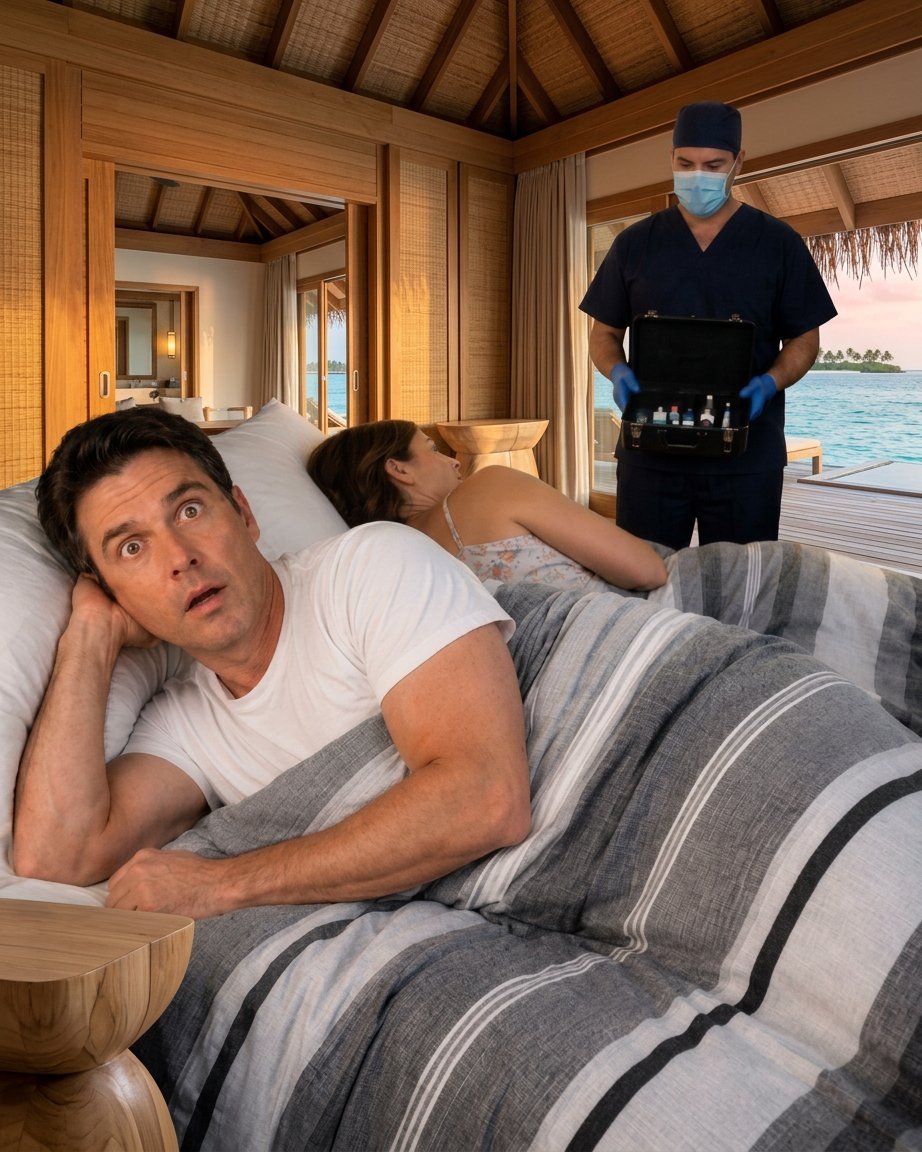
In one hand, he carried a narrow black case.
He didn’t switch on a light.
He knew exactly where he was going.
Sarah’s side of the bed.
My entire body went rigid.
She didn’t move, but I saw her eyes squeeze tighter—not like someone sleeping, but like someone preparing herself.
The man stopped beside her.
For several seconds, nobody spoke.
Then he bent slightly and whispered in a voice so low it twisted my stomach.
— It’ll only take a minute.
Sarah gave the smallest nod.
Something primitive surged through me.
Rage.
Humiliation.
The hot, dizzy kind that wipes away reason.
I could already imagine myself lunging across the mattress.
Then I heard another sound.
A soft snap.
Rubber.
Latex.
A faint sterile smell reached me through the darkness.
Alcohol.
Plastic.
Something clinical and cold.
The black case opened with a soft metallic click.
Sarah lifted one trembling hand toward the collar of her nightshirt.
The stranger leaned over her, reached into the open case, and lifted something thin and silver into the narrow strip of light beside our bed.
My hand was already moving toward the lamp.
I clicked the switch.
Yellow light flooded the room, tearing through the shadows and blinding all three of us.
The man spun around, shielding his eyes with one gloved forearm. I surged upright, the mattress groaning beneath me. My chest heaved, my hands clenched into fists, every nerve in my body ready for a confrontation.
“Get the hell away from her!” I roared.
Sarah gasped and sat up, clutching the collar of her nightshirt.
“David, stop! Wait!”
The stranger cautiously stepped backward and raised both gloved hands.
He wore a dark, unbranded tracksuit. A surgical mask rested beneath his chin, and a lanyard with a small identification badge hung around his neck.
“Sir, please calm down,” the man said, his voice flat, exhausted, and entirely unbothered by my aggression. “I’m not here to hurt anyone.”
My eyes jumped between him and Sarah.
The narrow black case was open on the nightstand.
Inside were organized compartments filled with sterile medical supplies—vials, alcohol wipes, disposable syringes, and a sleek handheld mechanical pump attached to a thin silver needle.
An IV port applicator.
I turned toward my wife.
Her nightshirt collar had been pulled down on the left side, exposing a square patch of medical tape covering a semi-permanent port beneath her collarbone.
The skin surrounding it was bruised in shades of purple and yellow.
The rage disappeared from my chest so quickly that it left behind nothing but icy confusion.
“What… what is this?” I breathed, my voice cracking. “Sarah, what is this?”
She couldn’t look at me.
Sarah buried her face in her hands as her shoulders began to shake.
“I’m sorry,” the man murmured softly, reaching down to close the black case. “I should let you two talk. Mrs. Vance, we didn’t complete the infusion, but I set the line. I’ll step outside for ten minutes.”
“Infusion?” I repeated, the word tasting like ash in my mouth. “What infusion? Who are you?”
“I’m Marcus,” he said, pulling off his latex gloves with a crisp snap. “I’m a private home-care nurse. I’ve been coming here at night for the past three weeks to administer your wife’s late-stage trial treatment.”
He picked up his case and quietly left the room, closing the door behind him.
The silence afterward felt heavier than the darkness had.
I sat on the edge of the mattress staring at Sarah.
Under the bright lamplight, I suddenly saw everything I’d somehow failed to recognize during the previous six months.
The hollowed cheeks.
The sharpness of her collarbones.
The unnatural paleness of her skin.
“Sarah…” My voice was barely a whisper. “Talk to me. Please.”
She pulled her knees against her chest and wrapped her arms around them.
When she finally looked up, tears filled her eyes.
“It started eight months ago,” she said quietly, her voice trembling. “Persistent fatigue. Joint pain. I thought I was just getting older, or stressed from managing the house while you worked those eighty-hour weeks at the firm. I went for a routine blood test.”
She stopped and swallowed before forcing herself to continue.
“It’s aggressive, David. A rare strain of non-Hodgkin’s lymphoma. By the time they caught it, it was already advanced.”
The room seemed to move around me.
For a moment, I couldn’t speak.
“Why didn’t you tell me?” I finally choked out, my eyes burning. “How could you keep something like this from me? I’m your husband!”
“Because you were already drowning!” she cried, the raw emotion finally spilling over. “Your father had just passed away, you were trying to make partner, and you were having panic attacks in the car every morning! If I told you, you would have broken. You would have given up your career, your sanity, everything, to watch me deteriorate.”
“So you just… handled it alone?” I asked, tears finally slipping down my cheeks. “Every night?”
“I couldn’t do standard chemo during the day without you noticing the hair loss and the sickness,” she explained, wiping her eyes with the back of her hand. “My doctor managed to get me into an experimental targeted-immunotherapy trial. But the medication has a strict 24-hour cycle and causes extreme nausea and drop in blood pressure right after administration. The trial sponsor agreed to send a midnight mobile nurse so I could receive the infusion while you slept, take the anti-emetics, and recover by morning before Maya woke up.”
Her gaze dropped toward her hands.
“Every night, I gave you a mild herbal sleep aid in your evening tea so you wouldn’t wake up to the sound of the door opening or me being sick in the bathroom. I was trying to protect you. Both of you.”
I covered my face with my hands as a broken sob tore through my throat.
The weight of my own assumptions crushed me.
I’d spent an entire day imagining the worst kind of betrayal while Sarah had been quietly fighting for her life in the bed beside me.
“And Maya…” I whispered, glancing toward the bedroom door. “She saw him.”
“Marcus is always quiet,” Sarah said softly. “But our floorboards squeak outside her room. She must have woken up, peeked through the door crack, and seen him coming in. I never knew she saw.”
I moved around the bed and sat beside her.
Then I wrapped my arms around her thin frame, holding her so carefully and tightly that I was almost afraid she’d break.
“No more secrets,” I sobbed into her hair. “No more pills in my tea. No more hiding in the dark. I don’t care about the firm. I don’t care about making partner. I am here. We fight this together.”
She clung to me and cried, finally releasing the weight she’d carried alone for months.
—
The next morning, the house was quiet.
I sat at the kitchen counter with two cups of coffee cooling in front of me.
Sarah was resting upstairs. Marcus had completed the infusion after our conversation, and the medication had left her weak and nauseous.
I had already called out of work indefinitely.
No elaborate explanation.
No apology to my boss.
Nothing at the firm mattered more than the two people inside my house.
Small footsteps came down the stairs.
Maya appeared in the kitchen doorway with her pink backpack over one shoulder, her large brown eyes searching my face.
She looked uncertain, clearly sensing that something in our home had changed.
“Dad?” she asked softly. “Is Mom sick?”
I put down my mug and walked toward her.
Then I knelt until we were eye level and gently brushed her hair away from her face.
“She is, sweetie,” I said, keeping my voice calm and gentle. “She’s been sick for a little while, but she was trying really hard not to worry us.”
Maya lowered her eyes and bit her lip.
“Was that man… a doctor?”
“He’s a nurse,” I explained, smiling softly to reassure her. “His name is Marcus. He comes at night to give Mom special medicine that helps her body fight the sickness. He’s a good guy, Maya. He’s helping her get better.”
She stayed silent for several moments, trying to understand.
Then she looked back at me with an expression far too serious for an eight-year-old.
“Is Mom going to be okay?”
“We’re going to do everything we can to make sure she is,” I promised, pulling her into a warm hug. “And you helped us, Maya. Because you told me what you saw, I found out the truth. You were a brave little girl.”
Her arms tightened around my neck and she rested her head on my shoulder.
“I don’t want Mom to look sad anymore.”
“She won’t have to face it alone anymore,” I whispered. “Neither will we.”
—
The following months were the hardest our family had ever faced.
But at least we weren’t moving through them in darkness anymore.
I took a leave from the firm.
I cooked, cleaned, drove Maya to school, and kept track of Sarah’s seemingly endless medical appointments.
Marcus continued coming at night for another three months until the experimental treatment ended.
The difference was that now I met him at the door.
I brought him water.
And during every infusion, I sat beside Sarah and held her hand.
There were days when the treatment left her too weak to get out of bed.
Days when fear returned to the house and seemed to settle into every room.
But we didn’t hide from it anymore.
We talked.
We cried.
We held each other when things became unbearable.
By the time winter arrived, a different kind of quiet had settled over our home.
Not the secretive, heavy silence from before.
Something peaceful.
It was a Tuesday afternoon in December when Sarah’s oncologist called.
Sarah was sitting on the living-room sofa wrapped in a thick wool blanket while Maya read beside her.
I stood near the window with the phone against my ear, my heartbeat pounding against my ribs.
“David?” the doctor’s voice came through the speaker. “I have the results from Sarah’s latest PET scan.”
My grip tightened around the phone.
“Go ahead, Doctor.”
“The targeted trial was a complete success,” she said, her tone light and full of warmth. “The tumors have shrunk completely. There is no evidence of active disease. Sarah is officially in full remission.”
I lowered my head as tears spilled down my face.
For several seconds, I couldn’t speak.
Then I crossed the room, dropped to my knees in front of Sarah, and rested my forehead against her lap.
“David?” Sarah asked, her hand instantly finding my hair. “What did she say?”
I looked up at her through tears.
“It’s gone,” I choked out, looking up at her with a tearful smile. “It’s all gone, Sarah. You’re in remission.”
Sarah gasped.
Her hands flew to her mouth as tears filled her eyes.
Maya dropped her book and threw herself around both of us, squealing with happiness. She probably didn’t understand exactly what remission meant.
She only knew the frightening days were finally ending.
—
That night, for the first time in nearly a year, our house felt completely safe.
No midnight footsteps moved down the hallway.
No shadow quietly entered our bedroom.
No one carried a secret burden alone in the darkness.
I lay beside Sarah listening to the calm rhythm of her breathing.
Color had begun returning to her cheeks, and the deep shadows beneath her eyes had faded.
I reached across and switched off the bedside lamp.
The room settled into comfortable darkness.
Outside, light snow had started falling, covering the trees in soft white.
Then I heard Maya’s bedroom door open down the hallway.
A moment later, small feet padded across the floorboards.
She peeked into our room clutching her stuffed bear.
“Dad?” she whispered into the dark.
“Yeah, sweetie?” I replied, raising my voice slightly so as not to startle her.
“Can I sleep with you guys tonight?” she asked. “Just for a little bit?”
Sarah stirred beside me, smiling through the darkness, and lifted the edge of the duvet.
“Come here, Maya.”
Maya hurried over, climbed into the middle of the mattress, and wriggled beneath the covers between us.
Sarah wrapped one arm around her.
I reached across them both and rested my hand over theirs.
“Dad?” Maya whispered, staring at the ceiling.
“Yes, Maya?”
“The moon really does follow our car, right?”
I smiled into the darkness and pulled my family closer.
“It sure does, kiddo,” I said softy. “It follows us everywhere we go.”
PART 2
The first morning after the truth came out, our house felt like a place relearning how to breathe.
No one pretended anymore.
Not me.
Not Sarah.
Not even Maya, who kept looking from one of us to the other with the grave concentration of a child who knows adults are finally saying the real thing out loud.
I knelt in the kitchen until we were eye level and told her what I could tell her without making her carry more than a child should. Her mother was sick. The man she saw at night was not a stranger hurting us. He was a nurse helping her. And because Maya had spoken up, we now knew how to protect each other better.
She took that in quietly, one careful piece at a time.
“Is Mom going to be okay?” she asked.
“We’re going to do everything we can,” I told her.
That was the truest sentence I had.
After she left for school, I sat at the kitchen counter with two cups of coffee cooling between us while Sarah leaned into her chair as if gravity had changed. In daylight, the bruising near the port was impossible to ignore. So was the exhaustion under her eyes. I had been living beside evidence for months and calling it stress because that explanation cost me less in the short term.
Now the cost of my own inattention was sitting across from me, pale and emptied out from a treatment I had never even known existed.
She apologized first.
Not for the illness.
For the secrecy.
For the tea.
For deciding alone what I could and could not survive.
I listened all the way through because interruption would only have been another form of control. Then I told her the part I hated most.
“I thought the worst thing possible,” I said. “Our daughter handed me the truth and I turned it into betrayal before I turned it into fear.”
Sarah shook her head immediately.
“You turned it into danger,” she said. “That’s what any parent would do if a child said a man was entering the room at night.”
Maybe.
But the word still lodged in me.
Danger.
Because she had been in danger the whole time and I had not known.
That day I called the firm and said I was taking leave indefinitely. No polished explanation. No timeline. No negotiation. My boss tried to ask whether something catastrophic had happened. I looked up at the bedroom ceiling while Sarah slept and answered, “Yes.” He stopped asking after that.
Marcus returned that night, and this time I met him at the door before he could reach the hallway. Without the dark and the panic around him, he looked younger than I expected and more tired. The black case in his hand no longer looked sinister. It looked expensive, careful, and necessary.
He apologized for the shock.
He didn’t need to.
Instead, I asked him to walk me through everything. The treatment schedule. What the bad nights usually looked like. What symptoms meant call now instead of wait. Which reactions were common. Which ones were dangerous. He answered plainly, without ego, as if the fastest way to make me useful was to trust me with the whole picture.
That changed something in me immediately.
The helplessness shrank.
Not the fear.
Fear stayed.
But fear and helplessness are not the same thing.
For the first time since Maya spoke in the car, I understood what action looked like.
It looked like anti-nausea medication arranged before midnight.
A bucket within reach.
A clean blanket warmed in the dryer.
The port supplies lined up in order.
A husband sitting awake on purpose.
And a wife who no longer had to fight for her life while pretending to sleep beside him.
PART 3
The months that followed were the hardest our family had ever lived through, not because the treatment was dramatic every day, but because it was relentless.
Everything reorganized itself around a cycle that had once been hidden inside the dark. Appointments. Bloodwork. Insurance calls. Trial updates. Pharmacy pickups. School lunches. Laundry. Dinners that had to be ready even when nobody felt hungry. The kind of labor families do when survival becomes domestic.
Marcus kept coming at night for three more months, but now the front door opened before he knocked. I would have water ready for him. Sometimes coffee. Sarah used to apologize each time the infusion left her too weak to hold a conversation afterward. Eventually she stopped apologizing, which I took as a sign of healing just as much as any lab number.
Maya adapted in the child-sized way children do when adults finally stop lying by omission. She learned Marcus’s name. She stopped calling him “the man.” Some nights she left a drawing on the kitchen counter for her mother before bed—a sun, a rabbit, the three of us standing beside a crooked blue house that looked nothing like ours and somehow exactly like us. Once she asked if cancer had feet because it seemed to keep chasing us from room to room. Sarah laughed for the first time in weeks.
That laugh nearly undid me.
Illness changes the arithmetic of a marriage. Things you once argued about become too small to mention. Other things, the ones you thought were settled by love alone, reveal how unfinished they always were. Sarah and I had to say hard things once the worst secret was out.
She admitted she did not trust me to survive the knowledge without imploding my own life around it. She had watched me unravel after my father died, watched me tie my identity so tightly to work that the thought of adding her illness on top of it felt like placing more weight on a beam already cracking.
I wanted to deny that.
I couldn’t.
She was right.
For years I had translated stress into work because work obeyed me in a way life didn’t. But cancer does not care how many hours you bill, how disciplined you are, or how convincing your calm sounds on conference calls. It humiliates the illusion that competence alone can protect the people you love.
There were days I hated myself for not seeing sooner. Days I hated her for not telling me. Days both feelings sat together until neither had enough purity left to be useful. On those days, Marcus would finish the infusion, close the case, and remind us both to eat something salty and sleep in shifts.
He never tried to become part of the family.
He became part of the system that kept us from breaking.
By late autumn, our house no longer felt haunted. It felt disciplined. The fear was still there, but it was named now. That changed the texture of everything. We knew what time the medication would hit hardest. We knew when Sarah would likely shiver and when her blood pressure would dip. We knew which jokes Maya made when she was afraid and which questions meant she needed the truth simpler than adults usually like to give it.
And through all of it, something else changed in the marriage too.
I stopped thinking of myself as the person rescuing Sarah.
She was not a crisis to manage.
She was the woman who, even while ill, had still been protecting Maya’s lunch forms, checking whether the heating bill had been paid, and worrying about whether my suits were back from the cleaners. The treatment stripped away vanity, but not character. If anything, it revealed hers more clearly.
One night, after Maya finally fell asleep between us on the couch during a movie she never finished, Sarah turned to me and said, “I thought if I kept it contained, maybe cancer wouldn’t get to become the center of our family.”
I looked at our daughter’s sleeping face and at the infusion bruise fading slowly under Sarah’s collarbone.
“It was never the center,” I said. “The silence was.”
She cried then.
Quietly.
Not because she disagreed.
Because we both knew it was true.
PART 4
By early December, the formal trial period ended, but the waiting did not.
That was the cruel part nobody prepares families for. After months of appointments and midnight infusions and measurable suffering, you still arrive at a week where all you can do is wait for a scan and a doctor’s voice and the interpretation of images nobody in the house can read for themselves.
The fear changed shape then.
During treatment, fear is busy. It has tasks. Pills to organize. Thermometers to check. Schedules to remember. Questions to write down for the oncologist. After treatment, fear becomes quieter and therefore sharper. It starts living in ordinary moments. Sarah pausing at the top of the stairs. Me watching her too closely when she laughed, as if energy itself could be a false signal. Maya asking if the nurse would still come tonight and then pretending she only asked because she liked his stickers.
Marcus’s visits stopped after the trial concluded, and that absence was its own kind of haunting at first. For three months his knock had meant action. Medication. Procedure. The next step, however difficult. Without it, the house had to rely on uncertainty instead of ritual.
I had not realized how much ritual had held us together until it was gone. I kept checking the clock at the old infusion hour. Sarah kept glancing toward the hallway as if expecting the soft knock to return. Even Maya noticed the shape of the missing thing and asked one night whether Marcus was helping somebody else’s mommy now.
“Probably,” Sarah said gently.
Maya nodded as if that mattered.
Maybe it did. Maybe children understand better than adults that help moving elsewhere means someone, somewhere, still needs it.
The scan was scheduled for a Tuesday afternoon.
Sarah spent the morning pretending to read while turning the same page every few minutes. I pretended to answer emails from work even though I had already written the same sentence twice and deleted it both times. Maya went to school with a brave face and asked whether she could sleep in our bed “even if nothing bad happens tonight, just because.”
At the imaging center, everything was aggressively normal. Soft voices. Gray carpeting. A coffee machine humming in the corner. Other families holding clipboards and pretending not to study each other’s faces. We sat side by side and said almost nothing.
On the drive home, Sarah stared out the window and said, “If it didn’t work, I don’t want Maya watching me disappear in pieces.”
I gripped the steering wheel so hard my hands hurt.
“It worked,” I said.
But hope spoken aloud is still not proof.
That night was the longest of the whole year.
Not the night Maya first told me about the man. Not the night I switched on the lamp. Not even the first infusion. This one. Because by then we loved each other with the truth fully exposed, and truth gives fear a cleaner surface to land on.
No one slept much.
The house made all its ordinary sounds louder than usual. The heat kicking on. Pipes shifting in the walls. Maya turning over in her room. Sarah’s breathing when it caught for one second and then settled again. I must have looked at the clock thirty times between midnight and dawn. Every hour felt like a test of whether patience can hold when there is truly nothing left to do.
We just waited for the call that would tell us whether the house we had rebuilt around honesty would now have to learn another, crueler kind of courage.
PART 5
The call came on a Tuesday afternoon in December while Sarah sat on the sofa wrapped in a wool blanket and Maya read beside her with one foot tucked under her leg.
I took it standing near the window.
By the time the doctor said the words complete success and no evidence of active disease, I had to put one hand against the wall to stay upright.
When I crossed the room and dropped to my knees in front of Sarah, I think she knew before I spoke.
“It’s gone,” I told her. “You’re in remission.”
Maya didn’t understand the medicine of the word, only the joy in our faces. That was enough. She threw herself at both of us and started crying because we were.
That night the house felt safe in a way it had not for nearly a year. Not perfect. Not magically cleansed of fear forever. But safe. No hidden footsteps. No secret infusions. No one carrying terror alone in the dark and calling it love.
Later, when Maya padded into our room holding her stuffed bear and asked to sleep between us for “just a little bit,” we lifted the blanket without hesitation. Sarah wrapped an arm around her. I placed my hand over both of theirs.
Then Maya asked if the moon really does follow our car.
“It sure does,” I told her.
And for once, the answer felt large enough for all three of us.
The years after that did not erase what happened. We did not want them to. Sarah stayed in remission. I never went back to the version of work that mistook absence for sacrifice. Maya grew old enough to remember that children sometimes see the truth before adults are ready to name it.
She asked different questions after that winter. Not frightened ones anymore. Wiser ones. Why do grown-ups hide things if they love each other? Why do people say they’re fine when they’re not? Sometimes Sarah and I had answers. Sometimes we only had honesty.
I learned that honesty is often enough.
I also learned something I should have known before the blizzard of my own assumptions hit our house.
Love does not become stronger by hiding the wound from the people who would help carry it.
It becomes lonelier.
What saved us was not bravery in the dramatic sense. It was the decision, once the light came on, to stop pretending we were safer in the dark.
And afterward, on the quiet nights when Maya’s bedroom door stayed shut and Sarah’s breathing stayed deep and easy beside me, I would lie awake for a minute and listen — not for danger this time, but for the ordinary sounds of a life that had been given back to us. The house no longer felt like a place hiding a secret I was too blind to see. It felt like ours again. Safe enough for ordinary mornings, spilled cereal, unfinished homework, and the kind of domestic mess no one needs to apologize for.
Sometimes survival sounds like sirens and shouted instructions. Sometimes it sounds like nothing at all, and that silence is mercy enough at last.
For us, that was enough.