PART 1
One day before my brother’s wedding, he demanded my penthouse and told me to move into a rental home. When I refused, he grabbed my hair and threw me to the floor while I was eight months pregnant. My water broke. My parents watched everything and walked away. I screamed… And two minutes later, there was a knock at the door…
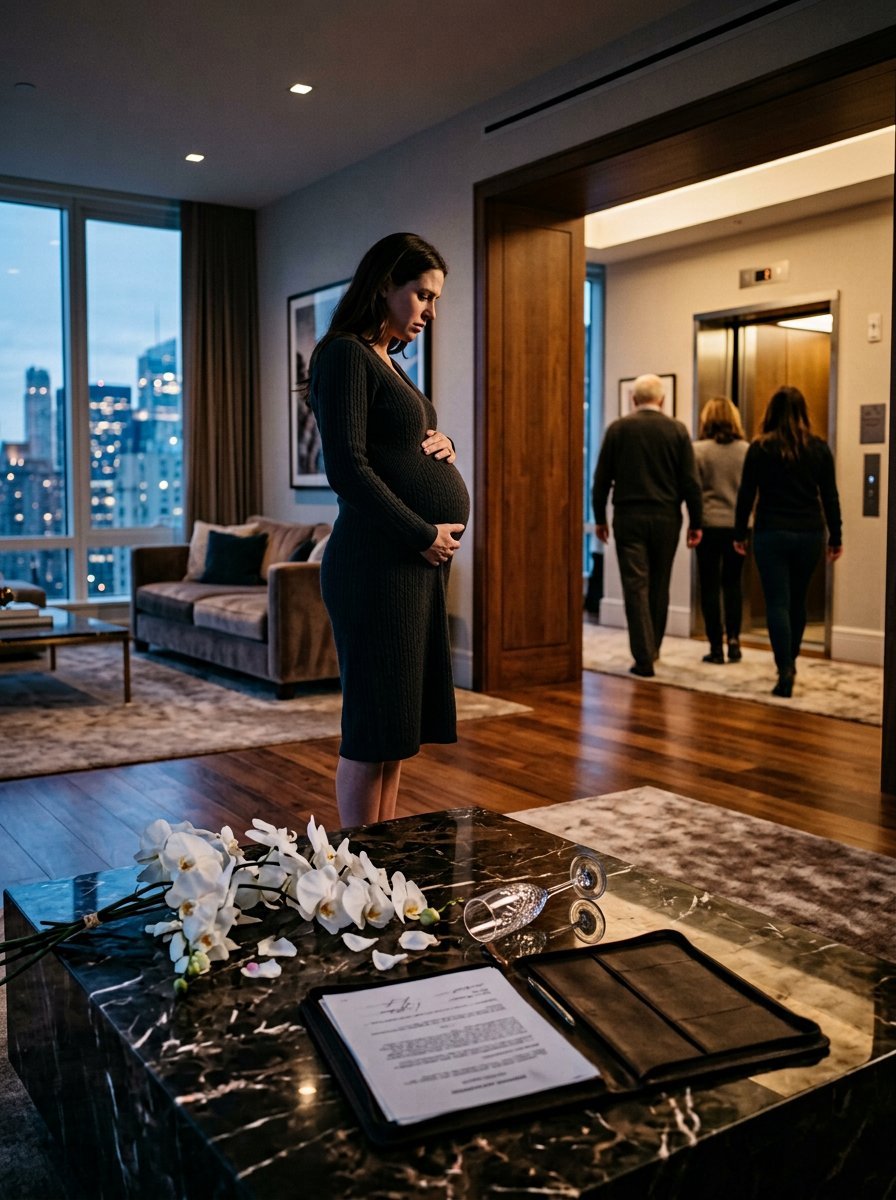
My brother threw me onto the marble floor while I was eight months pregnant, and the second I felt warm liquid spreading beneath my dress, I knew something was seriously wrong.
My parents stared down at me, heard me scream, and still headed toward the elevator.
Twenty-four hours earlier, I had been arranging white orchids for Ethan’s wedding rehearsal dinner in my Manhattan penthouse.
I had bought the apartment three years earlier after selling the cybersecurity company I had built from my kitchen table.
The sale had made me wealthy, although nobody in my family knew exactly how wealthy.
I had learned long ago that whenever Ethan heard about my money, he somehow decided my success should benefit him.
Ethan arrived that afternoon with our parents and his fiancée, Chloe, bringing champagne and an unbelievable sense of entitlement.
“We need to settle something,” he said, dropping onto my sofa. “Chloe and I are taking the penthouse after the wedding.”
I stared at him.
“Taking?”
Mom smiled as if she were explaining something obvious to a child.
“You’re single, Claire. You don’t need four bedrooms.”
“I’m pregnant.”
“You can rent somewhere in Queens,” Dad said. “Temporarily.”
Ethan pushed a folder across the table.
I opened it and found a deed-transfer form inside.
“You already had paperwork prepared?”
He grinned.
“Dad knows a guy.”
I closed the folder.
“No.”
His smile disappeared.
Ethan stood.
“I’ve spent months telling Chloe this would be our home.”
“That sounds like your problem.”
His face turned red.
“You always think money makes you better than us.”
“No. But ownership does make the apartment mine.”
Mom snapped, “Stop embarrassing your brother before his wedding.”
I reached for my phone.
Ethan moved before I could grab it.
His fist closed around my hair, and he yanked me backward.
“Sign it!”
“Let go of me.”
He pulled harder, then shoved me.
My hip struck the edge of the coffee table before I hit the floor.
A sharp cramp tore through my abdomen.
Then I felt the water.
I froze.
“Ethan…” My voice broke. “My water just broke.”
For one second, everyone simply stared at me.
Then Chloe whispered, “Oh my God.”
Dad grabbed Ethan and pulled him toward the elevator.
Mom picked up her purse.
I stared at them in disbelief.
“Call an ambulance!”
Mom glanced back once.
“You always make everything dramatic.”
The elevator doors closed.
I screamed for help.
Two minutes later, someone knocked hard on my front door.
“Ms. Claire Morgan?” a man called. “This is Special Agent Daniel Reeves. We need to speak with you about the attempted property transfer.”
I looked at the folder lying beside me.
And despite the pain, I understood something my family didn’t.
They hadn’t just attacked the wrong woman.
They had attached their names to the wrong crime.
The agent wasn’t alone.
A second investigator stood beside him, and behind them was Marcus Lee, my building’s security director.
Marcus took one look at me and immediately called emergency services.
As he knelt beside me, Reeves picked up the folder with gloved hands.
“Do not touch anything else,” he told his partner.
Between contractions, I managed to say, “My brother brought that.”
Reeves’s expression hardened.
“That confirms what we suspected.”
Three weeks earlier, my attorney had discovered something unusual during a routine title review.
Someone had submitted a preliminary request to transfer my penthouse into a newly created company called E&C Holdings.
The paperwork contained a scanned copy of my signature taken from an old family trust document.
I hadn’t confronted Ethan.
Instead, I authorized my attorney to preserve the records and contact investigators.
Part of me had hoped it was some ridiculous misunderstanding.
But staying quiet had never meant giving in.
Years of negotiating hostile acquisitions had taught me that angry people often reveal more when they believe nobody is fighting back.
Now I knew the truth.
At the hospital, doctors managed to stop the contractions long enough to stabilize both me and the baby.
I had bruising around my hip, but the fetal monitor remained steady.
Ethan never called.
Mom sent only one message.
Please don’t ruin his wedding over a family disagreement.
I forwarded it to Reeves.
The following morning, Chloe posted photos from the bridal suite.
Champagne.
Diamonds.
Smiling bridesmaids.
Then Ethan texted me.
Sign the deed by noon and we can forget yesterday happened.
I almost laughed.
He actually believed I was stuck in a hospital bed and desperate enough to keep the family together that I would surrender.
So I replied with three words.
Send the final version.
Ten minutes later, the document arrived.
This version was even worse.
My supposed signature had already been notarized.
The notary stamp belonged to Victor Hale, one of Dad’s golfing friends.
My attorney, Rachel Kim, called almost immediately.
“Claire, this is enough. And there’s another problem for them.”
“What problem?”
“The company receiving your penthouse lists your father as manager, Ethan as beneficiary, and your mother as authorized signer.”
I closed my eyes.
All three of them.
“They didn’t improvise this yesterday,” Rachel said. “They planned it.”
Something inside me became quiet.
Not broken.
Finished.
I authorized her to file.
At 11:42 a.m., a judge issued an emergency order preventing any transfer involving the property.
The forged documents were preserved.
Building surveillance footage was secured.
My smart-home system had also recorded Ethan yelling, “Sign it,” seconds before he threw me.
At noon, Mom called.
“You need to stop this nonsense before guests arrive.”
“You left me on the floor.”
“We panicked.”
“You walked away.”
Silence.
Then Dad took the phone.
“Family handles family matters privately.”
I looked through the hospital window at the Manhattan skyline.
“Then enjoy the wedding privately.”
He laughed.
They still thought I was bluffing.
By sunset, Ethan was telling rehearsal guests that the next day he would be moving into “his new Manhattan penthouse.”
He had no idea the locks had already been changed.
Ethan’s wedding was scheduled for four that afternoon.
At 3:20, Rachel entered my hospital room carrying a tablet.
“Do you want to watch?”
I hesitated, then nodded.
The hotel had agreed to preserve its security footage after receiving the court order.
Marcus had also provided investigators with video showing my family leaving my penthouse while I remained inside calling for help.
At 3:47, Ethan walked into the ballroom wearing his tuxedo and smiling like a king.
Dad clapped him on the shoulder.
Mom adjusted his boutonniere.
Chloe approached them in her wedding gown.
Then three plainclothes investigators entered through the ballroom doors.
Ethan’s smile vanished.
Reeves walked toward him.
“Ethan Morgan?”
Dad stepped between them.
“Whatever this is, it can wait.”
“No,” Reeves said. “It can’t.”
He informed Ethan that he was being arrested in connection with the assault and the fraudulent property documents.
Another investigator served Dad with a warrant related to the forgery scheme.
Mom began shouting.
“This is Claire’s doing! She’s jealous of her brother!”
Rachel muted the video.
Five minutes later, Chloe called me.
“Tell me this isn’t true.”
“It’s true.”
“He said you promised him the apartment.”
“I never did.”
“He said the deed was already signed.”
“It was forged.”
There was a long silence.
Then she whispered, “He told my parents he owned it.”
“I’m sorry.”
Chloe canceled the wedding.
The investigation uncovered even more than I had expected.
Victor admitted that he had notarized the document without witnessing my signature.
Emails showed that Dad had helped establish E&C Holdings, while Mom had provided the old trust document containing my scanned signature.
Ethan eventually pleaded guilty to charges connected to the assault and property-fraud scheme.
Dad and Victor also entered guilty pleas in the financial case.
Mom avoided incarceration under her agreement, but she received probation and was ordered to pay restitution.
None of them kept their jobs, reputations, or access to me.
I filed civil claims as well.
Their attorneys tried to argue that I was destroying the family.
Rachel responded, “No. Your clients did that in a living room.”
Six weeks later, my daughter was born healthy and perfect.
I named her Hope.
A year passed.
I kept the penthouse because I refused to let violence decide where my daughter and I were allowed to live.
The room Ethan had planned to turn into his office became Hope’s nursery.
Morning sunlight poured across the same floor where I had once begged my family to help me.
Sometimes justice doesn’t arrive with shouting.
Sometimes it comes through preserved footage, frozen filings, honest witnesses, and one calm signature on the right legal documents.
On Hope’s first birthday, I stood beside the windows holding her while the city glowed below us.
My phone buzzed with another apology from Mom.
I deleted it without opening it.
Then Hope laughed.
I looked around the home they had tried to steal and realized I felt no anger.
That was the part they had never understood.
I didn’t win when they lost everything.
I won when I finally stopped needing them.
For once, the quiet future belonged entirely to us.
PART 2
The hospital room was too bright, too white, too controlled for the kind of rage moving through me. Machines made their indifferent sounds. Nurses stepped in and out with efficient calm. My body hurt in several places at once, and each time the monitor gave a steady answer for the baby, I had to fight the urge to cry from relief and fury at the same time.
Relief because she was still safe.
Fury because safety had depended on strangers acting faster than my own family.
Marcus from building security had done more for me in ten seconds than my parents had done in a lifetime of speeches about loyalty. Agent Reeves and his partner had entered my home expecting paperwork, not a pregnant woman on the floor with her water broken, and yet they had moved without hesitation. By the time the paramedics rolled me toward the elevator, the forged transfer file was already being treated like evidence instead of “a misunderstanding.”
That distinction mattered.
Families love that word when they need cruelty to sound accidental.
Misunderstanding.
Overreaction.
Private matter.
Family disagreement.
My mother had already used two of them in a single text before noon.
Please don’t ruin his wedding over a family disagreement.
I kept staring at that message because of what it revealed. Not concern for me. Not horror that Ethan had thrown his eight-months-pregnant sister to the floor. Her concern was the wedding schedule. Guests arriving. Optics. The sequence of public comfort being interrupted by consequences.
That was when the old fantasy fully died—the one where decency would appear if the emergency became visible enough.
It already had.
They had walked away anyway.
So when Ethan texted from the bridal suite and told me to sign by noon so we could all forget what happened, I did not read the message like an ultimatum.
I read it like evidence.
Rachel did too.
She called almost immediately after the notary version arrived and moved through the facts without wasting breath. The stamp belonged to Victor Hale. My father’s golfing friend. The receiving company, E&C Holdings, listed all three of them in different positions. No improvisation. No sudden ugly impulse after rehearsal stress. Structure. Planning. Intent.
I asked her once, “Is this enough?”
“It’s more than enough,” she said. “Now stop thinking like a sister and start thinking like the owner.”
Those words settled me.
Because ownership was the one truth nobody in my family had ever wanted to leave undisturbed. My success, to them, was acceptable only if it stayed available. Something they could reinterpret as shared blood equity the moment Ethan wanted a better view, a larger kitchen, a more impressive address to hand to his wife. The penthouse was never a home in their minds. It was a prize they believed family rank would eventually reassign.
They were wrong.
At 11:42 the emergency order came through. Rachel called back with her voice sharpened by the kind of satisfaction lawyers rarely allow themselves too early.
“Transfer frozen,” she said. “Documents preserved. We’ve moved on the footage too.”
The phrase that caught me hardest was not transfer frozen.
It was footage.
Because even before I saw it, I understood what that meant. There would be no family version later where Ethan merely raised his voice, where I stumbled, where everyone panicked nobly, where my mother did not hear me call for help. Cameras are merciless in exactly the way controlling families are not. They do not love you enough to help you lie.
Rachel also told me the smart-home audio had captured Ethan shouting, “Sign it,” seconds before he threw me.
That sentence became a hinge in my mind.
Not just assault.
Coercion tied directly to the transfer.
Not just brotherly rage.
A property crime with witnesses, records, and timing too ugly to clean up.
By noon, my mother was already begging me to stop the “nonsense before guests arrive.” By sunset, Ethan was still bragging to rehearsal guests that the penthouse would be his after the wedding. That was the piece that would have been almost funny if it had not been so violent. He still thought I was weak because I was hurt. He still thought a hospital bed made me cornered. He still believed woman plus pregnancy plus family pressure would equal surrender.
Instead, I changed the locks.
Not emotionally. Literally.
And when Rachel came in with the tablet at 3:20 and asked whether I wanted to watch what happened next, I knew the wedding was no longer the center of the story.
The paperwork was.
The evidence was.
And the family who had tried to force me out of my own home had just spent twenty-four hours proving every part of the case for me.
PART 3
The hotel ballroom looked exactly how Ethan had always wanted life to look around him: expensive flowers, polished glass, practiced smiles, and enough soft lighting to make entitlement seem elegant. Even through the tablet screen, I could see the confidence in the way he walked in wearing his tuxedo, as though the previous day had merely been an inconvenience on the road to the life he believed was his by right.
Dad clapped him on the shoulder.
Mom adjusted his boutonniere.
Chloe moved toward them in her gown, still hours away from understanding the difference between the man she had agreed to marry and the one he had already shown himself to be.
Then the investigators came through the ballroom doors.
No spectacle. No shouting. Just the kind of quiet official movement that changes the temperature of a room before anyone has said more than a name.
“Ethan Morgan?”
Even muted through the tablet speaker, I could see the moment his certainty fractured.
My father stepped between them and tried the oldest family tactic of all—delay dressed as authority.
“Whatever this is, it can wait.”
No, it could not.
That was the beauty of evidence once it has passed out of the family and into process. It stops caring whose day it is. It stops caring what guests will think. It stops caring who says “privately” when what they mean is “without consequences.”
Ethan was arrested in connection with the assault and the fraudulent property documents. My father was served with a warrant related to the forgery scheme. My mother started shouting instantly, and even in that moment she did not ask whether I was all right. She accused. She performed. She made sure the room had someone to blame before anyone there had time to realize the bridegroom had walked into his own wedding already tied to a property fraud file.
Rachel muted the video after that.
She did not need to show me the collapse frame by frame. I already knew enough.
What came next mattered in a different way.
Chloe called me five minutes later.
Her voice was not theatrical. That was what made it land. She sounded like a woman whose entire wedding day had just been dragged out from under her by the truth.
“Tell me this isn’t true.”
“It’s true.”
“He said you promised him the apartment.”
“I never did.”
“He said the deed was already signed.”
“It was forged.”
There was a long silence after that, the kind that arrives when a person is forced to compare the version of reality she agreed to marry against the one now held up by investigators, court orders, and recorded threats.
Then she whispered the sentence that told me how large Ethan’s lie had really become.
“He told my parents he owned it.”
That was his true addiction. Not the penthouse itself. The status story it allowed him to tell. The address, the view, the leverage, the wife who could believe she was stepping into a life he had built instead of one he planned to steal. Ownership was never just square footage to him. It was identity.
Which meant the wedding arrest did more than stop a ceremony.
It stripped his performance in public.
Chloe canceled the wedding.
I did not celebrate that.
She had done something weak by standing too close to his certainty, yes. But weakness and malice are not identical things. The real violence belonged to the man who had dragged his pregnant sister to the floor and then tried to carry forged paperwork into marriage as if that future were still available to him.
By evening, the case had widened. Victor admitted he notarized without witnessing my signature. Emails tied my father to the company structure. My mother’s role was there in document form too. What they had tried to call a family solution was beginning to read exactly as what it was: a planned transfer scheme built on blood ties, entitlement, and the assumption that I would rather swallow betrayal than expose them.
They misjudged the wrong thing.
Not my anger.
My finish.
PART 4
After the wedding collapsed, the family tried one last strategy.
They wanted language to save them.
Not truth. Language.
Miscommunication.
Stress.
Pre-wedding pressure.
A fight that got out of hand.
Paperwork prepared too early.
A notary mistake.
Words to shrink planning into confusion and assault into emotion.
Rachel dismantled that approach faster than I could have. “Your clients did that in a living room,” she said when their attorneys accused me of destroying the family. That sentence stayed with me because it cut through every performance they still hoped might blur responsibility.
By then, my world had narrowed to two things: legal precision and the baby.
The doctors had stabilized us, but they were still watching me carefully. Bruising deepened across my hip in colors I tried not to study too closely. Every monitor beep reminded me how thin the line had been between what happened and something far worse. The pregnancy did not pause because Ethan’s wedding had imploded. I still had to eat, rest, answer medical questions, breathe through sudden fear, and build myself back toward birth while the people who shared my blood tried to rearrange the language around what they had done.
That contrast made something permanent in me.
They were still worrying about reputation.
I was counting kicks.
I filed civil claims, not because I needed spectacle, but because the damage was real and I was done pretending accountability should arrive only in forms other people found emotionally convenient.
And through all of it, there was one fact I held like a rail in the dark:
the penthouse stayed mine.
That mattered beyond money. Violence had tried to make me small inside my own home. Fraud had tried to make me temporary inside my own future. Refusing to surrender the apartment was the clearest answer I had left.
He had wanted the room as proof of power.
I would keep it as proof of survival.
The legal process moved more slowly than the wedding had collapsed, but faster than my family expected. Hearing dates appeared. Statements were taken. The forged documents, the footage, the audio, the text messages, and the company paperwork all began aligning into a version of events no one could sweet-talk back into a “family misunderstanding.”
By the time I was finally discharged, my body was still healing, my daughter was still inside me, and the next room where my family and I would face one another would not be a dining room or a ballroom.
It would be a hearing room.
PART 5
Ethan eventually pleaded guilty to charges connected to the assault and property-fraud scheme.
Dad and Victor also entered guilty pleas in the financial case.
Mom avoided incarceration under her agreement, but she received probation and was ordered to pay restitution.
None of them kept their jobs, reputations, or access to me.
Courts can settle responsibility.
They cannot restore innocence.
But they can force the truth to stand still long enough for everyone to see it.
Six weeks later, my daughter was born healthy and perfect.
I named her Hope.
Not because the word felt soft.
Because I had earned a harder version of it.
The kind that survives evidence, signatures, bruises, and the knowledge that some people will walk away from you on a floor and still call themselves family the next day.
The room Ethan had planned to turn into his office became Hope’s nursery.
Morning sunlight crossed the same floor where I had once begged for help and received none. That was not poetic when I first lived it. It was practical. Crib. Chair. Bottles. Diapers. A lamp warm enough for three a.m. feedings. A stack of blankets folded in the drawer he once imagined filling with contracts. But practical things can become sacred when they occupy ground someone tried to take from you.
I kept the penthouse because I refused to let violence decide where my daughter and I were allowed to live.
That may be the clearest sentence in the whole story.
Not the arrests.
Not the canceled wedding.
Not the guilty pleas.
That.
Sometimes people assume winning means watching everyone who hurt you collapse. It doesn’t. Collapse is their consequence. It is not your healing. My healing began in smaller places. The first morning I woke without needing anyone’s approval. The first time I deleted my mother’s apology without opening it. The first time Hope laughed in the apartment and her laughter did not have to fight any older voice for space.
On her first birthday, I stood by the windows holding her while the city glowed below us.
She pressed one warm hand toward the glass and laughed at the lights as if the whole skyline had been arranged just to entertain her.
My phone buzzed again with another message from my mother.
I deleted it.
Then Hope laughed.
I looked around the home they had tried to steal and felt something I had not expected.
Not rage.
Not even victory.
Release.
My family never understood that the deepest break had happened before the charges, before the wedding, before the courtroom language. It happened the second I stopped needing them to become decent in order for me to move forward.
That was the true inheritance I was leaving my daughter.
Not square footage.
Not skyline.
Not money alone.
The knowledge that her safety, name, and place in the world would never depend on how politely she absorbed someone else’s entitlement.
People like Ethan believe power is what happens when everyone else yields.
They are wrong.
Power is what remains when you stop yielding to people who have mistaken your love for permission.
The forged deed failed.
The wedding failed.
The family story they had been telling about me—that I was dramatic, selfish, difficult, and obstructive—failed too.
What remained was simpler.
I had built something valuable.
They tried to take it.
They used blood, pressure, timing, and violence.
They still failed.
For once, the quiet future belonged entirely to us.