A text story
When my son Dustin told me his girlfriend was pregnant, he was seventeen.
I handed him two hundred dollars and said, “Not under my roof. You want to be a man, go be one.”
I thought I was teaching him.
That’s the sentence I’ve had to look at. Not I was angry — I was, but that’s not it. Not I panicked — I did, but that’s not it either. I thought I was teaching him. I had a whole philosophy in my mouth that night and I remember the taste of it, that clean righteous flavor, standing in my own kitchen with my arms crossed telling my child that consequences are how people become people.
He packed a duffel and walked into the rain. October 2009.
He never called.
I told folks at church he was doing well out west. Denver, I said, because I’d once heard him say something about Colorado. For sixteen years I said Denver. I said it so many times that I could see the apartment. Pastor Hollis asked after him every Easter and every Easter I said, “Doing real well, thank you for asking.”
Sixteen years of that.
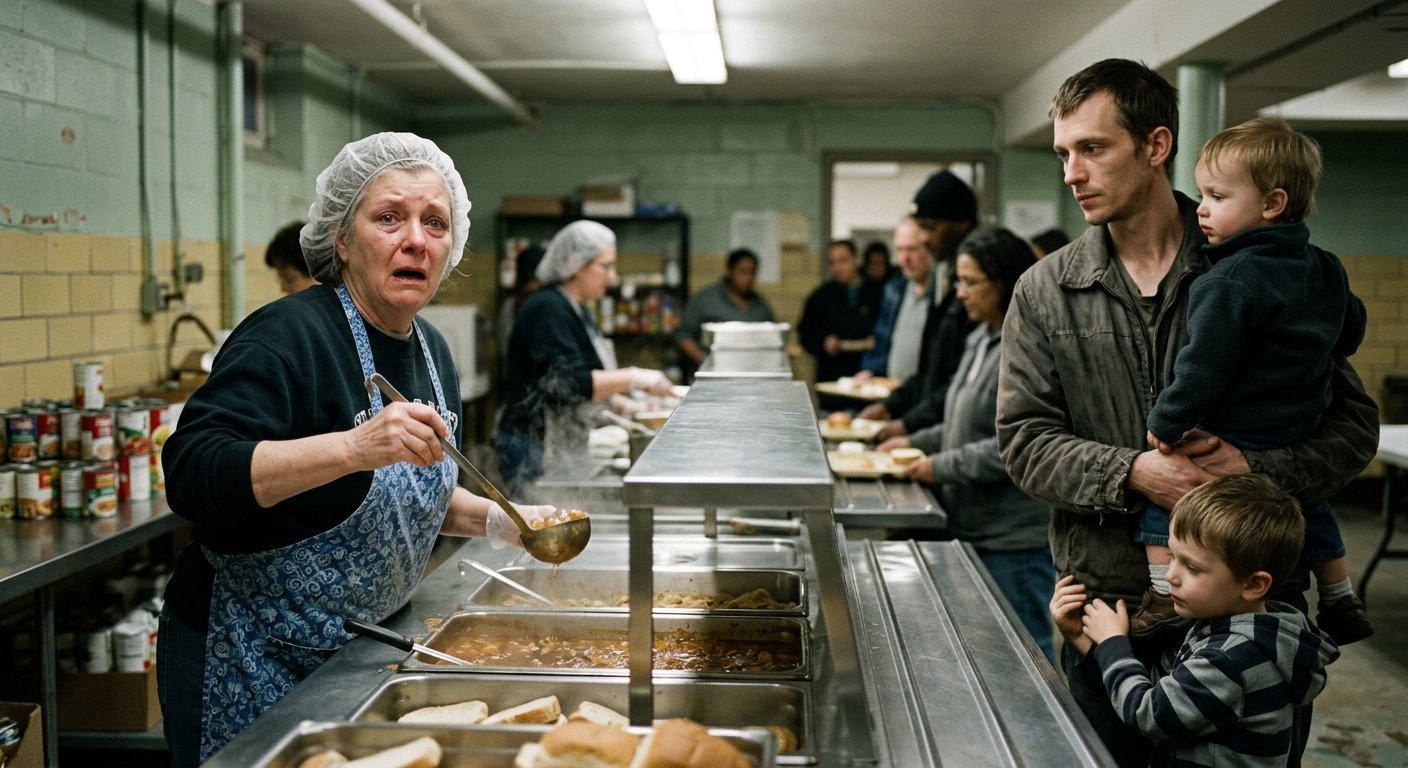
Every Tuesday I ladle soup at the food pantry on Ridge Avenue. I’ve done it since 2013.
I want to be honest about why, since I’ve been honest about everything else. I did it feeling good about myself. That’s the truth. There’s a particular warmth in being the woman behind the counter, and I stood in it every Tuesday for twelve years, and I understood it as generosity when a good deal of it was ballast — a weight I set on one side of a scale to keep the other side from showing.
Last week the line shuffled forward and I looked up.
A thin man. A toddler on his hip, another child — five, maybe — gripping the side of his leg with both hands.
Dustin.
Thirty-three years old. Gray already, at the temples. Wearing a jacket that was not warm enough for the day and shoes I couldn’t stop looking at.
The ladle went still in my hand.
He saw me behind that counter. And he did something I’ve thought about every hour since: he checked the children first. He glanced down at the boy on his leg to see whether he’d noticed anything, and then he leveled his face out, completely, and stepped forward.
Quiet, so the little ones wouldn’t hear, he said:
“Mom, I just need you to not say anything until we’re outside. Please. They think we’re getting soup.”
That was it.
That was the whole ask. Sixteen years, and what my son needed from me in that moment was silence — not money, not forgiveness, not a scene. He needed me to not detonate his children’s afternoon.
So I ladled soup into his bowl. I put the roll on the tray. I said, “There you go, sir,” and my voice did not break, and I am prouder of that than of most things I’ve done.
The five-year-old said thank you without being prompted.
They sat at the end table by the window. I finished my shift — forty more minutes, and I could not tell you one other face — and then I took off my apron and went out to the parking lot, and he was standing by a Buick that was older than the boy holding his hand.
Here’s what I learned in that parking lot, and then over eleven days, and then in a kitchen that used to be his.
He never went west. He got as far as Kingsport, Tennessee, which is a hundred and ninety miles, because that’s where Alicia’s aunt had a basement.
The baby — my granddaughter, who is now fifteen and whose name is June — was born in March of 2010. Dustin was eighteen. He worked at a tire shop and then a lumberyard and then eleven years at a distribution center where he ruined his back in a way that isn’t going to unruin.
He and Alicia lasted six years. She’s in Knoxville now; they’re decent to each other, she has the older girl every other weekend when the driving works out.
The two little ones are from his second marriage. Marisol died in 2023. Sepsis, thirty-one years old, four days from a sore throat to a funeral. That’s the boy on his leg and the toddler on his hip.
He lost the apartment in January. They’d been in a motel on Route 9 and then, for the last nine weeks, in the Buick and at a shelter on Poplar that takes families three nights out of seven.
And he’d been coming to that pantry for a month.
Not my Tuesday. He’d been coming Thursdays.
He knew I volunteered there. Of course he knew — the church bulletin is online, my name has been in it since 2013. He came Thursdays specifically, for four weeks, and then last week the shelter moved their intake and Thursday stopped working, and he had two children who needed to eat, and he came on a Tuesday knowing exactly what was behind that counter.
He told me that in the parking lot. He said, “I did the math on it for about an hour and the math came out that they eat.”
I asked him why he never called.
He was quiet a while. Then he said the thing that took the floor out from under sixteen years.
“I did. Twice. March of 2010 when June was born, from a payphone at the hospital. And in 2014 when I was working nights and things were all right for a minute and I thought maybe there was a way to start.”
I said that wasn’t true. I said I never got a call.
He said, “You answered the second one, Mom.”
And then I remembered.
2014. A number I didn’t know. A pause on the line — that pause, I remember the pause — and me saying “Hello? Hello?” twice and then, because I had decided years earlier what that pause meant, saying: “I’m not sending money.”
And hanging up.
He hadn’t asked for money. He hadn’t said a single word. He was thirty seconds into working up to hi, and I filled the silence with the only sentence I’d been rehearsing.
I have replayed that four seconds more than I have replayed the night with the two hundred dollars. Because the night with the two hundred dollars, I was a frightened forty-year-old woman who had been raised by people who thought the same way and I understand her, even if I don’t forgive her. But 2014 — 2014 I was calm, and comfortable, and I’d had five years to think about it, and I did that anyway.
They live with me now. That started eleven days after the pantry and it was not a discussion so much as a set of car trips.
The five-year-old is Ezra. The toddler is Wren, and she is a menace, and she has found the drawer with the wooden spoons. June, my granddaughter, who I met on a Sunday afternoon with my heart going like a bird in a box, is fifteen and reserved and has her father’s exact way of checking a room before she settles in it. She’s been over four times. She calls me Miss Deborah. That’s fine. That’s more than fine, that’s fair, and I’ve told her she can call me that for the rest of my life if she wants.
Dustin is on a waiting list for a back specialist and a different waiting list for housing. There’s a lawyer helping with a disability claim that should have been filed two years ago.
None of that is the point of what I want to say.
Two things, and then I’ll stop.
The first. I went to Pastor Hollis and asked to say something to the congregation, and I stood up in front of about ninety people who have heard me say Denver for sixteen years, and I told them the truth. All of it, including the phone call. It took four minutes and I have never done anything harder, including childbirth, including burying my husband.
Not for absolution. Two women came up to me afterward. One of them has a daughter in Ohio she hasn’t spoken to since 2018. The other one didn’t say anything, she just held onto my hand for a long time. That’s why. There are more of us in those pews than anybody lets on, all of us saying Denver.
The second thing is that I still work the pantry on Tuesdays.
Dustin thought I’d quit. He assumed it, actually — he said it’d be too hard, seeing that line now.
It is hard. It’s the hardest two hours of my week. Because now I look at every man in that line and I understand that he is somebody’s son, and that somewhere there is a woman telling her church that he’s doing well out west, and that she believes it, mostly, because the alternative is unbearable and belief is cheap.
I ladle the soup. I say “there you go, sir.”
And I don’t feel good about myself anymore, which as it turns out was never what that counter was for.