A text story
My mother kept a high school yearbook hidden in a locked drawer.
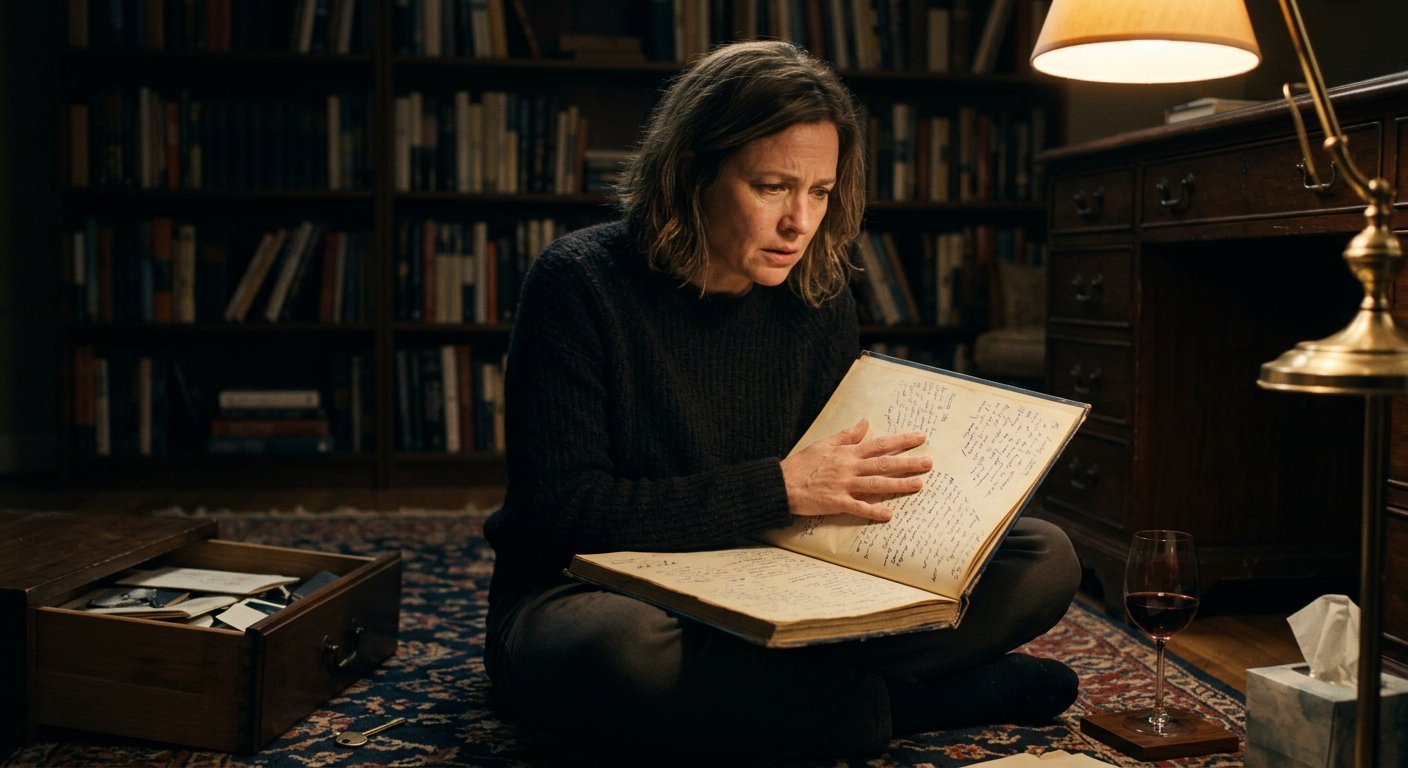
I found it after she died. Bottom left of her desk, the one drawer that never opened, which I’d assumed for forty years held tax records and the kind of paperwork you don’t explain to children. The key was taped under the drawer above it, which tells you something about my mother — she wanted it locked, but she didn’t want it lost.
Her senior year. 1974. Bellamy High, Savannah, Georgia.
I flipped through it on the floor of her study with a glass of wine and a box of tissues, doing that thing you do in the first week, where grief and curiosity are the same feeling.
A boy had signed the back page. Blue ballpoint, pressed hard, filling the whole white space above the endpaper:
“To Margaret. I will find you again. I promise. Love, James.”
I didn’t know any James.
My father’s name was Robert. Robert Sayles, forty-one years married to my mother, dead since 2016, a man who taught me to drive a stick shift in a church parking lot and who I still occasionally dial by accident.
I searched the yearbook. Found him on page 31. James Fuller. Class president. Debate. Track. Next to his photo, in that awful 1974 typeface: Most Likely to Succeed.
He’d been right about that, at least. I Googled him and got a retired superior court judge in Savannah. Seventy-one years old. A three-paragraph retirement notice from 2021 with a photograph of a tall Black man in robes standing in front of a bookcase, and a line about thirty-one years on the bench.
My mother was white. So was Robert. So am I.
I sat with that for a day and a half.
Then I called him.
He picked up on the fourth ring. I said my name, and that I was Margaret Sayles’s daughter, and that my mother had died on the ninth.
Silence for eight seconds. I counted them, later, off the call recording my phone makes automatically, which I have listened to more times than is healthy.
Then he said, “Margaret’s daughter.”
Not a question.
I said, “How do you know who I am?”
And he said: “Six hundred dollars a month. For thirty-eight years. To a PO box in your mother’s name. I never missed a payment.”
My whole body went cold, because I knew — I knew — what the next word was going to be, and I had known since I read the back page of that yearbook, and I had spent a day and a half refusing to know it.
He said: “Because you’re my sister’s daughter.”
Not his daughter. His niece.
I made him say it twice. I actually said, “Say that again,” out loud into the phone, like a woman in a film.
Here’s what he told me over the following three hours, and then over four more meetings, and then over a folder of documents that a seventy-one-year-old judge had kept in perfect order for four decades because that is simply how his mind works.
James Fuller had a younger sister named Delphine. In 1979 she was nineteen and pregnant and unmarried, in Savannah, in a family that had a great deal of church in it. She had the baby — me — in April of 1980 at a hospital in Augusta, and she signed the papers, and she died eleven days later of a postpartum hemorrhage that a better hospital would have caught.
Nineteen years old. Eleven days.
And my mother — Margaret — was, by then, twenty-four, married two years to Robert Sayles, working as a labor and delivery nurse at that hospital in Augusta.
She had been Delphine’s brother’s girlfriend for two years in high school, in Georgia, in 1972 through 1974, which was a thing you could do but not a thing you could do openly. That’s what the yearbook inscription was. That’s the whole story of that sentence. I will find you again. I promise. Two teenagers who both knew exactly what was going to happen when graduation came, and it happened, and their families made sure of it, and they didn’t see each other for five years.
Until a nurse in Augusta looked at a chart and saw the name Fuller.
What my mother did next was not legal in several respects, and she and James Fuller and a family court clerk named Odell Marchetti spent about nine months in 1980 doing something that I have been assured by two attorneys would be impossible today and was only barely possible then.
I was adopted by Robert and Margaret Sayles in January of 1981.
The paperwork records me as a private placement. It does not record that the adoptive mother had dated the birth mother’s brother. It does not record that James Fuller, then twenty-six and in his first year of law school, sat in a hallway of the Richmond County courthouse for six hours on the day of the hearing and did not go in, because a Black man’s presence in that room in 1980 in Georgia would have raised questions that would have collapsed the whole thing.
He never went in. He sat in the hallway. And then he went home and started sending money.
FIRST PAYMENT: MAR 1981 $ 45.00 (law school. it was what he had.) BY 1986: $150.00 BY 1994: $400.00 1999 – 2019: $600.00 TOTAL, 38 YEARS: $ 214,800.00 MISSED PAYMENTS: NONE
Six hundred a month to a PO box in Statesboro that my mother maintained for thirty-eight years and that I never once heard mentioned. It stopped in 2019 — not because he stopped, but because my mother wrote him a letter telling him to stop, that I was thirty-nine, that I had a house and a career and two children, and that he had discharged an obligation he’d never actually incurred.
He told me he kept sending it for four more months anyway and she returned all four.
“Why didn’t you ever contact me?”
That was my question. I asked it in about six different ways over three hours and he answered it patiently every time, which I’ve since learned is a thing thirty-one years on a bench does to a man.
He said, “I asked your mother that in 1987. She said, ‘When she asks.’ I asked again in 1998. Same answer. I asked in 2011 and she said, ‘James, if you tell her, you’re telling her because it will make you feel better, and that is not a reason.'”
He said Margaret was the toughest negotiator he ever encountered, and he spent three decades in a courtroom.
And then he said the thing that has rearranged how I think about my mother, who I had, I’m now realizing, understood as a fairly simple woman:
“She wasn’t protecting herself. She was protecting a promise she made to a dying girl she’d known for eleven days. Delphine asked her not to let you grow up as somebody’s secret. Margaret’s position — and she was right, and I fought her on it for thirty years — was that a child who is told at seven that her real family is nearby but can’t be seen is somebody’s secret. So she gave you a plain life with one story in it, and she kept the second story in a drawer, locked, with the key taped where you’d find it.”
He said: “She always intended you to find it. She just intended you to find it when there was nobody left who could be hurt by it.”
There are photographs. That’s the part I wasn’t prepared for.
My mother sent him photographs. Every year, both of them — school photos, then graduations, then my wedding, then my own children. Thirty-eight years of them, in a leather album in a judge’s study in Savannah, in chronological order, each one dated on the back in my mother’s handwriting.
He turned the pages for me one at a time and told me what he remembered thinking about each one. He said in 1994 he almost drove to Statesboro. He said in 2003 he wrote a letter and burned it. He said when I got married in 2007 he sat in his car outside the church, which I found out about eighteen years after the fact, standing in a study in Savannah, in front of a photograph of myself.
He looks like me. Or I look like him — the same heavy eyebrows, the same thing our faces do when we’re deciding whether to say something. My daughter noticed it in nine seconds flat when she met him, which is a thing thirteen-year-olds are useful for.
That was two years ago.
I have an uncle. I have three cousins in Atlanta and Charleston and one in Berlin. I have a grandmother’s grave in Savannah with a name on it I’d never heard, and next to it a smaller stone that says DELPHINE ROSE FULLER, 1960–1980, and beneath that, four words that James chose when he was twenty-one and had no money for anything longer:
SHE HAD ELEVEN DAYS
I go twice a year. I bring the kind of flowers that hold up in Georgia heat.
Robert Sayles is still my father. Nothing about this changed that, and I want that in writing, because I’ve noticed people expect the discovery to have demoted him and it did the opposite. A man who taught me to drive a stick shift knowing what he knew, and never once treated me as a decision he’d made — that’s harder than being born to somebody.
And my mother.
God, my mother. I spent forty-two years thinking she was uncomplicated. She stood in a hallway in 1980 and made a series of decisions that were illegal, enormous, and correct, and then she never mentioned any of them again, for thirty-eight years, while quietly maintaining a PO box and mailing photographs to a man she had loved at seventeen and given up.
The yearbook’s on my shelf now. Not locked.
I’ve read that inscription a few hundred times. I will find you again. I promise. Two kids in Georgia in 1974, and the promise was impossible, and everybody involved knew it was impossible when the ink was still wet.
He kept it anyway. Just not the way either of them meant.
He found her daughter. It took him thirty-eight years, six hundred dollars a month, and a phone call he did not make — and when it finally rang, he needed eight seconds, and then he knew exactly who I was.