A text story
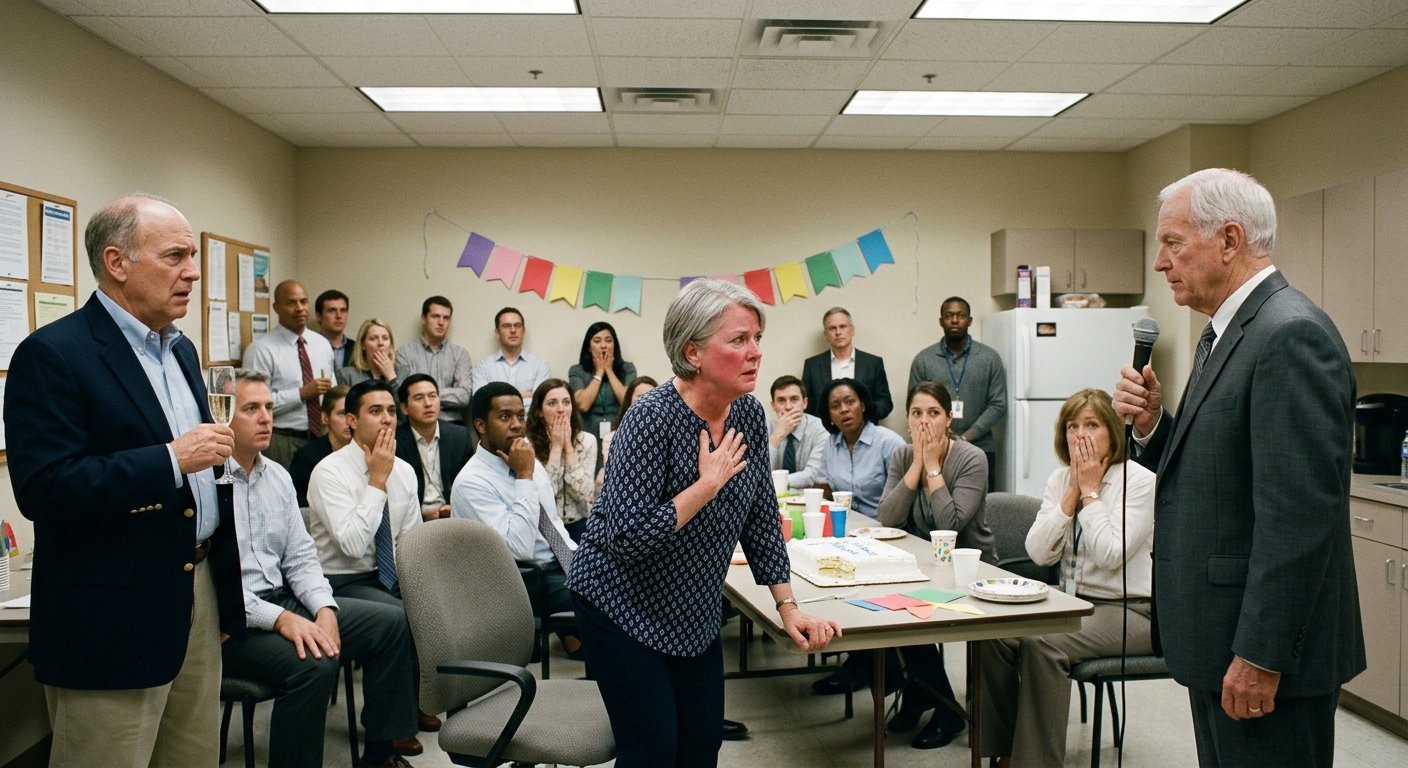
My husband announced our divorce at my retirement party.
I was sixty-four, celebrating thirty-five years at the same company. Delacroix Industrial Supply, four hundred and twelve employees, a warehouse and a two-story office building off the interstate that smells permanently of cardboard and hot copier.
I started there in 1990 as a receptionist. I retired as the person everyone called when things fell apart — not a title anybody prints on a card, but every single person in that room knew what it meant. When the ERP migration collapsed in 2016, they called me. When Rosalind’s husband died and nobody knew what to do about her leave balance, they called me. When a driver got stranded in Amarillo on Christmas Eve, he called me, at home, at ten at night, and I got him a room.
They put out a sheet cake and a banner and about ninety people came, which for a Thursday afternoon is something. For once, I felt seen.
Then my husband Roy stood up, tapped his glass, and smiled.
“Since everyone’s celebrating new beginnings — I’m filing for divorce.”
The room went silent. And then, because the silence wasn’t the shape he wanted, he added: “Maybe Marlene can stop pretending her little office job made her important.”
Thirty-nine years of marriage and I’ll tell you the truth: I wasn’t surprised by the divorce. I’d found the emails in February. I was surprised by the room. He’d chosen the room. That’s the part that told me who I’d been married to.
My face burned. I stood up, ready to walk out and disappear, which is what I had done in one form or another since 1986.
But my boss, Mr. Whitaker, took the microphone.
Now — Gerald Whitaker is seventy-one, he is not a warm man, he speaks about eleven words a day, and in nineteen years as owner I had never once heard him raise his voice.
He looked straight at Roy and said:
“Actually, I was saving this announcement for last.”
And Roy’s smile vanished, because he assumed — the way men like Roy always assume — that he was about to be part of something.
Here’s what I expected. I expected Gerald to defend me. Some version of this woman is the backbone of this company, delivered with enough steel to make Roy sit down.
That is not what happened, and it took me about a week to understand that what actually happened was much better, because it wasn’t about Roy at all.
Gerald didn’t look at Roy again after that first sentence. He turned to the room.
He said, “I’m sixty-two days from signing the sale of this company to Pellerin Group.”
Ninety people made a sound.
Because everyone in that building had heard the rumor since March, and everyone knew what Pellerin does, which is buy regional distributors, gut the back office, and run everything out of a shared service center in Tempe. Everyone in that room had done the arithmetic on their own job at two in the morning.
He said: “The deal has a carve-out. Twelve percent of the sale proceeds go into a distribution for employees with over ten years of service. That’s sixty-one people. Marlene’s known since January because she built the schedule — she’s had every one of your numbers on her kitchen table for five months and hasn’t said a word to a soul, which is why I could keep it quiet, and which is the entire reason I’m able to make it at all.”
Then he said, “Her figure is the largest on the list. She earned it before I ever thought of it, and I’d have signed the same document if she’d been retiring to a beach in Belize.”
And then — only then, and this is why I’ll be loyal to that man until I die — he looked over at Roy.
He said: “Sir, I don’t know you. But you’ve just publicly assigned a value to your wife’s work in front of the sixty-one people whose retirements it paid for. I’d sit down.”
Roy sat down.
Actually he didn’t sit down. He stood there for about four seconds doing something with his jaw and then he left, and the sound of that fire door at the back of the break room is a thing I will enjoy privately for the rest of my life.
Nobody followed him. Rosalind — the one whose husband died in 2011 — got up and cut the cake, loudly, and said, “Well, I’m having a piece,” and that broke it, and it turned back into a party. A strange one. But a party.
Now. I said this story is better than the one you expected, so let me tell you the parts that don’t fit on a poster.
The number was $340,000, before tax. It is a great deal of money and it is not “rich.” I’m sixty-five now, I have a mortgage with eleven years left on it, and a hip that needs doing.
The divorce was ugly for nine months, and Roy’s attorney went after that distribution hard, on the theory that it was compensation earned during the marriage. He was not entirely wrong, legally. We settled. He got a share of it. I want that in here, because these stories always end with the man getting nothing and in real life the man gets something, and you have to decide whether the remainder of your life is worth more to you than the satisfaction of a fight.
It was. I signed.
And the thing about the emails: I’d known since February and I hadn’t done anything, and I’ve had to sit with why. It wasn’t love and it wasn’t fear exactly. It was that I had spent thirty-nine years being the person who handles things quietly so that nobody’s day gets ruined, and I had extended that service to my own marriage. I was managing his affair the way I’d managed the Amarillo driver. Minimize disruption. Absorb it. Don’t make a scene.
He made the scene. In the end he did me the enormous favor of making the scene himself, in a room full of people who knew exactly what I was worth, and I have never been so grateful to be humiliated.
One more thing, which is the part I actually think about.
Three weeks after the party I asked Gerald why he’d done it that way — why he hadn’t just made the announcement clean, before, or waited till Monday and sent a memo.
He was quiet in that way he has, and then he said something that reorganized thirty-five years for me.
“I was going to announce it Monday, in a memo. I’d already written it.” He looked at his hands. “Marlene, you have worked for me for nineteen years and I have never once thanked you where anybody could hear it. I’d have done it in a memo. Your husband got up and did out loud what I have been doing quietly since 2006, and I recognized it, and it made me sick.”
He said, “I didn’t stand up for you. I stood up because I’d been doing a smaller version of the same thing and I got to see what it looks like from the outside.”
I’ve thought about that more than about the money.
Because he’s right, and because I’ve done it too — there are people who held that company together whose names I never said in front of anybody, and I had five months and a list on my kitchen table and I never once thought to add a sentence of my own to it.
The sale closed in September. Pellerin did exactly what everyone knew Pellerin would do; the back office in that building is nine people now, all in Tempe. Forty-one of the sixty-one took the money and went.
Rosalind bought a camper. She sends me photographs from parking lots.
I’m in the house. I kept it. I do three days a week of consulting for two small distributors who cannot afford a person like me full-time and know it, and they pay me a rate that Marlene-from-1990 would not have believed.
And I’ve started doing a thing that I recommend to everybody, which costs nothing.
When somebody does something well — anybody, the girl who fixed a billing error, the man who found the pallet — I say it in front of another person. Not privately. Not in a card. Out loud, where somebody else can hear, because I have now been on both ends of that room and I know exactly how much it weighs.
Thirty-five years I was the person everyone called when things fell apart. It took a man tapping a glass in a break room for anybody to say so at a volume the room could hear.
Don’t wait for the party. That’s all I’ve got.