A text story — 21 minute read
My mom was sentenced to die for killing my dad, and for six years, no one believed she was innocent.
Not the jury. Not the neighbors. Not our church. Not me.
That last one is the one I have to live with.
I was seventeen. My dad was found dead in the kitchen on a Tuesday morning in October. The knife was under my mom’s bed, wrapped in a hand towel from our own linen closet. There was blood on her robe. She said she’d found him and held him, and the state said people who find bodies call 911 in ninety seconds and she took nine minutes.
She had no alibi because she’d been asleep in her own house. They had motive: my parents fought, loudly, constantly, and half of Marbury County had heard it through open windows in the summer. They had the robe. They had the knife under the bed.
Everyone said the same thing. It was her.
I said it too. Not out loud, not at first — but at the trial the prosecutor asked me whether my mother had ever threatened my father, and I said yes, once, and it was true, she’d said I could kill you in the way that exhausted people say it over a broken dishwasher, and I watched twelve faces change while I said it. I was seventeen and under oath and I told a fact that was true in a room where it became a lie.
That was my sin. Not doubting her. Testifying while doubting her.
Matthew was two years old when our father died. He doesn’t remember him. He barely remembered her.
For six years my mom wrote letters from prison. Every week without fail, in that careful looping hand, on the cheap lined paper they sell in the commissary.
“I didn’t kill him, sweetheart.”
She never once wrote it angry. That’s what got me in the end. Six years, three hundred-odd letters, and she never wrote how could you, never wrote you did this to me. She wrote about the reading program she ran on the block. She asked whether Matthew’s ear infections had stopped. She asked me to send school photos, and I did, every year, and I never wrote back about the thing itself because I didn’t know how to sign a letter that said I think you did it and I love you.
I raised Matthew. Twenty-three years old, a job at a distribution center, an apartment in Aliceville, a little boy who called me by my first name for two years before he switched to something between that and Mom and then just settled on it.
The appeals ran out the way they do. Not with a bang — with a series of increasingly short letters from increasingly tired lawyers. The last denial was two paragraphs.
They set the date for a Thursday in April.
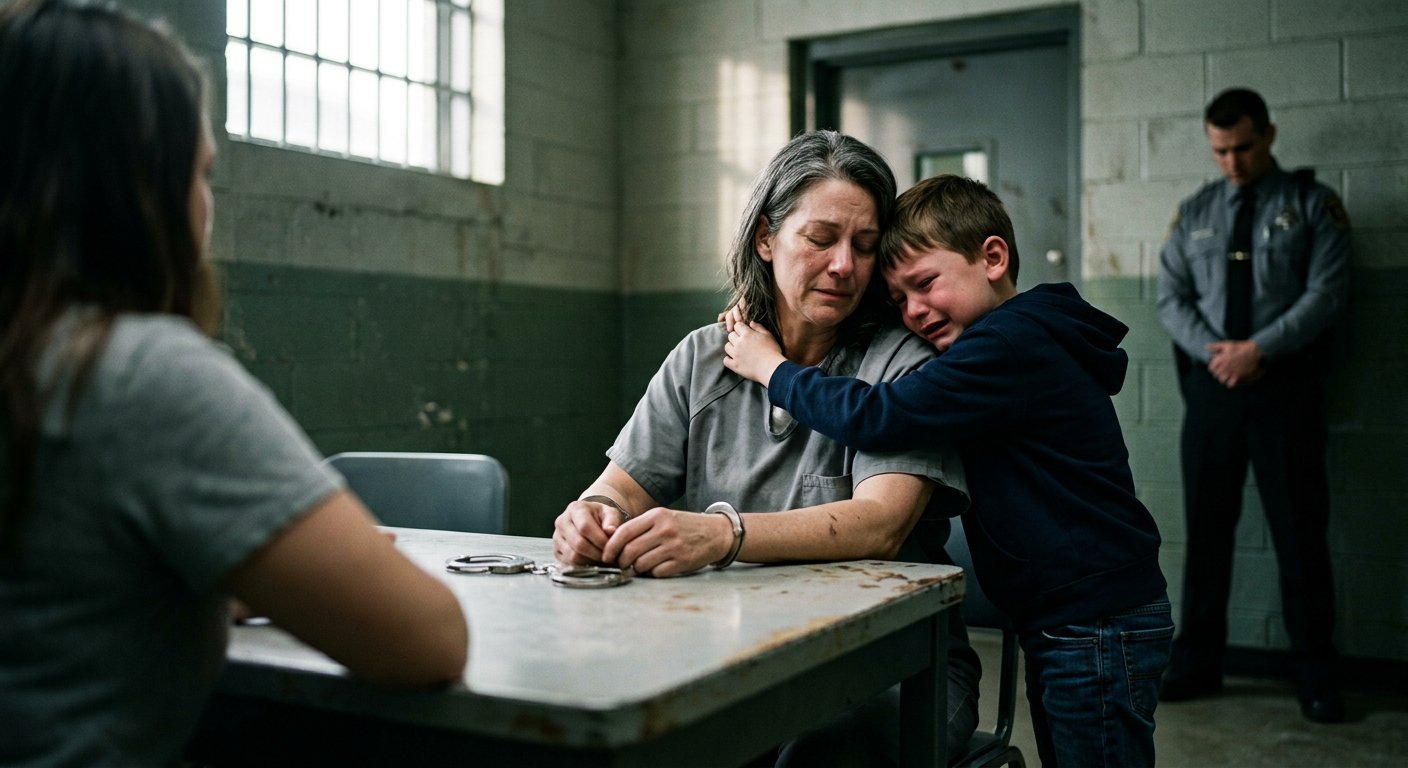
The morning of the execution they allow a contact visit. Two hours, in a room with a table and four plastic chairs and a guard against the wall who has done this before and hates it.
She was in a gray cotton uniform with her hands cuffed in front of her, and she’d lost weight, and she’d gone entirely gray at the temples in a way that made her look like her own mother.
She said, “Don’t cry for me.” Her voice was so tired. Not frightened — tired, the specific exhaustion of a person who has been insisting on something for six years to an empty room. “Just take care of Matthew.”
Matthew was eight years old. We had talked about this on the drive, and he’d nodded in that solemn way children have when they’re agreeing to something they can’t possibly understand yet.
He went around the table and hugged her.
And with his face against her shoulder and his arms up around her neck, my little brother whispered:
“Mom… I know who hid the knife under your bed.”
She went completely still.
I said, “Matty.”
He was crying by then, the awful hiccuping kind, and he said it into her shoulder so quietly that the guard didn’t hear it and I only just did.
He said: “It was me. I hided it. I’m sorry.”
Here’s the thing about a two-year-old.
A two-year-old does not understand death, or evidence, or police. What a two-year-old understands is that things on the floor go in hiding places, because that is the entire game of being two.
Matthew got up before anyone that morning — he always did, he was a five a.m. child — and he went into the kitchen, and he found something on the floor that was not supposed to be on the floor, the way he’d found the TV remote and the car keys and a jar of peanut butter on other mornings. And he did what he always did with things that belonged to grown-ups.
He took it to Mom’s room. He wrapped it in a towel because his hands got sticky and he didn’t like it. And he pushed it under the bed, into the place where he kept the things he took, which is where our mother had been finding her missing spatulas and hairbrushes for a year and a half.
He was two. He was doing a chore he’d invented. He was tidying.
And then he went back to his room and got into bed, because it was still dark, and forty minutes later our mother came downstairs and started screaming.
He never said a word about it. Not because he was hiding it — because he was two, and then three, and then four, and nobody on earth thought to ask a toddler where the murder weapon came from. It sat in him the way things sit in small children: not as a memory with a shape, but as a bad feeling attached to a bed, a towel, a kitchen.
What put the shape on it was a school assembly, six weeks before the execution, about telling a trusted adult if you know something. He’d asked me that night, out of nowhere, whether you could get in trouble for something you did when you were little.
I said no. I said of course not, buddy. And I went back to the dishes.
I have thought about those dishes more than almost anything else in my life.
I want to be honest about the next part, because the version where a child speaks and the doors fly open is not what happened.
An eight-year-old’s recovered memory of being two is worth nothing legally. Nothing. Our mother’s attorney — a woman named Frances Okonjo who had taken the case pro bono at the third appeal and had been losing for two years — told me that on the phone in a parking lot at 10:40 in the morning, gently, because she is a kind person who has had to say kind things at terrible speeds.
But she also asked one question I hadn’t thought to ask.
She said: “If he was hiding things under that bed for a year and a half — where’s the rest of it?”
Because the police took the knife. In 2019 they photographed and bagged the knife and the towel and the robe, and they did not inventory the miscellaneous junk shoved under a bed in a house nobody was living in anymore, and my aunt cleared that house out in a weekend and put four boxes in a storage unit in Demopolis that I had been paying eleven dollars a month for, for six years, out of pure inability to make a decision.
Unit 114. A box of my mother’s shoes, a box of dishes, a box of photo albums.
And a plastic laundry basket of everything that had been under the bed.
Spatulas. A hairbrush. Nine spoons. A garage door opener. A paperback. Two of my father’s ties.
And a man’s stainless steel wristwatch with a broken pin, which had never belonged to anyone in our family, with a brown stain dried into the seam of the band.
Frances got a stay at 4:15 in the afternoon. The execution was set for six.
I don’t have a clean memory of that hour. I have a memory of a courthouse hallway and the sound my own voice made and a bailiff bringing me water I didn’t drink.
The rest took eleven months, which is fast, and felt like a geological age.
The watch went to the state lab. The stain was blood, and it was my father’s. Under the band and in the pin housing was skin cell DNA belonging to one male contributor, and it was not my father, and it was not my mother, and in 2026 that profile went into a database that had not existed in a usable form in 2019.
It came back to a man named Royce Tillman.
CODIS HIT — CONFIRMED CONTRIBUTOR: TILLMAN, ROYCE E. PRIOR: BURGLARY 2ND (2014, 2016) THEFT OF PROPERTY 1ST (2021) STATUS AT TIME OF OFFENSE: RESIDENT, MARBURY COUNTY — 2.1 MI FROM DECEDENT ADDRESS
There had been four break-ins on our road that autumn. It was in the county paper. Nobody connected them to a stabbing, because from the first hour the police had a wife with blood on her robe and a knife under her bed, and once you have that, you stop being an investigator and start being a person who confirms things.
Tillman had come in through the laundry room door. My father, who never slept well, had come down at some point before dawn. It took eleven seconds, probably. Tillman ran. He lost a watch with a bad pin in a dark kitchen, and a two-year-old found it on the floor at five in the morning and put it where the missing spoons go.
My mother came home in March.
She is fifty-eight. She has been out for two years and four months.
She does not talk about the row. She talks a great deal about the food, which is somehow the thing she can say out loud. She cannot sleep with a door closed. She keeps a phone charged in three rooms.
Matthew is eleven. He carried it for a while — the idea that he did it, that he put her there — and we got him to a therapist fast, and she said the sentence that I’ve since repeated to myself several hundred times: a two-year-old cannot commit an act of concealment. He can only commit an act of tidying.
He knows he’s the reason she came home. We say it constantly. We are relentless about it. He whispered nine words in a room he wasn’t supposed to be able to change, and eleven months later she walked out of Tutwiler with a paper bag.
And me.
I asked her to forgive me on the third day she was home, in the kitchen of my apartment, badly, crying so hard I had to say it twice.
She said, “Sweetheart, you were seventeen and they took your father and then they took me in the same week and everyone in that county told you the same story. What were you supposed to have?”
I said that wasn’t an answer.
She said, “There’s nothing to forgive. You raised my son. You paid eleven dollars a month for six years for a storage unit you should have emptied, because some part of you couldn’t close the door on me.” She put her hand flat on the table. “That’s not doubt, baby. That’s the opposite. You just didn’t know what you were doing yet.”
I keep the storage receipt. Seventy-two months of eleven dollars, seven hundred and ninety-two dollars total, the stupidest and most important money I have ever spent.
Sometimes I think about the version where I finally got organized. Where at some point in year three I drove out to Demopolis with a truck and did the responsible thing and took four boxes to the dump.
Then I go and find my brother, wherever he is in the apartment, and I don’t say anything about it. I just sit down next to him for a while.