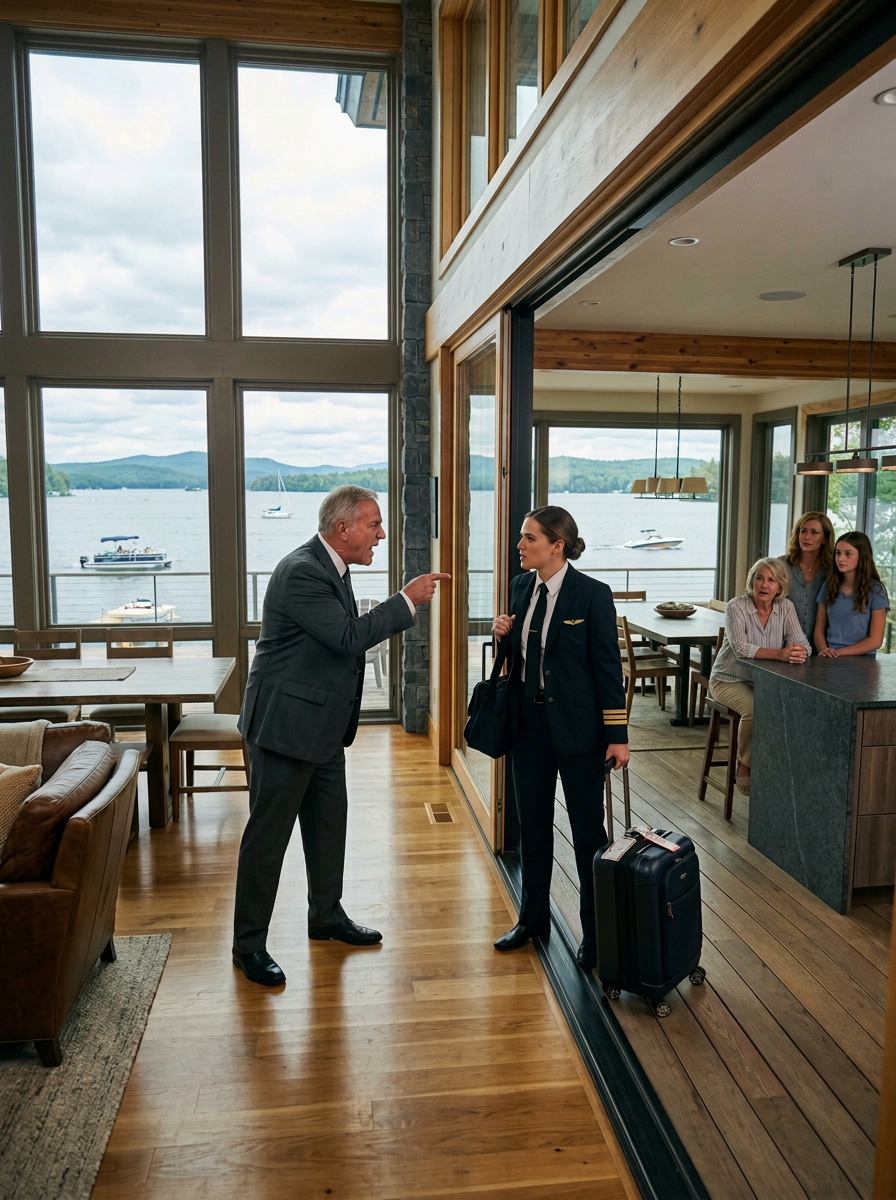
“Go back to your base, Commander. This villa belongs to your sister’s family now. You are banned from setting foot in here.”
My father said those words to me from the rooftop terrace of the house I had bled to buy, a champagne flute in his hand, my sister Olivia laughing beside him. I had just dragged myself home after three weeks of sleepless military drills, still in my sweat-soaked uniform, and this was my welcome.
He pointed at me, at the uniform, and sneered. “The military takes care of you now. This house? I’m giving it to Olivia and her husband.”
My duffel bag slid off my shoulder and hit the floor with a heavy thud. Over a hundred and ten thousand dollars I had bled to save this man, and this was what it bought me. A front-row seat to my own robbery.
I swallowed the humiliation whole. I gave him a thin, freezing smile. I nodded. And I turned on my heel and walked out.
They had no idea that a few days later, when they gleefully dragged their suitcases through that front door, I would already have a surprise waiting for them inside. Six hours of it. Just enough to bring every last one of those parasites to their knees, soaked and screaming into the dark, begging me to make it stop.
But let me back up. You can’t understand what I did without understanding the fifteen years that led to it.
I reversed out of my own driveway with my knuckles white on the wheel, the tires grinding over the gravel, and I refused to cry. I had been trained out of crying a long time ago. Instead, the pop of that champagne cork kept echoing in my skull, dragging me backward through a decade and a half of being treated as an ATM with a pulse.
That sound, that specific sound of unearned luxury, threw me all the way back to a freezing barracks during an early deployment, eating cold field rations out of a tin can while I stared at a bank statement that made my stomach turn. My entire combat paycheck, siphoned home to fund my father’s lifestyle.
Every dollar of it earned crawling through mud, running seventy-two hours without sleep, leading supply convoys through corridors where one wrong turn ended in a body bag. And it vanished into his pocket without a thank-you, without a phone call asking if I was still alive.
I remembered handing over thirty-five thousand dollars in cash for a top-of-the-line SUV, because my chronically unemployed sister and her useless husband David refused to take public transit like struggling adults. I stood in that blinding dealership after a forty-eight-hour logistics shift and put the keys in Olivia’s hand, and she didn’t say thank you. Not one word. She adjusted her designer sunglasses, clicked her tongue, and complained to the mortified salesman that the leather wasn’t the exact beige she’d demanded. Then she rolled her eyes at me, like I’d insulted her by buying the wrong color. And my father stood behind her in his tailored suit, arms crossed, nodding along with her complaint. He never told her to be grateful. He acted like my combat pay was his to hand out to his favorite child.
I remembered the two a.m. phone call, deep in a classified operation coordinating fuel for three carrier groups, when my father’s voice came trembling down a secure line begging for twenty-five thousand dollars to cover gambling debts before his creditors got to him. No apology. No confession. Instead he weaponized his blood pressure, screaming that if I refused, his heart would give out and leave Olivia an orphan. He didn’t care that I was in a restricted communication zone. I had to bypass my own security protocols and wire the money through an unsecured civilian channel, risking a reprimand that could have ended my career. My executive officer pulled me aside the next morning and asked, point-blank, why I’d accessed a nonmilitary financial system during an operational blackout.
I lied to protect my father. I put a decade of flawless service on the line for a man who gambled in basement card rooms while I ran million-dollar supply chains in combat theaters. And he repaid that by stealing the one sanctuary I had left.
I pulled onto the gravel shoulder of the mountain highway and slammed my fist into the dashboard, once, twice, three times, and the tears still would not come. Instead the grief hardened into something cold and clear and useful, cutting straight through fifteen years of blind loyalty to a single realization.
I owed these people nothing. Not a dollar. Not a tear. Not one more second of my dignity. The bloodline was dead.
I drove home to my sterile San Diego apartment, and the silence met me like a held breath. My keys hit the counter, and my eyes went straight to the folded flag in its glass case on the mantel, exactly where the chaplain had placed it in my hands three years ago.
Because that’s the other thing you need to understand. That’s the leash they used.
James. My husband. A combat officer who believed, right up to the end, in the inherent goodness of family, because he had never really met mine. I sat on the edge of the bed and I could smell the hospital antiseptic all over again, hear his raspy voice through the ventilator tubes in that ICU three years ago. He squeezed my hand with the last of his strength and whispered four words. “Take care of the family.”
That breath became a steel chain, and my father used it to drag me through the dirt for years. He memorized those words. He rehearsed them. Every time I tried to say no, every time I pushed back against a demand, he’d drop James’s name like a grenade. “James wanted you to take care of us,” he’d say, his voice thick with manufactured grief, and the ghost of my husband would stand in the corner of the room while I surrendered one more boundary in the name of a dead hero’s honor.
Three weeks after I buried James at Arlington, before the flowers on his grave had wilted, my father called in a fake panic about a foreclosure. I stood in a freezing bank lobby in the same black dress I’d worn to the funeral, eyes swollen raw, and signed over a fifty-thousand-dollar cashier’s check, nearly the entire military death benefit, to keep a roof over my father and Olivia. The teller looked at me with pity. Olivia looked at her phone and texted someone the whole time I was signing. My father folded the deed into his jacket and patted it twice, the way a man pats his wallet after a good deal.
They saw my husband’s death not as a loss but as a windfall. And they smiled while they took it.
I stood up from that bed and looked into the mirror, and the reflection wasn’t a grieving widow anymore, or an obedient daughter begging for scraps of approval. It was a decorated Navy commander with fifteen years of service on her chest and a spine forged in places where threats had real consequences.
I reached out and turned the flag case around to face the wall. James died believing they were a family worth saving. He was wrong, and I would not spend the rest of my life paying for his mistake.
The era of sacrifice was over. The next morning it became a mission.
PART 2
I walked through the reinforced doors of the San Diego Naval Base into a current of crisp salutes and quiet respect. “Morning, Commander.” Every voice carried something my own blood had never once offered me.
Here I was judged by execution. At home I had been judged by how fast I could wire a bailout. The contrast still made my jaw ache.
I sat at my desk and pulled up my encrypted contacts. Michael Vance. Former JAG. The man who had stood with me when a falsified supply report got pinned on my unit and three admirals wanted blood. He had dissected that case in seventy-two hours and never asked for a dime. He just said that’s what brothers do. A brother from military law, not from the lottery of DNA.
Then Ethan Wright. Former electronic-warfare officer. Neighbor near the base. A clearance that made government types nervous. I typed a short message to his secure line. Thirty seconds later, one word came back.
“Ready?”
I squared the physical files of the Lake Tahoe property. Original deed. Tax receipts. Renovation invoices I had personally funded. Insurance in my name alone. Every page was a round I had already paid for. The isolation of the night before was gone. I had a team. My father thought he had taken an empty house.
A few nights later, alone in the command center, my phone buzzed. John Martin.
“Listen carefully, Lauren. I’ve taken back the Lake Tahoe villa. I’m giving it to Olivia’s family permanently. They move in this week.” He decreed it like a king. “You’re an officer. You live on base. Everything’s subsidized. You don’t have a husband or kids. What do you need that big villa for? Give it to your sister. She needs a good environment for the children.” And then the crowbar. “That’s your duty. Before your husband died, he told you to take care of the family. You’re betraying your promise to James.”
The ceramic mug in my hand shattered. The handle snapped. Jagged shards cut my palm. Blood ran onto the floor around my boots. I barely felt it.
I brought the phone close. “Listen to me clearly. There will be no more concessions. This conversation is over.”
Two afternoons later, my right hand wrapped in gauze, Olivia called. The fake sobbing started instantly.
“Sister, please don’t do this to Dad. He has high blood pressure. You made him so angry. We’re really struggling, David can’t find work, the kids are crying. You’re an officer, you don’t understand the hardship of a nursing mother. We’re blood sisters. Blood is thicker than water.”
I could hear David in the background. “Tell her about the kids. Mention the blood pressure again.”
“Are you done crying?” I asked.
The sobbing stopped like a switch. “Why are you so cold-blooded? Dad has decided. This Sunday my family moves into the villa, whether you agree or not, and you have no right to stop it.”
I looked at my bandaged hand. “Try it. But remember, every trespass has its consequences.”
She had given me the day. Sunday.
I walked into Michael Vance’s office and dropped the stack on his desk. Deed. Tax receipts. The SUV wire. The gambling transfer. The fifty-thousand-dollar cashier’s check from the bank lobby in the black dress. “I need an armored legal bunker for my assets. An invasion is coming, and the enemy is my own family.”
He looked at the death-benefit copy longer than the deed. He had prosecuted generals. He said a parent using a dead son-in-law’s last sentence made those men look like amateurs.
We spent six hours sealing loopholes. Revoking every emergency access my father had ever been granted. The foreclosure story, the “temporary” names on utilities, the spare key Olivia had never given back — all of it had been left open because I had been trained to leave doors open for family. Michael closed them. Paper by paper. The villa was already mine. After that afternoon it was only mine.
Then I unrolled the villa’s blueprints. I did not sketch furniture. I mapped the house the way I had mapped a depot: where people enter, where they sleep, what they ignore because it looks like a fixture.
A photo buzzed in from Olivia. Four suitcases. Caption: See you Sunday, sis.
She had sent me the order of battle because she thought I was still the woman in the dealership holding the wrong beige.
PART 3
The next morning I briefed Ethan over his kitchen table. Coffee mugs. Circuit boards. Operation Storm. He grinned the way he had grinned the night he stayed up on energy drinks to pull a corrupted server because a fellow officer needed backup.
I told him what the house had already paid for. Thirty-five thousand in a dealership. Twenty-five thousand on a secure line I should never have opened. Fifty thousand in a funeral dress. A hundred and ten thousand, counted the long way, to keep a man in tailored suits who pointed at my uniform and told me to go back to base.
Ethan did not ask if I was sure.
For forty-eight hours we worked the lake house. Industrial batteries in the basement. Strobes in the ceiling fixtures. Acoustic emitters above the rooms they would sleep in. Every wire buried. One remote. My laptop in San Diego.
I am not going to dress that up. The source built a trap. I am reporting the trap.
On the final evening I stood on the porch with an industrial drill and bolted a reflective metal sign dead center in the oak front door. Automated surveillance area. Enter at your own risk.
The last legal checkpoint. A rational person could still turn around. Then I packed my tools and drove off without looking back.
Sunday came. I sat in the dark of my apartment watching three feeds. Deed in the drawer. Leave on the books. Gauze on a hand that had already paid enough.
The thirty-five-thousand-dollar SUV I had bought them swerved into my driveway. Dust. The same vehicle Olivia had accepted without thank you, the leather she had called the wrong beige, the car my combat pay had registered in a name that was not mine. My father climbed out first, chest out. Olivia and David hauled suitcases packed for a permanent stay. My stepmother Susan marched up in expensive heels.
Susan spotted the sign. She squinted. Her face twisted.
“What kind of garbage is this? Does she think a sign can scare anyone?”
She ripped it off the door, screws bending, wood splintering, and threw it in the dirt.
My father laughed from the bottom of the steps. “Ignore it. She’s throwing a tantrum because she got kicked out. Open the door, David.”
David jammed the spare key in the lock. The door swung wide. All four of them poured in, dragging suitcases across hardwood I had refinished with my own hands.
The sign in the dirt was the last warning. They had chosen. I had refinished that hardwood two summers before with my own hands. They dragged luggage over it as if the grain were already theirs.
Susan’s heels clicked like she was entering a hotel she had booked on my card. Olivia laughed. David had the spare key I had never asked to have returned, because I had been the sister who left doors open. My father surveyed the pines with the look of a man who believed a rooftop speech could move a deed.
Night fell over the trees. By ten, on thermal, four orange shapes settled into my beds and pulled my sheets up. I sat with coffee as black as the room. No second-guessing. The source says that. I will not add guilt I did not feel.
I pressed the red key.
PART 4
In under a second the villa went red. Strobes in every room. Air-raid sirens. Low-frequency sound the source had tuned for nausea. Ceiling sprinklers. A freezing mist.
I watched the feeds the way the source said I watched them. My father rolled off the master bed clutching his ears. Susan crawled the hall. Downstairs Olivia and David ran for the front door, and David shoved his own wife aside to reach the handle first.
The electromagnetic locks had shut when the system armed.
There was no exit.
For six hours I sat in a quiet room in San Diego and watched four people I used to write checks for huddle soaked in my living room. The source says I did not look away. I did not look away.
I will say the rest of it plainly, because a sixty-five-year-old reader will, and she should.
This was not a court. This was not a locksmith. This was a commander locking her father, her stepmother, her sister, and her sister’s husband inside a house they had entered after tearing down a posted warning, and leaving the system on until dawn. The source calls it a field exercise. The law has other words. I did not add a second night. I did not add blood. I did not add a weapon. I also did not pretend it was tea.
At dawn the timer released. The doors hissed. They crawled onto the lawn.
My phone rang. My father, hoarse.
I answered. “Sorry, Dad. Must be a glitch in the automated anti-theft system. The house has owner-recognition sensors. Next time, don’t break into someone else’s home. Have a peaceful morning.”
I hung up.
The next morning David brought a locksmith. One look at the grid and the scorched frame, and the locksmith put his hands up and left.
That night they pounded my apartment door. I opened it. I had been expecting them.
My father jabbed a finger at my face. “You dare use that demonic stuff to torture your own flesh and blood? I’ll file for court-martial. I’ll accuse you of domestic abuse and destroy your military honor. You’ll lose your rank, Lauren!”
Olivia pushed past him. “You’re a demon. We’ll cut ties. You’ll die alone. No one will ever acknowledge you again, unless you transfer the villa to our names right now to compensate for mental damages.”
They had broken into a house with my name on the deed, after ripping down the sign, and they wanted me to pay them for the night.
I folded my arms. I did not raise my voice. They had come to the apartment of a widow they still believed they could move with disgrace. They did not look like a family. They looked like people who had spent six hours finding out the house did not know their faces, and who thought the cure was to yell James’s name in a hallway.
“Are you two done with this circus? Want to sue? Go ahead. But to walk into a court-martial, you first have to prove legal ownership.”
A father cannot file a court-martial. I did not bother teaching him that. He had never learned a uniform except as a reason I didn’t need a house.
I shut the door. The deadbolt went home.
They still thought the villa was a thing I could be screamed into signing over. They had the spare key. They had the torn sign. They had the threat. They had James’s four words, worn smooth from use. They did not have the deed. They did not have Michael’s six hours.
They had not yet been told who owned it.
PART 5
The next morning we sat in the notary office of William Hayes.
My father, Susan, Olivia, and David marched in convinced the threat to my career had brought me to surrender.
My father slapped the glass table. “No more games. Sign the transfer papers. If not, this afternoon the accusation letter lands on your commanding officer’s desk.”
I sat across from them in dress uniform and drank my tea.
William Hayes slid a sealed dossier to the center of the table.
“Sorry, Mr. Martin. Commander Martin cannot transfer the villa to your family, because she is no longer its owner.”
The air left the room.
“What do you mean?” my father said.
I leaned forward. “Last Monday morning, I signed the papers donating the entire Lake Tahoe villa to the Navy Veterans Support Fund. The contract is binding and irreversible. In return, I retain the exclusive right to use the property for the rest of my life.”
Susan made a sound. David’s mouth opened and closed. My father tried to stand and sat back down. Olivia folded onto the glass and cried in a way she had not rehearsed.
They had nothing left to take.
A few days later I drove back up the mountain alone. Windows down. Pine. Cold water. No champagne in the vents. No perfume. No one in the passenger seat telling me what James would have wanted.
I spent the morning taking the system out. Strobes. Sirens. Ethan’s wiring from the basement. I patched the drywall until the holes were only paint. I mopped until the water ran clear. Room by room I put the house back to a house. I would not live inside a weapon. The veterans who would sleep here later did not need to know what the ceilings had done for one night.
I walked out onto the rooftop terrace, the same stones where my father had stood with a flute and pointed at my uniform and told me I was banned from my own floor.
The sun came up over the lake and laid gold on the boards the strobes had turned red.
I stood where he had stood.
I did not feel sorry for him. I did not feel like a conqueror. I felt the absence of a weight I had carried since I was old enough to write a check. No more midnight wires. No more death-benefit lobby. No more beige leather. No more voice on a secure line telling me his heart would give out if I said no.
James died believing they were a family worth saving. He was wrong about them. He was right about one thing, in a way he never meant. I did take care of the family. The one that salutes in the morning. The men who asked for nothing when I called. The veterans who will use that house after I am gone.
I just stopped mistaking the people who share my blood for the people who earned the word.
The terrace was quiet. The lake did not care who had popped champagne on it. I filled my lungs once, all the way down, and I went back inside alone to finish the floors.