My handbag landed on the concrete beside me, thrown there by my own father, and he stood over me in the doorway of the house that was legally mine and told me to go ahead and call whoever I wanted.
I want to tell this part carefully, because I have decided, in the telling, not to relive the worst few minutes of that morning inch by inch.
You do not need me to walk you slowly across that kitchen floor.
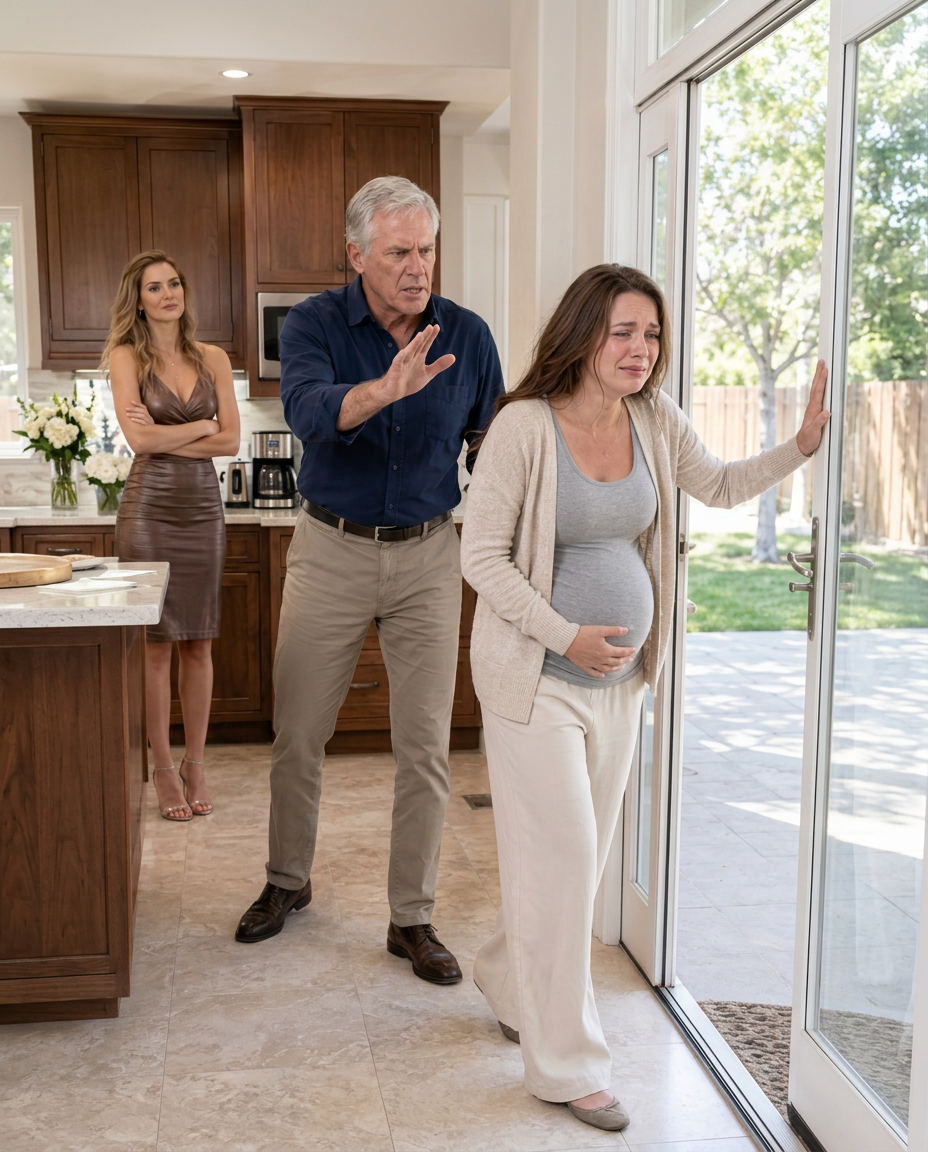
It is enough to say what happened, plainly, the way it will one day be read into a record: that my father came into my home uninvited, told me to get out, put his hands on me when I refused, and dragged me out onto that porch by my hair while his young wife stood in my kitchen and laughed.
I was eight months pregnant.
When I came down on the concrete, my water broke.
So that is the shape of it, and I will leave the rest of the choreography where it belongs, which is behind me.
What I want you to understand is the one thing I knew with total certainty, even sitting soaked and shaking on that porch with my scalp on fire: that the house behind him was mine.
Not his.
Not the bank’s.
Mine.
My father had walked into my life that morning absolutely certain of a great many things, and almost none of them turned out to be true.
I am telling you this from a long way past it, with my daughter asleep in the next room and the whole nightmare closed and filed.
So let me say now what I could not have promised then: we were all right.
She was all right.
Hold onto that while I tell you how close it came.
I have thought a great deal, since, about why I felt so certain in that moment — soaked, injured, in early labor, thrown out of my own home — that the house behind my father was mine and not his.
It was not confidence, exactly.
It was closer to the opposite.
For three weeks I had been certain of nothing at all.
Grief had taken every solid thing in my life and turned it to fog; I could not have told you what day it was, or whether I’d eaten, or how I’d gotten from one room to another.
But the deed was not a feeling.
The deed was a fact, filed in a county office, with my name printed on it in ink, and facts do not care whether you are grieving.
That was the thing I clung to on the concrete, and it turned out to be the exact thing my whole ordeal would come down to: that in a world where my father could take almost everything from me — my composure, my safety, very nearly my child — there were a handful of plain recorded facts he could not touch no matter how loudly he insisted otherwise.
I did not know yet how many of those facts my husband had quietly left me.
I only knew there was one, and that one was enough to stand on.
My hands were shaking so hard I could barely work the phone.
But my mind, for the first time in three weeks of fog, had gone perfectly clear and cold.
I did not call for an ambulance first.
I know how that sounds.
I pulled out my phone, sitting there on the wet concrete with a contraction building low in my back, and I called Miriam Whitlock, who had been my husband’s estate attorney and one of the few people he trusted without reservation.
She answered on the second ring.
“Adeline.
Is everything all right?”
“My father is inside my house,” I said, keeping my voice as level as I could.
“He just put his hands on me.
My water broke on the porch.
And I think he’s trying to take the property.”
Whatever softness had been in Miriam’s voice went out of it at once, and something precise and hard came in behind it.
There was no gasp, no oh honey, no wasted second.
“Listen to me,” she said.
“Do not go back into that house under any circumstances.
Hang up, call 911 right now, then call me straight back.
While you do that, I am sending a clerk to the county recorder’s office and I am personally calling the bank.”
“What bank?” I asked.
“Miriam, what bank?”
“The one holding the trust account Declan set up to protect you,” she said.
“Which your father seems not to know exists.”
PART 2
I went very still on that porch.
Through the open front door I could see my father crossing the living room toward Declan’s old desk, pulling open the main drawer, already going through my dead husband’s private papers as if they were his to search.
“There’s more you need to know, and quickly,” Miriam went on. “Your father called my office yesterday afternoon. He told my clerk that you were overwhelmed by grief and had authorized him to manage and liquidate the estate. My office refused to accept his word without written proof. But I want you to hear the important part, Adeline. He called yesterday.”
Yesterday. Not this morning, in some confused rush of misplaced concern. Yesterday, deliberately, before he ever put a key in my door.
The assault on the porch had felt, in the moment, like a man losing his temper. It was not. It was the last step of a plan.
That was the version I could almost have survived believing — my father, overcome, monstrous for a moment. The phone call to Miriam’s office the day before took that mercy away. It meant the man who grabbed my hair had woken up that morning knowing what he intended to do, had gotten dressed for it, had brought his young wife along to witness it, had carried in a folder prepared in advance.
The violence had not been a loss of control. It had been a tool.
To understand any of it, you have to go back three weeks.
My husband, Declan Gallagher, had been driving home along the highway outside Syracuse when another vehicle crossed into him. One minute I was setting the table and listening for his car in the drive. The next I was standing in our kitchen with a stranger’s voice in my ear, staring at the half-full coffee mug he’d left by the sink that morning and would never come back to rinse.
I was eight months pregnant. I slept badly and forgot to eat and kept one of Declan’s soft old T-shirts folded under my pillow because it still carried the faint smell of him, and I could not yet make myself wash it.
The house became the one place on earth where I could still half-hear his footsteps in the hall if I held very still. I did not know, in those foggy weeks, that the same house was about to become the thing my father tried to take from me before my husband was even properly buried.
Into that fog, into a woman who could scarcely track the days, my father walked with a folder and a plan. He was counting on the fog. What he had not counted on was that my husband, who knew my father better than I did, had left that cornered animal something sharper than instinct to fight with.
My father had never bothered to learn the one fact that mattered. Declan had bought the house before we married — that part was true, and I suppose it was the part my father had built his whole confidence on. What he’d never troubled to check was that, after our second anniversary, Declan had quietly added my name to the deed.
We had lived there together for six years. It was legally, fully, unambiguously mine.
It was the kitchen table where we used to argue, laughing, about paint colors neither of us really cared about. It was the upstairs hallway where Declan had assembled the baby’s crib and sworn the instructions had been written by someone with a personal grudge against new fathers. It was the wide front porch — the same porch — where he stood every morning with his coffee, reading the weather forecast aloud with the total, unshakable confidence of a man who was wrong about the weather roughly half the time.
That was the porch my father threw me down onto.
He loved that we were going to raise our daughter in that house. He had made very sure, without ever telling me, that no one would be able to take it from us once he was gone.
My father arrived on a gray Tuesday with his new wife, Courtney, who was twenty-four — two years younger than my youngest cousin, thirty-two years younger than him — and they did not knock. He still had the emergency key I’d never thought to take back.
He came in carrying a dark folder and set it on the table in front of me like paperwork I’d already agreed to.
“You can’t stay here anymore, Adeline,” he said. “Declan left massive debts. The house has to be sold. I’m handling the liquidation.”
I looked up at him. “You’re handling nothing in this house. Get out.”
I have already told you I won’t narrate what came next in detail, and I’m going to keep that promise. He didn’t take being refused any better than he ever had.
Behind us, the whole time, Courtney was laughing — not a loud laugh, just an easy, careless one.
Then my father picked my handbag up off the floor, tossed it out onto the porch beside me, and told me, smug and certain, to go ahead and call whoever I liked.
He was so sure there was no one I could call who would matter.
PART 3
“What business interests?” I asked Miriam, still sitting on the porch, the folder visible through the doorway on the kitchen table. “What is he even trying to take?”
Miriam took a short breath, the only pause she allowed herself the whole call.
“Declan anticipated that your family might come after the estate once he was gone,” she said. “So he built for it. The house, the personal investment accounts, and the controlling shares in Baldwin-Gallagher Logistics are all held inside the trust, and the trust is written to protect you and the baby specifically. Here is the part that matters this morning. If your father forged your signature on any document to gain authority over that estate — and it appears that is exactly what he attempted — then he has automatically triggered the fraud clause Declan wrote into it.”
“And what does that do?” I asked.
“It means,” Miriam said, cold and clear, “that your father does not control the company he believes he controls. Not anymore. Not as of the moment he forged your name.”
Baldwin-Gallagher Logistics was my father’s shipping company. That was how he told it, anyway, to anyone who would sit still for it.
The truth was in the name, if anyone had ever bothered to read it. Declan had worked at that firm for years as a senior executive. He and my father had built its major operations together. But my father never liked to acknowledge how much of the company was Declan’s doing. At family dinners he spoke about the enterprise as though every truck and every contract existed because of his own singular genius, and Declan, sitting across the table, rarely bothered to correct him.
Sitting on that porch, with Miriam’s voice in my ear, I finally understood what Declan had actually been doing all those years. He hadn’t been letting my father win. He had been watching him — patiently, quietly, the way one watches a fault line — and then he had gone and built the whole structure of our protection around what he’d learned, and said nothing of it, because saying so would have tipped off the very man it was built to stop.
He let me keep, for as long as I could, the softer version of my father, and he built the hard version’s defeat into the paperwork where it would wait until the day I needed it.
“Your medical safety is the only priority right now,” Miriam told me. “Everything else — the house, the company, all of it — lives in the records now, and the records don’t move for anybody. Stay on that porch. Let the paramedics reach you. Let him leave every single thing he brought right where he put it.”
My whole life, my father had wanted arguments, because arguments were the game he knew how to win. He could dominate a conversation. He could make you feel insane for being right. In an argument, Gerald Baldwin was undefeated.
Miriam Whitlock did not argue. Miriam dealt in things that did not care how loudly my father could yell.
The emergency key he had never returned. The folder sitting on my table. The call he’d made to her office the day before, using my name. The false claim of authority. The ransacked desk. The recorded deed with my name on it. The trust. The controlling shares.
None of those facts could be shouted down.
We were playing two different games and only one of us knew it. My father was playing the contest of wills and volume. Declan and Miriam had moved the whole contest onto different ground. Not who is more certain, but what is written down.
His certainty meant nothing to a deed. His volume meant nothing to a trust.
He was a champion who had trained his whole life for a sport that was no longer being played.
PART 4
Inside the house, my father’s phone rang.
I watched him glance at the screen, and something about the number made him answer at once.
“Yes, this is Gerald,” he said.
I couldn’t hear the voice on the other end. But I could see my father, framed in my own doorway, and I watched his posture change — the broad shoulders stiffening, the free hand going still.
“What do you mean, the accounts are frozen?” he said, and for the first time in my life I heard my father’s voice shake.
Beside him, Courtney had fallen still. The easy amusement was draining out of her face.
“Gerald, what’s happening?” she asked.
“Be quiet,” he snapped, waving a hand at her without looking. But this time she didn’t smile and fall silent. This time she just stared at him.
“He looks terrified,” I whispered to Miriam.
“Good,” she said, unbothered. “That’s the bank’s fraud department executing the hold. Stay where you are.”
I called 911, and I gave the dispatcher my address, and I heard myself say the words out loud — that I was eight months pregnant, that my father had dragged me out of my house by my hair and my water had broken on the porch.
Then I called Miriam back, and I did the single hardest thing she asked of me, which was nothing at all.
Because through the doorway, my father’s voice climbed, panicked and defensive, into the phone: “I did not forge my daughter’s signature on those trust documents!”
He said it to the bank. He said it loudly, into a recorded line, in front of an open door and a daughter sitting ten feet away — a denial of a thing no one on that call had yet accused him of out loud.
Every cell in my body wanted to shout back through the doorway that I knew about the call to Miriam’s office, that Declan had seen him coming and built a wall he’d just run himself straight into.
“Don’t respond to that,” Miriam said low in my ear. “Not a word.”
The confession I wanted to force out of him was already happening. He was making it himself, into a recorded line, unprompted, denying a forgery no one had yet named.
The girl I used to be needed him to admit it to her face. The woman I was becoming understood that his admission to the bank was worth a hundred times more, and that the surest way to ruin it was to give him the argument he was so desperate to have.
So I sat on my porch, and I held my tongue, and I let my father talk himself the rest of the way into the trap.
So I said nothing.
The ambulance turned into my driveway, its lights sweeping red across the front windows, and another contraction pulled tight and low across me.
And in the middle of all of it — the sirens, the phone, the collapse happening inside my house — the thing that hit me hardest was not my father at all.
It was that Declan should have been there. He should have been the one grabbing the packed bag from the hall closet. He should have been the one telling me I was breathing too fast, timing the contractions on his phone, making some terrible joke because he never knew what else to do when he was frightened.
Instead there was a lawyer in my ear and a stranger’s siren in my driveway and the man who raised me standing inside my home discovering that the plan he’d thought was airtight had no air in it at all.
The paramedics were coming up the porch steps toward me with their kit when my father finally lowered the phone from his ear.
He stood in the middle of my living room, staring at nothing. Then he looked down at the folder he’d carried so confidently into my kitchen an hour before — the folder full of paperwork meant to make my house his — and he looked at it like a man seeing a trap he’d already stepped in.
Courtney took a step toward him.
“Gerald,” she said. “Gerald, what happened? What did they say?”
He didn’t answer her. He couldn’t.
The house was not finished deciding.
The baby was not here yet.
The record was still being written, and he was still standing in my living room holding a folder that could bury him.
PART 5
“Adeline,” Miriam said. “A clerk from my office is at the recorder’s office right now. Your name is still on the deed. Nothing has been changed. The house is yours.”
I let out a long, shaking breath. After the morning I’d had, that one plain fact felt less like a victory and more like a floor.
Courtney’s eyes moved to me — sitting on the porch floor, a paramedic already kneeling at my side. I must have looked like the most defeated woman in New York.
An hour earlier, Courtney had stood in my kitchen and laughed. Now she stood beside my father in the wreckage of their morning, waiting for him to explain how it had all come apart.
He had no words for her either.
Courtney was not laughing anymore.
They took me to the hospital, and that evening, a few weeks earlier than we’d planned but strong and furious and perfect, my daughter was born. I’m going to keep the birth to myself, mostly, the way I kept the kitchen floor to myself, except to tell you the one thing that matters: she was healthy. Seven pounds of outrage with her father’s dark hair.
We had made it. Both of us.
After that, the records did exactly what Miriam had promised they’d do, without any speeches from me. The morning became a case, and the case was made of things that could not be shouted down.
The 911 recording. The paramedics’ report. The emergency key. The folder my father had left sitting on my table, which — because I never touched it — stayed right where he’d set it, every page of it evidence. And, above all, the call he’d made to Miriam’s office the day before, and the forged authorization behind it.
My father was charged over what he did to me in that kitchen, and charged again over what he’d tried to do to the estate. He spent a great deal of money on lawyers who told him, one after another, that there was no argument to be won here, because the other side wasn’t arguing.
The other side was only reading facts into a record.
And the fraud clause did what Declan had built it to do. The moment my father forged my name to reach for the controlling shares in Baldwin-Gallagher Logistics, those shares moved beyond his reach entirely, into the protected trust, and the board that had for years deferred to Gerald Baldwin was handed a documented case of fraud against its own chairman.
They removed him.
The company that carried his name at the front no longer belonged to him in any way that counted, and the half of the name he’d always pretended didn’t matter — the Gallagher half, Declan’s half — turned out to be the half that had quietly held all the power the whole time.
I did not gloat. I let the law do the work and kept my hands and my voice out of it. It was the first time in my life my silence had been a choice instead of a surrender.
He wanted a war with his ungrateful daughter. What he got instead was a stack of records and my absolute refusal to give him the scene he needed.
Courtney left him before the first hearing. There was no money left to laugh beside.
A judge granted me a protective order, and my father — stripped of the company, facing the charges, abandoned by the young wife he’d rebuilt his vanity around — has kept his distance ever since.
He has never met my daughter.
He wrote me a letter, once, some months later, that began as an apology and became, by the third paragraph, an explanation of why none of it had really been his fault. I recognized the shape of it from my whole childhood.
I did not write back.
We stayed in the house. Of course we stayed. It was ours — it had always, legally and truly, been ours — and I was not going to let the memory of one gray Tuesday drive me out of the home Declan had fought, from beyond his own death, to keep under our feet.
The kitchen where my father dragged me is also the kitchen where Declan and I argued about paint. The porch where I was thrown down is also the porch where he read the weather wrong and kissed me goodbye a thousand mornings.
I get to decide which of those the house is.
My daughter is learning to walk now, in the upstairs hallway where her father once sat swearing at the instructions to her crib.
Some evenings I stand on the front porch, and I let it be both things at once, because a place can hold more than one story and this one is ours to fill from here.