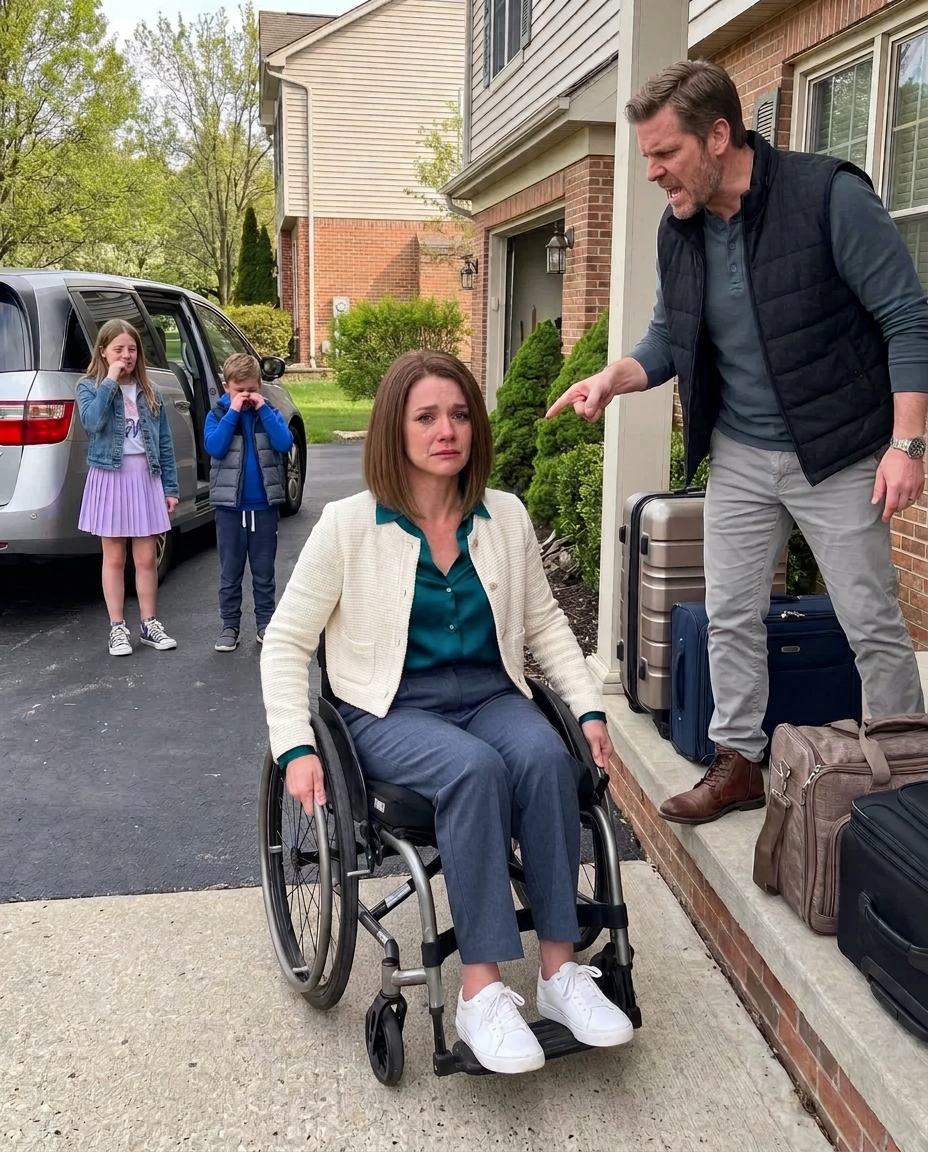
When the hospital transport van stopped outside my house in Columbus, Ohio, I noticed the luggage before I noticed my husband.
Two suitcases sat neatly on the porch.
Daniel stood beside them with his arms crossed.
My twelve-year-old daughter, Lily, sat silently beside me in the van. My eight-year-old son, Noah, held the backpack he had brought to visit me throughout six weeks of rehabilitation.
A delivery truck had hit me while I was driving home from work.
The spinal injury left me unable to move my legs.
Doctors couldn’t tell me whether that would ever change.
Daniel looked at my wheelchair.
Then at the children.
“Get out,” he said. “Take your kids. I don’t need you anymore.”
Even the transport driver stared at him.
I said nothing.
I smiled.
Daniel clearly thought I was too stunned to fight back.
What he didn’t know was that three days earlier, while I was still at the rehabilitation center, our bank had called about several suspicious transfers from our joint savings.
He also didn’t know that Rebecca Sloan, an attorney who worked with my employer, had already helped me freeze what remained.
Most importantly, Daniel had forgotten one very important detail.
The house belonged to me.
My father had purchased it years earlier and left it solely to me when he died.
Daniel had lived there for nine years.
His name had never appeared on the deed.
“Mom?” Lily whispered.
“I’m okay,” I told her.
Daniel stepped closer.
“You heard me, Claire. I changed the locks. Go stay with your sister.”
My eyes moved toward the new deadbolt.
Then back to him.
“You changed the locks on my house?”
His expression tightened.
“It’s our house.”
“No,” I said quietly. “It’s mine.”
Right then, a black sedan pulled in behind the transport van.
Rebecca stepped out first.
A county deputy followed her carrying a folder.
PART 2
Daniel’s face changed immediately.
Rebecca walked onto the porch and handed him a copy of the deed, notice of the frozen accounts, and a formal demand requiring him to restore my access to the property.
The deputy looked toward the new lock.
“Sir, if Ms. Carter is the sole owner and legal occupant, you cannot lock her out without a court order.”
Daniel stared from the documents to me.
“You planned this?”
“No,” I said. “You did.”
Then Rebecca opened another folder.
“We also need to discuss the $38,000 transferred from the marital savings account to an account in your name last month.”
Daniel went pale.
The driver lowered the wheelchair ramp.
I rolled toward my house.
My children followed.
For six weeks, Daniel had assumed my accident had made me helpless.
Marriage, he kept saying, gave him the right to stay. The deputy made it equally clear that changing the locks while I was hospitalized had created a problem Daniel apparently hadn’t considered.
The ramp was still the van’s ramp. The deadbolt was still new. The bags were still his idea of a welcome.
Daniel didn’t leave quietly.
For the next twenty minutes, he argued with the deputy.
Then Rebecca.
Then me.
He insisted that being my husband gave him the right to stay.
Rebecca calmly explained that marriage didn’t give him the right to exclude the titled owner from her own property.
Eventually, he unlocked the door.
The inside of the house told me almost everything else.
Half our photographs had disappeared.
Daniel’s clothes had been moved into the downstairs guest room.
Empty wine bottles crowded the recycling bin.
On the kitchen counter were restaurant receipts, two expensive shopping bags, and a handwritten note signed with one woman’s name.
Vanessa.
Lily noticed before I could turn it over.
“Who’s Vanessa?”
Daniel snapped, “Go upstairs.”
“She stays with me,” I said.
Rebecca photographed everything visible in the rooms.
Daniel had transferred $38,000 from our joint savings in four separate transactions.
Some of that money was insurance money intended to make the house accessible after my injury.
The rest included years of savings for Lily and Noah.
Daniel claimed he’d moved it “for household expenses.”
Rebecca laid copies of the bank statements across the dining table.
“Then documenting the expenses should be simple.”
Daniel said nothing.
That evening, my sister Rachel arrived with groceries and stayed with the children while Rebecca helped me organize documents.
She had already warned me not to search Daniel’s private devices. We didn’t need to. The financial records gave us enough to start with.
Daniel packed a duffel bag and announced he was staying at a hotel “until everyone calmed down.”
Before leaving, he leaned toward me.
“You think a wheelchair makes you powerful because people feel sorry for you?”
I met his eyes.
“No. Paperwork makes me powerful because you signed your name to everything.”
His jaw tightened.
Then he walked out.
PART 3
The next morning, I filed for divorce.
It wasn’t revenge.
It was protection.
Rebecca referred me to a family-law attorney named Marcus Hale.
By noon, Marcus had requested temporary orders involving custody, access to money, preservation of marital assets, and Daniel’s financial disclosures.
He also warned me not to expect some instant courtroom victory.
For years, I had handled compliance audits for a medical equipment company.
I knew how to build a record.
Bank statements.
Texts.
Insurance notices.
Medical bills.
School records.
When Daniel called accusing me of turning the children against him, I ended the conversation and asked him to communicate through the parenting application Marcus recommended.
Then the bank investigator called.
The $38,000 hadn’t simply been transferred.
Daniel had spent $14,600 as a deposit on a leased luxury SUV.
Nearly $9,000 had gone to Vanessa Brooks, a twenty-nine-year-old real estate agent he’d been seeing while I was in rehabilitation.
The rest had been transferred yet again.
Three days later, he came to the house demanding to talk to me alone.
I stayed in the living room with Rachel present.
“Claire, I made mistakes.”
“That’s a different sentence from ‘Get out.’”
“I can put some of the money back.”
“Some?”
He swallowed.
“Vanessa has part of it.”
I nodded.
“Then you should probably call her.”
Vanessa left a voicemail. I forwarded it to Marcus.
“Do nothing else,” he said. “Let the records speak.”
Two weeks later, we appeared in Franklin County family court for a temporary hearing.
Rachel had altered a navy blouse so it sat correctly while I was seated.
Lily and Noah stayed at school.
I didn’t want them anywhere near the legal fight.
Daniel arrived with an attorney I’d never seen.
He looked polished again.
But the confidence was gone.
Daniel’s lawyer argued that the transferred money had been used for legitimate marital expenses and that Daniel had voluntarily left the house to reduce tension.
Marcus responded with the bank records, documentation showing the insurance money was meant for accessibility work, and Daniel’s own messages from the week before I came home.
One stood out.
While I was still in rehabilitation, Daniel had written:
Don’t worry about bills. I’ve got everything handled here.
That same day, he’d transferred $10,000.
The judge didn’t accuse Daniel of stealing.
This was a divorce hearing, not a criminal trial.
But she ordered both of us to preserve marital assets, required a detailed accounting of the transferred money, and prohibited unusual withdrawals without proper notice.
I received temporary primary residential custody.
Daniel received a structured parenting schedule.
The children and I remained in the house.
Daniel could not return without agreement or another court order.
Outside, near the elevator: “You’re trying to destroy me.”
I turned my chair toward him.
“You told a woman recovering from a spinal injury to leave her own house with two children.”
Marcus stepped beside me.
Daniel stopped talking.
PART 4
The following months were harder than any courtroom scene.
Winning a hearing didn’t make living in my body easier.
I had to relearn almost everything.
How to move from my chair to my bed without help.
Which grocery-store aisles were wide enough to turn around comfortably.
How long it took to get two children ready for school when I couldn’t simply run upstairs because Noah forgot his homework.
The insurance funds Daniel had touched were supposed to help pay for modifications.
My employer allowed me to return to work remotely at first.
Rachel drove the children when I couldn’t.
A contractor widened the bathroom doorway, lowered part of the kitchen counter, and eventually replaced the temporary metal ramp with a permanent one.
I hated needing help.
But I hated being underestimated more.
Daniel’s financial disclosures arrived in November.
He had opened two credit cards I knew nothing about.
Hotel rooms, jewelry, restaurants, trips from the months before my accident.
He had also borrowed against his retirement account.
After a letter from Daniel’s attorney, Vanessa returned $6,000.
Daniel managed to return another $11,000 by getting rid of his interest in the luxury SUV lease and liquidating an investment account.
A substantial amount was still gone.
He offered to waive any claim to the furniture if I stopped pursuing the missing funds.
I declined.
Then he offered to repay more money if I immediately agreed to equal parenting time.
I declined again.
Custody wasn’t something I was willing to bargain for money.
One evening, Noah asked me a question that hurt more than anything Daniel had ever said.
“Did Dad leave because you can’t walk?”
I put down the towel I had been folding.
“No,” I said. “Dad made choices because he is responsible for Dad’s choices. My wheelchair did not make those choices.”
“Are you going to walk again?”
“I don’t know.”
He thought about that.
“Will you still come to my soccer games?”
“Yes.”
“Even if there are stairs?”
“I’ll find another way in.”
By spring, I was driving again with hand controls.
Lily leaned back through the open door.
“You did it.”
“So did you.”
Our divorce mediation was scheduled for May.
Daniel arrived with far fewer demands.
The house was still my separate inheritance.
The disputed transfers still needed to be resolved.
We negotiated for nine hours.
I didn’t get everything I wanted.
Neither did Daniel.
The papers were not signed yet.
Real life rarely ends with one side winning absolutely everything. Marcus had said that without making it a speech. Nine hours. The house still mine. The transfers still a number. Custody still not for sale.
The pizza was not ordered yet.
The ramp was in place.
The bags were no longer on the porch.
It was not finished.
PART 5
The final settlement required Daniel to reimburse a substantial portion of the dissipated money through his share of our marital assets.
I kept my house.
I received primary residential custody.
Daniel had regular parenting time and shared decision-making on major matters.
We agreed that communication would continue through the parenting app.
When we finally signed the documents, Daniel stared down at his copy for a long time.
Then he looked at me.
“Was any of it real?”
I thought about nine years.
Two children.
Christmas mornings.
His hand gripping mine when Lily was born.
And the way he’d gradually stopped meeting my eyes after the accident.
“Yes,” I said. “Some of it was.”
“But real things can still end.”
He nodded once.
Our divorce became final in July, almost one year after the crash.
I didn’t throw a party.
I ordered pizza.
Rachel brought a grocery-store cake anyway.
She’d had the bakery write NEW CHAPTER across it in uneven blue icing.
Lily laughed.
Noah immediately claimed the corner piece.
We ate outside beneath the string lights my father had installed years earlier.
Several weeks later, Daniel arrived to pick up the children for the weekend.
He stood at the bottom of the ramp.
“You’ve changed everything.”
“Some things needed changing.”
“You know, that day on the porch, when you smiled, I thought you were in shock.”
“I was.”
“Then why did you smile?”
Because I remembered the call from the bank.
Because I knew whose name was on the deed.
Because Rebecca was already driving toward the house.
But I gave him the simplest answer.
“I realized you thought the wheelchair was the worst thing that had happened to me.”
His expression tightened.
“And it wasn’t?”
“No.”
Noah burst through the front door carrying his glove.
I watched them leave.
Then I locked the door and returned to the kitchen.
My laptop sat open on the lowered counter.
Three days earlier, I’d been promoted to senior compliance manager. More responsibility. Better salary. Occasional travel, which my company had agreed to arrange accessibly.
Lily’s summer-camp schedule hung on the refrigerator.
Beside it was Noah’s soccer calendar.
There were medical appointments too. Physical therapy. Follow-up imaging. A specialist consultation in Cleveland.
My legs still didn’t move.
Some mornings, nerve pain woke me before sunrise.
Some buildings were still frustratingly difficult to enter.
Sometimes strangers spoke to Rachel instead of me, as though sitting in a wheelchair had erased my ability to answer for myself.
I did not measure the day by whether I would walk.
I measured it by the lock.
I locked the door.
The bags were not there.