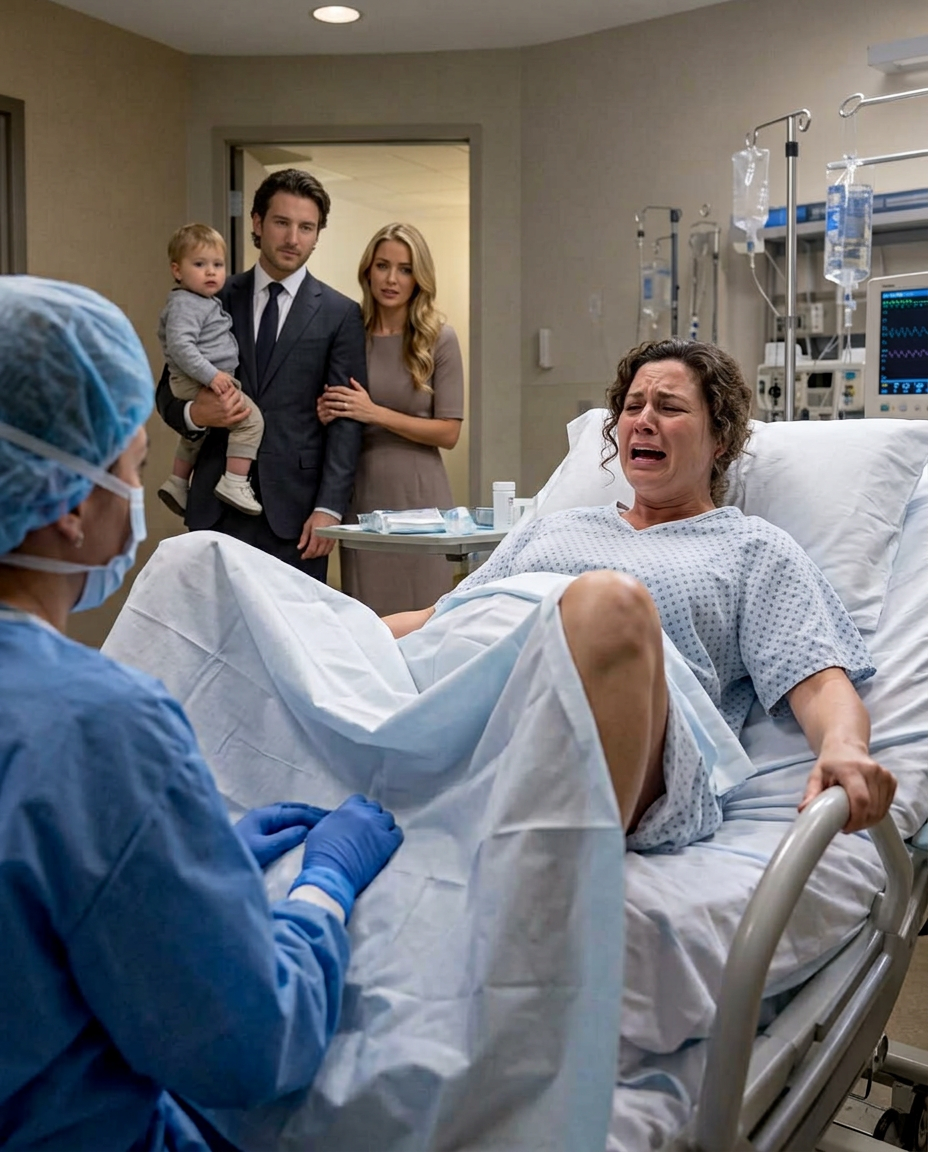
The delivery room doors banged open, and the sound went straight through my aching skull as another contraction crested and broke over me.
I will not dwell on the physical part of it.
Anyone who has been through a long labor knows the shape of it, and anyone who hasn’t does not need me to draw the picture.
It is enough to say that I was at the very end of it, wrung out and shaking and past the reach of the polite version of myself, when the midwife braced against my knees and told me it was time.
“You’re fully dilated, Adriana,” she said.
“I need everything you have, right now.”
And that was the moment I heard the hard leather soles on the tile.
Not the soft squeak of a nurse’s shoe — the deliberate, unhurried tread of a man who has never once in his life walked into a room that did not belong to him.
I knew that walk better than I knew my own heartbeat.
Four years of marriage teaches you a man’s footsteps the way it teaches you his silences, and Roderick’s had always carried the same message: that wherever he was going, the space would rearrange itself to accommodate his arrival.
He walked into restaurants that way, and boardrooms, and, once, a hospital where his own father was dying, checking his watch in the corridor.
It had charmed me, at the beginning, that confidence — I had mistaken it for strength, the way you do when you are young and have not yet learned that the two are not the same thing, that real strength has no need to announce itself and that the men who cannot enter a room quietly are usually compensating for something they are terrified you will notice.
By the time those soles crossed the delivery-room tile, I had learned the difference in full.
And still, some animal part of me, some exhausted laboring part, felt the old reflex flicker — the trained instinct to make room, to smooth the way, to become smaller and more pleasant so that the large man would not be displeased.
I want to name that reflex, because I think a great many women will know it.
Even then.
Even flat on my back at the end of a thirty-hour labor, with my daughter’s head crowning, the first thing my body wanted to do when my husband walked in was apologize for the inconvenience of my own pain.
It was the last time that reflex ever ran in me.
He was about to burn it out of me for good.
“Sir, you cannot be in here,” the charge nurse said, stepping into his path with both hands up.
“This is an active delivery.
You need to leave immediately.”
I turned my head against the soaked pillow and forced my stinging eyes open, and there he was in the doorway — my husband of four years, Roderick Pembroke, in a custom suit without a single wrinkle in it.
And half a step behind him, one manicured hand resting on the small curve of her own belly, stood Odette Marchetti — a former marketing intern from his old university, a young woman I had personally trained the year before.
“Adriana,” Roderick said, crossing to the side of my bed with both hands in his trouser pockets.
“There’s an administrative matter we need to settle, while you’re still clear-headed enough to follow it.”
“Have you lost your mind?” the midwife shouted, gloved hands in the air.
“This woman is crowning.
Whatever this is can wait until the baby is out!”
“It will only take a moment.” He raised one finger to quiet the room, the same gesture I had watched him use to silence a boardroom a hundred times.
“Odette has already given birth to my son.
He’s fifteen months old now.”
The room kept moving around me — voices, alarms, the midwife’s hands — but all of it had gone strangely far away, as though I were hearing it from underwater.
“The Pembroke line requires a male heir to carry the foundation,” Roderick went on, glancing at my heart monitor with the detachment of a man reading a stock ticker.
“Little Nash has already been entered into the Pembroke Living Trust and registered with the family bank.
Which means the child you’re delivering today will be excluded from the core trust.”
“You brought her here,” I whispered.
“To tell me this.
While I’m in labor.”
“The birth certificate will be filed under your maiden name.
Ashworth.” He adjusted a cuff, not looking at me.
“I won’t short you on support.
You needn’t worry about the basic logistics.”
From the doorway, Odette smoothed the front of her cashmere dress, calm as a junior executive who had just closed a hostile takeover.
“The baby’s here!” the midwife cried, and lifted a small, furious, wailing shape into the light.
“It’s a girl.
A healthy girl.”
They wiped her down and laid her on my chest, and the whole roaring room narrowed to the warm, impossible weight of her against my collarbone, her cry sharp and alive in my ear.
I put my hand over her back.
I have never in my life been so tired, or so instantly, ferociously certain of anything.
Roderick leaned over and gave his newborn daughter perhaps half a second of his attention, then checked his watch.
“A girl suits your household better anyway,” he said, already stepping back toward the door.
“She’ll fit your life.
Be reasonable when my legal team calls, and I’ll cover a recovery retreat — Miami, or wherever you’d prefer.”
“You are a monster,” I said into my daughter’s hair, and the tears came at last, hot and silent.
“Odette’s feeling faint, so I’m going to take her home,” he said, turning his back on the two of us without a flicker.
“I’ll send my mother to look in on you tonight.” And the heavy doors swung shut behind them, and the room went quiet.
I looked down at the sleeping girl on my chest, and I felt the shock in me cool and harden into something with a clean edge.
Roderick believed he had just stripped me down to nothing.
He had forgotten one thing about the empire he was so sure was his.
The entire legal skeleton of the Pembroke Group — the whole two-billion-dollar structure — rested on a trust I had designed, myself, three years earlier.
I was not merely a beneficiary of it.
PART 2
I was the sole trustee, with unilateral authority over all of it.
Three years before that delivery room, the Pembroke Group had been a promising, chaotic, badly structured company drowning in its own success. I was the one who sat up through the nights building it a spine — the trust that held the equity, the layered structure that protected it from creditors and raiders and, though I did not phrase it that way then, from Roderick’s own worst instincts.
I made myself the sole trustee not out of ambition but out of caution, because someone sober had to hold the center.
Roderick signed every document I put in front of him without reading a line, because reading was beneath him and because he trusted that his clever wife was making him richer, which she was. He never once grasped that the architecture keeping his empire standing had my name at the load-bearing point of every beam.
To him I was the wife who handled the tedious legal parts so that he could do the important work of being important. He had spent four years standing inside a house I built, admiring his own reflection in its windows, never noticing whose hand was on the foundation.
In the delivery room he thought he was evicting me from his life.
He did not understand that, structurally speaking, he had always been living in mine.
I reached for the phone on the bedside table with a steady hand and called my oldest friend, Priya Rhodes, a senior corporate litigator down in Atlanta.
People are often struck by that detail — the steadiness of the hand. A woman minutes out of a traumatic birth, freshly abandoned, her newborn on her chest, calmly dialing a lawyer. They expect the hand to shake.
It did not, and the answer is not that I am made of stone. The shaking had already happened, months earlier, alone, in bathrooms and parked cars and the small hours of too many nights, when I first found the transfers and understood what my marriage actually was.
By the time Roderick made his announcement in that delivery room, I had already done all my shaking. I had grieved the marriage in private while it was still technically alive, which is the loneliest grief there is, because you cannot tell anyone and you must go on setting the table for the man you are mourning.
So when the blow finally landed in public, out loud, in front of the medical staff, it did not shatter me the way he expected it to. It landed on a woman who had been braced for it for the better part of a year.
He thought he was catching me at my weakest — flat on my back, in pain, undefended. But a woman who has spent nine months quietly preparing to survive you is not at her weakest in the moment you strike. She is at her most ready.
“Adriana!” Priya answered on the second ring, bright with anticipation.
“Did you have the baby? Boy or girl?”
“Priya,” I said, flat and even. “I need you to drop whatever you’re holding.”
Her voice changed in an instant. “What’s wrong? You sound frightening.”
“Roderick has a secret fifteen-month-old son with an intern. He brought her into the delivery room, during labor, to inform me that our daughter is cut out of the family trust.” I looked out the window at the skyline. “I need three things, now.”
“Name them.” I could already hear her keyboard.
“One. A divorce petition with an emergency motion to freeze every joint and corporate asset. Two. Contact the trust auditors and execute Article Seventeen for beneficiary violations, by eight tomorrow morning. Three. A discreet, professional moving crew at the island house, three o’clock tomorrow afternoon.”
There was a pause.
“Adriana. If we pull all three of those levers, you will flatten his financial standing inside forty-eight hours. Are you certain you want a full war?”
“He ended our marriage in front of the medical staff,” I said, listening to my daughter breathe. “I’m not starting a war. I’m just clearing the wreckage.”
By nine the next morning the private room smelled of lilies and antiseptic, and Roderick’s mother came gliding through the door with a silver thermos and a bright, cheerful dress.
“Oh, Adriana, my dear, you look worn to the bone,” Rowena cooed, setting the thermos down and sparing the bassinet a single glance. “She’s a sweet little thing. Girls are so affectionate when we’re older, aren’t they.”
“Thank you for coming, Rowena,” I said, sitting up with a face I kept perfectly smooth.
“Roderick told me the whole situation last night.” She poured a small cup of broth with practiced grace. “You mustn’t take the birth-certificate business to heart, dear. The Pembroke name simply needs a male heir at the head of the foundation, and truly, we only wanted to spare you any stress in your third trimester.”
“I understand your priorities completely,” I said, and sipped the broth. It tasted of salt and dust.
“I knew you’d be sensible.” She patted my arm. “And society is so progressive now — carrying the Ashworth name won’t be the least bit of a problem for her.”
I smiled and thanked her and let her believe every word had landed exactly as she intended.
The moment the door closed behind her, I rang the nurses’ station and told them, over the sharp protest of my own body, that I would be signing myself out that afternoon.
I had needed to know whether the mother had known. And she had — that was plain in the ease of her, the practiced grace with which she poured broth for the daughter-in-law her son had humiliated in a delivery room the night before, as though we were discussing a redecoration that had not gone quite to my taste.
There was no shock in her, no shame, no flicker of the outrage a decent woman feels on behalf of another. There was only management. She had come to smooth me down, to frame the erasure of my daughter as a sensible modern accommodation, to make sure I would be, in her word, sensible.
The cruelty in the delivery room had not been one man’s aberration. It was a family position. It was the water they swam in. The Pembrokes had decided, somewhere up the line, that a woman was a vessel for producing heirs and a daughter was a rounding error, and they had all quietly agreed to it, and Roderick had merely been the one crude enough to say the policy out loud with the monitors still beeping.
That was worth knowing. It hardened the last soft place in me.
Priya reached the hospital lobby by noon in a dark SUV and took my bags without a single question. We drove out to the coastal estate on St. Simons Island, where four moving trucks were already idling along the length of the drive.
Twelve uniformed movers were working through the front door under Priya’s sharp eye. I sat in an armchair on the back patio with my daughter in my arms and watched them take the house apart around me — the leather chairs, the commissioned art, the wine, the imported rugs, all of it packed and carried out over the course of a single afternoon.
They even wheeled out the heavy wall safe from Roderick’s study, which I had emptied the week before of the ledgers that detailed his quiet offshore transfers.
I had known. I had known for months.
If you knew — if you knew about the intern, and the child, and the money moving out to the coast — how could you carry that pregnancy to term beside him and say nothing? How could you sip your coffee across the breakfast table from a man you had already decided to dismantle?
The answer is not that I am cold. The answer is that I was pregnant, and unwell, and physically incapable of fighting the war I knew was coming, and so I did the hardest thing there is, which is to wait. I let him believe he was getting away with it, because a man who believes he is getting away with something grows careless, and a careless man leaves a trail. Every week I stayed quiet, his contempt made him bolder and his bookkeeping sloppier, and my forensic accountants had another clean transfer to document.
I was not being weak in those nine months. I was being patient, in the specific, disciplined, teeth-gritted way that looks identical to weakness from the outside and is its exact opposite. I gathered. I documented. I built the case beam by beam, the same way I had built the trust, and I carried my daughter to term inside the belly of the very house I was quietly wiring to come down.
And I promised her, before she was born, that she would never once know how much it had cost me to keep smiling at her father across that table.
She never has. That is the one secret from those nine months I intend to keep for good.
By four o’clock, the ten-thousand-square-foot house was an echoing shell — bare floors, blank walls, the sound of my daughter’s small breathing carrying clear across empty rooms that had been full that morning.
“That’s the last of it,” Priya said, walking back through the stripped living room with a cold bottle of water for me. “Ready to go?”
“Not quite,” I said, and nodded toward the tall wall beside the grand staircase.
Our wedding portrait still hung there — six feet of it, Roderick smiling in a velvet tuxedo with his arm around a version of me who had believed him.
I handed the baby to Priya, took a thick red marker from my bag, and walked up to the canvas. Two heavy strokes, and a jagged red cross sat over my husband’s painted face.
“Now we can go,” I said, and capped the marker, and took my daughter back.
Three hours later, as I was checking into a quiet residence in Charleston, my phone lit with a message from Priya.
Roderick just reached the island house. The hospital told him you’d checked out early. The trap is sprung.
I read it twice, sitting on the edge of a strange bed with my sleeping daughter beside me, and I felt no triumph in it. Only the cold, level calm of a woman who had spent nine months preparing for a day she’d prayed would never come, and had come anyway.
The red cross changed no account balance. It froze no asset. It was the one purely emotional thing I permitted myself in a plan that was otherwise as cold and precise as an audit.
Then I capped the marker, and picked up my daughter, and became, again, the surgeon — because it was the surgeon, not the wife, who was going to keep us both safe.
PART 3
For two days I recovered in a high, quiet apartment in Charleston and let the thing I had built do its work, while Priya fed me the fallout by the hour.
Roderick’s first move was to drive to my parents’ place, certain he’d find me weeping in their guest room. Instead he was met at the gate by my brother, Everett, who declined to let him past the end of the driveway — and who then, without raising his voice, recited back to him the make and registration of Odette’s sports car and the exact unit number of her waterfront apartment, so there could be no more pretending any of it was a secret.
The real reckoning arrived at nine o’clock on Monday morning, when my legal team served formal notice of the trust freezes directly to the corporate headquarters of the Pembroke Group.
By mid-morning, every account tied to his corporate operations was locked. The empire he had walked into that delivery room believing he owned outright had, overnight, stopped answering to him at all.
My secondary phone rang at noon, showing Roderick’s private number.
“Adriana!” He had lost every ounce of the boardroom polish. “Where are you? Where in God’s name are you?”
“That is no longer any concern of yours,” I said, adjusting the blanket over my daughter’s legs.
“Do you have any idea what you’ve done? The bank has frozen our entire operational liquidity! You moved your equity to a third-party entity overnight!” His breath came in ragged bursts. “Tell me what you want. Take the island house. Take the cars. Take twenty million in cash — but lift this freeze, right now, so we can talk like adults.”
“You still don’t understand what’s happening,” I said quietly. “This isn’t a settlement negotiation.”
“Are you going to burn the whole Pembroke Group to the ground?” His voice cracked straight down the middle. “You spent four years helping me build this company!”
“I didn’t help you build it, Roderick.” I kept my voice level and cold. “I built it. The structure, the architecture, the trust the entire thing stands on — that was mine. And you took what I built and used it to fund your mistress and your secret child.”
There was a silence on the line, and I could hear him rearranging his face for a new approach even through the phone, the way I had watched him do across a thousand dinners.
He was searching for the register that would work on me — the charm, then the reason, then the threat, running through his whole repertoire and finding, for the first time in our marriage, that none of the keys fit the lock.
Every tool he reached for had been forged for a different woman — the accommodating one, the one who smoothed his way, the one who made herself smaller so he could feel large. That woman had signed herself out of a hospital the day before and was not coming back.
He kept speaking into the phone, and I kept listening, and somewhere in there I understood that he still, even now, could not quite believe it was happening — that he was searching for the sentence that would make me fold, certain it existed, certain it was only a matter of finding it.
There was no such sentence. There had not been one for months. He simply hadn’t noticed the woman he was married to had already left the room.
He went silent, and I let the silence sit before I finished it.
“You siphoned more than four million dollars out of our corporate reserves to buy that woman her property on the coast,” I said. “I have the audit trail. Every transfer, every shell, every date. And two hours ago, I submitted the whole of it to the federal regulators.”
When he finally spoke, his voice had shrunk to almost nothing.
“How long have you known.” It was not even a question. “You knew. Before you went into labor, you already knew.”
“I gave you nine months,” I said. “Nine months, Roderick. Every single day I waited for you to come to me and tell the truth, to show me one flicker of ordinary decency. And instead you walked her into the room where I was delivering our daughter, and you did it there, on purpose, because you wanted me too broken to fight.” I closed my eyes. “Sign the unconditional divorce papers. Or let it go to a judge, who will hand me everything regardless.”
“Adriana, please.” He sounded smaller than I had ever heard him. “Do you really hate me this much?”
“I don’t hate you at all,” I said, and it was the truth. “You simply don’t matter to me anymore.”
I ended the call before he could answer, and I blocked the number, and I sat for a while with my hand on my daughter’s back, feeling it rise and fall.
PART 4
What Roderick did not know was that my forensic accountants had already found something a great deal stranger than embezzlement.
Buried under the transfers to Odette’s coast house was a separate wire — two million dollars, moved out of a Pembroke shell account into an offshore firm called Kestrel Holdings.
It did not fit the pattern of a man spending money on a mistress. It was too large, too clean, too deliberately hidden even from his own hidden accounts.
And when my people finally traced who sat behind Kestrel Holdings, I understood that my husband was not only a liar and a thief. He was also, without the faintest idea of it, somebody’s mark.
It reframed everything, that two-million-dollar wire, though it would take Roderick weeks to feel the full weight of it. Because it meant the intern in the delivery room had not been a random cruelty, a middle-aged man’s ordinary affair with a younger woman.
She had been placed.
Someone had studied my husband, found the exact shape of the hole in him — the bottomless need to be admired, the dynastic hunger for a son, the vanity that could not tolerate the idea that his wife was the competent one — and had built a person to fit that hole precisely, and slid her into his life like a key into a lock.
Weston Kingsley had looked at the Pembroke Group, at the fortress trust I had built around it, and understood that he could never breach it from the outside. So he had not tried.
He had gone in through Roderick instead, through the one part of the structure I could not engineer against: my husband’s own character.
The trust I built was impregnable. The man I married was the unlocked door. In the end, every fortress has exactly one weakness, and it is almost never in the walls. It is in whoever you left holding the keys.
I did not tell him. I sat on what I knew and let it ripen, because some truths do more work when a man arrives at them himself.
Priya’s next message came ten minutes later.
Roderick is demanding an emergency paternity test from Odette. He’s convinced the male heir is the only thing that saves face with his board. He’s clinging to the boy.
I looked at the sealed folder resting on the coffee table in front of me, and I let myself, for the first time in a very long time, smile.
He was clinging to the one plank in the whole wreck that would not hold his weight.
Odette tried to stall the test, claiming she was traveling. It did not matter, because I already had the answer, and had had it for two weeks.
A discreet investigator I had retained months earlier had, in the course of ordinary and lawful work, come by what was needed to establish the truth — a sample from Roderick, a sample from the child — and the laboratory did the rest.
The certified result was Exhibit B in my divorce filing, and it left no room at all for interpretation.
Zero percent probability of paternity.
The boy Roderick had built his whole cruel arithmetic around — the male heir he had entered into the Pembroke Living Trust, the son he had chosen over his own daughter in a delivery room — was not his son. Had never been his son.
He had thrown away his marriage, his daughter, and, though he did not yet know it, his freedom, to secure an heir who carried not one drop of his blood.
My investigator was watching Odette’s building the afternoon it all came apart, and so I know how it went, in more detail than I ever wanted.
Roderick let himself into her apartment unannounced and found her throwing designer clothes into open suitcases. She had not heard him come in. She was on speakerphone, and the voice on the other end belonged to Weston Kingsley — Roderick’s fiercest rival in the commercial real-estate market, a man he had spent a decade trying to beat.
“Weston, he knows everything now!” Odette was crying into the phone. “You promised me — once he was ruined, you’d move me and Nash out to the West Coast! Nash is your son, Weston! I did every single thing you asked to get inside his accounts!”
Then she turned, and saw Roderick in the doorway, and dropped the phone.
He crossed the room and picked it up and put it to his ear.
“You made a very convincing proud father, Roderick,” Kingsley’s voice said, cool and amused. “I’ll give you that. Your wife’s trust was a fortress from the outside — I could never have touched it. But your ego was the easiest back door I have ever walked through in my life.”
He did not shout. He did not throw anything.
He simply sat down on the hallway floor with the negative paternity test in his shaking hands, while Odette picked up her bags and stepped over his legs and walked out the door without once looking back.
A man alone on a floor, holding proof that the son he had traded everything to secure was another man’s child, planted in his life by an enemy who had read him like a cheap paperback.
Kingsley’s line about the ego being the easiest back door he had ever walked through was not a boast. It was a diagnosis, and it was correct.
The indictment had not come down yet.
The phone in Charleston had not yet rung.
He was still sitting on that floor, still certain, somewhere under the ruin, that a sentence existed that would make the woman who built the trust fold.
There was no such sentence.
PART 5
Priya called me as the sun was going down over the Charleston harbor.
“The federal prosecutors handed down the indictment this afternoon,” she said, in the clean, unhurried voice she used when the news was very large. “Corporate fraud and tax evasion. They’re looking at a seven-year minimum. Adriana — it’s finished. It’s actually finished.”
“Thank you, Priya,” I said, watching the light go gold and then rose across the water. “For all of it.”
When I set the phone down, I sat for a long while and tried to locate the triumph I had assumed I would feel, and could not find it anywhere. What I felt instead was quieter and stranger and, in the end, better than triumph.
I had not destroyed Roderick. Every wound that closed over him that autumn was one he had opened himself — the fraud was his, the theft was his, the lie in the delivery room was his, and even the rival who had played him had only been able to do it because Roderick’s vanity had left the door standing open.
I had not brought him down. I had simply stopped holding him up, turned the lights on, and let everyone see the shape of what he had actually built.
The empire, it turned out, had always been mine. I was only taking it back.
Eight months went by in a blur of quiet mornings and long working days. I was at the desk in my new office at Ashworth Capital, reviewing quarterly projections, when the legal notification appeared on my screen.
The court had entered a final divorce decree by default, on account of the defendant’s incarceration. Full physical and legal custody of my daughter, Blythe Ashworth, was granted to me alone.
I closed the laptop and let myself feel it.
Blythe was eight months old, bright and round-cheeked and forever hauling herself upright against the furniture to attempt another wobbling step across the office rug. She carried my name — the name Roderick had meant as a demotion and I had turned into an inheritance.
He had ordered my daughter registered under my maiden name as a punishment — a way of marking her, from her first day, as excluded, second-tier, not a true Pembroke. He meant Ashworth to be a lesser name, a consolation stamp on a child who had failed to be a son.
Within a year the name Pembroke would be a thing people said quietly, attached to indictments and prison terms, while the name Ashworth sat over the door of a growing, clean firm built from the equity that had always, underneath everything, been mine.
He had tried to brand my daughter with the mark of exclusion, and he had, without knowing it, spared her the one name in that whole affair that would become a liability. My Blythe would never have to explain, on a school form, why she shared a surname with a convicted man.
Two months after that, a request came through his public defender. His trial had concluded; he had taken a plea; and before he was transferred to the long-term facility, he wanted, the letter said, a short meeting.
I went. I wanted to look at him one last time with clear eyes and owe him nothing afterward.
We sat on opposite sides of a thick glass panel. He was hollowed out in his orange jumpsuit — thin, gray at the temples, his hands shaking as he lifted the receiver.
“Eight years,” he said, his voice a scrape of its old self. “I took the plea this morning.”
I gave a single nod and said nothing.
“I didn’t ask you here to beg,” he said, and pressed his free hand flat against the glass, his eyes filling. “I asked you here to tell you I’m sorry. Every night in that cell I replay the delivery room. I threw away everything we built, for a lie that was never even mine.”
“You made your choices, Roderick,” I said.
“Is Blythe well?” His voice shook apart on her name. “Will you — someday, when I’ve served my time — will you ever let me see her?”
I leaned toward the glass.
“Do you remember what you said in front of the medical staff,” I asked him, “while I was in labor with her? You said she was excluded. You tried to erase her before she had taken a single breath of air.”
“I was out of my mind, I wasn’t — ”
“My daughter does not need a father who treated her birth as a liability to be managed,” I said, and I kept my voice quiet and even, because cruelty was not what I was there for. “She will never know who you are. Not out of revenge. Out of care. It is the single kindest thing I can do for her.”
There is a difference between a father a child has lost and a father a child was never safe to have. Roderick had stood over Blythe’s first breath and called her an exclusion, a household matter, a girl who would suit my life better than his. A man does not say that in a moment of madness. He says it because it is what he believes.
I would not hand my daughter, at five or ten or fifteen, to a man capable of weighing her worth against a son’s and finding her wanting, and trust him not to let her feel it.
He wanted absolution, sitting behind that glass. Absolution was his to seek elsewhere. My job was the girl with paint on her fingers.
His hand slid down the glass, and the receiver dropped from his fingers to the little steel counter, and he folded forward over his own arms with his shoulders shaking.
I hung up my side, picked up my bag, and walked out through the long corridor without once looking back.
Three years later, the afternoon sun lay warm and gold across the courtyard of a small preschool in Charleston. I was standing by the brick gate, straightening my jacket, when a little girl with a wild halo of brown curls came barreling across the yard and launched herself into my arms.
“Mommy!” Blythe shrieked, wrapping her arms tight around my neck.
I caught her and laughed and kissed her cheek. “How was painting today, my love?”
“Look!” She dug a bright, dripping-with-color drawing out of her little backpack. Two figures held hands beneath an enormous rainbow.
“It’s you and me! But Mommy — Oliver in my class said everybody has a daddy at home. Where’s my daddy?”
I stopped, and I knelt down on the sidewalk so that I was level with her big, clear eyes.
“Do you feel like there’s anything missing at home, sweetheart?” I asked her.
Blythe tipped her head to one side and thought about it, seriously, the way she thought about everything. And then she broke into a huge grin and shook her curls hard.
“Nope! Because I have the best mommy in the whole world, and you can do everything!”
Something in my chest went warm and full and still. I stood, and took her small hand in mine.
“Come on,” I said. “Let’s go get ice cream to celebrate that drawing.”
And we walked off down the sunny sidewalk together, her hand in mine, toward all the ordinary days ahead.