PART 1
Seconds before boarding, I posted one final announcement:
“I’m divorcing my husband, effective today.”
At that exact moment, my CEO husband was at St. Catherine’s Hospital beside his mistress as she gave birth to his child.
My phone rang within thirty seconds.
“Don’t you dare get on that plane!” Grant roared.
Behind him, I heard a newborn crying and Melissa Crane demanding that he return to the room.
I looked through the glass at the private jet waiting on the rain-covered tarmac.
“You chose your family, Grant. I’m choosing mine.”
“You have nothing without me.”
I switched off my phone and walked toward the gate.
For six years, Grant had introduced me as the quiet wife who preferred charity work.
He rarely mentioned that my late father had founded Northstar Medical Systems, the company Grant now ran, or that I controlled forty-one percent of its voting shares through an irrevocable family trust.
I had supported Grant becoming CEO because I believed ambition and integrity could exist in the same man.
Three weeks earlier, an anonymous envelope proved me wrong.
Inside were hotel receipts, private messages, and photographs of Grant kissing Melissa, Northstar’s chief financial officer.
The final page hurt most: a prenatal invoice charged to an executive medical account while Grant was telling employees layoffs were necessary.
I didn’t confront him.
Anger would warn him. Silence gave me time to learn how deeply his betrayal had reached into my father’s company.
I hired forensic accountant Lena Ortiz and gave her legal access through the trust’s audit rights.
What she found turned heartbreak into strategy.
Melissa’s apartment, luxury car, and nearly $2.8 million in fake consulting payments had all been funded through Northstar vendors.
That morning, Grant texted that an “urgent acquisition meeting” would keep him away overnight.
At noon, the hospital’s family liaison accidentally called me about paperwork for “Mr. and Mrs. Hale’s baby.”
I thanked her, opened my laptop, and sent the evidence to every independent director.
As I reached the gate, a silver-haired woman rose from a leather chair.
Evelyn Shaw, Northstar’s board chair, held a sealed blue folder. Beside her stood Daniel Kim, the company’s general counsel.
“The emergency vote is ready,” Evelyn said. “But he knows where you are.”
Beyond the terminal glass, headlights cut through the rain.
Grant’s black sedan jumped the curb and stopped outside.
Less than an hour after his son’s birth, he had left Melissa and the baby to chase me.
PART 2
The terminal doors flew open.
Grant stormed inside without a coat, his white shirt half-buttoned and a hospital visitor band still around his wrist. He spotted me near the gate and hurried forward — then he saw Evelyn and Daniel, and he stopped abruptly. “Why are they here?”
Evelyn remained calm. “Because Olivia requested an emergency meeting under Article Seven.”
Grant laughed, though his face had gone pale. “My wife doesn’t understand corporate bylaws.”
“Your wife wrote Article Seven with her father,” Daniel said.
I opened my tablet. Nine directors appeared on the secure call.
For six years he had called me the quiet wife who preferred charity work, and somewhere along the way he had started to believe his own story. I remembered the first time he’d said it, at a charity gala in our second year of marriage, his hand resting lightly on the small of my back. “Olivia prefers charity work,” he’d told a table of donors, and the table had smiled and looked away from me, and I had understood, quietly, what I was being turned into. A woman with no opinions and no ledger of her own.
My father used to say that the books of a company tell the truth even when the people don’t. He taught me to read them before I could drive, sitting me on a stool in his office with a green ledger and a pencil until I could find the one line that didn’t belong. And Article Seven — the emergency provision that lets the board act without the chief executive present — was one of the last things he and I drafted together, late at night in a kitchen full of coffee cups. He wrote it for exactly this. The day the company’s own leader had to be stopped.
“Turn that off,” Grant said, stepping closer. “We can settle our marriage privately.”
“You made our marriage a company expense,” I replied.
I presented the evidence one piece at a time. A shell consultancy registered to Melissa’s brother. Her apartment billed as temporary executive housing. Prenatal care hidden under employee wellness expenses — a pregnancy folded into the accounting while Grant stood in front of the workforce and said layoffs were necessary. He had looked employees in the eye and told them there was nothing left to spare, all while the mother of his child billed her doctors to the same account he was draining. And a forged approval bearing my electronic signature.
Lena had traced every transfer, and Daniel confirmed the original server logs were preserved.
Grant first called the payments retention incentives. Then he blamed Melissa. Finally, he blamed me. “Olivia has been emotional since her father died,” he told the board. “This is revenge because I wanted a child and she couldn’t give me one.”
The cruelty did exactly what he intended. It landed in my chest like a closed fist — the one wound he knew would bleed, the one he had helped me carry for years. It also erased the last doubt from Evelyn’s face.
I opened one final audio file.
Two nights earlier, Grant had taken a call in our kitchen, unaware our security system had archived the sound after a glass-break alert. His voice filled the terminal.
“Once the acquisition closes, move the remaining money and dilute Olivia’s trust. She signs whatever I put in front of her.”
Melissa laughed.
“And after the baby?”
“I’ll make Olivia look unstable, divorce her, and keep the company.”
Silence followed.
PART 3
Grant reached for the tablet, but Daniel moved it away.
Evelyn called the vote.
Eight directors suspended Grant immediately. One abstained. A second vote froze his executive access and referred the evidence to federal authorities and Northstar’s insurers. His watch and his phone began buzzing as company access and corporate cards were disabled, one by one, while he stood there in the middle of the terminal still wearing the hospital band from his son’s birth. I watched him feel it happen — the little empire in his pocket going dark, notification by notification — and I felt nothing but a calm I had not felt in six years.
“You planned this,” he whispered.
“I documented it,” I said.
Daniel handed him the suspension notice. Evelyn gave me the blue folder. Inside was the signed board resolution appointing me interim executive chair until an independent CEO could be selected. I looked at it and felt my father in the room for the first time since he died — not as grief, but as a steady hand on my shoulder, telling me to stand up straight.
Grant stared at the seal, then at the jet outside. He finally understood. I wasn’t fleeing. I was flying to Seattle to stop the acquisition he planned to use as cover for the theft.
I turned toward the gate. The jet sat on the rain-covered tarmac, waiting the way it had waited all morning, and for the first time I understood that boarding it was not an escape. It was a return.
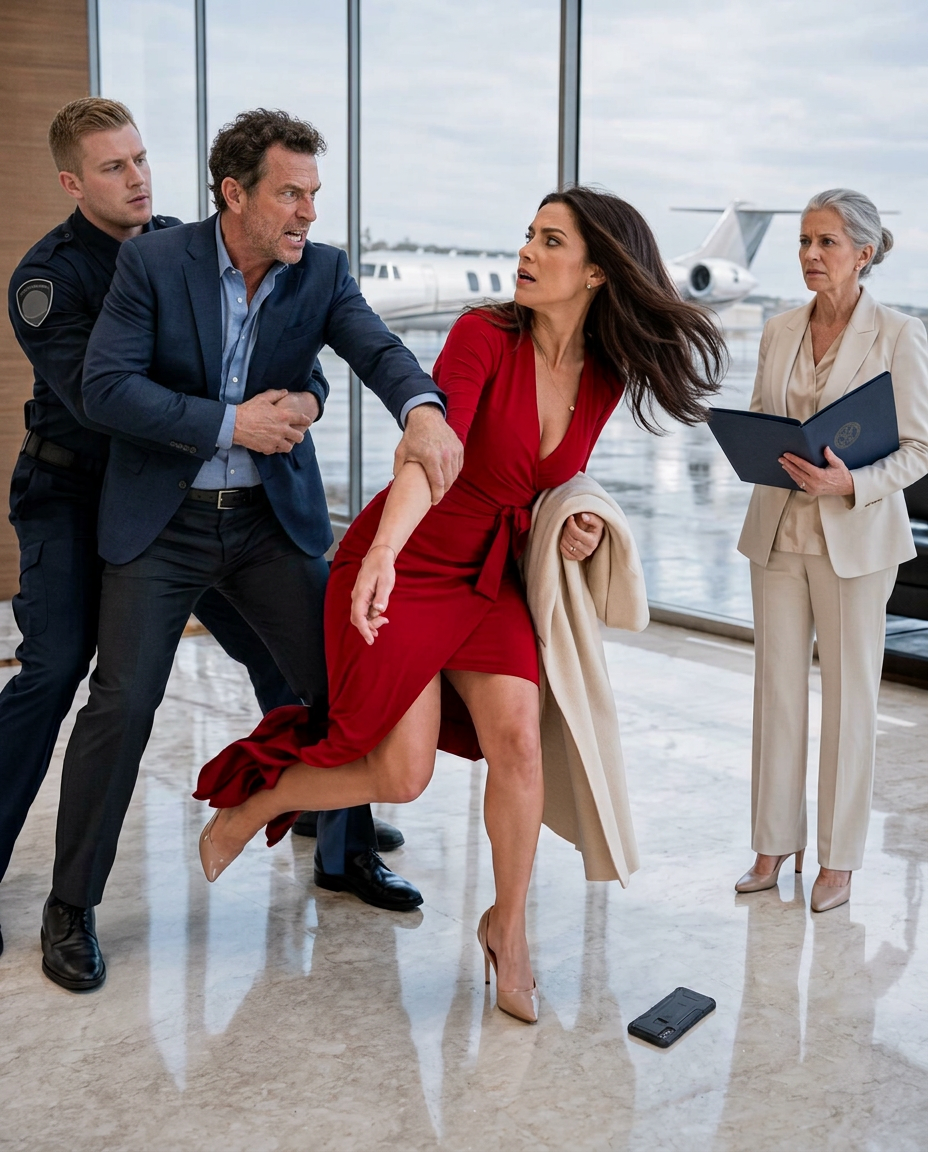
His hand closed around my wrist.
Grant yanked me backward, sending my phone sliding across the marble. “You are not taking my company,” he shouted.
For six years I had been the quiet one. I had smiled at the dinners, nodded at the decisions, kept my father’s company running while wearing a stranger’s face. And in that moment, with his fingers around my wrist in front of the entire terminal, I did not raise my voice. I did not pull away. A terminal security officer crossed the room and pulled him off me while Daniel recovered my phone.
“It was never your company,” I said. “You were trusted to lead it.”
Grant struggled until the officer warned him to stop. Evelyn stood between us with the signed resolution. That was what finally stopped him. Not another man. Not someone waiting to rescue me. It was the board’s votes, my father’s legacy, and the truth that all the power Grant had flaunted came from the family he had tried to defraud.
His anger turned into bargaining.
“Olivia, listen. Melissa means nothing. I panicked. The baby—”
“Your son means something,” I said. “He deserves a father who does not abandon him on his first day alive. Go back to the hospital.”
“If you board that plane, we’re finished.”
I removed my wedding ring and placed it on the suspension notice.
“That was the announcement.”
Security escorted Grant outside. Through the glass, I watched him call Melissa. She answered long enough to scream before hanging up.
PART 4
On the flight to Seattle, I didn’t sleep.
Lena Ortiz sat across from me and walked through the numbers for the fourth time. The $2.8 million she had first traced through fake consulting payments was, she said, only the surface. Every hour her team found another vendor, another shell, another quiet transfer. The outside auditors were already describing a figure far higher than her first review had found — money that was not waiting for the signing but already moving through the deal structure toward accounts none of us recognized.
That was the acquisition’s real purpose. Grant needed it to close so the theft could disappear into it. The deal I was flying toward wasn’t just paperwork. It was the door he planned to walk the company through.
And then there was the signature.
Somewhere in the evidence was a forged approval bearing my own electronic signature — a document I had never signed, my name placed there to make the fraud look authorized. That was the part that kept me awake. If anyone could make that forgery stand, the whole scheme would wear my face instead of his. The trust I controlled. My father’s name. My seat at that table. All of it could be turned into the weapon that buried me rather than the shield that saved the company.
The trust was the part Grant never understood. It was irrevocable, sealed — the one thing he could never take outright, which was precisely why the recording had talked about diluting it. He couldn’t seize my father’s company, so he planned to erode it from the inside, one signed page at a time, until the quiet wife owned nothing but a title and a story.
Melissa made sense in a way that turned my stomach. She was the chief financial officer — the one person with the access and the signature rights to route money through vendors without raising a single flag. Grant hadn’t chosen her at random. He had chosen her because she held the keys to the cash, and he had let me believe it was my failing that drove him to her.
“He planned for you to sign for all of it,” Lena said quietly. “That was the design from the beginning.”
I had heard it in his own voice, in the kitchen recording: she signs whatever I put in front of her. Grant had counted on that woman staying quiet forever — signing whatever was placed in front of her, and never once asking what was underneath.
The anonymous envelope still haunted me, too. Someone had known about Grant and Melissa long before I did. Someone had gathered the receipts and the messages and the photographs and sent them to me with no note, no name, no return address. I had no idea who they were, or what they knew that I didn’t, or whether they were trying to save me or simply to use me. I didn’t know if they were a friend or an enemy who shared a common target. Some nights I thought it hardly mattered.
Somewhere below us, in a hospital I would never see, a boy a few hours old was learning to breathe without knowing that his father had already run from him once that day. I thought about him more than I wanted to admit.
And there was the ninth director. Eight had voted to suspend Grant; one had abstained. The board had spoken with a single crack in its voice, and I didn’t know what that crack meant. It was the kind of detail I once would have let pass. Now I understood that details like that one were how a careful man built his exits in advance.
The plane cut through the dark toward a city where, in nine hours, a man I had trusted for six years would sit down with a pen and complete the theft he had dressed up as an acquisition. Lena closed her laptop and looked at me. “You should sleep,” she said. “Tomorrow you won’t be able to.”
By the time we landed, it was set to sign at nine o’clock the next morning.
We worked through the night in a Seattle boardroom. Lena’s team reconstructed the money’s path in real time. The recall order on the wire was filed before dawn. At six, the first confirmation arrived. At seven, the second. At eight, the bank had still not confirmed that the funds had been stopped. At 8:30, a junior analyst brought in a coffee that no one drank. At 8:40, the room had gone so quiet I could hear the rain on the windows and the hum of the laptop fans.
At 8:48 a.m. — twelve minutes before the pens were set to touch paper — Lena looked up from her laptop.
“Olivia.”
Her face was gray.
“The wire is still moving.”
I looked at the clock.
Twelve minutes.
That was all that stood between my father’s company and a theft that would gut it.
And I was the only one left who could walk into that room and stop it.
PART 5
In Seattle, we stopped the acquisition twelve minutes before signing.
The outside audit later uncovered $4.6 million in diverted funds, far more than Lena’s first review had found.
Northstar terminated Grant and Melissa for cause. The Justice Department later charged them with wire fraud and conspiracy. Both accepted plea agreements requiring restitution. Grant also lost his stock options under the misconduct clause he had once insisted on adding to executive contracts. I took a quiet satisfaction in that one — the clause he had argued for, in a meeting I still remembered, came back to collect what he owed.
Our divorce took nine months. His lawyers demanded half my trust until the judge reviewed our prenuptial agreement and the forensic report. I kept my inheritance, home, and shares. I asked only for my legal fees and the return of what belonged to Northstar’s employees. There were mornings during those months when I sat in a courtroom and listened to strangers argue over the worth of my silence, and I said nothing, because I had already said the only thing that mattered at an airport gate. People asked me, afterward, why I hadn’t just left quietly. I never knew how to explain that leaving quietly was the one thing I had already done for six years. This time I wanted to be heard.
The forged signature was never fully explained. The prosecutors had more than enough without it, and the case stood on what it stood on. Some questions stay where the past left them. I never learned who sent the anonymous envelope, and I never learned why the ninth director abstained. I only know that whatever hand pushed that envelope through my mail slot, it saved everything my father built. So, wherever you are — thank you.
Melissa faced consequences too, but I refused to punish her child. Through counsel, I ensured the baby’s medical coverage continued independently of his parents’ employment. The adults created the betrayal. The child had not. Whatever I felt about the woman, the boy did not choose any of it, and I would not let him begin his life paying for what his parents had done.
One year later, Northstar had recovered the diverted money, restored canceled employee bonuses, and hired a respected physician-executive as CEO. There was a moment, when the bonuses were restored, that I understood what the fight had really been about. Not the money. The people who had kept the company alive while its leader stole from them. My father had been right about almost everything. The one thing he never saw coming was the man I married. I remained board chair, working from an office that still held my father’s battered brass compass. I kept it on the desk, not as decoration, but as a reminder that direction is a thing you choose, again and again, even after someone else has spent years trying to turn the needle for you.
On the anniversary of that airport morning, I flew to Seattle again. I booked the same gate on purpose, the way you revisit the room where a fever broke. This time, there were no frantic calls. At the gate, sunlight stretched across the floor as a message from Evelyn appeared on my phone:
“Clear skies. Company secure.”
I smiled, switched my phone to airplane mode, and boarded.
Not because I was running from my old life.
Because I had finally taken back the controls.