I SENT my family $61,400 while serving in the Army—then I found the trust amendment that ERASED me from their future. When I stopped paying, they came at 5 A.M. How far would they go?
The pounding hit my apartment door at 5:03 in the morning.
Hard enough to rattle the chain.
“Erin! Open this door before I break it!”
My father’s voice.
I’m Staff Sergeant Erin Callahan. Thirty-one years old.
Army logistics NCO at Fort Bragg. Eleven years of training to stay calm when everyone else loses control.
None of it prepared me for this.
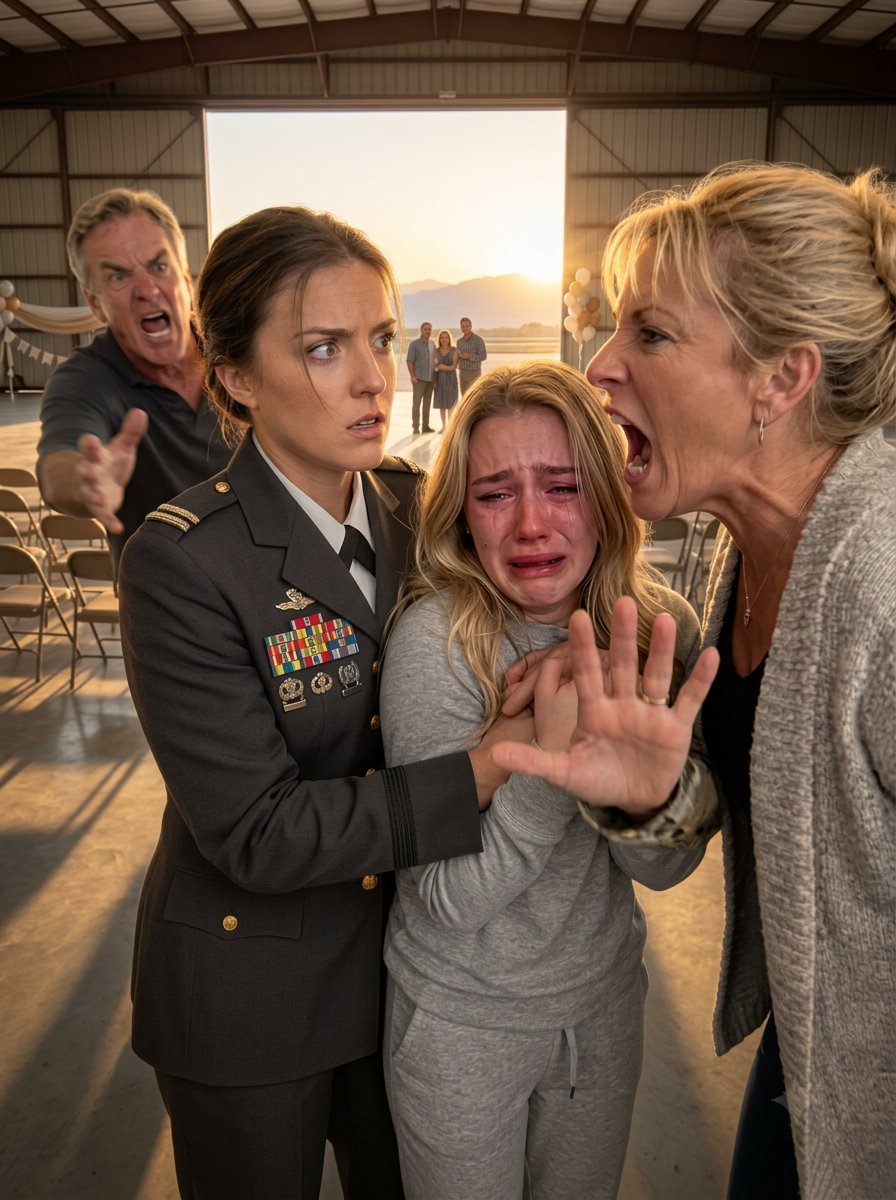
My father, mother, and twenty-three-year-old sister were crowded outside my peephole like a collection team.
I opened the door three inches. Chain still on.
“Why are you here?”
Dad shoved his shoulder against it. The chain tore free.
The door slammed into my cheek.
He stormed inside. Mom followed, pale and tight-lipped.
Kelsey pushed past in pink sweatpants—and stared straight at my desk.
“Give me your debit card,” Dad said.
“Get out.”
For five years, I had sent them about $850 every month.
Mortgage shortfalls. Power bills. Truck repairs. Kelsey’s “emergencies.”
$61,400 total. Because I believed my family was struggling.
I ate noodles after field exercises. I drove a car with a failing transmission so they could keep their home.
Then Mom accidentally emailed me a scanned amendment to their living trust.
My name was GONE.
Kelsey inherited everything. The house. The savings.
Next to my name, Dad had written: “Erin is independent and has already made her own life.”
I canceled the automatic transfer that afternoon.
Now Dad held out his hand. “The bank rejected the mortgage payment. Card. Now.”
“You cut me out while using me as an ATM.”
Mom grabbed my forearm. “Don’t punish us over paperwork.”
I pulled free. “You have ten seconds to leave.”
Kelsey lunged for my desk. My wallet sat there, right beside my closed Army laptop.
I caught her wrist before she touched either.
“That computer is government property.”
She clawed at my hand. Dad slammed both palms into my shoulders, driving me backward into a bookshelf.
Mom wrapped an arm around my waist, yelling that I was hurting Kelsey.
I broke Mom’s grip. I stepped between Kelsey and the desk.
Then I pulled out my phone.
“I’m calling 911.”
Dad’s face changed. “You’d call the police on your own family?”
“You forced your way into my home.”
I put the dispatcher on speaker. I gave my address.
They started retreating. But Dad stopped in the broken doorway.
“You think that uniform protects you? I’ll call your command.”
“I’ll tell them you have PTSD. I’ll tell them you’re unstable and dangerous.”
“Everything you say is being recorded.”
He smiled. “Then record this: by Friday, you won’t have a career.”
They disappeared down the hallway.
I told the dispatcher they were leaving. I set the phone on the entry table.
I checked the Army laptop for damage.
I never heard what my family said near the stairwell.
Two mornings later, someone knocked again.
Through the peephole: a county deputy. Two Military Police soldiers.
And my company commander, Captain Maya Torres.
I opened the door slowly.
The deputy’s hand rested near his holster. “Staff Sergeant Callahan, your family reported that you pointed a handgun at them and threatened to kill them.”
“They provided three sworn statements.”
“That never happened.”
One MP stepped behind me. Another produced a search warrant.
Captain Torres wouldn’t meet my eyes.
Then the deputy walked directly to my couch.
He pulled on a glove. He reached between the cushions.
He raised a black handgun.
“Turn around,” he said. “Put your hands behind your back.”
That gun had NEVER been in my apartment. Yet someone knew exactly where police would find it.
What happened next threatened my freedom, my rank, and everything I had built.
But my family had overlooked one crucial detail.
PART 2:
The cold metal bit into my wrists before the deputy’s words finished landing. “That isn’t mine,” I said.
“It was in your couch, Sergeant.”
I stared at the black pistol in his gloved hand. Eleven years of Army discipline kept my voice steady, but my heart was slamming against my ribs. Captain Torres finally lifted her eyes from the floor, and the distance in them told me I had crossed a line I never expected to see. “Don’t say another word until counsel is present,” she said.
One MP took my upper arm and walked me out of my own apartment. The broken doorframe my father splintered. The bookshelf that had bruised my spine. The couch cushions where a stranger’s gun had somehow taken root.
Neighbors clustered in the hallway. Old Mrs. Higgins from 4B clutched her terrier and watched me pass like I was someone she no longer recognized. Maybe she was right. The Erin they knew would never have let this happen. The county cruiser smelled like burnt coffee and stale fear. The divider between me and Deputy Ramirez felt thicker than steel.
At the station, they fingerprinted me. They photographed my hands. They read me my rights, which I already knew better than my own childhood address.
Then Investigator Naomi Bell sat across from me in a room that smelled of bleach and old cigarettes. She slid three printed statements across the table.
“Your family gave detailed accounts,” she said. I read them. The world tilted.
Dad swore I opened the door screaming. Mom swore I pointed a black pistol at his chest. Kelsey swore I threatened to kill all three of them before Dad wrestled me toward the bookshelf. The three statements matched almost word for word.
“Sergeant Callahan, can you explain how your father’s firearm ended up between your couch cushions?”
“I can explain it, Investigator. You just won’t believe me.”
“Try me.”
“My sister planted it. While my father pinned me to the bookshelf and my mother screamed that I was hurting Kelsey, Kelsey was reaching between those cushions. They didn’t come for my debit card. They came to put a gun someplace your people would find it.” Bell’s pencil hovered over her notepad. “Why would they do that?”
“Because I stopped sending them money.”
The pencil came down. “Your career is in the balance, Sergeant. You’re going to need more than a motive.”
I had nothing else. The truth was all I had, and it wasn’t enough.
They questioned me for another hour. I admitted to pushing Mom’s arm. I admitted to catching Kelsey’s wrist. I admitted to being furious. They wrote everything down, and none of it sounded like self-defense.
When they released me pending investigation, Captain Torres was waiting by the door. “Walk with me,” she said.
We crossed to the base side of the county line before she spoke again. “I’m flagging your access. Weapon qualification suspended. Controlled equipment revoked. You’ll complete a behavioral health evaluation.”
Eleven years of service. One morning had stripped me down to a problem to be managed.
“I didn’t do this, Captain.”
“I know.” She turned to face me, jaw tight. “I know because one of my MP soldiers caught something the county missed. The hallway camera captured your family entering. Your sister’s hands were visible in the frame.” My heart started beating again.
“Her right hand was inside her hoodie pouch. The fabric stretched around something heavy. Your father’s hands were empty. Your mother’s were empty. Only Kelsey carried something into your apartment.”
“Between the couch cushions,” I whispered.
“Don’t tell anyone you know that yet. I’ve asked Major Danny Price to take your case. He’s JAG, and he used to put people away for a living. Now he gets them out.”
That night, I slept two hours. Every creak in my apartment sounded like my father’s voice. Every shadow looked like a gun barrel. Major Price met me the next morning in a conference room with dusty flags and a whiteboard full of erased names. He was wiry, forty-something, with eyes that measured everything twice.
“Here’s where we stand,” he said. “Your father reported his pistol stolen at 7:46 the morning after your family broke in. More than two hours after they left your apartment. He claims he last saw the weapon three weeks earlier.”
“That makes no sense.”
“Almost like he needed time to build the story.” Price flipped a page. “The serial number is his. The registration is his. The county is building a case that you took the gun when you discovered the trust amendment.”