My mother died when I was ten. I don’t remember much about the funeral, but I remember the weight of my dad’s hand on my shoulder, and the way he kept saying “we’re going to be okay” as if saying it enough times could make it true. For four years, we were okay. We weren’t great, but we were okay. We made pancakes that came out lopsided, and we left the Christmas lights up until March, and we were enough for each other.
Then Dad remarried when I was fourteen, and Cheryl moved in.
Cheryl was the woman who smiled for show and snapped in secret. At school events she’d wrap an arm around me and tell the other parents how “blessed” we were, and then in the car on the way home she’d hiss about the way I’d sat, the way I’d spoken, the way I’d made her look. She didn’t hate me loudly. She hated me in small, precise doses — a sigh when I left dishes in the sink, a cold look when Dad laughed too hard at one of my jokes. I told myself she was just adjusting. I told myself it would get better. It never did, but Dad loved her, and I loved Dad, so I learned to smile for show too. We became a house full of people performing a family.
When Dad died suddenly five years later, I was nineteen, and the whole performance collapsed overnight.
Cheryl did not wait for the funeral flowers to wilt. Two days after we buried him — two days, while the casseroles from the neighbors were still stacked in the fridge and the guest book still sat open on the hall table — she stood in the living room with her arms crossed and delivered the line I will hear for the rest of my life.
“You’re not family anymore. Get out.”
No tears. No hesitation. Just a woman finally dropping the mask, the way you might drop something heavy you’d been carrying too long.
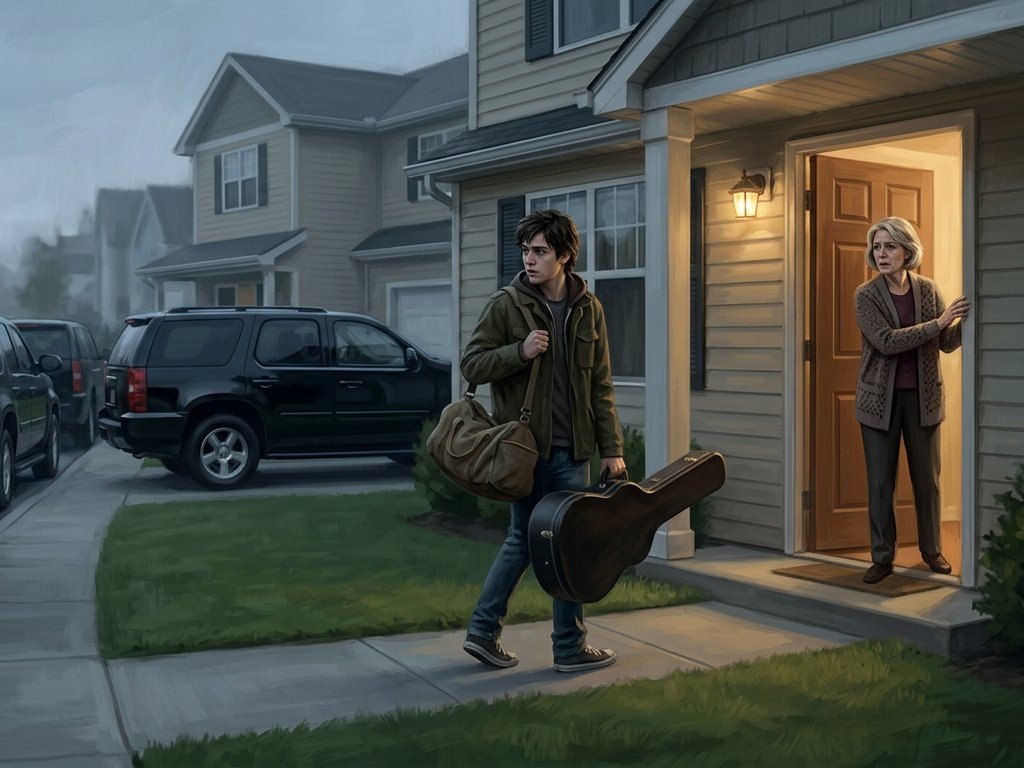
I left with a duffel bag and my guitar. That’s all I could carry. The guitar had been my mother’s, and then it was mine, and it was the only thing in that house that still felt like it belonged to me. I slept that night on a friend’s couch, staring at the ceiling, too hollowed out to cry.
The next morning, I came back to grab the rest of my things.
And that’s when I saw them.
Five black SUVs parked outside the house. Five. In a row along the curb, windows tinted dark, engines still ticking like they’d only just arrived. Our street was the kind of street where a single unfamiliar car got noticed, and five black SUVs looked less like a coincidence and more like a raid.
My first thought was that Cheryl had called security to keep me away. That she’d hired someone. That she’d decided to make her “get out” official, with men in suits to enforce it.
I walked up the front path with my heart in my throat, already rehearsing what I’d say, already bracing for a door slammed in my face.
But when the door opened, it wasn’t slammed.
Cheryl stood there, and she was pale. Not just tired-pale or no-makeup pale. Pale the way people go when something has knocked the air out of them. Her hands were shaking slightly, and her voice, when she finally spoke, was so sweet it nearly broke the air.
“Oh! I was just about to call you, sweetheart.”
Sweetheart. In five years, she had never once called me sweetheart.
I blinked at her. “What’s going on?”
She stepped back to let me in, and I saw them. Four people in dark suits, seated in our living room like they owned it. A fifth was out in the driveway on a phone. Briefcases, leather folders, a laptop open on the coffee table. And at the center of the table, a thick stack of papers with a silver pen laid neatly on top.
“These people are lawyers,” Cheryl said, in a voice so bright it was nearly a squeak. “Family lawyers. From your mother’s side.”
My mother’s side.
The pieces clicked together slowly, like a lock turning in an old door. My mother’s family — my grandparents, my aunts and uncles — had cut us off after she married my dad. They were wealthy people, old-money people, and they’d never forgiven her for choosing a carpenter over a country club. When she died, they vanished from our lives completely. I grew up thinking of them as a closed chapter, a family I had on paper but not in real life.
One of the lawyers stood and introduced himself. He was kind-eyed and careful with his words, the way people are when they know they’re about to change your life.
He explained it slowly, patiently, while Cheryl hovered in the doorway wringing her hands.
My grandmother — my mother’s mother — had died two months ago. And she had never stopped being my grandmother, not on paper. For years, quietly, she had maintained a trust in my name. It had been set up when I was born, back when the family was still speaking to us, and it had never been dismantled. Over twenty years it had grown — quietly, faithfully, like a tree planted before I was born and watered by people I never met.
Now, with my grandmother gone, the trust had matured. It was mine.
And so, it turned out, was a great deal more. The house, the investments, the shares in the family’s companies — all of it passed to me as the last direct heir of my mother’s line. My grandmother’s final letter made it clear: the family had been wrong to cut us off, and she had spent her last years making it right in the only way she knew how.
The lawyers hadn’t come to keep me out. They’d come to find me.
And Cheryl — Cheryl, who had thrown me out with a duffel bag and a guitar — had opened the door that morning to discover that the house she thought she’d inherited, the house she’d planned to sell, the house she’d stood in while she told me I wasn’t family — wasn’t hers at all.
It had never been hers. It had been my dad’s, and my dad, it turned out, had left everything to me.
Everything.
I looked at her across the living room, and for the first time in five years, I saw her clearly. Not as the stepmother who could wound me, but as a small, frightened woman who had gambled everything on cruelty and lost.
“Oh,” I said quietly. “So that’s why I’m suddenly ‘sweetheart.'”
She flinched like I’d slapped her.
The lawyers walked me through everything over the next two hours. They were gentle with me, gentler than anyone had been in weeks. They explained what the trust meant, what the will said, what my options were. And the whole time, Cheryl sat in the corner, folding and unfolding a tissue, waiting to find out what would happen to her.
When the lawyers finally asked me what I wanted to do — about the house, about Cheryl, about all of it — I thought for a long time.
I thought about my mother, who used to sing to me with that guitar before bed. I thought about my dad, who tried so hard to give me a family twice, and who died believing he had. I thought about all those years of snapping in secret and smiling for show, all that wasted energy performing love instead of just feeling it.
And I thought about what it would cost me to become the kind of person Cheryl had been.
I didn’t kick her out. That’s the thing nobody expects, and it’s the part I’m proudest of. I could have said “you’re not family anymore, get out” — the exact words, delivered in the exact doorway. I could have watched her pack a duffel bag of her own. It would have been fair. It would have been, by almost any measure, exactly what she deserved.
But I’d spent five years learning what it feels like to be made small, and I didn’t want to be the person who made anyone else feel that way.
So I made her a deal instead. She could stay in the house for six months, rent-free, long enough to find her feet. After that, it was mine to do with as I pleased. She signed the papers with a shaking hand, and I signed the rest with a steady one.
I sold the house a year later. I used some of the money to finish school, some to set up a small music scholarship in my mother’s name, and some to buy a little house with a porch where I could sit in the evenings and play the guitar my mother left me. The family money was never really the point. The point was that, at nineteen, with nothing but a duffel bag and a guitar, I learned that the family you come from doesn’t get to decide who you are.
Cheryl and I exchange Christmas cards now. That’s all, and that’s enough. Some doors aren’t meant to be reopened. But the one she slammed in my face that night turned out, in the end, to be the door that set me free.
The five black SUVs drove away before noon that first day, leaving a stack of papers and a whole new life behind. I stood on the porch and watched them go, my guitar still in my hand.
And for the first time since my mother died, I felt like something out there was looking out for me.
I still play that guitar every night. And every time I do, I think of my mother, and my dad, and the grandmother I never got to know — and I understand, finally, that family isn’t a performance, and it isn’t a performance of cruelty either.
Family is the one thing that stays, even after everyone’s gone.