Part One
I kicked my daughter out when she was seventeen.
She stood in my kitchen with her backpack still on, rain in her hair, and told me she was pregnant — and I handed her a suitcase and said, “Figure it out.”
I have written that sentence and deleted it a hundred times in nine years, trying to make it sound like anything other than what it was. It was me, failing my child at the exact volume of cruelty I’d sworn I’d never use, because I grew up on it and promised myself I’d do better. She didn’t cry. That’s the part that has never left me — she just looked at me for a long moment, like she was memorizing the place where her mother used to be. Then she zipped the suitcase and walked out into the rain.
That was nine years ago. I told everyone — and mostly myself — that it was tough love. That she’d come home when she was hungry enough. She never did. She stopped answering, then changed her number, then was simply gone, and the space where my daughter should be has been the loudest room in my house ever since.
For the last four years, I’ve volunteered at the women’s shelter on Route 4. Tuesday nights. I fold towels. I sort donations. I do not say why I’m there, and nobody asks, because shelters understand unfinished business better than anywhere on earth. It makes me feel decent. That’s the word I use — decent — like penance is a bar of soap and if I just keep scrubbing, someday I’ll feel clean.
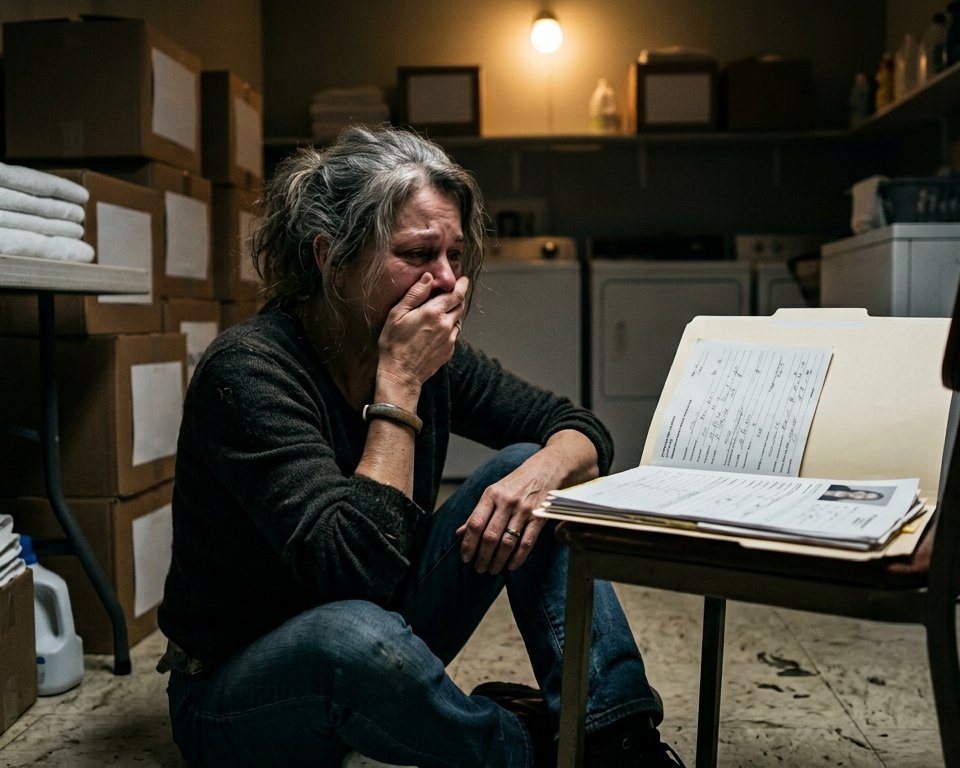
Last Tuesday, the intake coordinator left a file on the counter next to the towel shelf. Open. They’re digitizing the old archives this month, so paper is everywhere, and I honestly don’t know what made me look down. Maybe nothing did. Maybe nine years of punishment finally got tired of the room and let the truth in.
My daughter’s name. Megan Leigh Rowan.
Intake date: March 14, 2018. Three months after I put her out. She walked into this shelter — this room, the one I’ve been folding towels in trying to feel decent — while I slept warm in the house I’d thrown her out of.
She was seventeen weeks pregnant. I read it three times, and then I read the line that took the floor out from under me: she gave birth in the shelter bathroom, on the second floor, because she couldn’t afford the ER copay. My daughter had her baby on a tile floor with a volunteer holding her hand, three miles from the bedroom I grew her in.
Under Emergency Contact, she wrote: None.
Under Family Support: None.
And under Reason for Seeking Shelter, one sentence, in the handwriting I taught her to loop when she was six:
“My mother found out I was pregnant and told me to figure it out. I tried to tell her that the father was her boyfriend, Rick. She handed me a suitcase before I could finish the sentence.”
I had to sit on the floor when I read it. Not a chair. The floor — the same shelter floor where other women’s broken pieces get set down gently. And in the humming dark between the towel stacks, nine years rearranged themselves into the truth: the way Rick had always driven Megan to work offering his “help.” The gifts. The way he’d whispered for weeks before that night that teenagers lie, sweetheart, tough love is the only language they hear. And the thing I will see when I close my eyes for the rest of my life: Rick, standing in the kitchen doorway as my daughter tried to speak — and the flicker of relief on his face when the suitcase cut her off.
I had not just failed to protect her from a man. I had been his alibi, wearing an apron.
Part Two
The intake coordinator, Luisa, found me on the floor. She crouched down, read the open page upside down with the ease of long practice, and said the thing that stopped my heart a second time:
“Oh — Megan. I pulled her file because of Friday. She’s the keynote at our anniversary dinner. Did nobody tell you?”
Here is what my daughter figured out, while I was learning to fold towels to feel decent. She got her GED at that shelter table. She won a scholarship. She became a labor and delivery nurse — let that sit in you a minute, the way it sat in me: the girl who delivered her own baby on a bathroom floor because she couldn’t afford a copay now spends her nights catching other women’s babies in bright, safe rooms, whispering I’ve got you for a living. She started a fund at this very shelter called Nobody Figures It Out Alone, which pays ER copays for shelter moms, because she remembered exactly what it costs to be poor at the moment you’re most afraid. Her son — my grandson — is eight, named Max, after Maxine, the overnight volunteer who held Megan’s hand on that bathroom floor and told a terrified seventeen-year-old that she was doing beautifully.
Luisa also told me, gently, what the advocate’s notes said: Megan had disclosed everything in 2018. Rick had been thirty-eight. She declined to press charges because he’d told her no one would believe her, that her mother would always choose him — and Megan, God help me, believed he was right. She had proof of what I’d made her believe: the suitcase.
I did not sleep after Tuesday. On Wednesday I did what I should have done nine years earlier: I went to the police, and I told them everything — every drive, every gift, every whispered tough love, every look on his face — and then the hardest phone call of my life, to a detective who took my statement like a professional and my shaking like a human being. And then something happened that I did not deserve and will spend my life being grateful for: Megan, who had every right to let the ocean close over this, gave her statement too. On her terms. In her own words, as a twenty-six-year-old woman and not a silenced girl. Because Rick has a new wife, and that wife has a daughter who just turned fifteen, and Megan said the most Megan sentence I have ever heard:
“I’m not doing this for nine years ago. I’m doing it for fifteen. Somebody should have done it for me at fifteen.”
The affidavit includes a paternity test. Max is the evidence no one can lawyer away. Rick was charged last month. His new family is safe. I say these facts plainly because Megan lived them at full price.
I did not go to the anniversary dinner. I wasn’t ready to spend my daughter’s first public telling of her own survival making it about my face in the crowd. Instead I wrote her a letter — one page, no excuses, no requests. I want to be honest about something here: even if the father had been a boy her own age, handing a pregnant child a suitcase was wrong. The truth about Rick didn’t create my guilt. It just showed me I had failed to keep her safe twice — once by not seeing him, and once by not hearing her. I told her: I believe you. I’m sorry. I will be at the shelter on Tuesdays whether you ever speak to me again or not. You don’t have to figure anything out alone ever again — and neither, thanks to you, will anyone else.
Four months of silence answered me. I folded towels. Then in March — a Tuesday, of course — a card came to the shelter, addressed to Evelyn, towel department. Inside was a crayon drawing of a nurse with enormous superhero hair, and a note in handwriting I’d know anywhere:
“This is Max. He calls towels ‘rectangle origami’ and wants to learn from the supervisor. Terms: slow. He can call you Evelyn. No promises about anything else. — M.”
She came the next Tuesday, and stood in my folding room doorway in scrubs the color of a winter sky, and watched me fold one towel — badly, from nerves — and said, dry as her mother: “You missed the corner on that one.” Max is all elbows and opinions and told me I was “pretty good at origami for a beginner.” We take it in teaspoons. Some Tuesdays she stays twenty minutes. Some Tuesdays she tells me about her shift and laughs once, sharp and surprised, like a sound coming back from far away. I do not ask for more than the teaspoon. She has taught me that love is not the grand gesture — it is the repeated, quiet act of showing up to the same room and folding what’s in front of you.
Two weeks ago, in the middle of the donation sort, she said “Mom, can you hand me—” and then caught herself, and froze, and neither of us said a word about it, and a small warm thing healed with an audible little stitch.
I used to volunteer to feel decent. Not anymore. Decent is a feeling — it comes and goes like weather. Useful is a promise. So I am there every Tuesday, folding, sorting, and every copay that Megan’s fund erases means one more girl who gets to have her baby in a bright safe room with someone whispering I’ve got you. The fund’s name is on the wall by intake now, and I read it every week like a prayer I’m still learning:
Nobody figures it out alone.
She figured that out at seventeen, on the worst night of her life. It took me forty-six years and a file on a counter. But I’m learning. I’m still figuring it out — and for the first time in nine years, thank God, not alone.