A text story
Fifty years ago I worked the late counter at a diner on Route 40, the kind of place that stayed open because the truckers needed somewhere to be at three in the morning. Formica counter, twelve stools, a pie case with a light that buzzed. I was nineteen and I worked eleven at night to seven in the morning because the shift differential was thirty cents an hour and thirty cents an hour was the difference between my rent and my mother’s insulin.
And a girl slept behind the laundromat next door.
Fifteen, maybe. Sixteen at the outside. She’d found the spot where the dryer vents came out of the wall, and if you sat right up against that brick you could stay alive through a February in Ohio. She had a canvas bag and a coat that wasn’t a coat, it was three sweaters, and she had that particular straight-backed way of sitting that I’ve only ever seen in people who have decided they will not be pitied.
Too proud to beg. I tried, twice. The first time I brought a plate out and said, “Here, it’s free,” and she looked at it and looked at me and said, “No thank you, ma’am,” at nineteen I was nobody’s ma’am, and she went back to looking at the parking lot. The second time she just got up and walked to the far end of the alley until I left.
So I stopped offering.
Instead I got clumsy.
Del, who owned the place, had one rule about food: if it’s wrong, it’s garbage. Wrong plates couldn’t be sold, couldn’t be eaten by staff, couldn’t sit under a lamp. Wrong plates went in the bin out back. That was the rule, and Del was a hard man about it, and the rule had a hole in it you could drive a truck through.
So I burned a plate every night. I dropped a burger. I ruined some eggs — broke the yolks, over-salted the hash, let the toast go black on one corner. I got very skilled at ruining food in ways that didn’t actually ruin it. A burger that hit the clean end of the prep counter is a burger. Eggs that are “too hard” are eggs. And mistakes went out the back door wrapped in foil, into the bin, on top of a folded paper bag I’d put there at the start of every shift so nothing ever touched the bottom.
I never said a word about it. She never said a word about it. That was the whole arrangement, and it worked precisely because neither of us ever named it. Some nights I’d see the bag was gone by two a.m. Some nights it sat till four and my stomach would go tight until it disappeared. Once there was a snowstorm and I made three mistakes and stayed forty minutes past clock-out with the back light on.
Eight months of mistakes.
Then one night in October she wasn’t there. Not that night, not the next, not the one after. The bag stayed on the bin until the raccoons found it and Del yelled at me about the lid. I walked the alley. I asked at the laundromat. I asked the night dispatcher at the truck stop across the road, which was the worst hour of my life, standing there describing a girl to a stranger and watching him understand exactly what I was afraid of.
Nobody knew anything. Girls like that didn’t get looked for. That’s what one of the older waitresses told me, kindly, like she was doing me a favor.
And I have spent fifty years hoping she made it somewhere warm.
I want you to understand that this isn’t a thing I thought about once a decade. This is a thing I thought about at red lights. At my wedding, absurdly, for about four seconds during the vows. When my daughter turned fifteen and I looked at her at the breakfast table — the whole soft, safe, complaining shape of her — and had to leave the room. Every February. Every time I burned toast, which after fifty years I still cannot do without my chest going tight.
You’d think a person would let it go. But you don’t let go of the ones you don’t get an ending for. You just build a room in yourself and keep them in it.
I moved into assisted living in March. Sold the house, gave the good dishes to my daughter, kept eleven boxes out of a whole life. It’s a decent place. Third floor, a window that gets the afternoon. My hip is what it is and I stopped pretending about the stairs sometime last winter.
Yesterday they brought my new roommate.
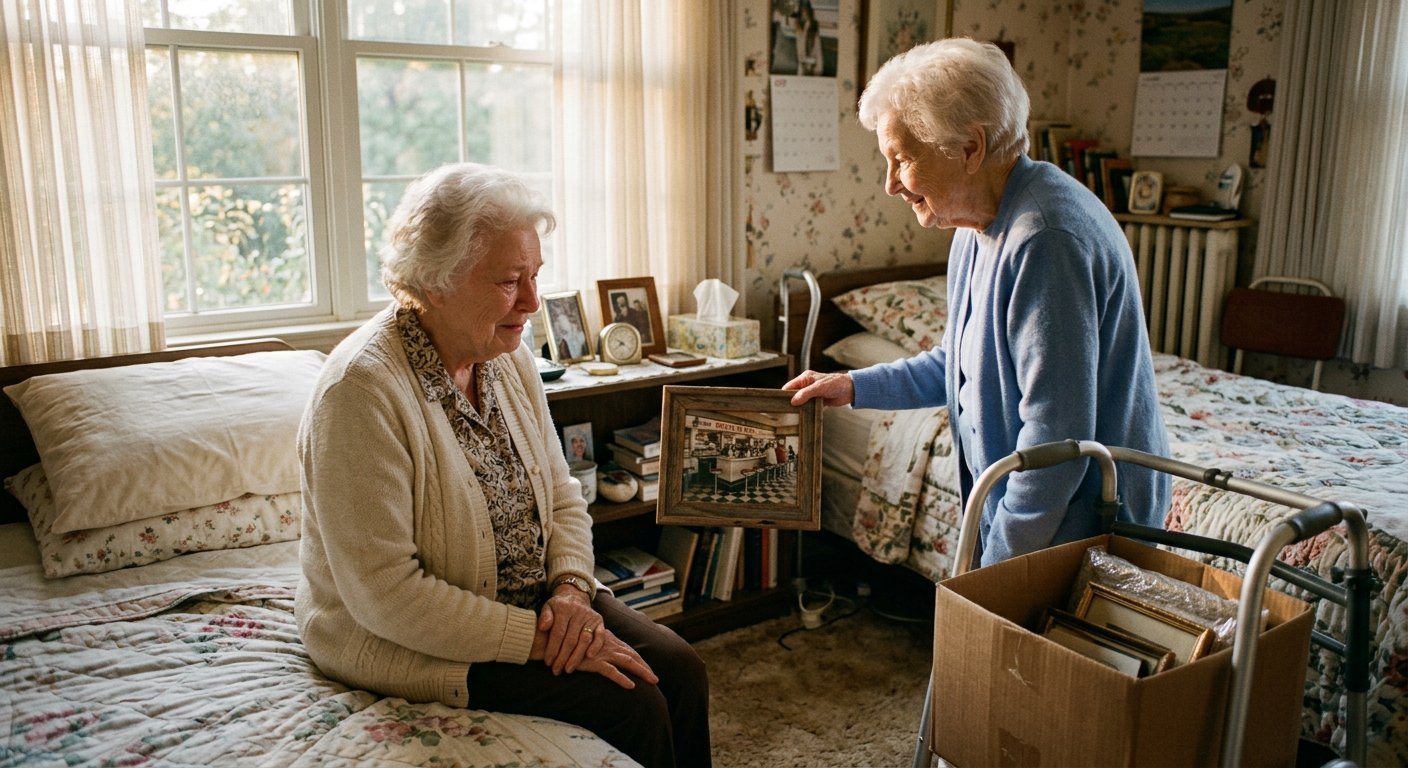
A small woman with white hair, moving slow behind a walker, and an aide carrying a box of picture frames because she wouldn’t let them go in the truck with the rest. Eighty-something. Straight-backed. I noticed that before I noticed anything else — that particular way of sitting down, spine like a plumb line, the posture of someone who decided a long time ago that she would not be pitied.
She started setting her frames on the shelf between our beds. And the first photo she put up was a diner.
Route 40. The pie case with the buzzing light. Twelve stools. My counter.
I couldn’t breathe. I sat on the edge of my bed with my hands in my lap like a child and I stared at that photograph and the room went strange and far away.
She caught me staring. And she said:
“They tore it down in ’09. I bought the sign at the auction — it’s in my daughter’s garage, she thinks I’m crazy.” She straightened the frame with one finger. “I ate there every night for eight months when I was fifteen. Out of the bin around back. There was a girl on nights who was the clumsiest cook in the state of Ohio.”
She turned around.
“Hello, Ruth.”
I said her name. I hadn’t known her name for fifty years — I want to be clear about that, I never knew it, I’d made up six of them over the decades — and she told me it then, standing between our beds. Alma. Her name was Alma.
She’d known mine the whole time. She’d read it off my apron. She said she used to say it to herself walking to the bin, thank you Ruth, thank you Ruth, because she couldn’t say it out loud without crying and if she cried she’d have had to admit she needed help, and she’d have rather frozen.
October of that year, her aunt in Dayton finally answered a letter. That’s where she went. No goodbye, because she left on a Tuesday afternoon with four hours’ notice and no way on earth to reach a girl who only existed to her between eleven p.m. and seven a.m.
She finished high school in Dayton. Worked forty-one years for the county, the last nine running the office that placed unaccompanied kids in emergency housing. Two children. Five grandchildren. A husband named Walter, gone six years now, who she says never fully understood why she wrapped leftovers in foil instead of plastic and would not be talked out of it.
“I looked for you,” she said. “In the eighties. I drove out there twice. The diner was still up but nobody remembered a night girl from 1975.”
We had been looking for each other, in opposite directions, across the same fifty years, and a scheduling clerk with a bed-assignment spreadsheet did what neither of us could.
She sleeps by the window. She snores, a little, which I have not mentioned to her.
Last night, around eleven — the hour my body still recognizes even now, even after all this time — I heard her turn over in the dark.
“Ruth,” she said. “You awake?”
“I’m awake.”
A long pause. Then: “I made it somewhere warm.”
“I know,” I said. “I can see you from here.”