Thirty-seven American lives had returned home because of decisions I made.
Thirty-seven families had received phone calls saying their husbands, daughters, sons, mothers, and fathers were alive.
There had been no interviews.
No newspaper stories.
No public ceremonies.
I had preferred it that way.
Commander Brock Sullivan knew none of that.
But one man near the reviewing platform did.
Sergeant Major Thomas Reed.
He stood motionless beside the stairs.
To anyone else, his expression looked neutral.
I knew him better.
I saw the tension in his jaw.
The tiny narrowing of his eyes.
He wasn’t afraid for me.
He was afraid for Brock.
Because Thomas Reed knew what Brock had just done.
And he knew who he had done it to.
I breathed in.
Slowly.
Four counts.
Held it.
Released it.
Exactly the way training teaches you to breathe when everyone around you is losing control.
Boots shifted faintly across the formation.
Brock mistook my silence for submission.
Men like him often did.
“Apologize,” he said.
I looked directly at him.
“For what?”
A whisper moved through the formation like wind through dry grass.
His nostrils flared.
“For disrespecting a superior officer.”
I glanced toward the blood on my boot.
Then back at him.
“You hit me.”
He smiled.
“That wasn’t a hit.”
He gave a small shrug.
“It was a correction.”
Something changed across the field.
I felt it.
So did he.
But Brock was too angry to understand what it meant.
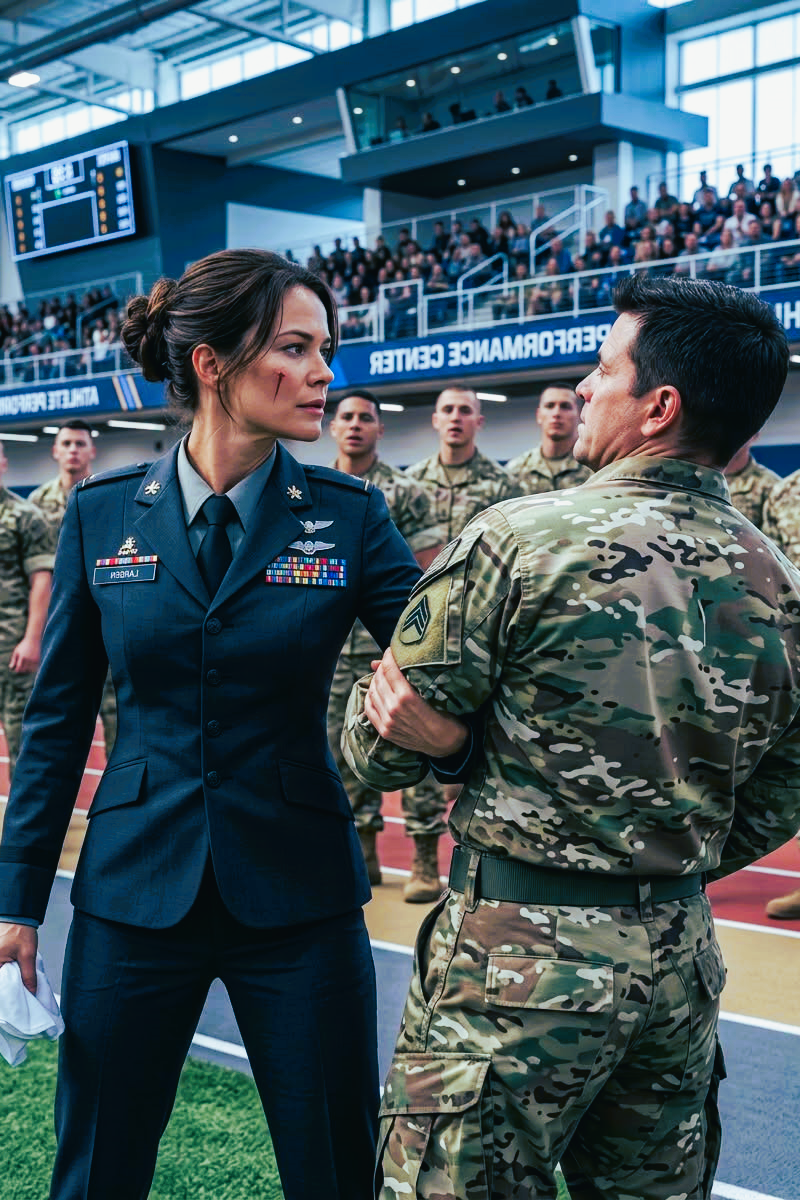
I reached into my jacket and removed a folded white handkerchief.
I pressed it against my lip.
When I lowered it, a crimson stain marked the fabric.
I folded the cloth once.
Then again.
Carefully.
No shaking hands.
No rush.
No panic.
Because silence is not weakness.
Calm is not surrender.
And bleeding does not mean you have lost.
Most importantly, rank was never created to protect arrogance from consequences.
Brock laughed.
“Finished with your little performance, Captain?”
I returned the handkerchief to my pocket.
“No.”
I looked at him.
“You are.”
His face hardened.
He moved before anyone else could react.
This time it wasn’t an open hand.
It was a fist.
He lunged forward.
Hard.
Fast.
Angry.
But anger makes people predictable.
I stepped toward him instead of backing away.
Inside his reach.
My left hand caught his wrist.
My right arm rotated beneath his elbow.
My hip shifted.
His balance disappeared.
There was no dramatic struggle.
No wild punch.
No unnecessary violence.
Only leverage.
Timing.
Training.
In one smooth motion, Commander Brock Sullivan’s boots left the ground.
And that was when a voice thundered from the reviewing stand.
“COMMANDER SULLIVAN! STAND DOWN!”
Brock hit the grass on his back.
Air exploded from his lungs.
I released his arm immediately and stepped away.
Two security officers started forward.
Then stopped when another voice cut through the silence.
“Do not touch Captain Hayes.”
Every head turned toward the platform.
Rear Admiral Nathan Cole, the senior officer overseeing the joint exercise, had risen from his chair.
His expression was not angry.
That somehow made it worse.
Brock pushed himself onto one elbow.
“Admiral, she attacked—”
“I watched what happened.”
Brock froze.
Rear Admiral Cole descended the stairs.
Sergeant Major Thomas Reed followed him.
So did two men in dark civilian suits who had spent most of the morning standing unnoticed behind the reviewing area.
Brock climbed to his feet.
His face had gone red.
“She assaulted me in front of the formation.”
“No,” Reed said quietly.
“You threw a closed fist at her.”
Brock looked at him.
“Stay out of this, Sergeant Major.”
Thomas Reed did not move.
His voice remained calm.
“You should stop talking, sir.”
That was the first moment I saw uncertainty enter Brock Sullivan’s eyes.
Not fear.
Not yet.
But uncertainty.
He looked toward the admiral.
“Sir, Captain Hayes has been disruptive since she arrived. She refuses to recognize the chain of command. She’s an administrative observer acting like she has operational authority.”
Rear Admiral Cole stared at him for several seconds.
Then he turned toward me.
“Captain Hayes.”
“Sir.”
“Are you injured?”
“Minor cut inside the lip.”
“Do you require medical attention?”
“No, sir.”
He nodded once.
Then he looked at Brock again.
“Commander Sullivan, who told you Captain Hayes was an administrative observer?”
Brock hesitated.
“It’s on the visitor roster.”
“Is it?”
“Yes, sir.”
Cole glanced toward one of the civilians.
The man opened a black leather folder.
“No, Commander,” the civilian said. “It isn’t.”
Brock’s face changed.
“What?”
The man removed a page.
“The roster states Captain Avery Hayes, Department of Defense Special Evaluations Division.”
Brock swallowed.
“I was told—”
“You assumed,” Rear Admiral Cole said.
Nobody moved.
Cole looked across the formation.
Then toward the still-live microphone.
“Turn that off.”
A communications officer hurried forward.
I spoke before he reached it.
“Leave it on.”
Several heads turned toward me.
Rear Admiral Cole studied my face.
I continued.
“Sir, what happened was public. The response should not be hidden.”
For several seconds, the only sound was the flag snapping in the wind.
Then Cole stepped away from the microphone.
“Very well.”
He motioned to the man with the black folder.
The civilian opened it.
“Commander Sullivan, you were informed three weeks ago that an independent operational assessment would take place during this training cycle.”
Brock’s eyes flickered.
“Yes.”
“You were not told the identity of the lead evaluator.”
“No.”
The civilian turned toward me.
“Captain Hayes is that evaluator.”
A murmur moved through the ranks.
Brock stared.
The man continued.
“She did not come here to inspect administrative procedures.”
He paused.
“She came here to evaluate command judgment, operational discipline, leadership culture, and the treatment of subordinate personnel inside units preparing for classified deployment.”
The blood drained from Brock’s face.
Suddenly, the quiet woman with the folder was no longer a paperwork officer standing where she didn’t belong.
She was the person whose report could determine whether his unit was trusted with missions beyond Coronado.
But even that was not the real secret.
Brock still didn’t understand.
His voice dropped.
“She still disobeyed a direct order.”
“Your order had no authority over her assignment,” Cole answered.
Brock looked at me.
I could see him searching for a way back.
A technicality.
A regulation.
Anything that would restore the world he thought he controlled.
Then Sergeant Major Thomas Reed stepped toward the microphone.
“Commander.”
Brock turned.
Reed looked at me first.
There was history in that look.
Years of it.
Then he faced Brock.
“You asked why Captain Hayes didn’t appear intimidated.”
Brock said nothing.
Reed continued.
“Eight years ago, I was part of a joint task force operating outside the publicly acknowledged theater.”
The field became completely still again.
“Our position was compromised.”
Reed’s voice slowed.
“We had wounded personnel. Communications were failing. Two extraction routes were blocked. We had hostile forces moving toward us from three directions.”
I felt the old memory return.
Dust.
Smoke.
A radio pressed against my ear.
Men bleeding in darkness.
A helicopter unable to reach the original landing zone.
Reed continued.
“Command estimated that a direct extraction would cost most of the team.”
Brock stared at him.
“A young officer identified a fourth route through terrain our mapping system had marked as impassable.”
My throat tightened.
“She reorganized the defense. Redirected aerial surveillance. Coordinated two ground elements that had lost contact with each other and personally led the movement of wounded personnel through that route.”
Reed looked toward the formation.
“Thirty-seven Americans made it home.”
A long silence followed.
Then he looked directly at me.
“Captain Avery Hayes was that officer.”
The whispers were louder this time.
Not because people were talking carelessly.
Because more than a thousand human beings had just been forced to rewrite everything they thought they knew about the woman standing in front of them.
Brock shook his head.
“That would be in her record.”
One of the civilians almost smiled.
“It is.”
He closed the folder.
“You simply don’t have clearance to read it.”
That sentence hit harder than anything I could have said.
Brock’s mouth opened.
Nothing came out.
Rear Admiral Cole motioned to the civilian.
The man removed another document.
“Captain Hayes has participated in multiple special access operations. Significant portions of her service history remain classified.”
He looked at Brock.
“Which means your assumption that an unimpressive public record equals an unimpressive officer was precisely the type of command failure this assessment was designed to identify.”
Brock looked around.
For the first time that morning, he seemed to notice the cameras.
The microphones.
The 1,040 witnesses.
The officers who had seen everything.
He lowered his voice.
“This is being exaggerated.”
I finally spoke.
“No.”
He turned toward me.
I took one step forward.
“The slap was not the reason you failed.”
His expression twisted.
“You attacked me.”
“You threw a fist after striking me in front of your personnel.”
“You embarrassed me.”
“No, Commander.”
I kept my voice level.
“You did that yourself.”
His jaw tightened.
I continued.
“The problem isn’t that you misjudged me.”
I glanced toward the formation.
“The problem is what your behavior tells me about how you treat people you believe cannot challenge you.”
Nobody moved.
I looked at Brock again.
“You thought I was an administrative captain.”
He remained silent.
“So you decided humiliation was acceptable.”
His eyes shifted.
“You thought I had no powerful connections.”
Another pause.
“So you believed nobody would hold you accountable.”
Brock’s face hardened.
“You don’t know anything about how I command my teams.”
“Actually,” I said, “I do.”
That stopped him.
I turned toward Thomas Reed.
He handed me the black folder I had carried onto the field earlier.
The folder Brock had dismissed.
I opened it.
Inside were months of interviews.
Anonymous statements.
Training records.
Medical logs.
Internal complaints.
Transfer requests.
Three resignations.
Two disciplinary cases that had been quietly downgraded.
And a pattern.
I removed the first sheet.
“Petty Officer Daniel Mercer.”
Brock’s eyes narrowed.
I read.
“Reported being struck during a closed training debrief after questioning an unsafe exercise order.”
A faint reaction moved through one section of the formation.
I took out another page.
“Lieutenant Rachel Monroe.”
Brock’s face tightened.
“Requested reassignment after documenting repeated public humiliation of junior officers who challenged command decisions.”
Another page.
“Chief Petty Officer Marcus Bell.”
I looked up.
“Hospitalized after a training incident involving an unauthorized escalation in environmental exposure.”
Brock interrupted.
“That was investigated.”
“It was.”
“And cleared.”
“No.”
I closed the folder halfway.
“It was buried.”
Rear Admiral Cole turned sharply toward him.
Brock’s face went pale again.
The field no longer felt like a ceremony.
It felt like a courtroom.
I continued.
“This assessment began because three separate reporting channels produced the same pattern.”
My voice carried through the microphone.
“Fear.”
I looked across the rows of uniforms.
“Not fear of combat.”
“Fear of speaking.”
A few faces changed.
Small reactions.
But I saw them.
People who knew exactly what I meant.
“Personnel under Commander Sullivan described an environment where disagreement was labeled disloyalty.”
I turned another page.
“Safety concerns became weakness.”
Another.
“Questions became disrespect.”
Another.
“And when mistakes occurred, blame traveled down.”
I looked at Brock.
“Never up.”
His mouth tightened.
“You’re relying on anonymous cowards.”
Several people in the formation shifted.
That sentence destroyed whatever sympathy remained.
I stared at him for a moment.
Then I said quietly, “That is exactly why they were afraid to put their names on the complaints.”
Rear Admiral Cole turned toward security.
“Commander Sullivan is relieved of command effective immediately.”
The words landed like steel.
Brock blinked.
“Sir?”
“You heard me.”
“On whose authority?”
“Mine.”
“This is insane.”
“Commander.”
Cole’s voice hardened for the first time.
“You assaulted an officer during an official ceremony, attempted to strike her a second time, publicly admitted you considered physical force a legitimate command correction, and have now been confronted with evidence of a broader pattern of abuse of authority.”
Brock shook his head.
“You can’t destroy twenty years of service over one misunderstanding.”
I saw something different in his face then.
Not arrogance.
Desperation.
Twenty years.
Deployments.
Promotions.
Medals.
Everything he believed made him untouchable was collapsing in less than ten minutes.
But actions do not become harmless just because consequences arrive late.
Rear Admiral Cole answered.
“No one is destroying your career, Commander.”
He paused.
“Your choices brought you here.”
Two security officers approached.
Brock stepped backward.
His eyes landed on me.
“This is what you wanted.”
I said nothing.
“You came here looking for a reason to take me down.”
“No.”
He laughed bitterly.
“You expect anyone to believe that?”
I closed the folder.
“I came here hoping the complaints were exaggerated.”
That silenced him.
“I spent three weeks observing your unit.”
I stepped closer.
“I watched how your people stood when you entered a room.”
Brock stared.
“I watched conversations stop when you walked past.”
Another step.
“I watched junior officers look at one another before answering basic questions.”
His breathing had become heavier.
“I watched experienced operators hesitate before reporting problems because they were trying to predict your reaction instead of solving the problem.”
I shook my head.
“That is not discipline.”
The wind lifted a strand of hair across my cheek.
“That is fear wearing a uniform.”
Brock’s hands curled into fists.
Security moved closer.
He looked toward the troops.
“None of you would be standing here if I hadn’t pushed you.”
Nobody answered.
“Tell her!”
Silence.
Brock’s voice rose.
“Tell her how many times I made you better!”
Still nobody spoke.
Then someone did.
A voice from the third formation.
“Sir.”
Heads turned.
A young lieutenant stepped one foot forward.
His face had gone pale.
But he continued.
“You made us afraid to tell you when you were wrong.”
Brock stared at him.
The lieutenant’s hands trembled slightly.
But he did not step back.
Then another voice came from farther down the formation.
“You told us hesitation was weakness.”
A chief petty officer this time.
He looked straight ahead.
“So we stopped reporting injuries until they got worse.”
Another voice.
“You threatened my evaluation when I questioned a dive plan.”
Then another.
“You transferred my partner after he filed a complaint.”
The field changed.
Not into chaos.
Into truth.
One voice at a time.
People who had spent months believing they were alone discovered they were surrounded by others carrying the same silence.
Brock looked from face to face.
For the first time, his authority was gone.
Not his rank.
Not yet.
Something more important.
The belief that everyone around him accepted his version of reality.
“Enough!” he shouted.
No one flinched.
That was when Brock finally understood.
The thing he had spent years creating had reversed.
The room no longer belonged to him.
The field no longer belonged to him.
The fear no longer belonged to them.
It belonged to him.
Security stepped beside him.
“Commander Sullivan, please come with us.”
He looked toward Rear Admiral Cole.
“Sir.”
Cole gave a single nod.
“Go.”
Brock looked at me one last time.
His voice dropped.
“You think you’re better than me?”
I met his eyes.
“No.”
He waited.
I continued.
“I think every person wearing this uniform deserves a leader who remembers that authority is a responsibility.”
I paused.
“Not a weapon.”
Something in his face broke.
Not dramatically.
Just enough for me to see the truth.
He had expected anger.
Revenge.
Humiliation.
Something he could fight.
Calm accountability gave him nothing to attack.
Security escorted him away.
No one applauded.
I was glad.
It was not a victory.
Careers would be investigated.
People would testify.
Families would revisit injuries they had tried to forget.
Command structures would be reviewed.
There was nothing worth celebrating.
Rear Admiral Cole stepped toward the microphone.
He looked at the 1,040 service members standing in front of him.
“What you witnessed today does not weaken this command.”
His voice carried across the field.
“Ignoring it would.”
He paused.
“Leadership without accountability is not leadership.”
Then he turned toward me.
“Captain Hayes, the platform is yours.”
I looked at him.
“Sir?”
“You came here to deliver an assessment.”
I glanced toward the troops.
More than a thousand faces were watching.
Not with curiosity anymore.
With expectation.
I stepped toward the microphone.
The blood on my lip had begun to dry.
I could feel the ache in my cheek.
For a moment, I considered the speech prepared inside my folder.
Seven pages.
Carefully written.
Statistics.
Readiness evaluations.
Command metrics.
I closed the folder.
There were things numbers could not explain.
So I spoke without notes.
“Some of you learned something about me today.”
I looked across the field.
“But I learned something more important about you.”
No one moved.
“You stood here and watched a senior officer lose control.”
I paused.
“Some of you were afraid.”
A few eyes dropped.
“That does not make you weak.”
I continued.
“Courage is not the absence of fear.”
The wind snapped the flag behind me.
“It is deciding what matters more.”
I looked toward the lieutenant who had spoken first.
“Sometimes courage is entering a building where someone is shooting at you.”
Then toward the chief petty officer.
“Sometimes courage is diving into black water when you don’t know what is beneath you.”
Then toward the wider formation.
“And sometimes courage is telling the person who writes your evaluation that they are wrong.”
Silence.
“If a leader punishes truth, eventually the organization stops receiving truth.”
I let that settle.
“And when that happens, people get hurt.”
Somewhere in the first row, an officer nodded.
“Your rank gives you authority over decisions.”
I looked toward the senior officers.
“It does not give you ownership over human dignity.”
Then I looked toward the junior personnel.
“And if you are ever placed in command, remember what happened here.”
I touched the corner of my lip.
“People may forget your speeches.”
I glanced toward the direction Brock had been taken.
“They may forget your decorations.”
I paused.
“They will never forget how you made them feel when they were powerless.”
Nobody applauded immediately.
For three or four seconds, the parade ground remained perfectly still.
Then Sergeant Major Thomas Reed raised his hand.
Not to clap.
To salute.
He turned toward me.
His hand touched the edge of his brow.
I stared at him.
Eight years disappeared.
I saw the wounded men in that distant valley.
The radio.
The dust.
Thomas Reed lying against a rock with blood soaking his uniform while insisting someone else be evacuated first.
Thirty-seven lives.
Thirty-seven families.
One mission almost no one would ever know happened.
I returned the salute.
Then Rear Admiral Cole saluted.
Then another officer.
And another.
Across the field, hands began rising.
Rows of them.
Hundreds.
More than a thousand service members stood under the California sun, saluting in silence.
No cheering.
No celebration.
Only respect.
The kind Brock Sullivan had demanded.
And the kind he had never understood could not be forced.
Three months later, the formal investigation concluded.
Commander Brock Sullivan faced multiple disciplinary findings related to assault, abuse of authority, unsafe command practices, and interference with internal complaints.
Several earlier cases were reopened.
Personnel who had requested transfers were interviewed again.
Training policies changed.
Anonymous reporting protections were strengthened.
Two senior officers who had ignored previous warning signs were removed from supervisory positions.
But the most important change could not be written into a regulation.
People started speaking again.
Junior officers challenged unsafe plans.
Senior enlisted leaders raised concerns before problems became disasters.
Training injuries were reported instead of hidden.
Command meetings became louder.
More argumentative.
Less comfortable.
And safer.
Six months after the incident, I returned to Coronado.
No ceremony this time.
No cameras.
No reviewing stand.
I walked along the edge of a smaller training field while another class prepared for an exercise.
Sergeant Major Thomas Reed found me near the bleachers carrying two cups of coffee.
He offered me one.
“You still take it black?”
“You remembered.”
“You kept thirty-seven of us alive. I figured remembering your coffee order was manageable.”
I smiled.
We watched the trainees for a while.
Then Thomas nodded toward my face.
“No scar.”
“Disappointed?”
“A little. Would’ve made the story better.”
I laughed.
Then he became serious.
“You know what they’re calling that day?”
I looked at him.
“What?”
“The quiet parade.”
I shook my head.
“That sounds dramatic.”
“They’re military people. Everything gets a name.”
He took a sip of coffee.
“There’s something else.”
I waited.
Thomas looked toward a group of young officers standing near the field.
“One of those lieutenants was there that morning.”
I followed his gaze.
“He requested this assignment after the investigation.”
“Why?”
Thomas smiled faintly.
“Said he wanted to learn how to lead people without making them afraid of him.”
For the first time, the memory of that morning did not taste like blood.
It felt lighter.
I looked across the training field.
A young officer was listening while a petty officer explained a problem with a piece of equipment.
The officer didn’t interrupt.
Didn’t shout.
Didn’t posture.
He listened.
Then he asked a question.
Maybe that was all leadership really was in the beginning.
The ability to understand that the person standing in front of you might know something you don’t.
Thomas glanced at me.
“You ever regret keeping your record classified?”
“No.”
“Even after all that?”
“Especially after all that.”
He raised an eyebrow.
I looked toward the ocean.
“If people respect me only after learning what I’ve done, then they haven’t learned the right lesson.”
Thomas considered that.
Then nodded.
Across the field, the young lieutenant called his team together.
Nobody looked frightened.
Nobody stopped talking when he approached.
They gathered around him.
They listened.
Then he listened back.
I smiled.
Commander Brock Sullivan had believed rank created respect.
He had believed fear proved strength.
He had believed silence meant obedience.
He was wrong about all three.
The strongest person on that parade field had never been the loudest.
The most respected officer had never demanded respect.
And the most important lesson delivered that morning had not come from a speech.
It came from a woman standing beneath the California sun with blood on her lip, refusing to bow her head.
Because real authority does not need humiliation.
Real courage does not need applause.
And real warriors do not have to remind the world how dangerous they are.
Sometimes they simply stand still.
Let the truth arrive.
And wait for everyone else to understand who they have been standing beside all along.