I told my son he was no longer welcome in my house.
He was eighteen. He had taken six hundred dollars from the drawer of my desk and he refused to explain it, and I asked him three times, and on the third time I said, “Get out, then.”
He packed one duffel bag. He did it in about nine minutes, which I have since understood was not shock but readiness.
That was 2014.
I never called. Not once in eleven years. I want to put that down without any softening, because every version of this I’ve told myself has softened it, and I’m done doing that. He didn’t call me either, but he was eighteen and I was fifty-one, and only one of us was the parent.
Last month the local paper ran his picture. Judge Marcus Bell, appointed at thirty. Youngest on the county bench in forty years.
My hands went cold.
The article said he’d worked nights through school. Finished college in five years while doing it. Law school after. Bought a house on Coolidge for $286,000 last spring.
Without me. All of it without me.
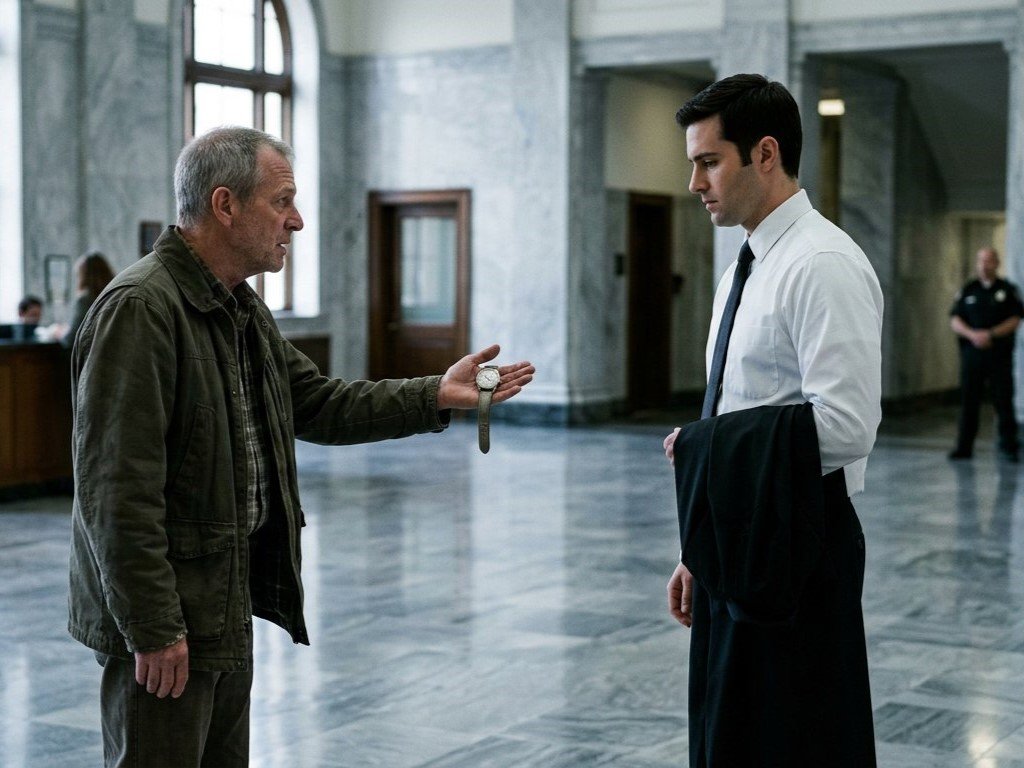
I drove to the courthouse that Friday carrying the watch I’d given him at his high school graduation — the one he’d left on the dresser when he went. A Seiko. Not expensive. I’d had his initials done on the back at a place on Third Street.
The receptionist called his chambers.
He came out in shirtsleeves with his robe over one arm. He looked at me for a long moment.
And he said, “You wanted me gone. Why are you here?”
I said I’d seen the paper. I said I was proud of him. I held out the watch.
He didn’t take it.
He said, “Dad, do you know what the six hundred dollars was for?”
I said no. I said he’d refused to tell me, which was the entire problem, which had been the entire problem for eleven years.
And he said, “It was for Mom’s headstone. The balance on it. You’d stopped making the payments.”
My wife Rosalind died in November of 2012. Marcus was sixteen.
We bought the marker on a payment plan — eighty-one dollars a month to a monument company in Fairview — because I had no life insurance on her, because she was forty-four and we were going to do it the following year.
In 2014 I lost the route job and took a lesser one and I let some things go. I told myself I’d catch them up. I did not, in fact, ever consciously decide to stop paying for my wife’s headstone. I just stopped opening that envelope.
The monument company sent a final notice in March of that year. It went to the house. I never saw it because I’d stopped looking at that particular kind of mail, and my son — seventeen, then eighteen — had been quietly pulling it out of the pile for five months.
He’d been paying it himself since January out of a stockroom job. Eighty-one a month.
Then in May they sent a letter saying the account was going to collections and the marker — which was already cut, already carved, sitting in a yard in Fairview with her name on it — would be resold as blank stock if the balance wasn’t cleared in thirty days.
Six hundred and forty dollars.
He took six hundred out of my desk and put forty of his own with it and drove to Fairview on a Saturday and paid it in cash.
The stone went in that August. I’d assumed the payments had simply finished. I never checked. I have visited that grave — I want to be precise — I have visited that grave probably thirty times in eleven years and stood in front of a headstone my son bought and never once wondered how it got there.
“Why wouldn’t you tell me?”
That’s what I said, standing in a courthouse lobby at sixty-two years old. It was the stupidest question of my life and I asked it in a room with a security guard in it.
And Marcus said the thing I’ve been carrying around ever since:
“Because you’d have been ashamed. You’d stopped paying for Mom’s stone. If I told you, you’d have had to know that about yourself, and I’d watched you all year and I didn’t think you could hold it.”
He said: “I was protecting you. I was eighteen and I thought that was my job. And then you told me to get out, and I figured — all right. He’d rather have a son who’s a thief than know.”
He said, “So I let you have that. I gave it to you. It was the last thing I had to give you and I gave it to you and it cost me eleven years and I’d do it again, because I was seventeen when my mother died and I didn’t have anything else.”
I did not defend myself in that lobby, and that’s the only thing I did right in eleven years.
Because there’s a version where I say you should have told me, and it’s even reasonable, and it’s exactly what a man who cannot hold a hard thing would say. He’d have been proven right in the hallway.
So I just stood there. And after a while he said, “I have a hearing at two.”
I said, “Okay.”
He said, “The watch. Leave it with Denise at the desk. I’m not saying no. I’m saying not from your hand today.”
And he went back through the door.
Now the part where I resist making this a reunion, because it wasn’t one.
We’ve spoken four times in six weeks. Twice on the phone, twice at a diner on Route 6 that he picked, which is forty minutes from both of us and is nobody’s territory.
He’s married. Her name is Priya, she’s an ICU nurse, they’ve been together six years. There was a wedding in 2021 that I did not know had happened. They have a daughter, Rosalind, who is two.
He named his daughter after my wife and I found out about it from a man at a diner counter.
I have not met her. He’s been clear about that: not yet, maybe later, and the decision isn’t only his. Priya has known me as a story for six years and it is not a flattering story and she is entitled to her own timeline.
When I asked what I could do, Marcus said, “Nothing fast.”
Two things I’ve made myself write down.
The first. I didn’t throw my son out over six hundred dollars. I threw him out because he wouldn’t explain, and because a man who won’t explain himself was, in my house, the worst thing you could be — my own father was that man, and I’d spent thirty years priding myself on not being him.
So when my grieving son stood in my study and said nothing, I didn’t see a boy protecting me. I saw the thing I hated. And I reached for the only move I had, which was the door.
Eleven days after that I’d have taken it back. I know that. I knew it then. I didn’t call because calling would have meant admitting that I’d done it in about four seconds, out of an old reflex about my father, to a child who had buried his mother twenty months earlier.
Every year after that made the call harder, and that’s not a tragedy, that’s just cowardice on a payment plan.
The second. He is thirty years old and he is a judge and he got there working nights, and there is a narrative available to me where I say look what he became, as though the door had been a kindness in disguise.
I won’t have it. He didn’t succeed because I threw him out. He succeeded in spite of it, and the proof is the number he told me at the diner: that he lived in his car for nine weeks in the fall of 2014, in the lot behind a Kroger on Vine, while working nights and taking two classes.
Nine weeks. Forty minutes from my house. I was watching television.
The watch is in his chambers. Denise told me she’d put it on his desk and about a month later he mentioned, in passing, at the diner, that it was in his drawer.
Not on his wrist. In his drawer. I’ll take it.
I drove out to Fairview in October. I’d never actually been to the monument company — Rosalind’s arrangements were made over the phone in a week when I couldn’t do much of anything.
They still had the file. A man about my age pulled it up and read it off a screen for me.
BELL, ROSALIND M. (1968-2012) granite marker, flush, 24×12 PAYMENT HISTORY 2013 Jan – Dec $81/mo PAID 2014 Jan – Apr $81/mo PAID [payer: M. BELL, cash, counter, monthly] 2014 May 31 $640 PAID [payer: M. BELL, cash] note: “customer age 18, asked that stone be set before august. no contact re: father.” BALANCE $0.00 SET 14 AUG 2014
No contact re: father.
He’d told them not to call me. At eighteen, in a monument company office in Fairview, with six hundred dollars of my money and forty of his own on the counter, he thought to say that.
Still protecting me. From a phone call that would have told me what I’d stopped paying for.
I sat in that parking lot a long time.
I go to the grave more often now, and I go for a different reason, which is that I’ve started paying attention to the stone itself rather than what’s under it.
It’s flush granite, twenty-four by twelve, her name and the dates and a line she liked.
An eighteen-year-old bought it with cash on a Saturday and told nobody, and then he let his father throw him out rather than say so, and then he went and lived in a car behind a Kroger, and then he became a person who sits in a room deciding what people deserve.
I don’t think I get to be proud of that. Pride would mean I had something to do with it.
What I’ve got instead is a standing reservation at a diner on Route 6, every other Thursday, seven o’clock, which he set and which I have never once been late for.
Nothing fast. That’s the arrangement.
I’m sixty-two. I’ve got time, which is more than I deserve and exactly as much as I’m going to use.