here’s a boulder in our north field that four generations refused to move. It sits dead center, costs us a headache every planting season, and machinery big enough to shift it has existed for sixty years. It is roughly the size of a kitchen table, gray granite gone green on the north face where the moss likes it, and it has a low shoulder on the west side polished smooth — polished, we always joked, by a hundred years of farmers leaning against it to curse it.
Every new tractor, same conversation. My father had it with his father in 1974 when the John Deere 4430 arrived with more horsepower than the whole county had in 1936. I had it with my father in 1998 when we leased the big Case with GPS guidance that could plant a row straight as a rifle shot — except for the graceful, infuriating curve it had to make around the rock. My son Tyler had it with me three years ago, standing in the north field with a rental excavator brochure on his phone. “We could pull that rock in an afternoon,” he said. Word for word. I swear the rock teaches you the sentence when you’re old enough.
And every generation, same answer from whoever was oldest. My great-grandfather Emil said it in Norwegian first, they tell me, and then in English when the kids stopped learning Norwegian: “The rock stays.” My grandfather Karl said it with his jaw set like the rock itself: “The rock stays.” No reason given. Ever. Not once in ninety years. You could ask why. People did ask why. Asking why got you the same three words a half-second faster and a look that ended the conversation.
We plowed around it for a century. There is a satellite picture of our farm on the internet, and you can see it — every row in the north field bends like water around a stone, because that is exactly what it is. Two hundred acres of straight lines and one soft, stubborn eddy in the middle. Surveyors asked about it. The county asked about it in the sixties when they were mapping drainage. An agronomist from the university asked about it in 2011 and offered to write a paper on “cultural obstructions in row-crop agriculture,” and Grandpa Karl told him he could write his paper somewhere else.
A pipeline company once offered to remove it free. This was 1989. They were surveying a route that ultimately went through the Hendersons’ land instead, and one of their engineers, being friendly, said they had a crew and a crane and dynamite for the deep stuff, and they’d pop that boulder out of the field as a courtesy. A gift. Ten minutes of work for them.
Grandpa walked them off the property.
Not politely, either, the way the story gets told at Thanksgiving. He was sixty-one years old and he put his hand on the engineer’s truck door and told him that if any man touched that rock, the pipeline would be the second thing buried on this farm that day. Then he stood at the end of the driveway until their trucks were out of sight. My father watched the whole thing from the barn. He said it was the only time in his life he ever saw Grandpa shake.
We thought it was stubbornness. Norwegian stubbornness, the kind that’s practically a crop we raise alongside the corn. Old men and their monuments. Every farm has something like it — a gate that doesn’t close right but never gets fixed, a dead tree left standing, a rock. You stop asking. The rock becomes weather. It becomes the place you set your thermos. It becomes the landmark in every direction ever given on our land: past the rock, left of the rock, north of the rock. My mother scattered nothing there, planted nothing there, but every June, I realize now, looking back — every single June — Grandpa walked out to the north field alone, in the evening, and stood by the rock for a while with his hat off. We thought he was checking the corn.
He was not checking the corn.
Part II — February
He passed in February. Karl Emil Sorensen, ninety-six years old, in his sleep, in the farmhouse he was born in, during the kind of snowstorm that shuts the county down. It took two days for everyone to get there. He would have liked that — the weather making his funeral inconvenient. He never trusted anything easy.
Ninety-six years. He was born on that farm in 1928, which means he was eight years old in 1936 — a fact none of us thought about until later, until the will, when we all did the arithmetic at the same time in a lawyer’s office and the room went quiet.
The funeral was what farm funerals are. The church was full because when a man lives ninety-six years in one township, he is owed a full church, even in February. Men I didn’t know shook my hand and told me Karl had pulled their fathers’ trucks out of ditches. The Hendersons came. The lady from the co-op cried. Tyler, my son, twenty-six now and working the farm with me full time, gave a reading and got through it, mostly.
Afterward, at the house, over hot dish and bars, the family did the other thing families do. We talked about the land. Quietly, respectfully, the way you talk about a thing that feels too soon to talk about but has to be talked about, because it’s February and planting is in ten weeks and somebody has to know whose name goes on the operating loan.
And I will be honest, because Grandpa’s will has made honesty a family policy: somebody mentioned the rock. It was my cousin Dana, who farms with her husband on the west quarter. She didn’t mean anything by it. She said, “Well, at least now we can finally pull that rock,” and she laughed a little, and the laugh died in the middle of the room like a bird hitting a window. Nobody said anything. My father — eighty-one himself now, the new oldest — looked at his coffee. And I realized that he was deciding, right there, whether to say the three words. Whether they were his to say now. Whether he even knew why he’d be saying them.
He didn’t say anything. That’s the part I keep coming back to. The oldest living Sorensen did not know why the rock stayed. He had guarded the rule his whole life without ever being told what was under it. His father, Karl, had said “the rock stays” to him for sixty years and had never once explained, and my father had never pushed, because you didn’t push Karl, and now Karl was in the churchyard and the reason — we assumed — was in there with him.
Two weeks later, the lawyer called. Grandpa’s will was ready to be read. We expected the usual: the land in a trust, the equipment split sensible, the accounts divided, some money to the church. Karl was not a complicated man on paper. He was a complicated man everywhere else.
The will covered the land. It covered the equipment, down to the 1952 Ford 8N that hasn’t run since Reagan, which he left to Tyler “because he is the only one patient enough to deserve it.” It covered the accounts — and then, in its own numbered paragraph, the rock.
Its own paragraph. Paragraph fourteen. The lawyer, a young woman from town who had clearly read it beforehand and clearly did not know what to make of it, paused before she read it aloud. She said, “This next section, Mr. Sorensen dictated to me personally last spring. He asked that it be read exactly as written, to the whole family together.” She looked up at us. The room — fourteen Sorensens in a conference room built for eight — did not breathe.
She read:
“To my grandchildren, who will finally ask the right question: it’s not about the rock. Look UNDER the north side, one arm’s length down. It’s been waiting there since 1936. Then decide for yourselves if the rock stays.”
Nobody spoke. Then everybody spoke. And then, because we are farmers and it was March and the ground had just gone soft enough, we did the only thing that could be done with a paragraph like that.
We dug that same afternoon.
Part III — One Arm’s Length Down
Fourteen of us drove out to the north field in six trucks. The snow was mostly gone, lying in gray ribs along the fence line, and the field was that raw brown-black it gets in early spring, and the rock sat dead center where it had sat since before any of us, before Karl, before the county road, maybe before the Norwegian ever got off the boat.
My father brought the spades. Tyler brought a tarp and a five-gallon bucket. Dana brought her kids, because whatever this was, Grandpa had addressed it to grandchildren, and she figured that meant everybody’s. My aunt Ruth, who is eighty-four and Karl’s last living sibling’s widow, insisted on coming, and we set a lawn chair in the field mud for her like a throne, and she sat wrapped in a horse blanket and watched with an expression I could not read at the time. I can read it now. She knew. She was the only one left who knew, and she never said a word all afternoon. She just watched us find out.
The north side of the rock. One arm’s length down. We measured off my father’s arm, elbow to fingertip and then some — Karl’s arms were long — and we started cutting sod a spade’s width from the stone.
You want to know what it’s like to dig into ground your family has deliberately not dug into for ninety years? It is like opening someone’s mail. All of it. Every letter they ever got. The dirt came up dark and heavy, and every spadeful, fourteen people leaned in.
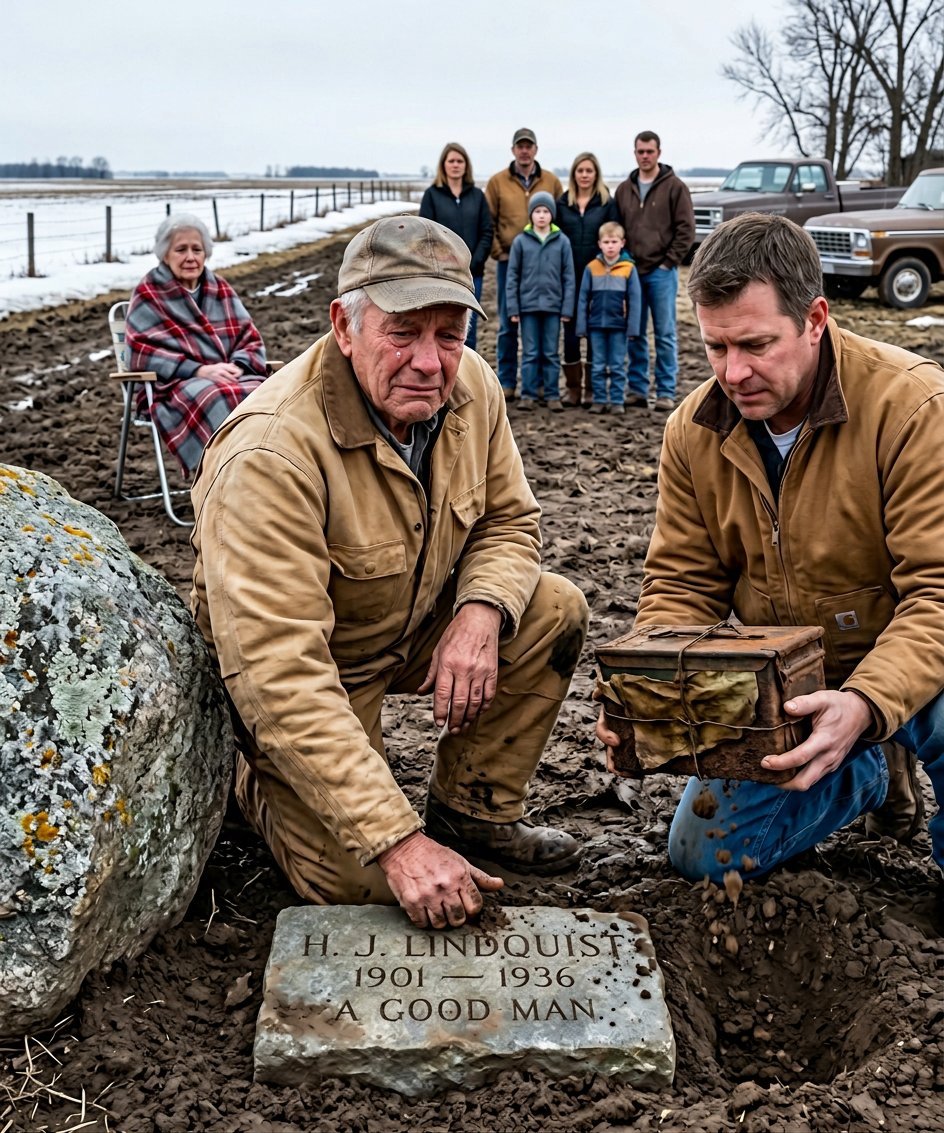
Two feet down, Tyler’s spade rang. Not stone — metal. A dull, hollow clank that went up my arms even though I wasn’t the one holding the handle. Tyler got down on his knees and worked with his hands, and my father knelt across from him, eighty-one years old in field mud in March, and I knelt too, and we lifted it out together.
It was a steel ammunition box, army surplus, the old kind, wrapped in what was left of an oilcloth slicker and bound with wire. Heavy. Rusted at the hinges but sound — Karl, or someone, had greased it and wrapped it right. And under it, when we lifted it clear, there was something else: a flat piece of fieldstone, hand-chiseled, the letters shallow and worn but legible the moment my father brushed the dirt away with his thumb.
H. J. LINDQUIST
1901 – 1936
A GOOD MAN
A grave marker. Buried face-up, one arm’s length down, on the north side of the rock.
The rock was a headstone. It had been a headstone for ninety years, dead center of our north field, and four generations of my family had plowed a perfect, gentle, protective curve around a grave.
Nobody said anything for a long time. Dana’s youngest asked, “Who’s H. J. Lindquist?” and Aunt Ruth, from her lawn chair, said the first thing she’d said all afternoon.
“Open the box, honey. Harald can tell you himself.”
Part IV — 1936
We opened the box in the machine shed with the whole family around the workbench because the wind had come up and it felt wrong, somehow, to do it in the field, standing on top of him.
Inside, dry as the day they were sealed: a leather wallet. A pocket watch with a cracked crystal, stopped at 4:40. A photograph of a woman and a little boy, studio-stiff, the corner stamped by a photographer in Duluth. A Norwegian psalm book, small enough for a shirt pocket. And an envelope, thick, with writing on it in a hand we all knew from ninety birthdays’ worth of cards — Karl’s hand, but younger, steadier. It said: The truth about the rock. Karl Sorensen, written 1951, sealed. For whoever finally asks the right question.
My father opened it. He read it out loud. It took eleven minutes, and I have never heard a room of Sorensens stay silent for eleven minutes, before or since.
I won’t give you every line — the letter belongs to the family, and some of it is Karl talking to his own father in a way that’s not for strangers. But here is the truth of it, the truth that sat under the north side of that rock since 1936:
Harald Lindquist was a hired man. He came through in the spring of 1936, the worst year — the drought year, the grasshopper year, the year the banks took the Petersen place and the Wold place and were circling ours. He was a Norwegian off the ore boats, out of work when the shipping died, walking farm to farm. Great-grandpa Emil couldn’t pay him. Harald worked anyway, for meals and the hayloft, because, as he told Emil, “a man rusts standing still.” He stayed five months. He fixed the windmill. He taught eight-year-old Karl to whittle and to swear in Norwegian, in that order. Every evening he wrote to his wife and boy in Duluth, saving string, saving stamps.
In August, the bank scheduled the auction. The farm was done. Sixty dollars behind — sixty dollars, in a year when nobody in the county had six. And on the last Friday before the auction, Harald Lindquist walked into the kitchen, laid his wallet on the table, and paid it. All of it. His whole ore-boat severance and every dollar he’d saved to bring his family west. Emil refused it. Harald said — and this line was in the letter, in quotes, because Karl was in the room when he said it — “You can pay me back when the rain comes. The land has to live, or none of us do.”
The rain came in September. And in September, Harald went up on the windmill one more time, to grease the head before he left for Duluth — the watch in his pocket stopped at 4:40 when he fell.
They wrote to his wife. And here the letter gets hard: the wife was gone. The Duluth address came back marked deceased — the flu that spring — and the little boy in the photograph had been taken in by cousins somewhere in Canada, no address. Nowhere to send the body. No money for a churchyard plot, not that Emil would have sent him to lie in town among strangers anyway. So Emil buried him at the highest, best-drained point of the north field — dead center, in the ground Harald’s sixty dollars had saved — chiseled the stone himself, laid it face-up over the box, and dragged the boulder over the grave with four horses so that no plow, no bank, no pipeline, no future grandson with a rental excavator brochure would ever cut into that ground by accident.
And then he never told anyone why. Because Emil, who could not pay Harald back when the rain came, decided the debt would be paid a different way: the land would keep him. For as long as there were Sorensens on it, the field itself would stand watch. “The rock stays” wasn’t stubbornness. It was a debt being serviced, three words at a time, for ninety years.
The last page of Karl’s letter said this. I know it by heart now:
“My father guarded him and told no one, because he was ashamed the debt could never be paid. I guarded him and told no one, because after so long, I didn’t know how to explain a man none of you had met. But a farm is not dirt. A farm is everyone who kept it alive. You are standing on sixty dollars, a windmill, and a man who never got home. Now you know. Decide for yourselves if the rock stays.”
Part V — The Decision
Decide for yourselves. That was the strangest mercy of the whole will. Four generations had been given no choice and no reason. We were given both.
We took a vote that night at the farmhouse table, because Karl’s paragraph seemed to want one — decide for yourselves, plural, all of us. Dana’s kids voted. Aunt Ruth voted. Tyler, who three years ago stood in that field pricing excavators, sat with Harald’s pocket watch in his hand the whole meeting and didn’t say a word until the end.
It was not even close. It was not even a discussion, really. The vote was fourteen to nothing, and the only debate was whether “the rock stays” was even the right way to put it anymore — whether a thing can be said to stay once you understand it was never an obstruction at all. It was the most important structure on the farm. We had been plowing around our own history, our own survival, the whole reason there was a field to plow.
But we did change things. Karl’s letter set us free to do that, I think — then decide for yourselves cuts both ways. That spring, we didn’t plant the circle around the rock. We seeded it to native grass and wildflowers, a ring about forty feet across, so now the satellite picture shows the rows bending around a small green island instead of a gray smudge. Tyler cleaned the chiseled fieldstone, and we set it upright at the base of the boulder, facing north, the way a headstone ought to face the road. The county historical society got a copy of Karl’s letter. The original stays in the ammunition box, back in the house now, on the shelf where Grandpa kept his psalm book.
And we went looking for the boy. The little boy in the photograph, taken to Canada in 1936. It took Dana’s daughter four months on the genealogy sites — Harald’s son died in 2003, in Manitoba, a retired schoolteacher — but his granddaughter is alive, in Winnipeg, and in June she drove nine hours south with her own two kids to stand in our north field.
She brought a photograph of her great-grandfather Harald as a young man on the ore docks, grinning, cap pushed back. We put it next to Karl’s letter. She stood at the rock a long time, one hand flat on the low polished shoulder on the west side — the shoulder we always joked was worn smooth by farmers leaning on it to curse it.
It wasn’t farmers cursing, Aunt Ruth told her. It was Emil, and then Karl, standing there every June evening with their hats off, one hand on the stone. Ninety years of Junes. That’s what polishes granite.
“He was only supposed to be here five months,” his great-granddaughter said.
“He kept the farm alive,” I said. “So the farm kept him. That was the deal.”
She asked if we had ever thought of moving him to a churchyard, giving him a proper plot, a proper stone. And I understood, finally and completely, why Grandpa walked that pipeline crew off the property in 1989, why his hands shook, why no reason was ever given. Because the reason was not shameful or dark or strange. The reason was so simple it could break your heart in a sentence, and Karl was not a man who let his heart be broken in front of engineers.
This is the proper plot. Dead center of the best-drained ground on the farm he saved, under a stone four horses moved, in a field that has bent around him gently for ninety years like the whole land is standing at a graveside — because it is.
Tyler drives the big Case now. The GPS still draws that curve in the north field, the one that used to make him crazy, the soft eddy in two hundred acres of straight lines. Last planting season I rode with him, and when we came around the grass ring — flowers up, stone straight, moss on the north face where the moss likes it — he lifted his cap off, one-handed, without thinking, the way you do passing a church.
Every new tractor, same conversation. Someday Tyler’s kids will stand in that field beside some machine that could lift the boulder like a bottle cap, and they’ll say the sentence the rock teaches every generation: we could pull that rock in an afternoon.
And Tyler will give them the answer. But not the way we got it. He’ll give them the whole answer — sixty dollars, a windmill, a stopped watch, a man named Harald Lindquist who never got home, and a family that has been keeping its word since 1936.
We dug that same afternoon. We found it.
And the rock stays.