My daughter asked me to co-sign an $8,000 loan for her first year of college. She sat at our kitchen table in May of 2008 with the papers printed from the library because we didn’t have a printer, her hair pulled back the way her mother used to wear it, her hands shaking a little on the edge of the form. “Get a job like I did,” I said, and shut the door.
I didn’t slam it. That’s what I tell myself now. I closed it. Firm. Final. Like you close a toolbox after work is done. She was eighteen. Eighteen years and four days, actually. She had that cheap blue graduation gown folded on the back of the kitchen chair because she didn’t want to throw it away, and she had gotten into State, which was two hours away and wanted more money than I made in two months at the plant.
Eight thousand dollars. That was the number on the line where my signature was supposed to go. Co-signer. I’d heard that word on the radio, in those ads that play between innings — co-sign and you’re responsible. I had been responsible for a lot by then. My mother had died that February. Pneumonia. Fast. My wife, Lena, had left in 2004 when Jenna was fourteen, moved to Ohio with a man who sold insurance. I stayed. I kept the house with the furnace that rattled every January. I kept the job at Henderson Fabrication where I started at nineteen pulling wire and now, at forty-seven, I was the guy they sent when the heat wouldn’t kick.
I told myself I was being practical. College was a scam. Everybody knew that in 2008. The housing market was crashing. My 401k was a joke. Kids came out with debt and no jobs. “Get a job like I did,” I said. I meant: learn a trade, work with your hands, don’t owe anybody. What I really meant, I think now, was: don’t leave me. Don’t think you’re better than this house. Don’t go two hours away and become someone who doesn’t need me to fix her furnace.
She didn’t cry when I said it. That was the worst part. She just looked at me. She was always a quiet kid. When she was six she took apart our toaster and put it back together and it worked better. When she was twelve she fixed the neighbor’s bike chain without being asked. When she was sixteen she got straight A’s and never bragged. She just folded that paper in half, then in half again, until it was a small square, and put it in her backpack.
“Okay,” she said.
That night she slept on the couch because I’d taken the door off her bedroom to paint it and never put it back. In the morning she was gone before my shift. She left a note on the fridge: Found a scholarship two states away and took it. Don’t worry. — J. Two states away. Indiana. A small engineering school I’d never heard of that had given her a full ride for “women in thermal systems” or something like that. I didn’t even know what thermal systems were.
That was 2008.
Part II — The Silence
She never called. Not once.
At first I told myself it was pride. Then I told myself it was busy. She was in college. Kids are busy. Then she graduated, and still nothing. Then 2010, 2011, 2012. The years did what years do when you don’t call someone. They stacked up like pallets in the back of the plant. Quiet and heavy.
I still tell the men at the plant she’s just busy. That’s been my line for seventeen years. Earl asks at lunch, “How’s your girl doing? Still doing that engineer thing?” and I say, “Oh, you know, she’s busy. Big project.” Mike asks on the smoke break, “She ever come home for Christmas?” and I say, “She wanted to, but work.” They nod. They have daughters too. They know how it goes. Daughters get busy.
The truth is I checked. Not much, but I checked. In 2014 I got a smartphone because Henderson made us use an app for work orders. I typed her name into Google one night after two beers. Jenna Keller. There she was. Second from the top. A LinkedIn picture I didn’t recognize — short hair, safety glasses on top of her head, standing in front of some big silver machine. Senior Design Lead at some company in Fort Wayne. Then a year later, another search: she’d moved back to our state. Then nothing for a while because I stopped looking. Looking hurt too much. It felt like opening that furnace panel and finding everything burned.
I kept her room the same for three years. Then I turned it into storage. Then I turned the storage into a place to put my boots so they’d dry. Her blue graduation gown stayed on the back of that kitchen chair for six months until the cat threw up on it and I finally threw it away. I never washed it. I should have washed it.
What I did do was work. I worked every overtime shift they offered. Furnaces in winter, AC in summer. I fixed things for people who had more money than me and never learned their names. I fixed the elementary school where she went to kindergarten. I fixed the church where my mother’s funeral was. I told myself that was enough. A man who can fix things is never useless. That was my father’s line. He died in ’99, lungs full of shop dust.
Last spring, Earl retired. At his party, his daughter flew in from Seattle with two kids. She hugged him like she meant it. I stood in the corner with a paper plate of cake and watched and felt something cold move through my chest that wasn’t the air conditioning.
On the way home that night, I drove past State. The college she didn’t go to. The one that wanted $8,000. There were kids on the lawn with backpacks. I was sixty-four. My hands hurt in the morning now. Arthritis. And I thought, for the first time in a way I couldn’t push away: what if she had needed me to say yes? What if the only thing she needed was for one person to sign his name and say, I believe you will pay this back because you are my daughter and you can do anything?
I had shut the door. She had walked through a different one two states away. And she never came back through mine.
Part III — The Work Order
Last month they sent me to fix a furnace at a new engineering firm downtown. That’s what the ticket said: “No heat — 3rd floor — new build — KELLER THERMAL SOLUTIONS — downtown — priority.” It was a Tuesday. Rain. November rain that gets into your boots even if you park close. I was supposed to be off that day, but Dave called out with his back, and I said I’d take it because downtown jobs are easy — new buildings, clean filters, usually just a thermostat someone set wrong.
I didn’t notice the name until I was already there. Keller. Common enough. I parked my van in the loading zone, grabbed my toolbox, and walked up to this glass building that wasn’t there five years ago. All glass and steel and those bare bulbs that rich people like. The lobby was cold, and that should have been my first clue — new building, no heat on the third floor, whole system probably unbalanced.
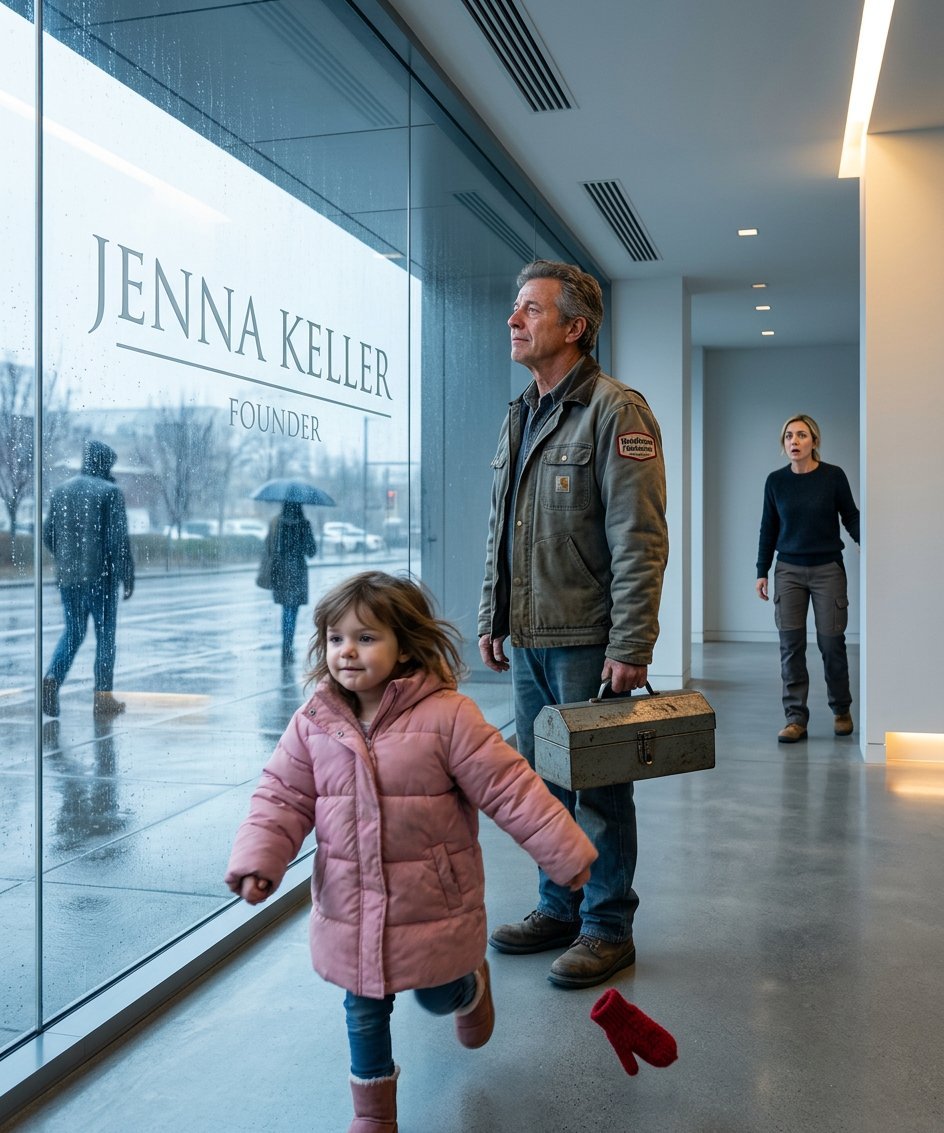
I pushed the door and the receptionist wasn’t there yet. It was 7:40 a.m. The lights were on automatic. And on the glass wall that separated the lobby from the offices, etched in big, clean letters, was her name.
JENNA KELLER
FOUNDER
Her name was etched on the glass. Founder.
I stood in that cold lobby a long time. My toolbox in my hand. My old work boots dripping on their polished concrete floor that probably cost more than my truck. I stared at that name and I felt my heart do something I haven’t felt since my mother died — it stopped, then it hammered, then it stopped again.
It couldn’t be her. There are a lot of Kellers. But I knew. I knew the way you know a furnace is going to fail before it fails, by the sound it makes. Jenna. My Jenna who fixed toasters at six. Jenna who wanted $8,000 and I told to get a job like I did.
I didn’t move. I couldn’t. The rain hit the glass roof. The heat was off and I could see my breath. I had spent seventeen years telling the men at the plant she was just busy. Busy building this, apparently. Founder. That word is a big word. It means you started something from nothing. It means you didn’t need a co-signer.
I thought about turning around. Leaving the work order. Calling Dave and saying I got sick. I could have. No one would have known. But my hands were already cold, and my boots were already wet, and I was already there, standing under my daughter’s name like a man waiting to be judged.
Then a little girl ran past. She must have been four, maybe five, in a puffy pink coat that was too big, her hair in a messy ponytail. She ran from the hallway into the lobby, giggling, and as she passed me her mitten fell off. Just dropped. Red mitten, hand-knit, on the concrete. She didn’t notice. She kept running.
And she had my mother’s chin. That hard little cleft, that stubborn chin that could hold a whole family together. My mother’s chin, on a little girl I had never seen before, in a building with my daughter’s name on the glass.
A woman came around the corner to catch her. “Lily! Lily, wait!” And then my daughter stopped. Looked at me. She said nothing at first. She just stopped.
Part IV — Founder
She was thirty-five now. Not eighteen. Her hair was shorter, like in that LinkedIn photo, but she had those same eyes — my eyes, actually, which she always hated because they were too serious. She wore a dark sweater and work pants and boots, not a suit. An engineer’s clothes. Her hands were clean but her nails were short, like someone who works.
For a second I thought she didn’t recognize me. I’ve gotten older. Heavier. Grayer. My beard is white now. Then I saw it hit her. Her mouth opened a little. Her hand went to her chest, not in a dramatic way, just like she needed to hold herself still.
“Dad?”
That one word. Dad. I hadn’t heard it in seventeen years. I had told Earl at lunch last week that she calls me every Sunday. Here she was saying it for real and it sounded like a foreign language I used to be fluent in.
I held up my mitten. The little girl’s red mitten. It was warm from her hand.
“She dropped this,” I said. My voice sounded like a furnace with a bad bearing. Grinding.
My daughter — Jenna — didn’t take the mitten right away. She looked at my toolbox, then at my Henderson Fabrication patch on my jacket, then back at the glass with her name on it. Founder. I watched her put it together.
“You’re here for the furnace,” she said. It wasn’t a question.
“Third floor. No heat,” I said. “They sent me.”
She nodded. Then she called, “Lily, come here, sweetie.” The little girl came running back, and Jenna scooped her up. The girl had my mother’s chin and Jenna’s eyes and a smear of peanut butter on her cheek. “This is Lily,” Jenna said, looking at me. “My daughter. She’s four.”
My granddaughter. I had a granddaughter. Four years old. In a pink coat that was too big. I felt my knees go a little weak and I put my hand on my toolbox to steady myself.
“Hi,” I said to Lily. “You dropped this.” I held out the mitten and she took it and said “Thank you” very seriously, like Jenna had taught her manners.
Jenna set her down and said, “Go find Ms. Ana, okay? Mommy will be there in a minute.” Lily ran off, mitten back on, and then it was just us in that cold lobby under that name.
I wanted to say so many things at once that nothing came out right. I wanted to say I’m sorry. I wanted to say I saw your scholarship. I wanted to say I’m proud of you. I wanted to say $8,000 was never about the money, it was about me being scared you’d leave and you did anyway and you were right to. I wanted to say I still have the toaster you fixed.
What I actually said was: “Founder. That’s a big deal.”
She laughed. Just once, short, and it sounded a little wet, like she was going to cry. “It’s just a name on glass,” she said. “It peels off.”
“Don’t peel it off,” I said too fast. “It looks good. It looks… it looks right.”
We stood there. The rain drummed. The building was still cold.
“I didn’t know it was your building,” I said. “If I’d known, I would have…” I stopped. What? Would have worn a better jacket? Would have not come? Would have called first in 2008?
“I know,” she said. And she did know. That was the thing about Jenna. She always knew.
She told me the story in two minutes while we stood there, the story of the last seventeen years that I had missed because I was too proud to ask. Scholarship to Trine. Engineering degree, top of her class. Internship that paid. Master’s paid for by the company. Worked in Fort Wayne for six years designing heat exchangers for people like me to install. Saved every penny. Met a man named Daniel who was kind and who left when Lily was one because he didn’t want to be a dad, and that was his loss. Moved back home two years ago because her mom — Lena, my ex-wife — got sick, and Jenna wanted Lily to know her grandmother before it was too late. Started Keller Thermal on a Small Business loan she got without a co-signer, because she had learned how to do things without one.
“I thought about calling you,” she said, looking at the floor. “A lot. But every time I picked up the phone I heard you say, ‘Get a job like I did.’ And I had. I had gotten a job. Two jobs in college. And I thought, if I call him now, he’ll think I’m calling because I need something. And I didn’t want you to think that.”
“I never thought you were busy,” I blurted out. “At the plant. I tell them you’re busy. But I knew you weren’t calling because… because I shut the door.”
She looked up at me then, really looked at me, and I saw my little girl in there, the one who used to sit on my shoulders to change lightbulbs because she liked being tall.
“You did,” she said quietly. “You shut the door.”
And then, after a pause that lasted a whole winter, she said what I had been waiting to hear since that day in May 2008, the words that the prompt on that image cut off before it could give me.
Part V — The Mitten
She said: “Do you want to come upstairs and fix my furnace? Lily’s classroom is up there and it’s freezing.”
It wasn’t “I forgive you.” It wasn’t “I missed you.” It wasn’t the movie ending where we hug and cry and seventeen years disappears. It was better. It was a job. It was an invitation to do the one thing I knew how to do, in the place she had built, for the granddaughter I had just met.
“Yeah,” I said. “Yeah, I can fix it. I can fix it.”
We went up the stairs because the elevator was out too — part of the same zone failure, she explained, talking like an engineer now, talking fast about a damper that wouldn’t open. I listened. I actually listened. I didn’t pretend to know. I asked questions. She answered. In that stairwell, for the first time since she was fourteen, we were talking like two people who liked the same thing — how things work, how heat moves, how you can take cold air and make it warm if you know where to put your hands.
The third floor was a big open office with desks and a little daycare corner in the back with tiny chairs and crayons. Three women in hard hats were huddled in blankets looking at a laptop. Lily was there with Ms. Ana, drawing. When she saw me she waved with her mittened hand.
The air handler was in a closet. I opened it. It was a brand-new high-efficiency unit, the kind I’d only seen in catalogs because Henderson never buys new. The damper was stuck closed. A five-dollar actuator had failed. Five dollars. That was it. Five dollars was keeping Founder Jenna Keller’s whole building cold.
I had the part in my van. I always have the part. I went down and got it, and Jenna came with me, holding the door while I carried my toolbox in the rain. We didn’t talk on the way. We just walked side by side under her building’s awning that said KELLER THERMAL SOLUTIONS in that same etched glass font.
I fixed it in eleven minutes. I showed her how — the actuator, the linkage, the little set screw that strips if you overtighten it. She watched my hands, my old arthritic hands, and she said, “You still do it the same way. Pinky out to balance.” I didn’t know she remembered that.
When the heat kicked on, the women cheered. Lily cheered loudest. Warm air came out of the vents and fogged the cold glass for a second. Jenna put her hand in front of a vent and closed her eyes.
Then she turned to me and said, “Dad, do you want to have coffee? Not now. Now’s work. But… next week? We have a lot of… we have a furnace maintenance contract we need to bid out. And Lily… she doesn’t have a grandpa on this side. Daniel’s dad isn’t… anyway. Would you…?”
She was nervous. My daughter, the Founder, nervous to ask her father for coffee.
I said yes. I said yes so fast I surprised myself. I said, “I’m off Thursdays. I can bring donuts. The kind with the chocolate. You used to like those.”
“I still do,” she said.
We didn’t hug in that mechanical closet. It didn’t feel right yet. But she walked me down to the lobby, and at the door she stopped under her name on the glass. Founder. Jenna Keller. My daughter.
“Dad,” she said, and this time her voice was steady. “That loan. In 2008. I want you to know… I got that scholarship because you said no. I was so mad I wrote the best essay I’ve ever written. It was called ‘The House That Fixes Itself.’ It was about you. About watching you fix everything in our house with nothing. I got $28,000 a year because you told me to get a job like you did. So… thank you. I think. I’m still mad. But thank you too.”
I stood there with my toolbox in the cold lobby that was finally getting warm, looking at my daughter and my granddaughter’s red mitten on the floor where she’d dropped it again, and I cried. I didn’t mean to. Sixty-four years old, rain on the glass, Founder etched above me, and I cried like I was eighteen again and someone had just shut a door on me.
Jenna reached out and put her hand on my arm. Just for a second. Her hand was warm from the vent.
“Thursdays,” she said. “Bring the chocolate ones.”
I walked out to my van. I sat in it for ten minutes before I could drive. I called Earl, even though he’s retired. I said, “Earl, she’s not busy. She’s a founder. She built a building downtown. And I have a granddaughter. Her name is Lily and she has my mother’s chin.”
Earl said, “Well, it’s about time you fixed that one too, Frank.”
Last Thursday I brought donuts. Chocolate ones. Lily ate two and got chocolate on her pink coat. Jenna showed me the blueprints for the next building. She asked me to look at the HVAC load calculations. I told her they were wrong on the second floor and she laughed and said, “I knew you’d say that.”
We are having coffee again this Thursday. I am bringing extra mittens, because Lily loses them. I am learning how to be a grandfather. I am learning that some doors you shut can still be opened from the other side, if you’re willing to stand in the cold lobby long enough and wait for someone to say, “Do you want to come upstairs and fix my furnace?”
My daughter asked me to co-sign an $8,000 loan for her first year of college. I said no. She found a scholarship two states away and took it. That was 2008. She never called.
Last month I fixed her furnace. Her name was etched on the glass. Founder.
The lobby is warm now.
— The End —