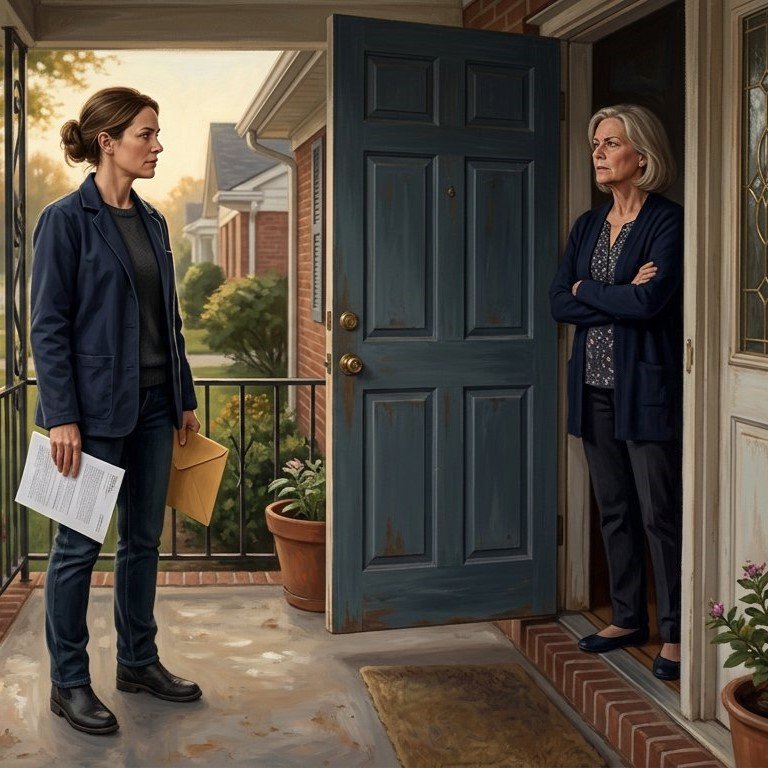
When my fifteen-year-old daughter Lucy came home with red, puffy eyes, I knew something was wrong before she said a single word. I handed her the folder. “I’m here about the two hundred and twenty dollars.”
It was a Friday in October, a little after five. I was standing at the kitchen counter in my work clothes, still wearing the badge from the insurance office where I process claims nine hours a day, listening to the dryer tumble and the radio murmur the weather. I heard the front door open, and then I heard nothing — no “Hi, Mom,” no backpack hitting the floor in that boneless way it usually does, no rush to the refrigerator. Just the sound of shoes being taken off very slowly, one at a time, the way you take your shoes off when you are trying not to cry.
She came into the kitchen with her arms crossed tight over her chest, like she was holding herself together from the outside. Her eyes were pink and swollen. Her nose was red. She had walked the four blocks home from the Carpenters’ house and it had clearly been the longest four blocks of her life.
“What happened, Lucy?” I asked.
She opened her mouth and then closed it and then opened it again, and what came out was almost a whisper.
“Mrs. Carpenter… she didn’t pay me.”
I put down the wooden spoon. “What do you mean, she didn’t pay you?”
“She did the whole thing.” Lucy’s voice cracked in the middle of the sentence. “She said it was a life lesson. She said I should get things in writing and never trust someone’s word. And then she — ” Lucy stopped, and her chin trembled, and she said it all in one breath. “She slammed the door in my face, Mom.”
My daughter had spent seven days that week taking care of a three-year-old named Maisie Carpenter. Seven days. Twenty hours and change, by my rough math, at eleven dollars an hour, the number Mrs. Carpenter had offered over the fence in August while she was deadheading her roses and Lucy was watering our sad little patch of tomatoes.
She said hard work was payment enough. She actually said that. I could hear the words coming out of Lucy’s mouth and I could picture exactly the tone they had been delivered in, because I have heard that tone before, in that same voice, at that same front door, when Mrs. Carpenter asked me to keep my recycling bins out of sight “for the good of the whole street.”
I asked Lucy to sit down. I made her a cup of tea, which she only drinks when something has gone badly enough that she wants to feel like a Victorian orphan, and I pulled the chair around so I was next to her instead of across from her.
“Tell me the whole thing,” I said. “Start at Monday.”
So she did.
Monday she had got there at seven in the morning because Mrs. Carpenter had a nine o’clock and needed to be out the door by eight-fifteen. Tuesday she stayed until six because Maisie was sick with an earache and Mrs. Carpenter said she couldn’t possibly miss her hair appointment, she’d had it booked for three weeks, and Lucy had held a sobbing toddler on the couch for two hours and read “Goodnight Moon” eleven times. Wednesday there was a fussy lunch and a tantrum and a diaper that Lucy quietly cleaned up without calling, because she didn’t want to be a bother. Thursday she had missed a rehearsal for the school play to cover an extra two hours. Friday, at one o’clock, she had knocked on the office door, politely, and asked to be paid for the week.
And Mrs. Carpenter had looked at her over her reading glasses and smiled a small, patient, awful smile.
“Lucy,” she said. “This is a valuable lesson. In the real world, people will promise you things. If you don’t have it in writing, you have nothing. Consider this your tuition. You’re welcome.”
Then she’d stepped back and closed the door, hard, in a fifteen-year-old girl’s face.
I gave Lucy the two hundred and twenty dollars that night. I went up to my bedroom, took the envelope out of the back of my sock drawer — the one marked BRAKES, which I had been feeding twenty, thirty dollars at a time since August while the car clicked every time I turned the wheel — and I drove Lucy to the ATM and deposited it in her account so she could spend it with her own debit card, like she had earned it, because she had.
She hugged me so hard her chin knocked into my collarbone. “Thank you,” she said into my shoulder. “But you don’t have to fix it. It’s not your fault.”
“Go to bed,” I said. “And Luce? Bring me your notebook. The one you keep the hours in.”
She looked at me like I had x-ray vision. She didn’t know I knew about the notebook. Mothers know about notebooks.
She brought it down — a lime-green spiral thing with a unicorn sticker on it from when she was eleven, and inside, in her careful round handwriting, a log of every shift she had worked since she was thirteen: date, times, total hours, whose house. She had logged her babysitting the way I log claims. She had drawn a little box next to each one.
Nineteen hours and forty-five minutes. Call it twenty. Two hundred and twenty dollars at eleven an hour.
But I had told her I’d pay her, and I’d paid her, and now Lucy was even, and Mrs. Carpenter was not. That’s the part that sat in my chest like a hot coal. That woman thought she was going to get away with it.
Not a chance.
I am not an impulsive woman. I process claims for a living; my job is basically the art of putting things in writing. So instead of marching across the lawn at midnight in a bathrobe, which is what my heart wanted to do, I took the notebook upstairs and I did the work.
First: the texts. Mrs. Carpenter is a woman of the modern age, and a woman of the modern age puts her worst behavior in writing. There they were, going back through the summer, in that bright bubble of blue: “Darling can you start at 7:30 tomorrow instead of 8? Maisie’s up early 🙄” and “yes 11/hr works for me!” and after Wednesday, “sweetheart you’re a lifesaver, I owe you big time.”
I screenshotted every single one. I did not delete anything. I printed them at the office on Monday morning before the mailroom guy even got in, and I clipped them into a folder with brass fasteners, because I am forty-two years old and I believe in brass fasteners.
Second: the invoice. I made it on the office template, the one we use for independent adjusters, because it is clean and it has a place for a due date. DESCRIPTION OF SERVICES: child care, 19.75 hours, $11.00/hour, rate confirmed by text 6/14 and 8/2. TOTAL DUE: $217.25. I rounded it to $220 because I’m not petty, I’m accurate, and I typed DUE UPON RECEIPT in the corner like a woman who means it.
Third: I called three people. The Turners down the block, whose son Marcus was sixteen and had mowed the Carpenters’ lawn all summer. The Bells, whose daughter Ainsley had weeded the side beds in September. And Maria Delgado, whose son Diego had walked Maisie’s stroller around the block every afternoon for two weeks in July while Mrs. Carpenter “worked from home.”
Every single one of them had the same story. Every single one of them had been paid late, or short, or not at all, and every single time there had been a reason that was not about money. Marcus had “missed a corner.” Ainsley had “pulled up some of the lobelia on purpose, apparently.” Diego had walked “too slow,” whatever that means when you are pushing a toddler.
And every family had heard the same sentence, in the same patient voice:
“They’re learning a life lesson. In the real world, people don’t always pay you what they promised.”
By the time I hung up with Maria Delgado, I had three notes on a legal pad and a plan that had nothing to do with yelling.
I knocked on Mrs. Carpenter’s door at eight the next morning.
She opened it with her reading glasses on and a coffee cup in her hand, and something in her face flickered when she saw me — but only for a second, and then it was smooth as glass.
“Good morning,” she said. “If you’re here about Lucy—”
“I’m here about the two hundred and twenty dollars,” I said. “And I brought you the writing.”
I handed her the folder. She opened it, and I watched her eyes move down the invoice, over the text screenshots, and land on the bottom page, where I had typed, in the calmest font available to modern technology, the names of three other families and the amounts outstanding.
I want to tell you she looked ashamed. She did not look ashamed. She looked annoyed, the way you look when a fly gets into the house in September.
“You understand,” she said, “that there was never any agreement.”
“There’s a text where you wrote ‘yes, eleven an hour works for me,'” I said. “That’s an agreement. It’s just printed instead of typed.”
“I’m not paying a fifteen-year-old for a job she was terrible at,” she said, and then she smiled that patient smile and said the thing that started all of this. “Honestly, you should be thanking me. I taught your daughter something her school never will. Nobody hands you money for nothing in the real world, and if you don’t get it in writing, you deserve what you get.”
And then Mrs. Carpenter told me something new: that Lucy had broken a vase. A blue vase, her mother’s, a valuable thing, and she had decided to be generous and let it go, but if I was going to be difficult about a few hundred dollars, then she supposed we could talk about the vase instead. Four hundred dollars, she said. Which meant, by her arithmetic, that I owed her a hundred and eighty.
Then she closed the door on me, too.
I stood on her porch for a moment with my folder, and I have to be honest: for about ten seconds, I wanted to cry. Because it’s one thing to be cheated. It’s another to be told that being cheated is a gift, and that you’re ungrateful for noticing.
But I went home, and I got on the computer, and I filed in small claims court. Forty-eight dollars to file. Three families, one case, four kids, six hundred and forty dollars in unpaid work, one woman who had taught the entire street a lesson she never intended to teach.
I told Lucy what I was doing. I asked her if she wanted to come.
She looked at me for a long moment, and then she said, “Do I have to talk in front of a judge?”
“You might. You can say no.”
She looked down at the notebook in her lap, at her own round handwriting, at the little empty boxes she’d drawn in the corner of each line, waiting to be checked off.
“I’ll come,” she said.
The hearing was on a Tuesday in November, in a room with beige walls and a clock that ran two minutes fast. Judge Okafor was a round, patient woman with reading glasses on a beaded chain. Mrs. Carpenter showed up in a cream-colored blazer with a folder of her own and a nephew who “worked in law,” which is not the same as being a lawyer, and which the judge clarified for her in about nine words.
It took eleven minutes.
The texts went into evidence. Lucy read her notebook aloud, and her voice shook on the first line and then stopped shaking, somewhere around Wednesday. Marcus Turner testified that he had been paid forty dollars for a summer of mowing. Ainsley Bell testified that she had been told she was “learning the value of doing things right.” Maria Delgado produced a screenshot in which Mrs. Carpenter had written, “Diego is a natural with Maisie, we adore him, I’ll settle up Friday.”
And I produced one photograph. It was a photo Mrs. Carpenter had posted publicly on September 22nd — I had found it at eleven o’clock the night before, on her public page, because I am good at my job. In the photo there was a table with a bowl of pears and a blue vase full of sunflowers. It was captioned “September in my little corner of the world. 🌻”
The alleged breaking had happened on September 18th.
Judge Okafor looked at the photograph. She looked at Mrs. Carpenter. She looked at the photograph again.
“Ma’am,” she said, in a voice that was not unkind and was not anything else either, “I see a vase.”
What happened next I did not expect. Mrs. Carpenter started to cry.
Not the kind of crying that gets you sympathy. The kind where your face gets red and your voice gets high and everything you’ve been holding in a room by yourself comes out in public at the wrong temperature. She said she had lost her job in June. She said she had been keeping up a house and a daughter and a car and a facade on savings, and that she had started telling herself a story about how young people needed to learn hard truths, and that the story had been very convincing to exactly one person, and that person was her.
“I didn’t think it was stealing,” she said. “I thought I was being honest with them about the world.”
“You owe these children six hundred and forty dollars,” Judge Okafor said. “And the filing fees. And ma’am — you do not get to call it a lesson. Work is the lesson. Pay is the pay.”
She paid. Money order, three envelopes, a check to the court for the fees, all of it within eleven days. Lucy’s cut came to two hundred and twenty dollars and change, and she handed me two hundred and twenty of it in an envelope and said, “I’m paying you back for the brakes.”
I said no. She put it on the counter and walked away, which is a negotiation style she clearly inherited from someone.
The other thing that happened, which I did not plan and did not expect, was that the street changed. Not in a dramatic way. There were no signs on the lawn, no shouting. But the parents of the neighborhood are a weather system, and word moved through it like a front off the plains. Nobody called Mrs. Carpenter a thief out loud. They just stopped being available. The Turners landscaped their own yard. Maria Delgado started walking her own dog. When Mrs. Carpenter asked the Hendersons’ daughter to watch Maisie on a Saturday, the answer was, “We don’t let her work without a contract anymore, sorry.”
And then, three weeks before Christmas, my doorbell rang.
It was Mrs. Carpenter. She was not wearing glasses or holding coffee or smiling a patient smile. She was holding a small tin of cookies that looked homemade in the slightly wrong way, and she stood on my step in the cold with her arms at her sides, and she said:
“Your daughter is the best babysitter on this street and I have nobody.” A pause. “And I owe you an apology. Not for the money. I paid the money. I owe you an apology because I said hard work was payment enough, and I said it to a kid, and I said it because it was what I needed to believe.”
I thought about a lot of things standing in that doorway. I thought about the ten seconds on her porch when I wanted to cry. I thought about Lucy’s notebook.
“Lucy is sixteen next month,” I said. “She sets her own rate now, and she’s going to want it in writing. If you’re serious, come back Saturday and ask her, not me.”
That Saturday, Lucy came down the stairs carrying her laptop and a single printed page.
I helped her with the phrasing, but not the numbers — the numbers were hers. It said: BABYSITTING AGREEMENT. Rate: $15 per hour, paid at the end of each shift, no exceptions. Late fee after 15 minutes: $5 per quarter hour. Cancellations under 24 hours: half the scheduled hours. Meals provided for Maisie; Lucy brings her own snacks. One page. Two signature lines. A small paragraph about being treated with respect, which Lucy wrote herself and refused to let me edit.
Mrs. Carpenter read the whole page twice, mouthing the words. Then she signed it with my pen, and paid for the first shift in advance, in cash, and handed over a second tin of cookies that were better than the first.
“Hard work is payment enough,” Lucy said, at the door, holding the signed page against her chest. “But I like payment better.”
I have never been prouder of anything in my life.
It is spring now. The brakes are fixed. The vase is a photograph I keep on my phone, in a folder called EVIDENCE, which is not the folder I thought, at forty-two, that I would be keeping about my own street.
Lucy has three regular clients and a shared calendar with Ainsley Bell, and they split the work and each keep their own books. She keeps the lime-green notebook with the unicorn sticker in a shoebox under her bed, and on top of it, in a plain black frame she bought with her own money, is a photocopy of her first signed contract with Mrs. Carpenter — “so I remember what I’m worth,” she says, which is a sentence I have repeated to myself more times this year than I can count.
Mrs. Carpenter pays on time, every time. She is still not my favorite person on the street. But in July, when her car wouldn’t start, it was Lucy who noticed her struggling with the jumper cables and walked over and helped her, unpaid, because Lucy is a better human being than either of us deserved.
The last time I saw Mrs. Carpenter, she was standing at her mailbox, and she said, “You know, I still think about that judge.”
“So do I,” I said.
“I tell Maisie,” she said. “When she’s older. I’ll tell her about the vase, too. I want her to know that her mother was not always the good guy.”
That’s the thing nobody tells you about the “life lesson” people. Usually they’ve been taught it themselves, by somebody who made them feel small and called it kindness. It doesn’t excuse what they do with it. It just means the lesson doesn’t stop with one person — it travels, forward or backward, whichever way you hand it to the next kid.
That fall, Lucy got a job at the bakery on Main, and on her first day she came home with the employee handbook and a piece of paper in her hand.
“Mom,” she said, “they said they’d pay me thirteen an hour. Can you look at the form?”
I looked at the form. It was all there in writing, exactly as promised. But Lucy didn’t know that yet. She was learning the habit, not the fear — checking the page, reading the line, doing the arithmetic in the margin, knowing that what she traded her hours for was a real number with her name on it.
That’s the lesson I want her to carry out of this whole mess. Not that people are dangerous. Not that you have to be hard to be safe. Just this: your work has a price, and the price is not a favor someone does you, and if the answer to “will I be paid?” is a story instead of a number, you are already being cheated.
Mrs. Carpenter thought she’d get away with it. Not a chance. A woman who keeps her receipts and a girl who keeps her notebook walked across the street one October morning, and the whole thing came apart in eleven minutes in a beige room with a clock that ran two minutes fast.
And as for hard work being payment enough?
It wasn’t. It was just the beginning of the invoice.
— The End —