My Four-Year-Old Son Called Me at Work, Crying: “Dad, Mom’s Boyfriend Hit Me With a Baseball Bat.” I Was Twenty Minutes Away—So I Called the Only Person Who Could Get There Faster.
My name is David Mercer.
And at 2:14 on a Tuesday afternoon, my four-year-old son called me from the house where my ex-wife was supposed to be keeping him safe.
“Dad… please come home.”
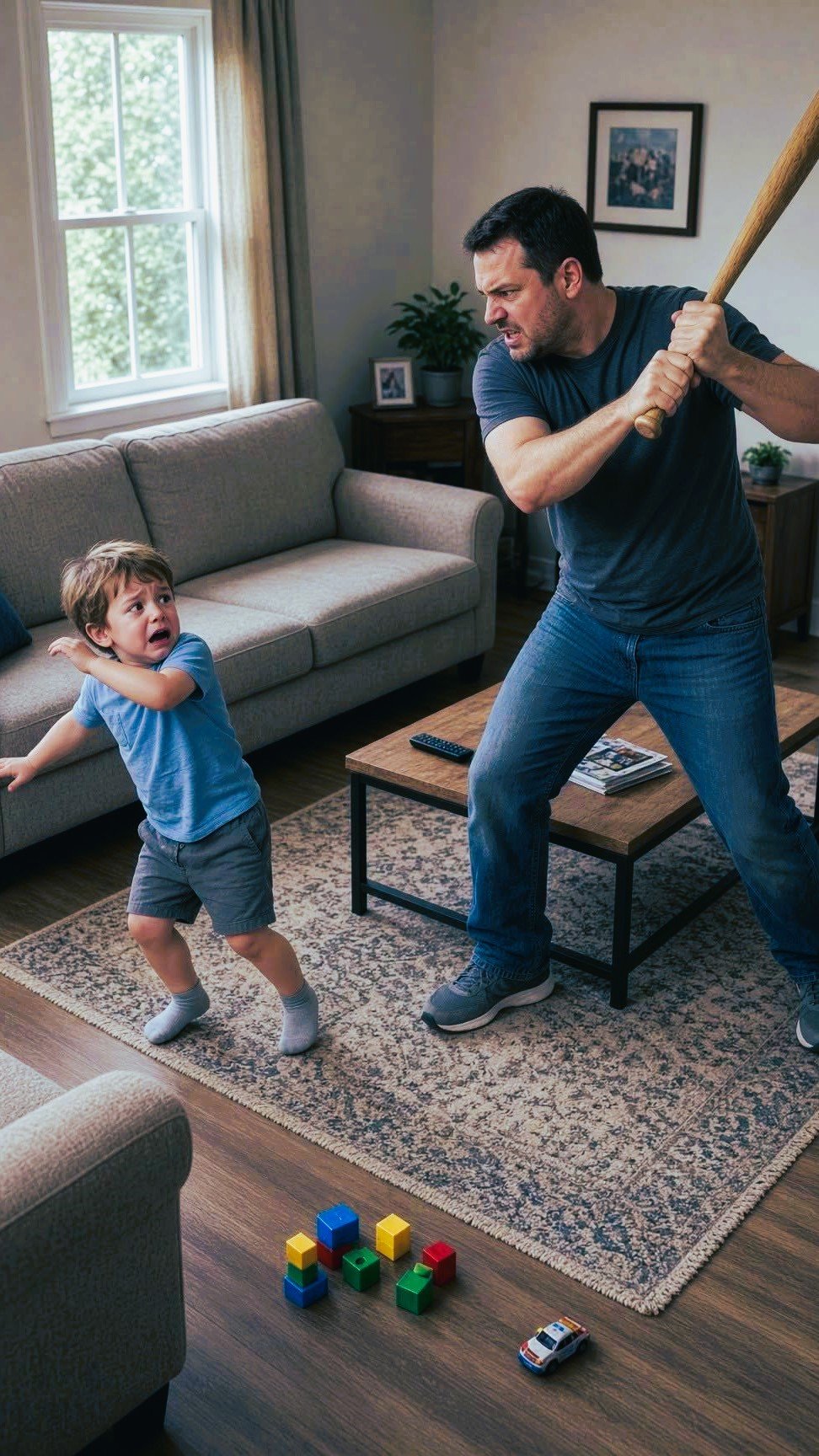
Twenty-three seconds later, he told me her boyfriend had hit him with a baseball bat.
Thirty-one seconds after the call began, Travis ripped the phone away.
I was twenty minutes from home.
My brother Derek was closer.
So I called him.
Then I called 911.
That decision may have saved my son’s life.
Derek reached the house first.
He stayed on the phone with me as he crossed the lawn.
“The front door is partly open.”
“Can you see Noah?”
“No.”
Then his voice dropped.
“There’s blood on the baseboard.”
My hands tightened around the steering wheel.
“Find him.”
Derek called through the doorway.
“Noah? It’s Uncle Derek. Come here, buddy.”
No answer.
Then Travis appeared.
I heard his voice through Derek’s phone.
“Who are you?”
“Where is Noah?”
“Get off the property.”
Derek asked again.
“Where is the boy?”
Travis laughed.
“He’s in the crawlspace where he belongs until he learns to shut his mouth.”
Every part of me wanted Derek to go through him.
Instead I shouted:
“Police are coming. Don’t engage unless you have to.”
Then I heard Travis threaten him.
I heard movement.
A crash.
The phone hit the floor.
When Derek finally came back on the line, he was breathing hard.
“David.”
“Are you okay?”
“I’m fine. Travis isn’t getting back up right now.”
“Noah?”
“I’m moving.”
He found the access door behind the pantry.
Locked.
Derek opened it.
“Noah?”
A tiny sound answered.
“Uncle Derek?”
Derek’s voice immediately softened.
“I’ve got you, buddy.”
“My arm hurts.”
“I know.”
“He hit me because I dropped my cereal.”
Derek went silent.
Then Noah whispered something worse.
“He said Daddy didn’t love me anymore.”
“Your daddy is coming,” Derek told him. “And nobody is touching you again.”
By the time I reached Maple Grove, police and paramedics were already there.
I ran inside.
Travis was being restrained by officers.
Derek sat on the bottom stair, bruised from the confrontation.
And wrapped inside his jacket was Noah.
My boy.
Pale.
Shaking.
His injured arm supported carefully against his body.
I dropped to my knees.
“Noah.”
He looked at me.
“Daddy?”
“I’m here.”
His lips trembled.
Then he said:
“I saved the phone. Did I do good?”
That broke me.
“You did perfect.”
I pressed my forehead gently against his.
“You did exactly right.”
Paramedics took him to Inova Fairfax Hospital.
Before Derek followed, he pointed toward Travis.
“Check his back pocket.”
A folded legal packet was sticking from Travis’s jeans.
An officer secured it.
The first page read:
IN RE: THE CUSTODY OF NOAH DAVID MERCER
EMERGENCY PETITION FOR TEMPORARY PROTECTIVE CUSTODY
Petitioner:
Helena “Lena” Mercer
Co-petitioner:
Travis J. Vance
And the allegation?
That I had physically abused and abandoned my son.
My hands went cold.
Attached were photographs of Noah showing dark bruises.
But something immediately felt wrong.
Some photographs had been taken inside the same house.
And the markings didn’t match anything I had ever seen on him.
Later examination would show that at least some of those photographs had been staged to create the appearance of prior injuries.
The petition had been filed less than an hour before Noah called me.
A temporary emergency order had already been signed.
Someone had been trying to turn me into the abuser before Travis attacked my son.
This wasn’t random.
It was preparation.
Lena arrived while police were still processing the house.
She stepped from a white Porsche and crossed the yard while speaking into her phone.
She hadn’t yet realized officers could hear her.
“The order is already signed,” she said. “Once David loses custody, we can move on the property.”
Then she entered the foyer.
Saw Travis.
Saw the police.
Saw Noah’s blood.
And stopped.
Her phone slipped from her hand.
A man’s voice continued through the speaker:
“Lena? If police secure that house before the records are removed, we have a serious problem.”
A patrol sergeant picked up the phone.
“Who is speaking?”
The call ended.
Lena looked at me.
“David… what happened?”
I held up the custody petition.
“You tell me.”
Her face changed.
Then the performance began.
She accused me of breaking into the house.
Claimed Derek attacked Travis without cause.
Insisted the temporary order gave Travis control over Noah.
But the officers already had Noah’s distress call.
They had Derek’s live phone connection.
They had the condition of the house.
And they had Travis’s own statements.
Her story had arrived too late.
Then my aunt arrived.
Eleanor Mercer had spent decades in federal appellate law before retiring.
I had contacted her earlier not to interfere with police, but because the custody order made no sense.
She arrived with independent counsel and asked one question:
“Who signed this?”
The answer was Judge Harold Hastings.
Eleanor knew the name.
And she did not like it.
“Hastings has been the subject of ethics complaints before.”
That was the beginning of the second investigation.
The first was about Noah.
The second was about why a custody order based on questionable evidence had been rushed through so quickly.
While police processed the scene, investigators found something unusual about Travis’s baseball bat.
Inside its hollow end was a small sealed metal cylinder.
A key.
Not a house key.
A specialized access key marked with an old Mercer family identifier.
I stared at it.
I had seen the crest before.
My father had kept boxes of military engineering records in the basement.
He had spent years working on secure electrical infrastructure before retiring.
I always assumed those records were historical.
Apparently, Travis did not.
Noah had caught Travis near the crawlspace earlier that afternoon.
Travis wasn’t looking for household valuables.
He was trying to access an old foundation compartment behind the utility wall.
Noah walked in.
Saw him removing something.
And said he was going to call me.
That was when everything escalated.
The baseball bat had not been brought into the house simply as a weapon.
It had also been used to conceal the access key Travis had removed.
My son had accidentally interrupted a larger plan.
A plan involving Lena.
Travis.
Judge Hastings.
And someone whose name appeared repeatedly in the financial and property records seized that night.
Senator Julian Sterling-Vance.
Travis’s biological father.
A nationally powerful politician preparing to launch a presidential campaign.
The story sounded impossible.
Until the records started matching.
Years earlier, my father had been involved in securing an emergency communications corridor beneath property later developed into our neighborhood.
Most of it was no longer operational.
But certain legacy access rights, land records, and emergency reserves remained tied to an old Mercer family trust.
The Maple Grove property sat above one of those protected utility sections.
The trust itself held significant assets.
Not because my family lived like billionaires.
We didn’t.
The assets had been restricted for decades and could not simply be withdrawn or sold.
But control of the property mattered.
And Julian Sterling-Vance’s consortium had been trying to acquire that control quietly.
They couldn’t simply buy it from me.
So the plan was different.
Destroy my position in family court.
Remove Noah from me.
Use Lena and Travis to gain control of the house.
Access the foundation compartment.
Recover the old master key.
Then transfer the property rights through a friendly judicial order before anyone understood what had happened.
Noah disrupted all of it by walking into the wrong room.
Or the right one.
Depending on how you looked at it.
At the hospital that evening, Noah slept with his injured arm stabilized.
Derek sat beside him with his own shoulder bandaged.
I stayed by the window.
Then an Assistant U.S. Attorney named Marcus Vance arrived with federal investigators.
Despite the surname, he had no loyalty to Julian Sterling-Vance’s operation.
He placed a file in front of me.
“Your son wasn’t the only target.”
I looked at him.
“What does that mean?”
“The custody petition, the property transfer, and the access-key theft are connected.”
“To Julian?”
“Yes.”
Marcus continued:
“Tomorrow morning, Senator Sterling-Vance is scheduled to appear at a major event in Washington. His consortium intends to announce a strategic infrastructure acquisition.”
“The property?”
“Partly.”
He looked toward Noah.
“They expected you to have lost custody by then.”
My stomach turned.
They had scheduled my destruction like a business meeting.
Marcus pushed another document toward me.
“We have warrants moving now.”
I looked at the clock.
Then at my son.
I didn’t care about Julian’s campaign.
I cared about Noah waking up and seeing me there.
So I said:
“I’m not leaving him.”
Marcus nodded.
“You shouldn’t.”
That answer earned my trust faster than anything else could have.
By morning, federal investigators had seized financial records tied to the consortium.
Judge Hastings’ communications were preserved.
Lena’s overseas accounts were flagged.
Travis’s devices were recovered.
And Noah’s distress recording was matched against the timeline of the custody filing.
The lie they had constructed was collapsing from both ends.
Then Lena asked to cooperate.
Not because she suddenly became brave.
Because she realized Julian’s people were going to leave her holding the entire disaster.
She admitted she had met Julian overseas.
She admitted he had promised her money.
She admitted Travis’s arrival in her life had not been accidental.
And she admitted the custody case had been designed to separate me from Noah long enough to gain control of the house.
“I didn’t know Travis would hurt him,” she said.
That sentence stayed with me.
Not because I believed it excused her.
Because it revealed how far she had already gone before physical violence finally made her uncomfortable.
You do not get credit for being surprised by the monster you helped invite into the room.
The Washington event never became Julian Sterling-Vance’s presidential triumph.
Before he could make his announcement, federal agents arrived with warrants based on the financial records, communications, and evidence recovered from Maple Grove.
Julian tried to frame everything as a family dispute.
Then as political retaliation.
Then as misconduct by overzealous investigators.
But private messages showed something much simpler.
He knew about the staged custody claim.
He knew Travis had been placed in Lena’s household.
He knew Judge Hastings was being pressured to move the emergency petition quickly.
And he knew the goal was control of the Mercer property.
The alleged abuse photographs became especially damaging once experts documented inconsistencies.
The boy Julian’s associates had tried to use as evidence against me was actually the victim of the man they had helped place inside his home.
Judge Hastings eventually began cooperating.
He admitted improper communication with intermediaries connected to Julian.
He claimed he had never expected Noah to be physically harmed.
Maybe that was true.
It didn’t matter nearly as much as he thought it did.
He had signed an emergency order affecting a four-year-old child without giving the evidence the scrutiny it deserved.
His judicial career ended.
Travis faced the most immediate consequences.
The criminal case involving Noah was separate from the financial investigation.
He could not explain away the distress call.
He could not explain the condition in which Derek found Noah.
He could not explain why the child had been confined.
And he could not explain the hidden access key inside the bat.
He eventually accepted a lengthy sentence rather than take every charge to trial.
I did not attend his sentencing.
I didn’t need to watch him lose his freedom to know Noah deserved his.
Lena’s case was harder for me.
She was Noah’s mother.
That fact did not disappear simply because I was angry.
But motherhood was also not a shield against consequences.
She had helped construct a false case against me.
She had exposed Noah to Travis.
She had accepted money and promises connected to the property scheme.
And when the danger became real, she was not there protecting her son.
Her parental rights were heavily restricted while the criminal and family-court cases proceeded.
Eventually, I received sole physical custody.
Any future contact between Lena and Noah would depend on the court, therapists, Noah’s welfare, and her own conduct.
Not on guilt.
Not on appearances.
Not on what she demanded.
For the first time, I stopped thinking of family as an automatic entitlement.
Family was responsibility.
Noah’s arm healed.
That sentence looks simple.
Living through it wasn’t.
There were appointments.
Physical therapy.
Nightmares.
Questions.
He became frightened when adults raised their voices.
For a while, he hated baseball.
Once, in a store, he saw a rack of bats and immediately grabbed my hand.
I knelt beside him.
“You’re safe.”
He stared at them.
“Can we leave?”
“Yes.”
We left.
I didn’t force him to be brave.
A four-year-old who calls his father while terrified has already been brave enough.
Derek became Noah’s shadow for a while.
Every Friday he came over.
They built wooden dinosaurs.
Fixed the bicycle.
Watched terrible cartoons.
One afternoon Noah asked:
“Uncle Derek, did you beat up the bad man?”
Derek looked at me.
I waited.
Then he told Noah:
“I stopped somebody from hurting you until the police got there.”
That was the answer I wanted my son to remember.
Not violence.
Protection.
There is a difference.
The deeper investigation into Julian’s consortium lasted more than a year.
It uncovered bribery.
Fraud.
Improper property transfers.
Hidden foreign accounts.
And attempts to privatize assets through shell companies.
Some of the grander claims surrounding the old Mercer military trust turned out to be exaggerated stories that had accumulated around decades of classified paperwork.
But the core facts were real.
The property had protected legal status.
The old infrastructure access was real.
The restricted trust assets were real.
And Julian’s people had tried to gain control through fraud.
That was enough.
Julian never reached the presidency.
He faced federal charges.
His consortium was dismantled.
Assets connected to unlawful transactions were seized or returned through court proceedings.
Other defendants cooperated.
Some received shorter sentences.
Others did not.
I stopped following every headline.
My son mattered more than watching powerful people fall.
The Mercer trust eventually came under independent professional management.
I insisted on it.
After everything that happened, the last thing I wanted was another generation believing secret family control was more important than ordinary human beings.
A large portion of recovered funds was directed into legitimate charitable programs.
Pediatric trauma care.
Legal assistance for parents dealing with coercive custody situations.
Temporary housing for children leaving unsafe homes.
And vocational programs for families rebuilding after crisis.
I named none of it after myself.
The largest children’s program carried Noah’s name only after he was old enough to understand why.
Fourteen months after the phone call, Maple Grove looked different.
The damaged foyer had been repaired.
The crawlspace was permanently sealed after investigators finished their work.
The old basement storage area became a workshop.
Derek helped build shelves.
Noah painted one of them blue.
Most of the paint ended up on the floor.
I left one little blue handprint on the wall.
Some marks deserve to stay.
Noah turned five that year.
His cast had been gone for months.
His arm had regained nearly all of its strength.
Derek gave him a hand-carved dinosaur.
I gave him a new bicycle.
And Noah gave me something I didn’t expect.
A drawing.
Three stick figures stood in front of a house.
One was small.
One was tall.
One was ridiculously wide.
I pointed.
“Who’s this?”
“You.”
“And this?”
“Me.”
I pointed to the giant square-shaped human.
“Uncle Derek?”
“Yep.”
Derek looked offended.
“Why am I shaped like a refrigerator?”
“Because you’re strong.”
Derek immediately accepted that explanation.
Then I noticed something.
There was no fourth person.
I did not ask Noah why his mother wasn’t in the picture.
That was his drawing.
His truth.
He was allowed to decide what belonged there.
One evening, months later, he asked me:
“Daddy?”
“Yeah?”
“Why didn’t you come first?”
The question hurt.
“I tried.”
“But Uncle Derek came.”
“Yes.”
He looked down.
I understood.
He wasn’t accusing me.
He was trying to understand the twenty minutes that had once felt like forever.
So I told him:
“I was too far away.”
“Did you know Uncle Derek would come?”
“Yes.”
“How?”
“Because when somebody we love needs help, Uncle Derek shows up.”
Noah thought about that.
Then:
“Like you?”
My throat tightened.
“I hope so.”
He leaned against me.
“You came too.”
“Yes.”
“I knew you would.”
That nearly broke me more than the original call.
People later told the story as though Derek was the hero.
He deserved every bit of respect for getting to Noah first.
Others focused on the corruption case.
The politician.
The judge.
The trust.
The hidden key.
But none of those were the moment I remembered most.
I remembered a conference room.
Old coffee.
A budget slide on a screen.
My phone vibrating twice against the table.
And the voice of a four-year-old saying:
“Dad… please come home.”
That was the moment everything changed.
Noah had been frightened.
Injured.
Threatened.
Yet somehow, he found a phone.
Remembered my number.
And called.
He did not know I was twenty minutes away.
He did not know Derek was closer.
He did not know police would come.
He simply believed his father would answer.
That trust became the thing I cared most about protecting afterward.
Not the house.
Not the money.
Not the Mercer name.
Trust.
A year and a half later, Derek and I sat on the back deck while Noah played in the yard.
Derek watched him climb onto his bicycle.
“Remember that day?”
“I try not to.”
“I do.”
I looked at him.
“Why?”
“Because you called me.”
I frowned.
“What?”
Derek shrugged.
“You could have tried to do everything yourself.”
“I was twenty minutes away.”
“Exactly.”
Then he looked toward Noah.
“You didn’t waste time proving you could be the hero.”
“You called the person who could reach him.”
I had never thought of it that way.
For months, part of me had secretly felt guilty that Derek reached Noah first.
As though a father should always be the first person through the door.
But fatherhood wasn’t winning a race.
It was getting your child help.
Even when someone else had to be the hands that reached him first.
Noah fell off his bicycle.
I stood immediately.
He popped back up.
“I’m okay!”
Derek laughed.
“See? Tough kid.”
I started toward him anyway.
Noah waved.
“Dad! I said I’m okay!”
I stopped.
He climbed back onto the bike.
Derek leaned toward me.
“Let him ride.”
I sat down.
That might have been the hardest lesson of all.
Protecting a child does not mean building a world where nothing can ever hurt them.
You can’t.
It means creating a world where, when something does happen, they know exactly where to turn.
I still have the original thirty-one-second recording.
I never listen to it.
I don’t need to.
The first words are carved into me.
Dad… please come home.
And the rest of my life is built around the answer I gave without even realizing it.
I came.
Derek came.
The police came.
Doctors came.
Counselors came.
Eventually, justice came.
Not quickly.
Not perfectly.
But Noah never had to wonder again whether someone would answer.
That is what I remember.
Not Travis.
Not Lena.
Not Julian Sterling-Vance.
Not the house.
Not the court documents.
My son.
His little hand around mine.
His healed arm.
His bicycle crossing the yard.
His laugh.
The life that continued after the worst afternoon of ours.
And whenever somebody asks me what saved Noah that day, I never tell them it was money, influence, family history, or some hidden legal document.
It was something much simpler.
A frightened four-year-old found a phone.
A father answered.
And when that father realized he could not get there fast enough—
he called the person who could.
THE END.