My daughter Norah has been dating the same boy for nearly eight months, and in all that time I never found a single reason to distrust him. Reel nine, ten minutes in. The room was dim, and completely quiet.
His name is Ellis. He is nineteen, a year older than she is, a sophomore at the state university studying audio engineering. He shakes my hand when he walks through the door, which is apparently an extinct gesture among people his age. He says “Yes, sir” and “Thank you, ma’am.” He carries in a box of doughnuts every other Sunday because he noticed, once, that I like the crullers. He fixed the belt on my lawnmower last June without being asked, and when I tried to pay him he looked genuinely confused by the idea. He sits through my long stories about the housing market without checking his phone. He brings our dog, Biscuit, a dented tennis ball every single visit, and Biscuit now waits by the front window on Sunday mornings like a parishioner waiting for the church bell.
Ellis is, by any measure a father could apply, a good kid.
Which is exactly why the Sundays were so hard to explain.
At eleven o’clock every Sunday morning he would arrive, and by eleven-fifteen he and Norah would be upstairs. Not in the living room, where the big television is. Not on the back porch, where we have a fan and a porch swing and a view of the live oaks. Upstairs. In her bedroom. With the door shut.
And then nothing. For hours.
Not the thump of music. Not the murmur of a movie. Not laughter, or arguments, or the creak of a bed, which — God help me — I listened for once or twice, in the way fathers listen for things they don’t want to hear. Just the low, occasional hum of voices too quiet to make out, and sometimes a strange mechanical whirring. Sometimes a dry clicking. Sometimes, faintly, an odd ratcheting sound, like a fishing reel or an old projector. Once I stood at the top of the stairs with a basket of folded laundry I didn’t need to deliver and heard a woman’s voice — not Norah’s, not my wife’s — speaking in a warm, distant, crackling register, like a radio broadcast from a storm-damaged station.
My wife, Diane, and I bought this house eleven years ago. Five hundred and twenty thousand dollars, which felt like an act of insanity at the time and now looks like the only smart thing we ever did. Four bedrooms and a study, a red brick Colonial with black shutters, a magnolia tree in the front yard that drops petals on the walkway every spring like confetti after a wedding. Norah’s room is at the top of the stairs, the one with the dormer window and the creaky third board. I painted that room pink when she was seven when she announced that blue was for babies. It took three coats. I remember standing on a ladder with paint in my hair, listening to her argue with a friend on the phone about whether a unicorn could beat a dragon in a fight, and thinking that I would happily paint this room a hundred more times in a hundred more colors if it kept her exactly that happy.
She’s eighteen now. Eighteen. That word does not mean what people without children think it means. It doesn’t mean finished. It means she’s standing in the doorway of our house with one foot already outside, and every time you look at her you’re looking at someone leaving.
So the closed door bothered me. Of course it bothered me. And I want to be honest here, because if you’re a father reading this and you’re in the same place I was, you need the honest version and not a flattering one.
Here is what I imagined.
I imagined that Ellis was not the boy he appeared to be. I’ve heard the stories. Everyone has. The polite one, the one who says “sir,” is the one nobody suspects until the day they’re all standing in a courtroom. I imagined that my daughter was doing things behind that door that she wasn’t ready to tell me about, and that I had failed, somewhere along the line, to raise her to know better. I imagined the worst thing a father can imagine, the thing that wakes you at three in the morning and makes you stand in the hallway listening to your own house breathe.
I imagined that the room was not dim and quiet because they were being innocent. I imagined it was quiet because they were hiding something from me.
Diane talked me off the ledge about six times. “She’s eighteen,” she said, folding towels at the kitchen island. “She’s an adult. If you march up there and throw the door open, the only thing you’ll prove is that you don’t trust her, and that’s a wound you can’t unmake.”
“He’s in her bedroom,” I said. “Every week. All day.”
“He’s in her bedroom with the door closed, every week, all day, and the house is still standing,” she said. “Nothing has happened to her. She’s happy. She’s never once come downstairs upset. Honey — a girl who is being treated badly does not sing in the kitchen at midnight.”
That was true. Norah had taken to singing again, softly and slightly off-key, which she had not really done since middle school. I’d catch her at the sink with a sponge in one hand and a song in the air, and something in my chest would go loose and warm.
But then I’d see the time. Noon. One o’clock. Two. Three. The heavy quiet of the second floor. Biscuit asleep at the foot of the stairs like a sentry who had abandoned his post.
And the Sundays were not the only thing. There were other pieces, small ones, that fit into no shape I recognized.
In February, Norah sold her car. Her beautiful little Civic, the one she’d worked nineteen months of after-school shifts to buy, the one she’d washed in the driveway every other weekend while singing into a bottle of car wax. Sold it, quietly, and started taking the bus. When I asked her why, she said, “It’s better for the environment, Dad,” and looked at her shoes.
In March, she started buying protein powder and eating eggs like a bodybuilder, and I found a ledger in the recycling — an actual honest-to-God spiral notebook page with rows of numbers on it, and the totals got bigger toward the bottom, and there was no title anywhere on the page at all.
In April, I came home early from a property showing and found Ellis’s sedan in the driveway with the trunk open, and in the trunk was what looked like a metal suitcase, the kind a magician keeps his saws in, wrapped in a moving blanket. Ellis slammed the trunk with a smile that came about a half second too late. “Equipment,” he said. “For school.”
“You’re in audio engineering,” I said.
“Yes, sir,” he said.
“My daughter sold her car,” I said.
“Yes, sir,” he said, and that was all.
And in May, I found the receipt. On top of my own desk, in my own study, under a stack of mail — a shipping confirmation from a company in Ohio called Archival Rescue, for something described as “8mm/Super-8 film scanner, refurbished, 2K oversampled.” Total with shipping and one “reel preservation service” line item: $2,140.
Two thousand one hundred and forty dollars, charged to a card whose last four digits I did not recognize.
I stood there in my study with that paper in my hand for a long time. It’s not a comfortable thing, the moment your house stops being the thing you think it is. I stood in the middle of a room I had paid for, and the room felt like it belonged to three strangers.
So on the last Sunday in May — the first Sunday in June, technically, if you want to be precise, and I do, because I have thought about that morning more than any other morning in my life — I decided I would know.
She was eighteen. She was an adult. But it was my house and my daughter and my hallway, and I was going to open the door.
And I wrote the year in my head as 2026, because that is what it was, and because there’s something about starting a new year that makes a man feel like he can finally take hold of things.
The morning had gone exactly as the others.
Ellis at eleven, doughnuts on the counter, tennis ball for Biscuit. Norah in a big gray sweatshirt and her hair in a messy knot, kissing the top of my head on her way past. Then up the stairs. Then the door. Then the quiet.
Twelve. One. Two.
Diane had taken the day to drive out to her sister’s in the hill country, so it was just me in a too-quiet house with a plate of cold crullers and my own thoughts turning over in my chest like a wheel of knives.
At three-forty I stood up. My knees popped. I remember that, which is strange, but memory keeps the oddest inventory. I climbed the stairs one at a time. The third board creaked, as it always does, and I heard it creak, and on the other side of the door I heard nothing at all — no scramble, no shush, no sound of guilt.
I put my hand on the knob and opened the door without knocking.
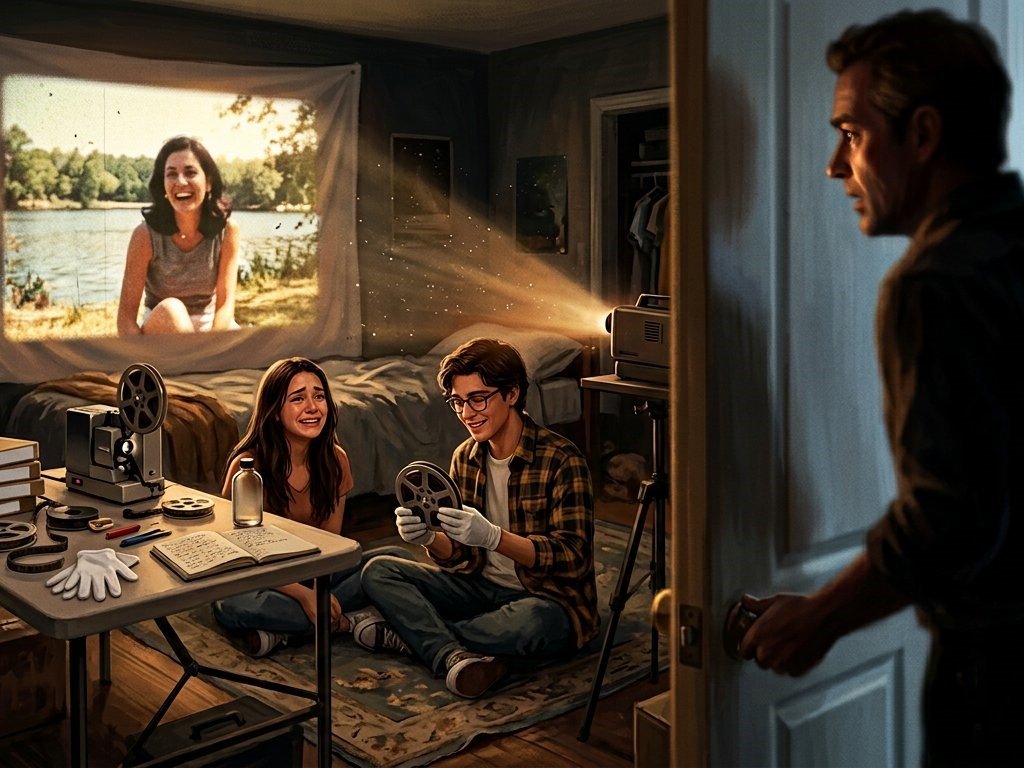
The room was dim. And it was completely quiet.
The blinds were drawn. The overhead light was off. The pink I’d painted a decade ago showed only in thin strips along the ceiling line where the bedsheet didn’t reach. Because there was a bedsheet — an old white one, pinned tight across the wall with binder clips — and it was glowing.
On the sheet: a woman.
She was young, maybe twenty-five, dark-haired, standing at the edge of a lake in summer sunlight. She lifted one hand and waved at whoever held the camera. Her mouth was moving. She was laughing, and I could not hear her, because the sheet on my daughter’s wall had no sound.
And all around the room, in a careful, impossible order I had never once imagined, was a studio.
A folding table from the garage, covered in archival boxes with labels written in Sharpie. Film reels standing in a row on a metal rack like coins in a collector’s drawer. Cotton gloves, folded, beside a bottle of film cleaner and a box of lint-free pads. A notebook open to a page of tiny handwriting. A battered laptop showing a timeline with sprocketed thumbnails. A projector on the dresser, purring. The metal suitcase from Ellis’s trunk, open, revealing oiled reels and a bulbous old lens. A trash bin holding a mountain of used swabs, the way you’d expect a bin to look in a hospital room or a darkroom.
And on the floor, cross-legged on the rug, side by side: my daughter and the boy.
Ellis had a reel in his gloved hands, mid-motion, as if I had caught him threading film like a needle. Norah turned to me in the doorway. Her eyes were shining, and her cheeks were wet, and she was smiling the biggest, most open, most entirely unguarded smile I had seen on her face since she was eleven years old.
“Dad,” she said. “You’re finally here. We need to show you something.”
I did not say anything. I could not say anything. My throat had closed up entirely, the way it does when you’re standing at the edge of something much bigger than you were braced for.
Norah wiped her face with the back of her wrist and took a breath, and then she said, in that brisk, practical way she has when she’s been carrying something heavy for a long time and has finally decided to set it down:
“That’s Mom’s grandmother. Her name was Ruth. She died in 1996, when Mom was six.”
I sat down on the floor. My legs simply stopped being interested in the arrangement, and I sat down, and Biscuit came up the stairs and laid down across my feet, because he is a terrible guard dog and a wonderful dog.
“Her brother had all the films,” Norah said. “He promised Mom he’d copy them someday. Then he got sick, and then he died, and his kids — you know how it goes — they sold the house in an estate sale. Everything in it. Some company bought the contents of the garage for two hundred dollars. Mom told me that story two years ago and she laughed, Dad. She laughed and said, ‘It’s fine. It’s been thirty years,’ and then she went in the kitchen and I could hear her crying through the wall and you were at work.”
I remembered that day. She’d been off all evening and I’d assumed it was the anniversary of her father’s death, which was close to that week.
“She said it was fine,” Norah said. “So I started looking. I called the estate company. I called the auction house. I called, like, eleven people. Ellis found the last one — one listing, on a forum, from a man in Cleveland who bought a crate of ‘miscellaneous home movies’ at a sale and had been using the reels to practice splicing. There were nine reels, Dad. Nine. He sold them to us for the cost of shipping, because he said he’d rather they go to family than sit in his garage another twenty years.”
“How much does shipping cost?” I asked, because it was the only question in my head that had a number attached and numbers were the only solid thing I could hold.
“Eleven hundred dollars,” Norah said. “For nine reels and the scanner rental. Then the scanner we bought used from a shop in Ohio. Two thousand one hundred forty.”
“Your car,” I said.
“Twenty-six hundred for the Civic,” she said. “Ellis put in sixteen hundred from his summer job and I covered the rest. We bought the scanner together. It’s here. We keep it in his closet because his mom lets him have the hall closet.”
“Your Sundays,” I said.
“Eight months of Sundays,” Ellis said, and for the first time he looked at me like a boy who wanted to be trusted and knew he might not be. “That’s how long it takes, sir. Twelve feet of film at a time. The splice cement takes forever to cure. Half the reels had vinegar syndrome, so we had to freeze them first and dry them out slow and clean them in passes. If the film gets wet when it’s brittle, it shreds. If your hands are warm, the emulsion will lift. You can’t rush it. You can’t rush any of it.”
“Eight months,” I repeated.
“It’s six hundred feet of film,” Norah said. “We’re on reel nine. That’s what you walked in on. We started the last reel ten minutes ago.”
I looked back at the bedsheet. The lake. The young woman. She had stopped waving. Now she was holding a baby up toward the camera with both arms above her head, laughing so hard her eyes were closed. And behind the camera, out of focus, was a shape I had seen my entire life in a frame on the mantel — my wife’s face, at six years old, squinting into the sun.
The room was quiet. The projector ticked. Somewhere a lawnmower started up three doors down, and the whole ordinary street went about its business while my daughter’s bedroom held a woman who had been dead longer than Norah had been alive.
“Why didn’t you tell us?” I asked. It came out small.
Norah looked at Ellis, and Ellis looked at the floor, and then she answered the way I think she had been rehearsing for eight months in case this exact question ever arrived.
“Because if I told you, and it didn’t work, then Mom would have had two years of being sad,” she said. “But if I did it first, quietly, and it worked — then she’d get it all at once. The whole thing. And it would be like getting them back instead of losing them again.”
“Your mother thought you two were up here—” I started, and stopped, because I couldn’t finish that sentence in front of a nineteen-year-old boy.
Norah’s mouth twitched. “I know what she thought. And honestly, Dad, I let her think it. Because a mother who thinks her daughter is being kind of boring and gross in her bedroom doesn’t go snooping for film. It’s the best hiding place in the world. Nobody looks for something good. Everybody looks for something bad.”
I have thought a lot about that sentence since. My eighteen-year-old daughter understood something about human beings that it had taken me forty-six years and a mortgage to learn.
Then Norah stood up and put her hand out to me, and I took it, and she pulled me to my feet in my own bedroom hallway with her grip, which was stronger than I remembered.
“Sit in the chair, Dad,” she said. “You’re ruining the end.”
So I sat in her desk chair. Ellis threaded the last reel. Norah hit a key on the laptop and the sheet went dark, and then came alive again with a new scene: a man in a flat cap carrying a little girl on his shoulders through a field of tall grass. The light was that low gold late-afternoon light that only exists in the summer, and it was 1978 or 1979, and none of these people had any idea that a girl born forty years later would spend eight months and her car money to bring them back. The man turned toward the camera and grinned, and he looked — I promise you this — he looked exactly like my wife does when she’s trying not to laugh.
We watched four minutes of that reel. There was no sound at all, and it was the loudest four minutes of my life.
When the projector flapped its loose end free and the sheet went white, Norah got up and hugged me with both arms, the way she did when she was small and her whole body was a single unit of trust. And over her shoulder I saw Ellis standing there with his cotton gloves in one hand, waiting to find out whether he was in trouble, and I have never felt more like a fool in my entire life.
“Ellis,” I said. He braced. “Bring the doughnuts up here. And there’s a bottle of root beer in the door of the fridge, and don’t tell your mother you drank one.”
That night, when Diane came home, I didn’t say a word. I just told her Norah wanted to show her something upstairs, and she went up the stairs in her good shoes with a tired face, and I stood at the bottom with Biscuit and listened.
I will never forget the sound. It was like a door in a house opening onto a room she had thought was walled up forever. There was a long silence while the sheet went bright and the girl on the lake lifted her hand, and then there was a sound my wife made that I have heard exactly twice in twenty-two years of marriage — once when Norah was born, and once at the top of those stairs.
Then the three of them were laughing and crying at the same time and I could hear Norah saying “It’s reel three, wait till reel three, that’s Grandpa with the truck” and Ellis saying “careful of the sprockets” and Diane saying “is that my grandmother — is that Ruth — oh my God, is that my grandmother’s hands.”
I stood at the bottom of the stairs with my hand on the newel post, and I thought about the receipt. I thought about it in my desk drawer, where I had put it after pulling it out of the trash. Two thousand one hundred and forty dollars, charged to a card belonging to a nineteen-year-old boy with a summer job, so that my wife could see her dead grandmother wave.
The next morning I called the archivist in Ohio. I asked what the best machine on the market costs, the real one, the one that does 4K oversampling with wet-gate prep, and I bought it. Norah cried at the kitchen table and immediately announced that she was going to open a small business restoring family films, that there were a thousand families with crates of reels in garages, that Ellis would do the audio. She put down a deposit on a used station wagon three weeks later, which she calls the Archive. Every Sunday they still come over, and every Sunday the door upstairs is still closed, and now Diane and I sit at the bottom of the stairs holding hands and listening to our daughter’s grandfather’s truck, the one that doesn’t exist anymore, start up with a roar on a bedsheet stretched across a wall in a room I painted pink in 2015.
The last reel had a scene at the end that nobody in our family had ever seen. It’s a birthday party, a backyard, maybe 1983. A little girl with a bowl haircut is blowing out candles and everyone is clapping. And then, right before the film runs out, the person holding the camera turns it around and points it into the glass of a sliding patio door — and there, reflected in the glass, tiny and blurry and lit up by the last of the evening, is the entire family, all of them, at once. Everyone alive, all in the same place, no one missing yet.
Norah transferred that single frame and printed it at twelve by eighteen and framed it in oak. It hangs in the upstairs hallway now, above the third board that creaks. We walk past it every single day.
And that is what was behind my daughter’s closed bedroom door for eight months. Not the thing I feared. Something worse, in a way. Something much bigger. A girl who took the one thing I’d been terrified of losing — trust, privacy, my kid’s whole heart — and spent it all on a gift nobody could hear coming.
You want to know the most ridiculous part? My house is worth five hundred and twenty thousand dollars, and I have never once been able to find anything good in it while snooping. Everything worth finding in that house, my daughter had to go to Ohio to bring home.
I knocked on my own daughter’s bedroom door last Sunday. Knocked. For the first time in eight months.
“Come in,” she said, and I did.
— The End —