Part 1
My husband of thirty-four years died suddenly while I was still holding his hand in the ICU.
Emmett Rowe. Sixty-six years old. He went into the hospital on a Sunday with what he insisted was indigestion and he died on the Wednesday of a dissection nobody caught in time, and the last thing he said to me was a complaint about the pillow.
That’s it. Thirty-four years and the last words were this pillow is a punishment. I’ve decided to find that funny. Some days it works.
I thought losing him was the worst pain I’d ever feel.
I had eight days of thinking that.
The probate hearing was scheduled fast because Emmett’s estate had a trust structure that needed a judge’s signature to unlock, and our attorney — Ines Ferraro, who has handled our affairs since 2004 — wanted the accounts frozen properly before anything moved. It was supposed to be twenty minutes. A formality. I wore a gray dress and I remember being annoyed that I had to put on real shoes.
My children came. Colin, thirty-two. Tess, twenty-nine. We sat in a row on a bench in a room with bad carpet and a water cooler.
At 9:52 the door opened and a woman walked in with two attorneys.
She was beautiful. I want to be precise about that because it mattered to how the room behaved. Forty, maybe forty-two. Dark hair pinned up, a navy suit that cost more than my car payment, the kind of composure that makes everyone else in a room adjust their posture. She looked like an answer to a question.
Her name, she said, was Vivienne Marchetti.
And she claimed she was the woman my husband had really planned a future with.
I want to describe the next eleven minutes the way they actually happened, because in my memory they’ve compressed into one long sound.
Her lead attorney — a smooth man named Prine — presented a will. Newly signed. Dated April 18, 2025. Notarized, witnessed by two, on proper paper, with Emmett’s signature on every page in that cramped left-leaning hand I have seen on thirty-four years of birthday cards.
It left her the house on Delmar. It left her the cabin at Squaw Lake, which Emmett’s father built in 1961. It left her every vehicle. And it left her more than $8.9 million in cash, investments, and life insurance — which is to say all of it, the whole thirty-four years of it, the business he sold in 2019 and the money we were careful with and the policy I sat in a kitchen and chose the beneficiary language for in 1994.
Prine spoke for six or seven minutes about testamentary capacity and the presumption of validity. Ines objected twice and was overruled twice, gently, because a judge cannot throw out a facially valid instrument because a widow is making a sound in the second row.
Then Vivienne Marchetti turned around in her chair and looked at me.
She did not look triumphant. That’s the thing I couldn’t process. She looked sorry for me, which is a much more effective weapon, and she said, quietly, in a voice pitched to carry exactly as far as our bench:
“He stayed with you out of guilt. Not love. You must have known that. I think you’ve known it for years.”
And my children lowered their heads.
That’s what broke me. Not the will. Not the woman. Not the number.
Tess put her hand over her mouth and looked at the floor. And Colin — my son, thirty-two years old, who has Emmett’s hands and Emmett’s terrible posture — leaned forward with his elbows on his knees and stared at a spot on that bad carpet and would not look at me.
They believed her.
My own children, in a courtroom, in eleven minutes, believed a stranger about their parents’ marriage.
I sat there and did the thing you do, which is go through your own life like a burglar, room by room, looking for what everyone else apparently saw. 2011, when he took the Tuesday calls in the garage. The four years he wanted separate accounts “for the business.” The way he’d gone quiet since the previous spring, that whole last year, distracted, up at strange hours, twice coming home at eleven at night from what he said was the storage unit.
I had explained all of it to myself at the time. Sitting on that bench I unexplained it in about ninety seconds.
I thought my world had ended. I mean that plainly and without decoration. I remember thinking, with a kind of calm that frightened me later: well, then none of it was real, and I am sixty-three, and I don’t know what I’m supposed to do with the rest of today.
Judge Amara Whitfield had the documents in front of her. She was reading the execution page. She had her pen out.
She said, “Ms. Ferraro, I’m going to note your objection for the record, but on its face —”
And the court clerk stood up.
Her name is Dorothy Bett. She is about my age. She has worked in that building for twenty-six years and she has the specific unbotherable calm of a woman who has watched every kind of family fall apart across that rail.
She said, “Your Honor. Before you sign. There’s a lodged instrument on this file.”
Everybody looked at her.
She said, “It was deposited with the court in November of last year. It’s sealed. It’s been in the vault seven months.”
Prine started to say something about relevance and Judge Whitfield put up one finger and he stopped talking, and I watched Vivienne Marchetti’s face for the first time since she’d turned around, and something in it had changed. Not much. A stillness.
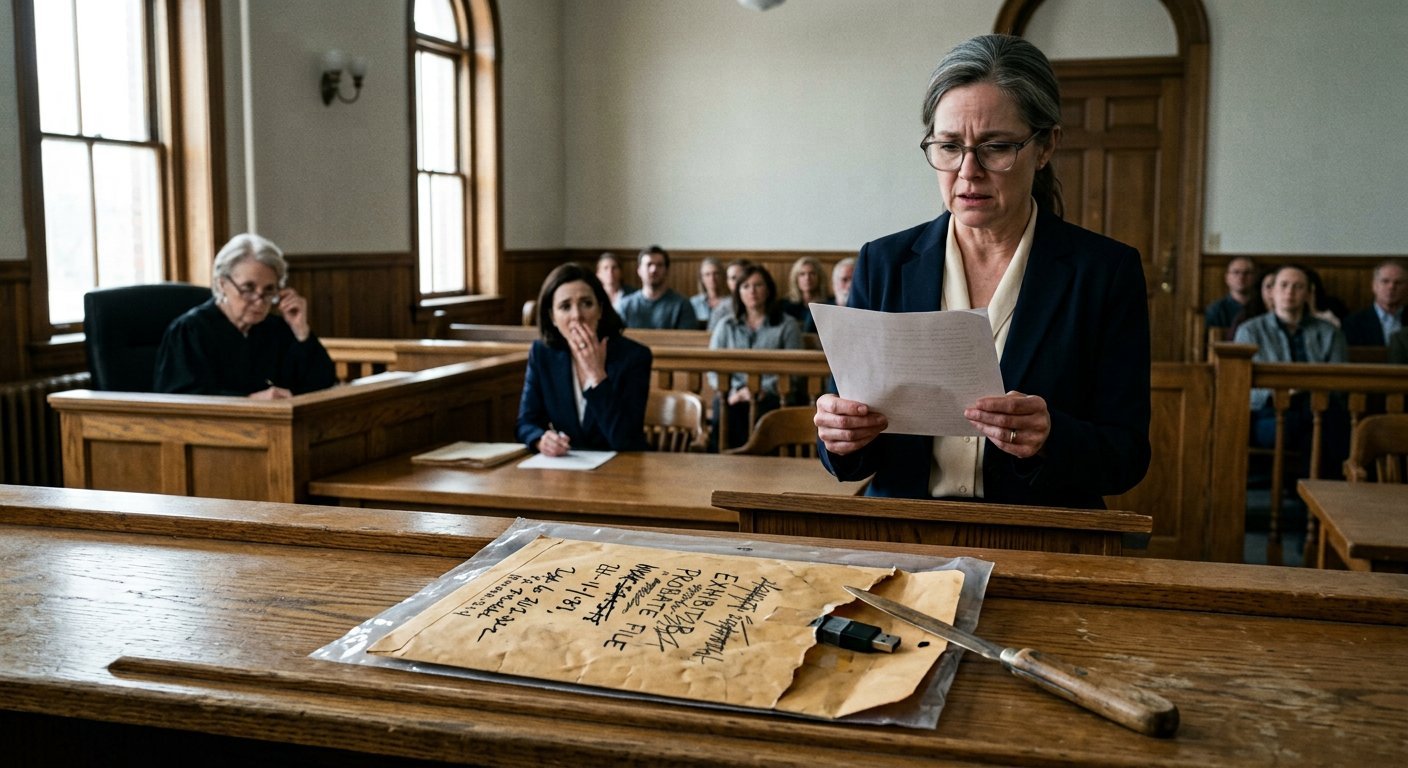
Dorothy Bett went to the back, and came back with a manila envelope in a plastic sleeve, and unlocked the sleeve, and set the envelope on the bench.
Across the front, in my husband’s cramped left-leaning handwriting, in black marker:
EMMETT T. ROWE LODGED 11 NOV 2025 — CLERK’S VAULT OPEN ONLY IF I DIE. If read in open court: read the first page aloud before any other document on this estate is signed.
Judge Whitfield looked at it for a long moment. Then she said, “Ms. Ferraro, you’re counsel of record for the decedent. Open it and read the first page.”
Ines Ferraro — who had known nothing about this, who I could see had known nothing, because her hands were shaking — slit the envelope with a letter opener Dorothy Bett handed her.
There was a thick sheaf inside. Forty pages, maybe more. And a small black flash drive taped to the inside of the flap.
She took out the first page.
She read the first sentence.
And the color went out of Vivienne Marchetti’s face like someone had pulled a plug.
Part 2
Ines Ferraro read the first sentence in a flat courtroom voice, the way lawyers read things when they don’t yet know what they’re holding.
“If you are reading this in a courtroom, then a woman has produced a will I did not write, and my family is currently looking at the floor, and I am very sorry that I could not fix this before I died — I have been trying since March.”
Nobody moved.
Ines looked up at the judge. The judge said, “Keep going.”
Here’s what the forty pages were.
Emmett had spent the last eight months of his life documenting an attempt to defraud him, and he had done it the way he did everything, which was slowly, thoroughly, and without telling me because he did not want to frighten me.
The woman’s name was not Vivienne Marchetti. It was one of four names she’d used. The one on her birth certificate was Vivienne Sloat, and she had two prior convictions in two states, one for forgery and one for a scheme in Missouri involving an elderly widower, a power of attorney, and a quitclaim deed.
She was not my husband’s mistress.
She was my husband’s bookkeeper.
Emmett sold his fabrication business in 2019 but kept a small consulting operation running out of the storage unit on Kirkwood — three or four clients, mostly old friends, more hobby than business. In late 2023 he hired part-time bookkeeping help through an online service. She came very well credentialed. The credentials were fabricated.
By spring of 2025 she had:
– signature authority on one operating account (obtained by forged addendum, Feb 2025) – copies of two years of tax returns, both SSNs, deeds to Delmar and the lake property – notary commission (VALID, obtained lawfully in her own name, Sept 2024) – ~$61,400 moved in eleven transfers, Mar-Sept 2025, disguised as vendor payments
The $61,400 is what he caught first, in March, when a vendor he’d never heard of showed up twice on the same statement.
And this is where my husband did the most Emmett Rowe thing a man has ever done. He did not confront her. He did not call the police that week. He opened a second set of books.
He wrote in the affidavit: “If I spook her she takes what she has and moves to the next one. I have her here. I would rather have her documented than have her gone.”
Eight months. Every statement. Every transfer with a timestamp. Screenshots of the shared drive access log. Two recorded phone calls, legal under our state’s one-party consent rule, on the flash drive taped inside the envelope flap.
And on page nineteen, the thing that made Judge Whitfield take her glasses off:
In August, Emmett had driven to a stationery supplier and bought a specific paper stock. Then he’d left a single blank sheet of it in the top drawer of the desk in the storage unit — the drawer she had access to and he’d been told, by his own attorney, not to touch.
That paper stock has a watermark. It also has a manufacturer’s lot batch that was not in production until July 2025.
The will in Prine’s hand was dated April 18, 2025.
It was printed on paper that did not exist in April.
I have never heard a room go so quiet.
Prine — and I’ll give him this, he was fast — asked for a recess. Judge Whitfield said no. She asked Dorothy Bett for the exhibit gloves and she looked at the will herself, at the watermark, holding the page up to the courtroom window, and then she set it down very carefully, the way you set down something that is now evidence.
She said, “Ms. Sloat, do not leave this building.”
That was the moment I understood she’d already read page one to the end.
The last four pages weren’t for the court.
They were a letter. Emmett wrote it in November, the same week he lodged the envelope, and it was addressed to the three of us by name.
Ines stopped reading aloud there and asked the judge whether she was required to continue, and the judge said no, and the judge cleared the courtroom for ten minutes, which I have since learned she did not have to do and did anyway.
So I’m going to tell you the parts I can say.
He apologized for the last year. For the garage calls, which were his forensic accountant. For the eleven p.m. nights at the storage unit, which were him photographing statements. For going quiet on me, which he said he’d done because I have a face that cannot hold a secret and if I’d known, she’d have known within a week.
He wrote: “I gambled that I had time. I have been wrong about my heart before.”
And then, in the last paragraph, to Colin and Tess, he wrote the sentence that has done more damage and more repair in my family than anything else in that envelope:
“If she got as far as a courtroom, she will have told you something about your mother and me. Whatever it was, you believed it for a few minutes, and you are going to have to live with that, and I’d ask you not to hate yourselves too much. She’s very good at this. It’s the only thing she’s good at. But you’ll need to make it right with her, and I’m not going to be there to make it easy, so you’ll have to do it the hard way, out loud.”
He wrote that in November. Three and a half months before he died. Sitting at our kitchen table, probably, while I was in the next room.
He knew his children would look at the floor.
He was right, and he knew it, and he loved them enough to leave them a door.
Vivienne Sloat was arrested in the corridor outside Courtroom 3B at 11:40 that morning.
Not, as it turned out, on anything to do with the will — that took eleven months and a different prosecutor. She was arrested that morning on a fugitive warrant out of Missouri that Emmett’s investigator had found in April and that Ines Ferraro had walked down the hall and handed to a deputy while the judge had the room cleared.
Attorney Prine, for the record, appears to have known nothing. He withdrew that afternoon and I believe him; she had paid him a real retainer with money she had taken from us, which is its own kind of joke.
The April will was voided in eight minutes at a hearing three weeks later. Emmett’s actual will — 2019, boring, everything to me and then split between the kids — was admitted without objection.
But that isn’t the end, and I want to be honest that the courtroom part was the easy part.
Because a piece of paper can be voided in eight minutes.
What she said to me — he stayed with you out of guilt, not love — took considerably longer.
And my son sat on a bench and looked at the floor, and my daughter put her hand over her mouth, and no judge can strike that from anything.
Part 3
I didn’t listen to the flash drive for four months.
It went into evidence, and Ines had a forensic copy made for the estate file, and that copy sat in the drawer of the desk in the room I still can’t call anything but Emmett’s office. I knew what was on it, in the sense that the affidavit described it: two recorded calls, March and September.
I didn’t want his voice. That’s the whole reason. I had gotten to a place by about February where I could get through a Tuesday, and I understood exactly what forty seconds of his actual voice would do to that, and I wasn’t ready to pay it.
What finally made me listen was Colin.
My son and I did not speak properly for eleven weeks after that hearing.
We spoke — logistics, the house, the insurance, whether I was eating. What we didn’t do was the thing his father told him to do, which was make it right out loud.
And I made it worse, because I was gracious about it. I kept saying it was fine, that anyone would have doubted, that she was very good. I was doing to him exactly what I’d done my whole life, which was smooth a thing over so nobody had to sit in it. Every time I said “it’s fine,” I made it a little more impossible for him to say the true thing.
He finally came over on a Sunday in June and stood in my kitchen and said, “I need you to stop letting me off.”
And then my thirty-two-year-old son said: “I didn’t believe her because she was convincing. I believed her because it made sense to me. That’s what I can’t get past. Some part of me had already decided Dad was the kind of man who’d do that, and she just put a face on it.”
He said he’d been angry at his father for a year before he died — the distance, the phone calls in the garage, the eleven o’clock nights. He’d built a whole theory in private. And when Vivienne Sloat stood up in that courtroom, she didn’t convince him of anything. She confirmed something he’d been quietly assembling since the previous spring.
“He was hiding something,” Colin said. “I was right about that part. I was just wrong about what a man hides things for.”
That’s when I got the flash drive out of the drawer. Not for me. Because he needed his father’s voice and I was the only person who could give it to him.
The first recording is March. It’s eleven minutes, it’s mostly boring, and it’s Emmett being deliberately stupid on the phone — playing the confused older man, asking her to explain the vendor line twice, letting her get comfortable. You can hear him doing it. He was a terrible actor and she couldn’t tell, because people who run those schemes are not actually listening to you, they’re listening for the moment you stop resisting.
The second recording is September the 8th. Four minutes and change.
It isn’t a call with her.
It’s a voice memo. He recorded it in his truck, alone, in the parking lot of the storage unit on Kirkwood, and he labeled it in the file as EXHIBIT 14 — CONTEXT, which is the most Emmett filename in the history of filenames. His attorney had asked him to record a statement about his state of mind and his intent, in case the whole thing ever ended up in front of a judge with him not there to explain it.
He does that for about ninety seconds. Very dry. Dates, amounts, the name of the investigator.
And then there’s a pause, and you hear the truck door creak, and his voice changes completely, and he says:
“Nadine, if you’re the one hearing this, then I got it wrong and I’m sorry, and I want to say the rest of it because I don’t trust that I’ll get to say it another way.
I know I’ve been a ghost since March. I know exactly what it’s cost you. I’ve watched you decide six or seven times not to ask me what’s wrong, and every one of those was you being kind to me, and I took it every time.
She’s going to say something about us if this goes bad. That’s how they work — they get one true thing and build a house on it. And the true thing she’s got is that I went quiet on my wife for eight months and she’s going to make that mean something it doesn’t.
So: thirty-four years. The pillow thing at the hospital — if I’m in a hospital, I’m going to complain about the pillow, and you’re going to think that’s a stupid last thing to say. It isn’t. It means I’m not scared, because you’re there. I’ve never been scared with you in the room. That’s the whole thirty-four years, Nadine. That’s it. That’s all of it.”
Then he says, “Okay,” in that way he had of ending things, and the recording stops.
September the 8th. Five months and three days before he died. He hadn’t been in a hospital yet. He didn’t know about the pillow.
He just knew himself.
Colin and Tess and I listened to it in my kitchen on a Sunday in June with the windows open.
Then we listened to it again.
I’m not going to describe what that was like. Some things you don’t hand over.
Here’s the rest, briefly, because I know how these stories are supposed to end and I’d rather tell you how it actually went.
The money. The estate settled fourteen months after the hearing. I recovered $61,400 minus about $19,000, because that’s what was left of it — the rest was gone into a life I’ll never see. The legal fees to void a forged will and prove a fraud came to just over $90,000. So the theft cost me roughly $110,000 net, and I want that number written down, because the version of this story where the widow wins is a version where she is a hundred and ten thousand dollars poorer for having been right.
Vivienne Sloat. She pled to two counts in our state and was extradited on the Missouri warrant. Between the two she’s serving something in the range of six to nine years. I went to the sentencing. She did not look at me. I had a statement prepared and I read four sentences of it and then folded it up and sat down, because standing in that room I realized I was about to perform for a woman who does not have the equipment to receive it.
Something I didn’t expect. The Missouri case had a victim — an eighty-one-year-old man named Curtis Vane who lost his house in 2021 and died in 2023 without seeing anything resolved. His daughter Renee reached out through the prosecutor’s office. We’ve talked probably thirty times now. She said the thing I keep coming back to: “My dad had nobody who’d kept a single receipt. Your husband kept eight months of them. She’s in prison because a stranger’s husband was careful.”
Emmett’s file did that. He built it for us and it did something for somebody in Missouri he never met.
The house. I sold Delmar in the spring. Not out of grief-decluttering; the stairs and I had a disagreement. I kept the cabin. Emmett’s father built it in 1961 and it has a wall in the back bedroom where three generations have marked heights in pencil, and Tess is expecting in November, and there is going to be a fourth line on that wall.
Colin. We’re all right. Better than all right, actually, in the specific way of two people who have said an unbearable thing to each other and survived it. He does a thing now where he asks me direct questions. *Are you actually fine or are you being nice.* It’s annoying. I hope he never stops.
The last thing.
People have asked me — more than once, and with real curiosity — whether the eight days between his death and that hearing did permanent damage. Whether the eleven minutes of believing my marriage was a fraud left something behind.
Honestly? Yes. Something is different. I check things now. I read documents twice. I have a distrust of composed, beautiful competence that I didn’t have at sixty-three.
But here’s what I’ve landed on, and it took the better part of two years.
My husband spent the last eight months of his life quietly building a wall between his family and a person who wanted to take everything from us, and he never once asked to be thanked for it, and he died with it unfinished, and the wall held anyway.
He wrote on that envelope: OPEN ONLY IF I DIE.
Which means for eight months he carried it around in his head as a real possibility — that he’d lose the race — and he still didn’t tell me, because telling me would have cost me eight months of sleep and might have cost us the case.
That’s not a man who stayed out of guilt.
That’s a man who bought his wife eight more months of not being afraid, and paid for it himself, in the garage, on the phone, at eleven o’clock at night.
I have the recording on my phone now. I don’t play it often. Maybe four times since June.
But it’s there, and I know the exact spot in the file where the truck door creaks and his voice changes, and on the bad days I put my thumb over that spot and don’t press it, and that is enough.