PART 1
I’d been dating Michael for three years.
He told me his wife had died of breast cancer in 2019.
Every time he spoke about her, tears filled his eyes. He said losing her had destroyed him and that he never thought he’d love again until he met me. I believed every word. Every tear. Every trembling breath.
Last Tuesday, an Amazon package arrived at my apartment.
Wrong address.
Same last name.
The correct address was only fourteen miles away, so I figured I’d do the neighborly thing and deliver it myself.
A woman answered the door.
Behind her stood two children—a little girl clutching a stuffed rabbit and a boy holding a soccer ball.
Then my eyes fell on her left hand.
She wore an engagement ring identical to mine.
The exact $6,200 Zales design Michael and I had picked together.
She smiled warmly.
“Oh, Michael must’ve used the wrong address again.”
My stomach dropped.
“How do you know Michael?” I asked.
She laughed.
“He’s my husband. We’ve been married eleven years.”
The world stopped spinning.
Slowly, I raised my own left hand.
Her smile vanished.
She stared at my ring.
Then whispered,
“He bought you the same ring?”
I swallowed hard.
“He told me you were dead.”
For several seconds, neither of us spoke.
Then tears rolled down her face.
“He told me he traveled constantly for work,” she whispered. “Three or four days every week.”
Everything suddenly made sense.
The canceled weekends.
The holidays he could “never” spend with me.
The phone calls he’d refuse to answer.
The hotel receipts.
The strange schedule.
He hadn’t been traveling.
He’d been living two separate lives.
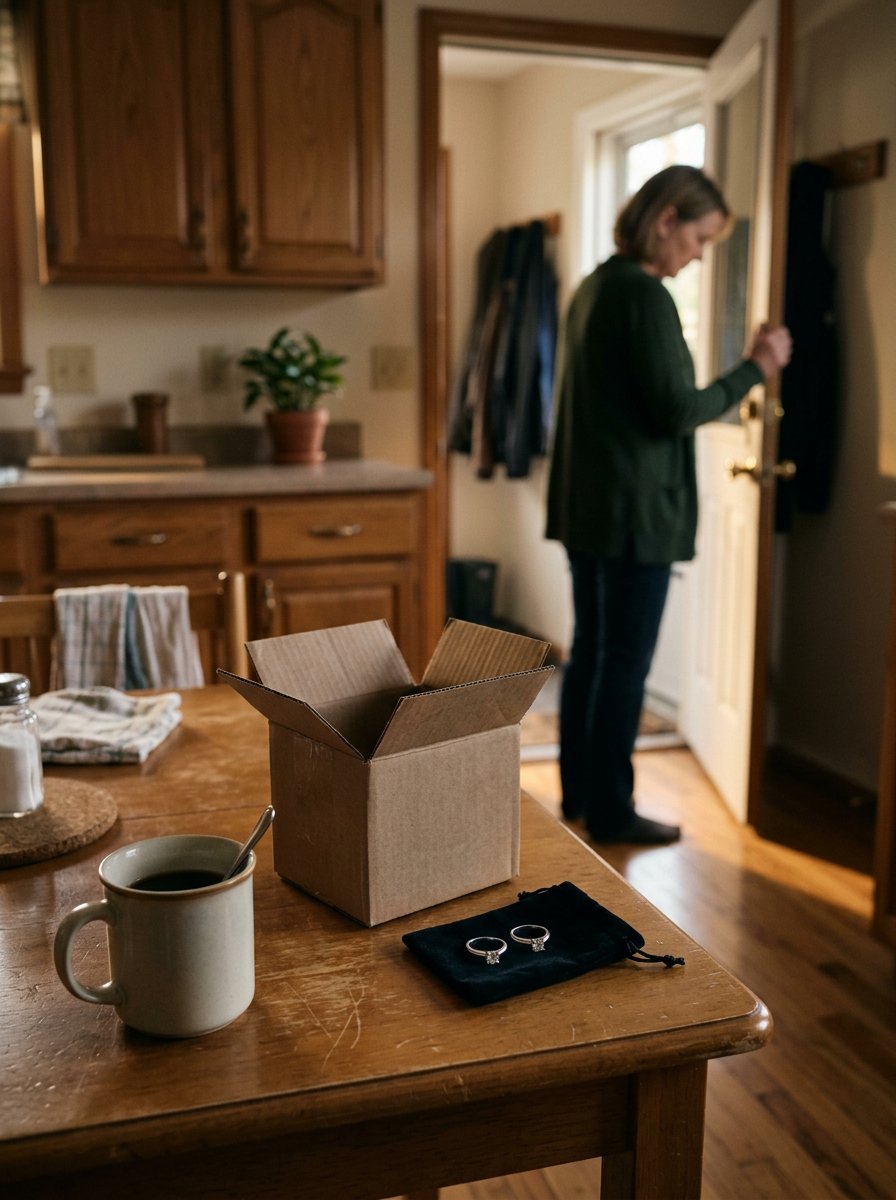
Instead of screaming or blaming each other, we sat at her kitchen table for nearly three hours.
She made coffee.
I couldn’t drink mine.
We compared photos.
Every anniversary.
Every birthday.
Every Christmas.
While he was celebrating with her, he’d tell me he was visiting his late wife’s parents.
While he spent Valentine’s Day with me, he’d tell her he was stuck at a business conference.
His lies were perfectly scheduled.
He even had two phones.
Two credit cards.
Two sets of stories.
The worst part wasn’t the cheating.
It was realizing how carefully he had rehearsed every lie for years.
His wife—Emily—opened a drawer and pulled out a folder.
Inside were life insurance papers.
Mortgage documents.
Their marriage certificate.
They were never separated.
Never divorced.
Very much married.
She looked at me and quietly asked,
“Do you want him to know we know?”
I looked around the room.
Family photos covered every wall.
Those children deserved better than the man pretending to be their father.
I nodded.
“But not yet.”
PART 2
Emily sat across from me with both hands wrapped around her coffee mug, but she never took a sip. Mine cooled untouched between us. The children had drifted into another room, and every small sound from that side of the house made the silence at the table feel even heavier. We had each just learned that the life we thought we understood had been staged around us with the same practiced tenderness, the same excuses, and even the same ring.
We started with the photos because photographs do not care who gets hurt by the truth. They keep their dates. They keep their backgrounds. They keep the smiles people wear when they still believe what they are being told. Emily pulled up anniversaries, birthdays, and Christmas mornings. I opened my own camera roll and messages. We slid our phones across the table and watched the pattern become impossible to deny.
On the weekend Michael told me he was visiting his late wife’s parents, he was in family pictures at her dining table with a paper crown tilted on his head and one of the children laughing beside him. On the Valentine’s Day he brought me flowers and apologized for being late because of traffic, he had already told Emily he was trapped at a business conference and would be home the next morning. The same man. The same calendar. Two different women being asked to carry two different versions of him.
The details were what made it ugly. Anyone can lie once in panic. What he had done was not panic. It was upkeep. It was maintenance. It was remembering which sorrow belonged in which house and which excuse belonged to which holiday. If he needed sympathy from me, he reached for the dead-wife story. If he needed distance from Emily, he reached for work. If he needed a weekend, he used grief in one direction and business in the other. He was not improvising. He was rotating masks.
Emily opened the drawer again and set the folder between us. Life insurance papers. Mortgage documents. Their marriage certificate. She did not need to point to anything inside it. The whole point of the folder was that it existed at all. Nothing about this marriage was paused. Nothing about it had been set aside while he “traveled.” The house was real. The obligations were real. The eleven years were real. So were the children standing in those family frames.
I kept thinking about the ring. Not just that he had bought us the same one, but that he had done it deliberately enough to repeat the choice down to the exact design. The same promise, copied. The same symbol, duplicated. He had not simply lied about love. He had mass-produced it.
Emily looked at me and asked questions without any bitterness in her voice. When had he proposed? How often did he disappear? Did he ever refuse a call and claim he was in a meeting? Did he always insist on choosing the restaurant? Did he avoid certain weekends? Each answer landed beside one of her own, and the line connecting them sharpened.
Yes, he refused calls.
Yes, he canceled weekends.
Yes, he could never seem to spend certain holidays where I was.
Yes, he had hotel receipts that did not match his explanations.
Yes, he always seemed to know in advance which days he could and could not belong to me.
The worst moment came when she asked me what story he had told about her. I said it plainly because there was no merciful way to say it: that she had died of breast cancer in 2019, that he had spoken about her with tears in his eyes, that he had made me feel heartless for ever asking questions about the parts of his life I could not see. Emily lowered her gaze, and for a moment I thought she might break. She did not. She straightened, pressed her thumb against the edge of the mug, and said the quietest thing she had said all afternoon.
“So that was the role he gave me.”
I nodded.
The children laughed somewhere down the hall. It cut right through me. Those children had no say in what kind of man their father had chosen to be, and that single fact kept either of us from turning the room into something ugly. We did not yell. We did not reach for revenge because revenge would still make him the center of the story. We wanted something smaller and harder than that. We wanted him to look directly at the truth with nowhere left to step around it.
When Emily finally asked, “Do you want him to know we know?” I looked at the family photos on the wall again. Then I looked at the ring on my hand, at the cold coffee, at the package that had arrived at the wrong door and landed at the right one.
“But not yet,” I said.
PART 3
For the next five days, we did not indulge in fantasies about humiliating him. We did the less satisfying work instead. We built a record. Every time either of us had a receipt, a screenshot, a missed call, a hotel charge, or a photograph, we matched it to a date and placed it beside the lie that had carried it. The envelope Emily would eventually bring to the restaurant did not appear by magic. It was assembled one overlap at a time.
The schedule that had once confused me became obvious once I could see both halves of it. His “work trips” were the nights he was with me. His “late meetings” often sat beside hotel reservations. The weekends he seemed tender and grief-stricken with me were the same weekends he used to create distance inside his own marriage. If Emily had a holiday dinner, I got an apology. If I had a birthday plan, she got an excuse. He had arranged his life like a man shuffling cards, hoping neither player would ever see the full deck.
We kept circling back to how unnecessary some of his lies had been. He did not just conceal. He embellished. He spoke of loss when logistics would have been enough. He made himself a widower in my eyes because a grieving man is protected by other people’s decency. You do not interrogate a man while he is crying over a dead wife. You let him go quiet. You forgive the unanswered call. You excuse the canceled holiday. That was what made the deception feel colder than ordinary cheating. He had hidden behind a woman he claimed to love and a disease that had never taken her.
Emily had access to documents inside the marriage. I had access to the promises he made outside it. Put together, the pieces were brutal. Bank statements confirmed where money had gone. Phone records showed the numbers and timing. Hotel reservations mapped the nights he said he was somewhere else. Photos gave the pattern a face. There was no need to guess anymore. The file grew thicker because he had been careful for years, and long-running lies always leave a paper trail behind them.
We agreed on one thing quickly: he would not hear any of this over the phone. He would not be allowed to hang up, switch stories mid-sentence, or perform wounded confusion from a safe distance. If there was going to be an ending, it needed to happen where both versions of his life were sitting in front of him at once.
Then Saturday handed us the opening on its own.
Michael invited me to dinner.
He said he had a surprise.
I stared at the message longer than I should have. Even after everything, some part of me could still predict the soft phrasing he would use, the rehearsed warmth, the way he would act as if the future were something he could unveil on command. I wrote back that I’d be there.
Emily did not tell me what to wear or what to say. She did not need to. By then the plan was simple enough to hold in a single sentence: let him walk all the way into his own lie.
When I entered the restaurant that evening, he was already standing, flowers in hand, smiling the smile I had once mistaken for sincerity. It was the kind of scene designed to disarm questions before they were asked. He looked proud of himself. Pleased. Certain. For one suspended second I saw the entire performance as he meant it to be seen.
Then he leaned toward me and grinned.
“So,” he said, “I’ve been thinking maybe it’s time we finally set a wedding date.”
That was the moment I understood how fully he believed he still controlled the script. He had spent five days moving between two lives without realizing the walls had already come down between them. He thought the surprise belonged to him.
Before I answered, another chair slid back.
Emily sat beside me.
The color drained from his face so quickly it looked as if someone had reached into him and pulled out the blood by hand. His eyes moved from her to me and back again. Flowers in one hand. Future in his mouth. Past and present suddenly seated at the same table.
“What… what are you doing here?” he asked.
I reached across the table. Emily took my hand.
Then I looked straight at him and said, “You should probably tell us which wife you’re talking to.”
PART 4
Everything after that line happened in plain sight, but it felt as if the room had narrowed around our table alone. The sound of silverware, low conversation, footsteps from other tables—all of it seemed to draw away until the only thing left was Michael’s face and the way it failed him. He opened his mouth once, shut it, and looked at Emily again as if one of us might still rescue him from the other.
Neither of us did.
Emily sat with the kind of stillness that does not need volume to feel final. I stayed where I was, my hand still in hers, because that contact said more than either of us needed to explain. He had spent years keeping us apart. Seeing us side by side was the one thing he had never planned for.
“I can explain,” he finally muttered.
It was a pathetic sentence for a man who had built an entire private system out of explanations. He had one for every missed weekend, every unanswered call, every holiday split in half, every hotel receipt, every stretch of silence. He had explained Emily’s continued existence by declaring her dead. He had explained my place in his life by pretending work kept him away from his family. He had explained and explained until explanation itself had become his shelter.
Emily shook her head.
“No.”
Then she set the envelope on the table.
Not dropped. Not slammed. Set.
That was what made it powerful. There was no drama left for him to hide inside. Only evidence. Paper was thicker than performance. Inside were copies of bank statements, phone records, hotel reservations, and photographs we had collected together. Every lie was there in duplicate: one story told to his wife, another to the woman he proposed to. Every excuse touched a date. Every overlap sat where he could see it.
He stared at the envelope as if it might contain some version of him he could still deny. Then he looked at me, and for a split second I saw him searching for the old reflex—for sympathy, for softness, for that instinct he had trained into me whenever his eyes filled and his voice lowered. It was gone. There was nothing left for those tears to land on.
People at nearby tables had begun to notice. I could feel it without turning my head. The source of the attention was not noise. It was the silence. Betrayal can be loud, but sometimes the most devastating version of it is two women refusing to make a scene because the truth is already humiliating enough on its own.
“I never meant for this to happen,” he said.
Emily answered before I could.
“No. You meant for it to never be discovered.”
That sentence hit harder than anything either of us could have shouted. It named the whole architecture of what he had done. Not a mistake. A concealment. Not confusion. Intention. Not one bad choice. Years of maintenance.
He buried his face in his hands.
Maybe he was ashamed. Maybe he was frightened. Maybe he was calculating what came next. In that moment, I found I did not care which one it was. Shame would not refund the years. Fear would not make either ring honest. And whatever came next would no longer be his to schedule around us.
Emily rose from her chair first.
I followed.
Then I slipped my engagement ring off and placed it on the table beside hers.
Two identical rings.
Two broken promises.
One dishonest man.
PART 5
Neither of us cried.
He had already taken enough tears from both of us.
There was no grand speech after that. No miracle confession that made the damage easier to hold. No sudden version of Michael that was more truthful than the one sitting in front of us. What followed was smaller than spectacle and more permanent than spectacle usually is. Emily filed for divorce the next week. Not because filing would repair eleven years, and not because paperwork could explain a man who had turned his life into compartments, but because some endings begin with a signature instead of a slammed door.
I went home and looked at everything he had ever given me. Once the lie was exposed, the gifts felt different. Not cursed, not dramatic, just emptied out. I packed every one of them into a box. Anything useful, I donated to a local shelter. It was the cleanest thing I could think to do with objects that had been purchased during a relationship that existed only because someone else’s marriage had been hidden from me. I was not interested in keeping souvenirs from a deception.
The ring was the last thing I dealt with. I had worn it while believing it meant the future. I sold it instead. The money did not restore dignity or refund trust, but it did become something honest once it left his hands. I used it to take my mother on the vacation we had talked about for years. That choice mattered to me more than any symbolic act of destruction ever could have. He had used that ring to duplicate a promise. I used the money to keep one.
I did not stay in contact with Emily out of obligation. I stayed because the truth had introduced us in the most brutal way possible, and yet what remained after the shock was genuine respect. We had met as two women standing inside the same lie, but we did not remain defined by him. We had compared notes, built the record, and ended the performance. After that, there was room for something quieter.
Months later, we met for lunch.
The children were laughing.
That sound struck me differently this time. At her front door, it had been the sound of innocence inside a house I did not understand. Now it sounded like air returning to a room after someone had opened a window. Emily looked lighter. Happier. Not untouched, not unscarred, but no longer carrying his careful schedule on her back.
There had been no prosecution, no dramatic public reckoning beyond that restaurant table, and no invented justice larger than what the source truthfully gives: a divorce filed, a fraud of intimacy exposed, and two women who refused to keep protecting the man who lied to both of them. That was enough for me. I did not need a bigger punishment to know the story had turned. He did not get to narrate us anymore.
Emily asked if I was seeing anyone.
“Not yet,” I said.
She nodded.
“Good.”
“Why?”
She looked at me for a long moment before answering, and there was nothing bitter in her face by then. Just clarity bought at an ugly price.
“Because now,” she said, “you’ll never ignore red flags just because someone knows how to cry.”