The responder’s hand moved toward his radio as my father’s confession echoed from the phone.
“I signed your name because I knew you’d be selfish about it.”
For several seconds, no one moved.
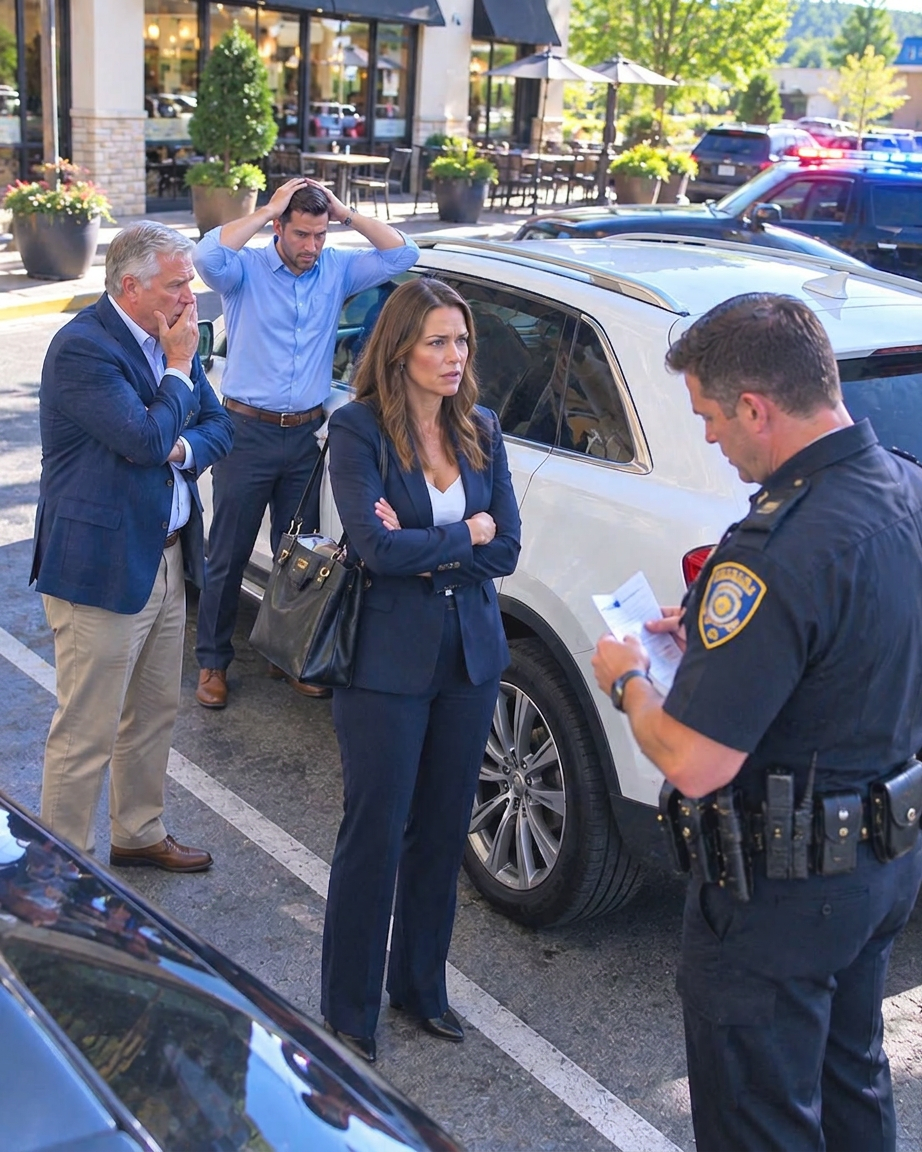
Lucas stood beside my pearl-white SUV with his mouth slightly open.
His friend had backed away far enough to make it clear he wanted no part of what was happening.
Diners near the restaurant entrance pretended not to stare, but every face was turned toward us.
The responder looked from the forged vehicle gift form to the original title I had brought from home.
“Sir,” he said toward my phone, “did you just state that you signed your daughter’s name on this document?”
Dad did not recognize the warning in his voice.
He was too angry that someone had finally challenged him.
“I handled the paperwork because she would have dragged this out,” he snapped.
“Lucas needs the vehicle.
Elina doesn’t.
This is a private family decision.”
“Ownership is not a family vote,” the responder said.
Lucas stepped forward.
“He means she agreed verbally.
She told us she would help with the baby.”
I looked at him.
“I offered to drive Jessica to appointments.
I never offered you my SUV.”
“That’s basically the same thing.”
“No,” I said.
“It isn’t.”
The responder raised the gift form.
“And a verbal agreement would not explain why her signature appears here.”
Lucas glanced at the page, then at my phone.
“Dad, stop talking.”
That was the first sensible thing he had said all evening.
Dad ignored him.
“Elina has always been dramatic about money,” he continued.
“I paid for plenty of things when she was growing up.
That vehicle is the least she can do for her brother.”
I felt the old reflex rise inside me—the urge to explain, defend, and present an itemized history of everything I had earned without his help.
I let the urge pass.
The title in the responder’s hand was enough.
The loan payoff confirmation was enough.
Dad’s voice on speaker was enough.
“Who notarized this form?” the responder asked.
He turned it toward the parking lot lights and read the name beneath the seal.
Claire Benton.
I knew her immediately.
Claire had managed the front office at Dad’s construction company for nearly fifteen years.
She attended my parents’ holiday dinners, brought casseroles when relatives were sick, and called my mother her best friend.
She also knew my signature.
Claire had once helped me prepare employment paperwork when I worked for Dad during college.
She had seen me sign dozens of forms.
The responder asked whether I had appeared before Claire that morning.
“I was at work from eight until after six,” I said.
“My building has badge records and cameras.”
He nodded and spoke quietly into his radio, requesting a supervisor and providing the vehicle identification number.
Lucas’s irritation turned into fear.
“Is that necessary?” he asked.
“She has the car back.
Nobody got hurt.”
I stared at him.
He had not apologized.
He had not asked whether I could forgive him.
His only concern was whether the consequences could still be stopped.
“You drove here on a suspended license,” the responder said.
“You possessed a vehicle taken without the owner’s permission, and you presented a transfer document the owner says is fraudulent.
Yes,
it is necessary.”
Lucas lowered his voice.
“Elina, tell him you don’t want charges.”
It was the same command Dad had given me in different words.
Make room for Lucas.
Protect Lucas.
Absorb the damage quietly so Lucas never has to feel it.
Before I could answer, tires squealed at the entrance to the lot.
A dark sedan swung into a space near us.
Jessica climbed out, one hand braced against the door and the other holding her phone.
She was seven months pregnant and looked as though she had been crying.
Lucas rushed toward her.
“Why are you here? You should be home.”
Jessica ignored him.
Her eyes went to my SUV, then to the official vehicle, then to the document in the responder’s hand.
“Did they find the form?” she asked.
Lucas stopped.
“What form?”
Jessica looked at him with exhausted disbelief.
“The one your father told you to keep in the glove compartment.”
He reached for her elbow.
She pulled away.
“Don’t,” she said.
The single word carried more anger than shouting would have.
She faced me.
“I didn’t know they were taking your car until Lucas brought it home this afternoon.
He said you had given it to us because of the baby.”
“I never did.”
Jessica nodded as though she had already realized that.
“I started asking questions.
His story kept changing.
First you offered it.
Then your dad convinced you.
Then he said the paperwork had already been completed.”
Lucas cut in.
“You’re upset.
You don’t know what you’re saying.”
Jessica’s grip tightened around her phone.
“Tell them what your father made you delete.”
The color drained from Lucas’s face.
Dad shouted through my speaker, “Jessica, stay out of this.”
She looked toward the phone.
“You used my baby as an excuse to steal from her.
I’m already in it.”
The responder asked what had been deleted.
Jessica opened a recovered video file.
“Our doorbell camera recorded them when they brought the SUV to our house,” she said.
“Lucas deleted the clip from the app, but it was still in the recently deleted folder on my phone.”
She pressed play.
The first frame showed my father stepping out of my SUV in Lucas and Jessica’s driveway shortly after noon.
Lucas emerged from the driver’s side.
Dad held the spare key fob in one hand and a manila envelope in the other.
The audio was faint but clear enough.
“She’ll make noise,” Lucas said in the recording.
Dad laughed.
“She always folds.
By tomorrow, she’ll be shopping for a little used car and telling everyone it was her idea.”
Lucas opened the envelope and looked at the gift form.
“What if she checks the signature?”
“Claire copied it from an old payroll document.
It’s close enough.”
In the parking lot, Lucas closed his eyes.
Jessica’s recording continued.
“And the license?” Lucas asked.
“Don’t get stopped,” Dad replied.
“Once the title transfer goes through, we’ll deal with that.”
Then Dad looked directly toward the doorbell camera.
“Does this thing record sound?”
The video jolted as Lucas reached up.
The screen went black.
No one spoke when it ended.
The responder asked Jessica to preserve the file and send a copy through an evidence link.
She did it immediately.
Dad had finally gone quiet on my phone.
“Are you still there?” I asked.
He ended the call.
A supervisor arrived minutes later, followed by another unit.
They separated us and took statements.
The forged document went into an evidence sleeve.
The responder photographed my original title, registration, identification, and purchase records.
Lucas tried to reshape the story three times.
First, he said he believed I had given permission.
Then he said Dad had assured him the transfer was legal.
Finally, he claimed he had never looked closely at the form and had not heard the conversation captured on the doorbell camera.
The supervisor listened without arguing.
When Lucas finished, the supervisor asked, “Why did you delete the recording?”
Lucas had no answer.
His friend was interviewed next.
He admitted Lucas had called him that afternoon to show off his new SUV.
According to the friend, Lucas said, “My sister didn’t have a choice.
Dad finally put his foot down.”
That statement destroyed what remained of Lucas’s claim that he believed I had volunteered the vehicle.
The officers confirmed his license was still suspended.
They also learned he had driven across town twice that day, including once with Jessica in the passenger seat.
Jessica heard that and turned on him.
“You told me your license had been reinstated.”
“I was going to fix it next week.”
“You drove me to my doctor in a stolen car without a license.”
“It wasn’t stolen.”
The supervisor held up the evidence sleeve.
“You should stop saying that until you speak with counsel.”
Lucas was cited for driving while suspended and detained while the officers consulted an investigator about the vehicle and document allegations.
Because the exact charging decision required review, they did not make dramatic promises in the parking lot.
They simply documented everything, secured the forged form, and arranged for my SUV to be released to me.
That restraint frightened Lucas more than shouting would have.
Real consequences were taking shape, one report and one piece of evidence at a time.
I stood beside my SUV while an officer checked the exterior.
There was a scrape along the rear wheel and a coffee stain across the center console.
The fuel tank was nearly empty.
Those small violations hurt in a way I had not expected.
They showed how completely Lucas had believed the vehicle belonged to him.
In a few hours, he had treated years of my work as something disposable.
Jessica approached me after giving her statement.
“I’m sorry,” she said.
“I believed him at first.”
“You brought the video.”
“After I found the form, I asked where it came from.
He said your father had taken care of everything.
Then I saw your name and knew the signature looked wrong.”
She glanced toward Lucas, who was speaking with an officer near the curb.
“He told me not to worry because you would never call the police on family.”
That sentence explained the entire plan.
They had not relied on a convincing forgery.
They had relied on my obedience.
My father had believed years of conditioning were stronger than a title, a tracking app, and the truth.
Jessica asked a friend to pick her up.
She refused to leave with Lucas, even if he was released later that night.
Before she walked away, she gave me one more piece
of information.
“Your mom knew they were taking it,” she said.
“She called me this morning and said the family had decided to give us a surprise.”
The betrayal was not a single impulsive act.
It had been discussed.
Planned.
Celebrated.
My mother had known Dad intended to remove the SUV from my driveway while I was at work.
Claire had prepared a false document.
Lucas had accepted the keys.
Everyone involved had counted on me being too ashamed to resist.
I drove home after midnight.
The SUV felt unfamiliar at first.
I adjusted the seat, wiped the steering wheel, and drove with both hands firmly in place.
My phone showed twenty-three missed calls.
Nine from Mom.
Seven from Dad.
Four from relatives who had not spoken to me in months.
Three from an unknown number that later turned out to belong to Claire.
The messages followed a predictable progression.
Mom began with, “Please call before this gets worse.”
Then, “Your father made a mistake, but Lucas could lose everything.”
Finally, “I hope you’re proud of destroying this family over a car.”
Dad’s messages contained no apology.
He accused me of humiliating him, endangering Claire’s career, stressing my pregnant sister-in-law, and sabotaging Lucas’s future.
He never mentioned forging my signature.
He never mentioned taking the SUV.
He never acknowledged that every consequence had begun with his decision.
I saved the messages and sent them to the investigator assigned the next morning.
My employer provided badge records showing I had entered the building before eight and had not left until after six.
Security footage showed me in meetings throughout the day, making it impossible for me to have appeared before Claire to sign the gift form.
The manufacturer supplied location data showing the SUV left my home shortly after eleven.
My own driveway camera, which Dad apparently forgot existed because it faced the side gate rather than the street, captured him entering with the spare fob and leaving in the SUV.
The most damaging evidence came from Claire herself.
She called me before speaking to investigators.
Her voice shook.
“Elina, your father told me you had agreed and were too busy to come in.
He said the signature was a formality.”
“So you copied it from my payroll record?”
Silence.
“He said it was what you wanted.”
“Did you watch me sign the document?”
“No.”
“Then why did you notarize it?”
Claire began crying.
I did not comfort her.
I told her the call was being documented and that she should speak honestly to the investigator.
Later, I learned she did.
Faced with the video and employment records, Claire admitted Dad had brought her an old form containing my signature.
She traced and practiced it before signing my name on the transfer document.
She then applied her notarial seal despite knowing I was not present.
She claimed Dad pressured her by reminding her that he controlled her job.
That did not erase her choice, but it helped explain how he had built the scheme.
He had used authority differently with each person.
With Claire, he used employment.
With Mom, he used loyalty.
With Lucas, he used entitlement.
With me, he expected silence.
The transfer was never completed.
The motor vehicle office flagged the paperwork before changing the title because the submitted
information conflicted with the electronic lien-release record.
The forgery had not been good enough to survive routine review.
It only needed to look convincing long enough for Dad to frighten me into surrendering.
The investigation continued for several weeks.
Dad and Claire faced charges related to the false document and attempted title transfer.
Lucas faced consequences for driving while suspended and for his role in taking and retaining the SUV despite knowing I had not agreed.
Their attorneys handled the exact charges and negotiated outcomes based on local law and each person’s cooperation.
There were no instant courtroom speeches and no theatrical judge slamming a gavel.
The consequences were slower and more believable.
Claire lost her notary commission and her job.
She later accepted responsibility and provided a full account of Dad’s instructions.
Lucas paid fines, completed required driving-related conditions, and remained without a valid license for longer than he had expected.
He was also ordered to compensate me for the wheel damage, detailing, towing-related costs, and legal expenses connected to protecting the title.
Dad’s business suffered when the document case became public record.
A major client suspended work with him, stating that trust mattered when signing construction contracts.
He blamed me for that too, until his own attorney reportedly told him to stop contacting me.
The family campaign against me weakened as the evidence spread.
Relatives who had called me cruel became quieter after hearing the doorbell recording.
Two apologized.
Most simply disappeared, unwilling to admit how quickly they had accepted Dad’s version.
Mom came to my house once.
She stood beside the rosemary planter where the SUV had been taken and held a container of food as though this were an ordinary disagreement that could be softened with dinner.
“Your father has lost so much,” she said.
“Because he forged my signature.”
“He was trying to help Lucas.”
“By stealing from me.”
She looked down at the container.
“The baby changed everything.”
“The baby did not sign my name.
Dad did.”
Her face tightened.
“Families forgive.”
“Forgiveness does not require pretending it never happened.”
She asked whether I would write a letter requesting leniency.
I told her I would provide only truthful information if asked.
She left the food on the porch.
I did not bring it inside.
Jessica separated from Lucas before the baby was born.
She did not make the decision because of one stolen vehicle.
The incident exposed a pattern she could no longer ignore: lies about money, lies about his license, and the certainty that someone else would always rescue him.
She allowed me to visit after the birth.
I held my niece in a quiet hospital room while Jessica slept.
Looking at that tiny face, I understood how easily people used the word family to excuse control.
Real family did not require one person to disappear so another could feel important.
Real help was offered, not seized.
Months later, I sold the SUV.
Not because Dad had been right that I needed something smaller, and not because seeing it caused me pain.
I sold it because I wanted the decision to be mine.
I chose a vehicle with better security, kept both key fobs, and placed every document in a locked cabinet.
The pearl-white SUV went to a teacher with two children who needed a reliable vehicle more than anyone I knew.
When she handed me the final payment, she stood beside the driver’s door and smiled.
“I’ll take good care of it.”
“I know,” I said.
And for the first time since this whole nightmare began, I felt nothing but peace when I watched someone else drive that SUV away.
It had once represented everything I thought my family was entitled to take from me.
My money.
My work.
My choices.
My silence.
Now it represented something completely different.
It was mine to give away.
Mine to sell.
Mine to keep.
Mine to decide.
No one else’s.
A week after the sale, I received a letter from Dad.
I almost threw it away.
Almost.
Instead, I opened it at my kitchen table.
The letter was three pages long.
The first page was mostly excuses.
He said he had been worried about Lucas.
He said the family was under pressure.
He said he had believed I would eventually understand.
He said he had never intended for things to become this serious.
Then came the sentence that made me stop reading.
“I thought because I was your father, I had the right to make decisions for you.”
I stared at those words for a long time.
That was the truth.
Not the SUV.
Not the baby.
Not the paperwork.
That sentence.
He had never really believed the vehicle belonged to Lucas.
He believed I belonged to the family.
That my income was family property.
That my boundaries were negotiable.
That my signature could be borrowed whenever someone needed something.
That saying no was an act of betrayal.
I folded the letter.
I did not respond.
Two months later, the prosecutor’s office contacted me regarding the case.
They explained that Dad had entered a negotiated resolution rather than taking the matter to trial.
Claire had cooperated fully.
Lucas had admitted that he knew the SUV was mine and that he had accepted it because he believed Dad could “make the problem disappear.”
The exact legal consequences were handled through the court.
There was no dramatic television-style confession.
No judge shouting.
No crowd cheering.
Just paperwork.
Hearings.
Financial penalties.
Probationary conditions.
Restitution.
And records that would remain long after everyone’s anger faded.
That was the part Dad never understood.
You can apologize for a conversation.
You can deny an argument.
You can tell relatives that someone misunderstood you.
But documents are different.
Documents remember.
So do recordings.
So do bank statements.
So do security cameras.
And sometimes, the truth doesn’t need a loud voice.
It only needs somewhere to exist.
I eventually heard that Dad had sold his second truck to cover some of the financial consequences.
Lucas moved into a small apartment.
Jessica filed for separation and later began raising her daughter with help from her own parents.
Mom stopped calling me every day.
Then every week.
Eventually, months passed without a word.
I didn’t chase any of them.
For years, I had confused distance with cruelty.
I finally understood that sometimes distance is simply protection.
Then, one Sunday afternoon, someone knocked on my door.
It was Lucas.
I hadn’t seen him in months.
He looked thinner.
Older.
The arrogance that had once filled his face was gone.
“I wanted to apologize,” he said.
I remained standing in the doorway.
“You already did.”
“No,” he said quietly.
“I apologized because my lawyer told me it would help.
This time I’m apologizing because I finally understand what I did.”
I said nothing.
He swallowed.
“I thought Dad would always fix things for me.”
“That was the problem.”
“I know.”
He looked down at his hands.
“I thought you would give in because you always had.”
I felt something inside me loosen.
Not forgiveness.
Not yet.
Just understanding.
“You were wrong,” I said.
“I know.”
He nodded.
Then he reached into his jacket and handed me an envelope.
Inside was a check.
For the remaining damage and expenses he owed me.
I looked at it.
“You didn’t have to bring this yourself.”
“I did.”
He paused.
“Jessica told me something after she left.”
“What?”
“She said our daughter is going to learn what respect means by watching how we treat people.”
His eyes reddened.
“And I realized I didn’t want her growing up thinking what I did was normal.”
That was the first thing Lucas had said that sounded like a man taking responsibility rather than looking for a way out.
I accepted the envelope.
“Thank you.”
He nodded.
Then he turned toward the driveway.
Before he reached the sidewalk, he stopped.
“Do you hate Dad?”
I looked at the empty space where my SUV had once been parked.
“No.”
He looked surprised.
“I don’t hate him,” I said.
“I just don’t trust him.”
Lucas nodded slowly.
“That’s worse.”
“No,” I said.
“It’s healthier.”
He left without asking to come inside.
I respected him for that.
That evening, I put the check into a drawer.
Then I opened another drawer.
Inside were the old documents.
The original title.
The forged transfer form.
Copies of the police report.
The doorbell-camera recording.
My employment records.
Everything that had once felt like evidence of how badly my family had betrayed me.
I considered throwing it all away.
Instead, I placed the folder in a fireproof safe.
Not because I expected another fight.
Because I had learned something important.
Trust should never depend on someone’s relationship to you.
It should depend on their behavior.
The following spring, Jessica brought her daughter to visit.
The little girl was barely walking.
She grabbed my finger with her tiny hand and laughed.
Jessica smiled.
“She likes you.”
I looked down at the child.
“She doesn’t know anything about cars.”
Jessica laughed.
“Good.”
We sat on the porch for a while.
No arguments.
No accusations.
No family politics.
Just sunlight and the sound of a baby trying to say words she didn’t understand yet.
Jessica eventually looked at me.
“I should have questioned Lucas sooner.”
“You questioned him when it mattered.”
“I wish I had done it before.”
“So do I.”
She nodded.
Then she asked the question I had heard so many times from other people.
“Do you think you’ll ever forgive them?”
I watched the little girl crawl across the grass.
“I don’t know.”
And that was the most honest answer I had.
I no longer believed forgiveness was something other people could demand from me.
I didn’t owe forgiveness because we shared DNA.
I didn’t owe reconciliation because someone was sorry.
And I didn’t owe access to my life because someone had once been part of it.
Maybe someday I would forgive Dad.
Maybe I wouldn’t.
Either way, I could still move forward.
A year after the incident, I bought another vehicle.
Nothing expensive.
Nothing flashy.
Just something practical.
When the salesman handed me the keys, he said, “Congratulations.”
I smiled.
“Thank you.”
I placed the keys in my palm.
Two identical keys.
Both mine.
I stood there for a moment, remembering the night Dad had taken the spare key from my house.
Back then, I had felt powerless.
Now I realized something.
He had never taken my power.
He had only shown me where I had been giving it away.
I drove home alone.
At a red light, my phone buzzed.
A message from Mom.
“Your father wants to know if you would consider talking.”
I stared at the screen.
Then I turned the phone face down.
The light changed.
I drove on.
Not because I was angry.
Not because I wanted revenge.
But because I had finally learned the difference between punishment and boundaries.
Punishment says:
“I want you to suffer because you hurt me.”
A boundary says:
“You don’t get to hurt me again.”
There was a time when my father could sign my name and expect me to clean up the consequences.
There was a time when my brother could take what he wanted because Dad promised there would be no consequences.
There was a time when my mother could call betrayal “family.”
That time was over.
I never got my old life back.
But I got something better.
I got a life that belonged entirely to me.
And that was worth far more than any pearl-white SUV.
Because the vehicle was never the real thing my father tried to take.
It was my right to say no.
And this time—
I kept it.