My daughter was fifteen when she finally looked at me and whispered, “I stopped telling Dad when it hurts. He says I’m just doing it for attention.” The next afternoon, I signed her out of school and took her to the hospital without telling my husband. Halfway through the scan, the technician stopped talking. Then the doctor walked in, closed the door, and asked me one question: “How long has her father known about this?”
I stood so quickly that the metal chair scraped across the hospital floor.
My phone was already in my hand.
For one brutal second, I wanted to call my husband right there.
Not later.
Not after we got home.
Not after I had time to think.
Right there in the exam room, with the doctor standing beside the computer and my fifteen-year-old daughter sitting on the paper-covered bed.
I wanted him to answer me immediately.
Why had he taken our daughter to a medical appointment five weeks earlier without telling me?
Why did the chart clearly say that additional imaging and follow-up had been recommended?
Why had none of that happened?
And why did our daughter believe that I already knew?
Worse—
Why did she believe I had agreed with him that her pain was only a desperate attempt to get attention?
My thumb hovered over his name.
Every angry question crowded into my throat at once.
Then I looked at my daughter.
She was sitting with her shoulders curved inward, both hands hidden deep inside the long sleeves of her hoodie.
She looked smaller than fifteen.
Not scared of the hospital.
Not even scared of whatever the doctor might tell us next.
She looked afraid of me.
That stopped me.
Because for five weeks, she had apparently believed that both of her parents had already decided she was lying.
Calling my husband now would turn the room into a fight between adults.
And she had already spent too long trapped in the middle of one she had never asked for.
So I lowered the phone.
The doctor remained beside the monitor.
The older note was still open.
Five weeks.
I kept staring at the date.
Five weeks.
That number changed everything.
The day before, I had signed my daughter out of school early because she had finally said something I could not ignore.
We were halfway to the car when she stopped walking.
Her backpack hung loosely from one shoulder.
She would not look at me.
Then she whispered,
“I stopped telling Dad when it hurts.”
I turned toward her.
“What do you mean?”
Her mouth tightened.
“He says I’m doing it for attention.”
There had been no teenage attitude in her voice.
No anger.
No dramatic eye roll.
Nothing exaggerated.
She sounded exhausted.
That frightened me more than tears would have.
I had asked how long the pain had been getting worse.
She shrugged.
I asked why she had not told me.
Another shrug.
Then she said quietly,
“I thought you knew.”
I remember staring at her.
“Knew what?”
She immediately changed the subject.
That should have told me something.
Instead, I thought she was embarrassed.
Teenagers hid things.
Teenagers minimized pain.
Teenagers did not always want their mothers involved.
I told myself I would take her somewhere the next day.
And I did.
I brought her to the hospital without telling my husband.
Not because I was trying to hide anything from him.
Because I did not want another debate before someone actually examined her.
By that point, I thought the problem was simple.
Our daughter was in pain.
My husband had not taken it seriously enough.
I would take her somewhere, get answers, and deal with the disagreement afterward.
I had no idea he had already brought her in.
Halfway through the scan, the technician’s entire manner changed.
At first she had been friendly.
Routine.
She asked my daughter about school.
She explained where to lie.
She told her when to stay still.
Then the screen changed.
The technician stopped talking.
Her eyes stayed on the monitor.
She adjusted something.
Looked again.
Then again.
I remember the silence more than anything.
It was the kind of silence adults use when they are trying not to scare a child.
After several minutes, she left the room.
She returned with a doctor.
He introduced himself, asked my daughter a few questions, then told her he wanted to speak with both of us in an exam room.
We followed him.
My daughter climbed onto the bed.
I sat beside her.
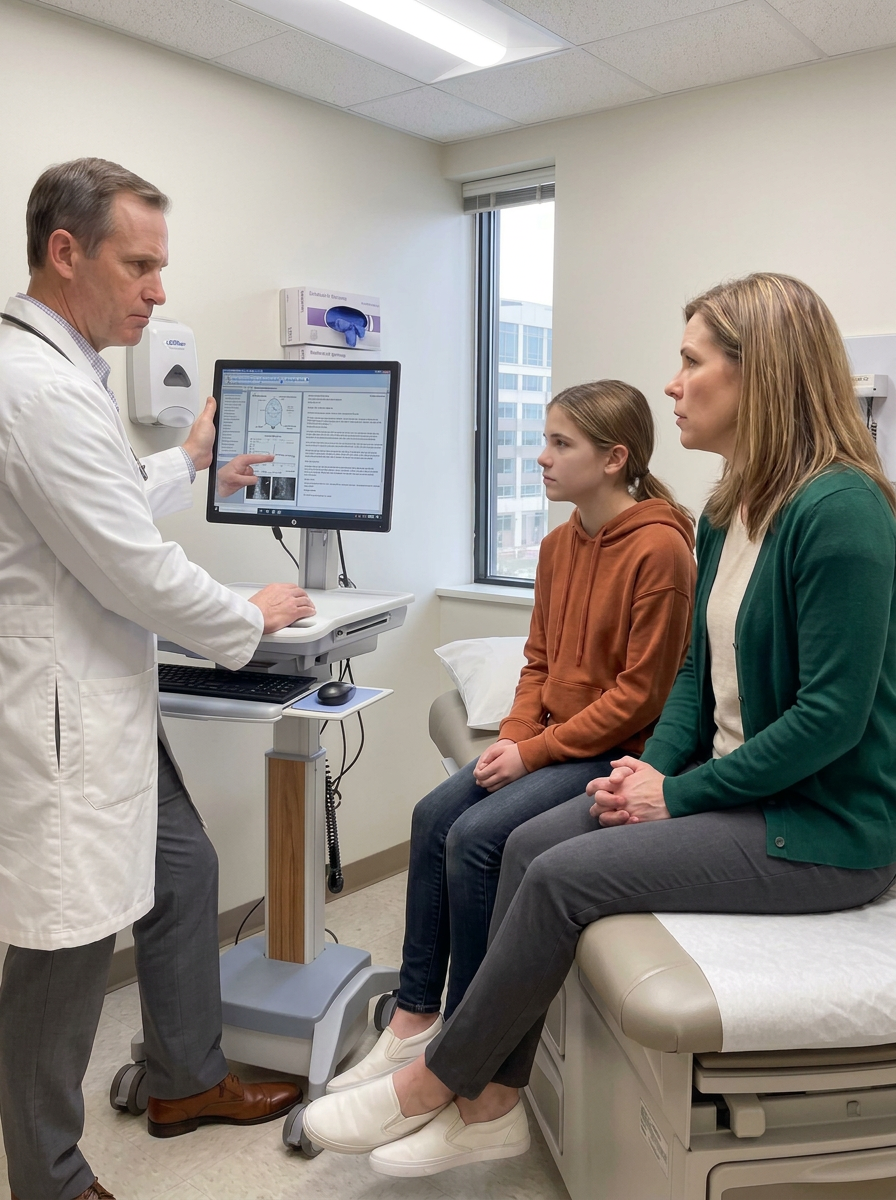
The doctor pulled up the chart.
Then he asked a question that made the entire room feel suddenly unfamiliar.
“How long has her father known about this?”
I thought he had confused us with another family.
“He doesn’t know,” I said. “I didn’t tell him we were coming today.”
The doctor looked at my daughter.
Then back at me.
“I’m not asking about today.”
My stomach tightened.
He turned the monitor.
“There is an earlier visit in her chart.”
I stared at the screen.
The date was five weeks earlier.
Her name.
Her date of birth.
Our insurance.
And under the section identifying the accompanying parent—
my husband’s name.
For a moment, I could not make sense of what I was reading.
“That can’t be right.”
My daughter immediately looked down.
The doctor did not argue.
He simply scrolled.
“She was seen for the same pain.”
I looked at my daughter.
“Dad brought you here?”
She nodded.
My chest went tight.
The doctor continued.
“The previous note documents that follow-up and additional imaging were recommended.”
I looked back at him.
“I was never told.”
Again, he did not accuse anyone.
He did not say my husband had intentionally ignored the recommendation.
He did not guess.
He stayed careful.
Professional.
But what he said next made the situation impossible to minimize.
“What we are seeing today requires prompt attention and further evaluation. I need to understand why the recommended follow-up apparently did not happen.”
I heard every word.
Yet all I could think was—
Five weeks.
Five weeks of mornings.
Five weeks of dinners.
Five weeks of school.
Five weeks of my daughter saying she was fine.
I turned toward her.
“Did Dad take you to that appointment?”
Another nod.
“What did he tell you afterward?”
She did not answer immediately.
Her fingers disappeared deeper into the sleeves of her hoodie.
Finally she said,
“He told me they didn’t find anything important.”
I looked at the doctor.
He did not challenge her memory.
He did not say she was mistaken.
He only rotated the computer farther toward me.
“Here is the discharge plan.”
I read it myself.
The recommendation was there.
Clearly.
It was not buried in medical language.
It was not presented as something optional.
There was supposed to be another step.
Follow-up.
Additional imaging.
Further evaluation if the pain continued.
I read the lines twice.
Then a third time.
A cold feeling spread through my stomach.
Because suddenly months of small moments rearranged themselves.
My daughter walking slowly down the stairs in the morning.
My daughter leaving half her dinner untouched.
The heating pad constantly disappearing into her bedroom.
Her skipping breakfast.
Her sitting differently on the couch.
Her saying she was tired.
Her refusing to go shopping one Saturday because she “just wanted to stay home.”
I had noticed all of it.
But nothing had seemed connected.
She was fifteen.
Cramps.
Stress.
School pressure.
Bad sleep.
Teenage moods.
There was always a reasonable explanation nearby.
I had asked her whether she was okay.
She always said yes.
Sometimes she said,
“I’m fine, Mom.”
Sometimes,
“It’s nothing.”
Sometimes she changed the subject.
And because I believed she would tell me if something was seriously wrong, I let those answers stand.
Now I understood something I had not understood before.
She had been learning not to talk.
The silence was not natural.
It had been taught.
I moved my chair closer to the bed.
“You are not in trouble,” I told her.
She kept looking down.
“I need you to tell me everything, even if you think I’m going to be angry.”
Her eyes became wet almost immediately.
Not dramatic tears.
Just a thin shine she tried to blink away.
“He got mad after the appointment.”
“Dad?”
She nodded.
“What did he say?”
“He said you were already stressed.”
“About what?”
“Work. Money. Everything.”
I waited.
She looked toward the wall.
“He said I was making it worse.”
That sentence hurt because it sounded familiar.
My husband had always hated problems that felt unnecessary to him.
Unexpected bills irritated him.
Last-minute changes irritated him.
Work problems irritated him.
If something did not have an immediate solution, he often treated the emotion around it as the bigger problem.
“Calm down.”
“You’re making this worse.”
“It’s probably nothing.”
“Don’t turn everything into a crisis.”
For years, I had called that impatience.
Sometimes I had even defended it.
That is just how he handles stress.
He likes practical solutions.
He doesn’t like drama.
Sitting beside my daughter in that hospital room, I wondered what those same traits felt like when you were fifteen and in pain.
Still, I looked for another explanation.
I wanted one.
Desperately.
Maybe my husband misunderstood the discharge instructions.
Maybe he thought they meant follow up only if things became severe.
Maybe he believed her symptoms were improving.
Maybe our daughter misunderstood something he had said.
Maybe the doctor at the earlier visit had made the recommendation sound less urgent than it appeared in the written note.
I tried to fit the situation into every innocent possibility I could find.
Then the doctor asked a question I had not thought to ask.
“Did your father ever tell you not to tell your mother about the follow-up?”
My daughter went completely still.
Her sleeve moved as she pulled her hand farther inside it.
That small movement frightened me.
Because children do that when the answer feels dangerous.
The doctor waited.
I waited.
Finally she nodded.
Something inside me dropped.
A misunderstanding could explain forgetting a detail.
Confusion could explain timing.
Stress could explain a missed phone call.
But telling your child not to tell the other parent?
That was different.
I kept my voice low.
“What did he say exactly?”
She lifted her eyes.
“He said you already knew.”
I frowned.
“Knew about the appointment?”
She nodded.
“And the follow-up?”
Another nod.
Then she swallowed.
“He said you agreed with him.”
“About what?”
Her face changed.
That was when I knew the answer would hurt.
“That I was doing it for attention.”
I stopped breathing for a second.
The room did not move.
The doctor did not move.
My daughter watched me like she was waiting to see whether I would confirm it.
Whether I would tell her yes.
Yes, I knew.
Yes, I agreed.
Yes, I had watched her hurt and decided she was exaggerating.
I leaned closer.
“I never said that.”
She looked down again.
“I didn’t know about the appointment.”
No reaction.
“I didn’t know about the follow-up.”
Her lips trembled.
I realized this could not be fixed by speaking quickly.
She had believed this for five weeks.
Five weeks of waking up in pain and believing I knew.
Five weeks of sitting across from me at dinner and believing I knew.
Five weeks of carrying the heating pad into her room and believing I knew.
Five weeks of interpreting every ordinary moment between us through a lie.
When I asked about school, she thought I already knew she was hurting.
When I asked why she had not eaten dinner, she thought I knew.
When I told her to get more sleep, she thought I knew.
She had been living beside me while carrying a version of me that did not exist.
A mother who had been informed.
A mother who had agreed she was dramatic.
A mother who had chosen not to help.
And my name had been used to make that story believable.
I looked back at the older note.
The facts were simple.
Her father brought her.
Follow-up was recommended.
I was not told.
Our daughter said he told her not to tell me.
She said he told her I already knew.
She said he told her I agreed she was seeking attention.
Those facts did not explain why.
They did not tell me what he believed.
They did not tell me whether he would deny it.
They did not tell me whether there was some piece of context I had not heard.
But they were enough to change something in me.
Trust.
My phone was still in my hand.
I looked at my husband’s name.
I could picture the conversation.
I could hear my own voice rising.
Did you take her here?
Why didn’t you tell me?
Why didn’t you schedule the follow-up?
Why did you tell her I knew?
Why did you use my name?
Why did you tell our daughter she was doing this for attention?
I could have asked every question immediately.
Part of me wanted to.
But then I saw my daughter watching me.
She had already spent five weeks believing her pain caused problems between adults.
If I called him now, what would she learn?
That speaking up had created exactly the explosion she had been afraid of?
No.
I put the phone down beside my chair.
Then I turned to the doctor.
“What happens next medically?”
He answered without hesitation.
More evaluation.
Further testing.
Prompt follow-up.
The exact medical questions still needed answers, and he was careful not to diagnose what had not yet been fully established.
That mattered to me.
Because in the middle of fear, it is easy to let the worst possibility become the only possibility.
I did not know yet what the final diagnosis would be.
But I knew this much.
My daughter needed care.
Not debate.
Not blame.
Not another adult deciding uncertainty meant nothing serious was happening.
She needed attention now.
And suddenly the word attention sounded different.
My husband had apparently used it like an accusation.
Doing it for attention.
Wanting attention.
Making everyone pay attention.
I looked at my fifteen-year-old daughter sitting on an exam table while doctors discussed further testing.
Of course she needed attention.
She was a child in pain.
Attention was not the problem.
The absence of it was.
That thought hit me harder than anything else.
Because I was not innocent just because I had not known about the earlier visit.
I had missed things too.
I had seen the heating pad.
I had noticed the slow mornings.
I had seen the untouched meals.
I had asked questions.
But when she told me she was fine, I accepted it.
I had been reachable in theory.
But had I made it easy enough for her to tell me something difficult?
I did not know.
And that guilt came fast.
I wanted to explain myself to her.
I wanted to say—
I didn’t know.
I thought you would tell me.
I thought Dad would tell me.
I thought this was ordinary.
I thought I was giving you privacy.
I thought I was respecting you.
I thought I was doing what a mother of a teenager should do.
But every explanation would have required her to take care of my feelings.
So I stopped myself.
This was not the moment for my defense.
She had carried enough adults already.
Instead I moved my chair closer.
“I need you to hear me.”
She looked at me.
“I did not know about the first appointment.”
Her face tightened.
“I did not know you were supposed to have additional follow-up.”
She blinked hard.
“And I never told your father that I thought you were doing this for attention.”
Her breathing changed.
I kept my voice steady.
“I believe you.”
That did it.
One tear slid down her cheek.
She wiped it quickly with the sleeve of her hoodie.
Then another.
She looked embarrassed.
Like crying itself might be evidence against her.
I reached toward her, then stopped before touching her.
I did not know whether she wanted comfort.
I did not want to assume.
So I rested my hand on the edge of the bed instead.
Close.
Available.
Nothing more.
The doctor continued talking about the next steps.
I listened carefully.
When he asked my daughter a question, I let her answer.
When she hesitated, I did not jump in.
That was harder than it sounds.
Parents get used to speaking for their children.
She eats normally.
She sleeps okay.
She has been tired lately.
She has school stress.
But this time, I watched her.
The doctor asked,
“When did the pain first begin?”
She answered.
“When did it start getting worse?”
She paused.
Then answered.
“Does eating make it better or worse?”
Another pause.
Then an answer.
Each time, I noticed the same thing.
She looked toward me before she spoke.
Not because she needed help remembering.
Because she was checking my reaction.
She was trying to determine whether the truth was safe.
That realization hurt more than anger could have.
My daughter was not confused about what had happened.
She was afraid honesty would cost her something.
Approval.
Peace.
Love.
Maybe all three.
And suddenly I knew that the conversation with my husband could not begin with the question he might prefer.
Was she being dramatic?
No.
It could not begin with whether work had been stressful.
It could not begin with money.
It could not begin with whether the doctor had been clear enough.
It could not begin with whether he thought the pain was improving.
Those questions might come later.
But the first conversation had to begin with what was documented.
He took her to the appointment.
Follow-up was recommended.
I was not told.
Our daughter said he told her to keep it from me.
Our daughter said he told her I already knew.
And she said he used my name to convince her that I believed she was seeking attention.
For years, I had trusted my husband’s certainty.
That was one of the reasons we worked well together.
He was decisive.
He rarely sounded unsure.
If something happened with the house, he handled it.
If there was a problem with insurance, he made the calls.
If the school sent confusing paperwork, he dealt with it.
I had come to associate confidence with control.
If he sounded calm, I assumed he had the information.
If he told me something was not a big deal, I believed he had reasons.
That day I learned a different lesson.
Confidence is not the same as completeness.
A person can sound absolutely certain and still leave out the one fact that would change your decision.
A person can call something minor and still be wrong.
And the person who pays the price is often not the one making the judgment.
I thought about the heating pad again.
Such an ordinary object.
It had always been somewhere in our house.
In a closet.
On the couch.
In my daughter’s room.
Before that day, I barely noticed it.
Now I could not stop seeing it.
It became a symbol of everything I had almost missed because pain can hide inside routine.
A child can still go to school.
Still answer texts.
Still laugh at a video.
Still argue about chores.
Still say “I’m fine.”
And still need help.
The doctor eventually left the room briefly to coordinate the next steps.
For the first time, my daughter and I were alone.
The silence felt different.
She stared at the floor.
I did not know how to fill it without making it about me.
So I waited.
After several seconds she said,
“Are you mad?”
I felt my throat tighten.
“At you?”
She shrugged.
“Any of it.”
“No.”
She looked at me.
“I’m not mad at you.”
“What if I should’ve told you?”
“You did tell me.”
“Not before.”
“You told me when you could.”
She looked down again.
I could see the old fear returning.
“But Dad said—”
“I know what Dad said.”
I kept my voice soft.
“And whatever conversation I have with him is my responsibility. Not yours.”
Her eyes filled again.
“You don’t have to explain him to me.”
She said nothing.
“You don’t have to defend him.”
Still nothing.
“And you don’t have to defend me.”
That made her look up.
“You do not have to choose between us to get medical care.”
For the first time that afternoon, her face loosened slightly.
Barely.
But enough.
Then she whispered,
“I thought you were disappointed in me.”
My chest hurt.
“For hurting?”
“For making things a big deal.”
I had to look away for a second.
Because that was what five weeks had done.
She had not simply learned to tolerate pain.
She had learned to feel guilty for needing help.
I turned back toward her.
“You are never a problem because you need help.”
She gave me a look that told me she wanted to believe that but did not yet know how.
And I understood.
Trust would not return because I said one perfect sentence.
Words mattered.
But after five weeks of believing something else, she needed evidence.
She needed to see what I did next.
The doctor returned.
More instructions.
More questions.
More arrangements.
At one point, my phone vibrated inside my bag.
I knew before looking that it could be my husband.
I almost reached for it.
Then I stopped.
My daughter noticed.
“You can answer.”
I shook my head.
“It can wait.”
“What if it’s Dad?”
“It can still wait.”
She studied my face.
That moment mattered.
Not because ignoring a phone call is heroic.
It isn’t.
But because for the first time since entering that hospital, she saw an adult make a decision based on her needs without treating her needs like an inconvenience.
So I left the phone where it was.
We continued listening.
The doctor spoke.
My daughter asked a question.
I asked another.
No shouting.
No accusation.
No adult confrontation.
Just care.
Later, when I finally picked up my phone, my husband’s name was there among the notifications.
I stared at it.
My anger had not disappeared.
If anything, it had sharpened.
There would be a conversation.
There had to be.
I needed to hear his explanation.
I needed to know why I had not been told.
I needed to know why the recommended follow-up had not happened.
I needed to know exactly what he had said to our daughter and why he had brought my name into it.
But I also knew something I had not known when I first stood up from that chair.
Not every urgent feeling requires an immediate reaction.
My marriage problem felt urgent.
My daughter’s medical care actually was.
Those were not the same thing.
So I locked the screen.
Put the phone back into my bag.
And turned toward her.
Her hands had disappeared into her sleeves again.
I rested my palm beside hers on the exam bed.
I did not grab her.
I did not ask her to hug me.
I simply put my hand there.
Close enough that she could choose.
For several seconds, nothing happened.
Then one finger appeared from inside the cuff of her hoodie.
Then another.
Slowly, almost cautiously, she slid her hand into mine.
I closed my fingers around hers.
Very gently.
That small movement nearly broke me.
Because I understood exactly what she was doing.
She was not saying everything was fixed.
She was not saying the last five weeks no longer mattered.
She was not saying she trusted me completely again.
She was offering me one inch.
One chance.
A tiny piece of trust.
And this time, I knew better than to demand the rest.
The doctor looked at us.
I looked back at him.
“Tell us what she needs next.”
He began explaining.
I listened.
My daughter listened.
And for the first time in five weeks, nobody in that room was asking whether her pain was inconvenient.
Nobody was asking whether she was exaggerating.
Nobody was accusing her of wanting too much attention.
We were finally paying attention to the only thing that should have mattered from the beginning.
Her.
I could not go back and erase the appointment I never knew about.
I could not erase the missing follow-up.
I could not erase the nights she lay in bed with a heating pad believing I had already chosen not to help her.
I could not erase whatever my husband had said or whatever fear had kept her silent.
But I could decide what happened next.
I could listen.
I could ask.
I could stop accepting “I’m fine” when everything in front of me said otherwise.
I could let her speak without making her responsible for anyone else’s emotions.
And when the time came to confront her father, I could do it without forcing her to stand between us.
There would be questions later.
Hard ones.
There would be explanations.
Maybe excuses.
Maybe denial.
Maybe answers I was not ready to hear.
But none of that belonged in this room yet.
This room belonged to my daughter.
Her pain.
Her voice.
Her care.
Her hand in mine.
For five weeks, she had believed asking for help would only create trouble.
I could not undo that belief in one afternoon.
But I could start replacing it.
One answer at a time.
One appointment at a time.
One choice at a time.
The doctor turned back toward the monitor.
My daughter tightened her fingers around mine.
I held on.
And this time, no one was going to teach her that asking to be cared for was the same thing as asking for attention.
The End.