A text story
My daughter asked me to watch her stepdaughter for the summer, and I almost said no because the girl wasn’t “really” my grandchild.
I’m ashamed of that now. Ashamed I grumbled about the three hundred dollars in groceries a kid would cost. Ashamed I said the words “she has her own people” out loud, on the phone, to my own daughter, about an eight-year-old.
My daughter Bree married Sam two years ago. Sam had Mabel from his first marriage, and Mabel’s mother has been out of the picture since the girl was three — not dramatically, just a slow fade to Nevada and a birthday card most years. Bree and Sam were both starting new jobs in June and the childcare math didn’t work, and Mabel’s usual summer arrangement was her paternal grandmother, Sam’s mother, out in Zephyrhills.
That arrangement had ended in April, and I hadn’t asked why, because I was busy being put out about the groceries.
The first week, Mabel barely spoke.
I’d raised two loud children and I had a whole set of expectations about what a house sounds like with a kid in it, and this was not that. She was silent. Not sullen — careful. She asked permission for water. She made her bed with the corners tucked before I was up, at eight years old, badly, but she did it every single morning.
She ate what was in front of her and never asked for anything, and if I offered seconds she’d look at my face for about two seconds before answering, and I understood later she was checking whether the offer was real.
The third night she stood in the kitchen doorway while I did dishes and did not come in, and I said, “You can come in, honey,” and she said, “I’m not allowed in kitchens.”
I turned the water off. I said, “You are in this one.”
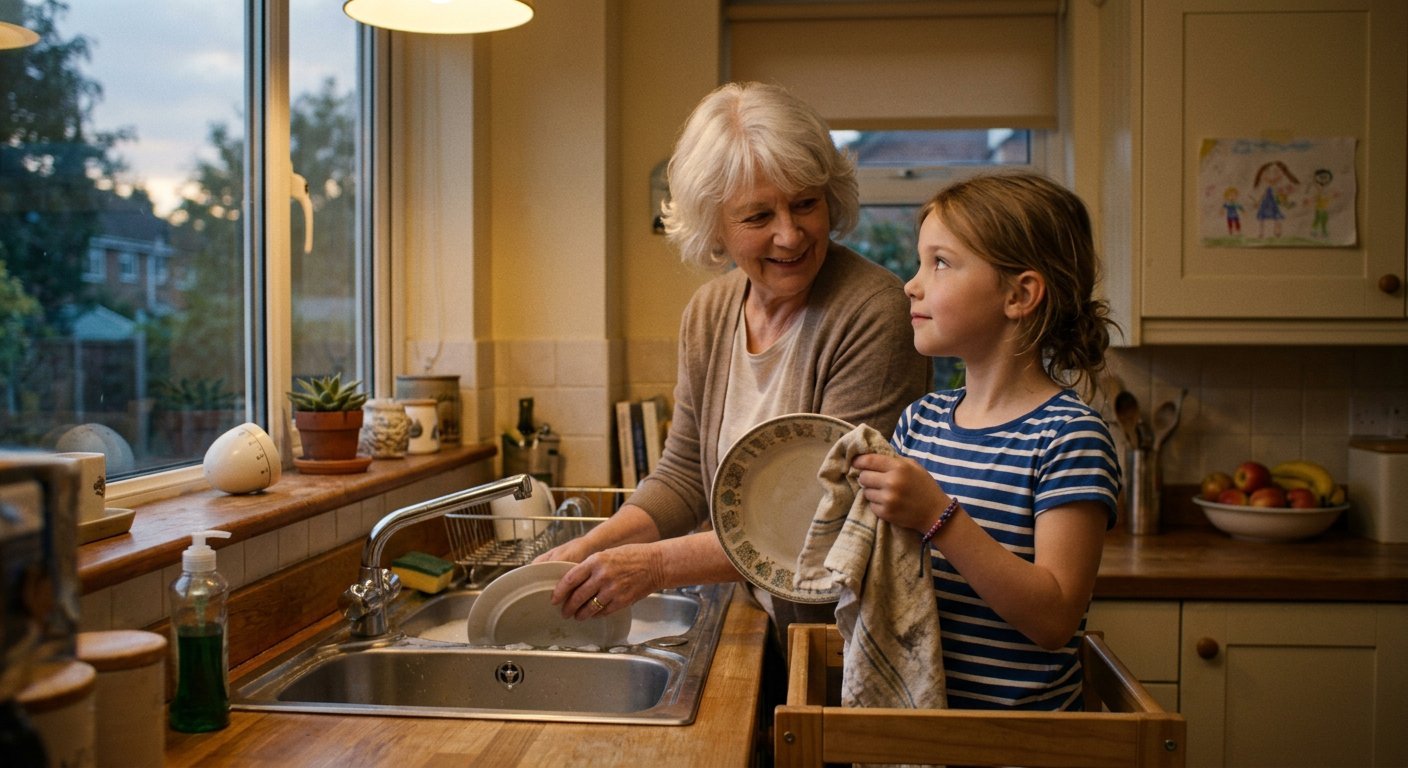
She thought about it a long time and then came in and stood next to me and dried a plate.
Then one night at the end of that first week, she was in bed and I was tucking the sheet and she asked, in a perfectly level voice:
“Do you have a rule about how long I’m allowed to stay?”
My chest squeezed.
I said this was her home as long as she wanted. I said it lightly, the way you say a thing you assume is obvious, and she started to cry.
Not loudly. She cried the way she did everything, which was quietly and with an eye on the door.
She said, “My other grandma had a timer. When it beeped, I went to the garage.”
The floor seemed to drop.
I sat down on the edge of that bed and made my voice as ordinary as I could and I asked, gently, what else happened in that garage.
And Mabel whispered, “She said if I told anyone, my daddy would send me to live with my mom in Nevada. Because I’d be making trouble in his new family.”
I want to say plainly what this was and what it wasn’t, because I spent about four hours that night imagining the worst version and I think anyone would.
Nobody hit that child. That was the first thing the investigator established and I’m grateful for it every day.
What happened was this. Sam’s mother had never accepted the divorce, blamed Mabel’s existence for a great deal, and had a system. Mabel was allowed two hours of the house per day. Living room, kitchen, the good rooms — two hours, timed on a kitchen egg timer set on the counter where the girl could watch it.
When it beeped, she went to the garage. There was a folding chair out there, and a plastic tub with a coloring book in it, and a bucket, because she was not allowed back in to use the bathroom.
Summers in central Florida. In a garage.
Four summers. From when she was four years old.
The rest of the year it was weekends, which is why nobody caught it — a weekend is short enough that a child comes home tired and quiet and everybody says oh she’s just worn out from Grandma’s.
And she never told, because a four-year-old was told that telling would get her sent away from her father, and a four-year-old believes that, and then a five-year-old believes it, and by eight it isn’t a belief anymore, it’s just the shape of the world.
The reason the arrangement ended in April is that Sam’s mother had a hip replacement scheduled. It ended for logistics. It would not otherwise have ended.
I called Bree at eleven at night and told her to come over, and to bring Sam, and not to bring Mabel into it.
I have thought a lot about how to describe what happened to Sam’s face in my living room at midnight. He is not a demonstrative man. He got very still, and then he said, “The garage,” in a voice I hadn’t heard from him, and then he went out to my back steps and was out there a long while.
He’d been in that garage. He’d walked past that garage forty times. He’d have said his mother was cold about Mabel — he’d have said she’s not warm with her, it’s a divorce thing, she’ll come around. He had a whole small language for it that let him keep dropping his daughter off.
He said, later, the thing that I think will follow him for the rest of his life: “She was quiet when I picked her up. Every time. And I told myself it was because she’d had a nice time.”
I’m not going to defend him and he doesn’t want defending. But I’ll say this, because it’s the same disease I had: he wasn’t cruel. He was convenient. He needed the childcare and his mother was free and available, and every one of us has a talent for not looking directly at the thing that would cost us if we saw it.
I’d almost said no over three hundred dollars in groceries. Different sin, same family of sin.
Here’s what happened after, because I think the after matters more than the reveal.
We reported it. Florida DCF, the next morning. Sam made the call himself, which I insisted on, and the investigator was a woman named Charmaine who was kind to Mabel and unsentimental with the adults.
The case was substantiated. There was no criminal charge in the end — the state attorney declined it, which I understood and hated — but it’s on record, permanently, which matters for one reason: Sam’s mother has since tried twice to get court-ordered grandparent visitation, and both times the file did the arguing for us.
She has not seen Mabel since April of that year and she will not.
Mabel started with a play therapist in July, a woman named Dr. Okafor, and she has been going for three years and will go as long as she wants to. The state of Florida doesn’t pay for that. We do. It is the best money any of us have ever spent and I don’t want to hear another word about groceries as long as I live.
Dr. Okafor told us something early on that reorganized how I thought about the whole thing. She said the garage wasn’t the wound. The wound was the timer. A child can survive being sent out. What that child had internalized was that belonging is metered — that there is a countdown running on every room she is in, in every house, always, and her job is to be so quiet and so useful that maybe somebody forgets to set it.
Which explains the made bed. And the dried plate. And do you have a rule about how long I’m allowed to stay.
She lives with me now, most of the time. That was not the plan and it’s what happened. Bree and Sam are twenty minutes away and she’s back and forth constantly, but her room is here and her books are here and that’s just the arrangement.
She’s eleven. She is loud. Dear God, she is loud — she sings in the shower with the door open, she narrates video games to nobody, she has opinions about the news. When she was nine she told me my meatloaf was “not a good one,” and I went into the bathroom and cried with the tap running, from pure joy, because a child who says your meatloaf is bad is a child who is not doing arithmetic about whether she’s allowed to be there.
Two things I’ll finish with.
The first is that there is no egg timer in this house. I threw mine out that week and I’ve never replaced it. If I need six minutes, I use my phone, face down, on silent. She’s never mentioned it and I’ve never mentioned it and I’m entirely sure she knows.
The second is a piece of paper on my refrigerator. Mabel wrote it a couple of months after she came, when Dr. Okafor had her working on what she called “house rules for a safe house.” She wrote out five. Four of them are ordinary child things about screens and bedtime.
Rule three, in orange marker, in an eight-year-old’s hand:
3. THE PEOPLE WHO LIVE HERE ARE ALLOWED TO BE HERE THE WHOLE TIME.
It’s been on that refrigerator for three years. The tape has gone yellow and I keep re-taping it.
She wasn’t “really” my grandchild. I said that out loud, on a telephone, to save three hundred dollars.
She’s my granddaughter. She was always going to be. It only took her one week to teach me, and she did it by asking, politely, how long she was permitted to remain in my house.
If a child in your life goes quiet in a particular house — if they come home tired and careful, if they ask permission for water, if they check your face before accepting food — ask them a plain question and give them a great deal of silence afterward. It costs nothing. It took me one bedtime and I nearly didn’t do it.