A text story
For thirty years I dropped everything whenever my daughter called. This week she’s going to learn the phone works both ways.
Let me back up.
Thirty years I gave that girl. Raised her alone from the time she was six — her father went to Bakersfield for work in 1994 and simply kept going. Then when she had her own and went back to the firm at eleven weeks postpartum, I raised her babies too. Up at five. At her house by six. Every single day.
School runs. Sick days. The stomach bug that went through all three of them in 2019 and I slept on her couch for nine nights. Sleepless nights, dentist appointments, the science fair volcano, the lice. All of it mine. I never once asked for a dime or a thank-you, and I want to be clear that I don’t say that for credit. I say it because it’s the arrangement I chose, and I’d choose it again, and that matters for what comes next.
Then she hired a young nanny with a nice car and a degree in early childhood development, and just like that Grandma was clutter.
The Sunday dinners dried up. The pickups stopped — I’d show up at 3:15 and the car seat would already be gone from the lot. She started dodging my calls. Three weeks of can’t talk now Mom and one voicemail that was clearly recorded in a parking garage.
When I finally caught her, she didn’t even soften it.
“We’ve got real help now, Mom. The kids need someone with energy, not somebody stuck in the old ways.”
Thirty years. Clutter.
I said, “Whatever’s best for them.” Hung up gentle.
And thirty years of dropping everything for that girl went still in me, and something steadier took over.
So this morning I got up, put on my good coat, and I drove over to her house.
Now — I know what you’re expecting. I’ve read the same stories you have. You’re expecting me to have gone over there and let her have it on her own front step. Said the speech. Handed her an invoice for thirty years of childcare at market rate, which by the way I did calculate one bad night in February, and it came to something north of four hundred thousand dollars.
That isn’t what happened.
What happened is I got there at 7:40 in the morning, which is when I have arrived at that house for eleven years, and I parked across the street rather than in the driveway, because the driveway isn’t mine anymore.
And I sat there.
At 7:52 the nanny’s car pulled in. Little white hatchback, very clean. And a girl got out of it — and I do mean girl, twenty-four at the outside — and she went up the walk with a canvas bag on her shoulder.
And she stopped at the door. And she stood there with her hand on the knob for a good long while, doing something with her breathing, the way you do before you go into a room you’re frightened of.
I know that pause. I have done that pause. I did it in 1994 outside a bank manager’s office, and again in 2011 outside a hospital room.
So I got out of the car.
Her name is Corrine. She’s twenty-three. She has a degree, that part was true, and eleven thousand dollars of debt against it and a car her stepfather co-signed.
I said, “I’m Maribel. I’m the grandmother.”
And that poor child’s face did something I will not forget, which was relief and terror at the same time, and she said, “Oh, thank God. Are you back? Please tell me you’re back.”
Here is what I learned standing on that walkway, and then in that kitchen, and then over three hours at a diner on Vineland after she called in and said she’d be late.
My daughter is not doing well.
She was passed over in October. Then in January the firm did what firms do and made her choose between her hours and her position, and she chose the position, and her hours are now something like sixty-five a week with a phone that never goes dark. My youngest grandson has been having what the school calls “dysregulation episodes” since September. There’s a specialist. There’s a waitlist. There’s a bill.
Corrine is not a nanny with a degree. Corrine is a twenty-three-year-old who is alone in a house with three children for eleven hours a day, four of whom — counting my daughter — are struggling, and she has been in that job for five months and has cried in that white hatchback more times than she could count.
And the line. That line I have been chewing on like a stone in my shoe for two months.
“The kids need someone with energy, not somebody stuck in the old ways.”
Corrine said, “She says that about herself. All the time. She said it to me my second week — that she’s stuck in the old ways and the kids need someone with energy.”
My daughter came home at 6:40 that evening and found me sitting at her kitchen table with a pot roast in her oven and Corrine gone home at five like a person with a life.
She stood in the doorway with her bag still on her shoulder.
She said, “Mom.”
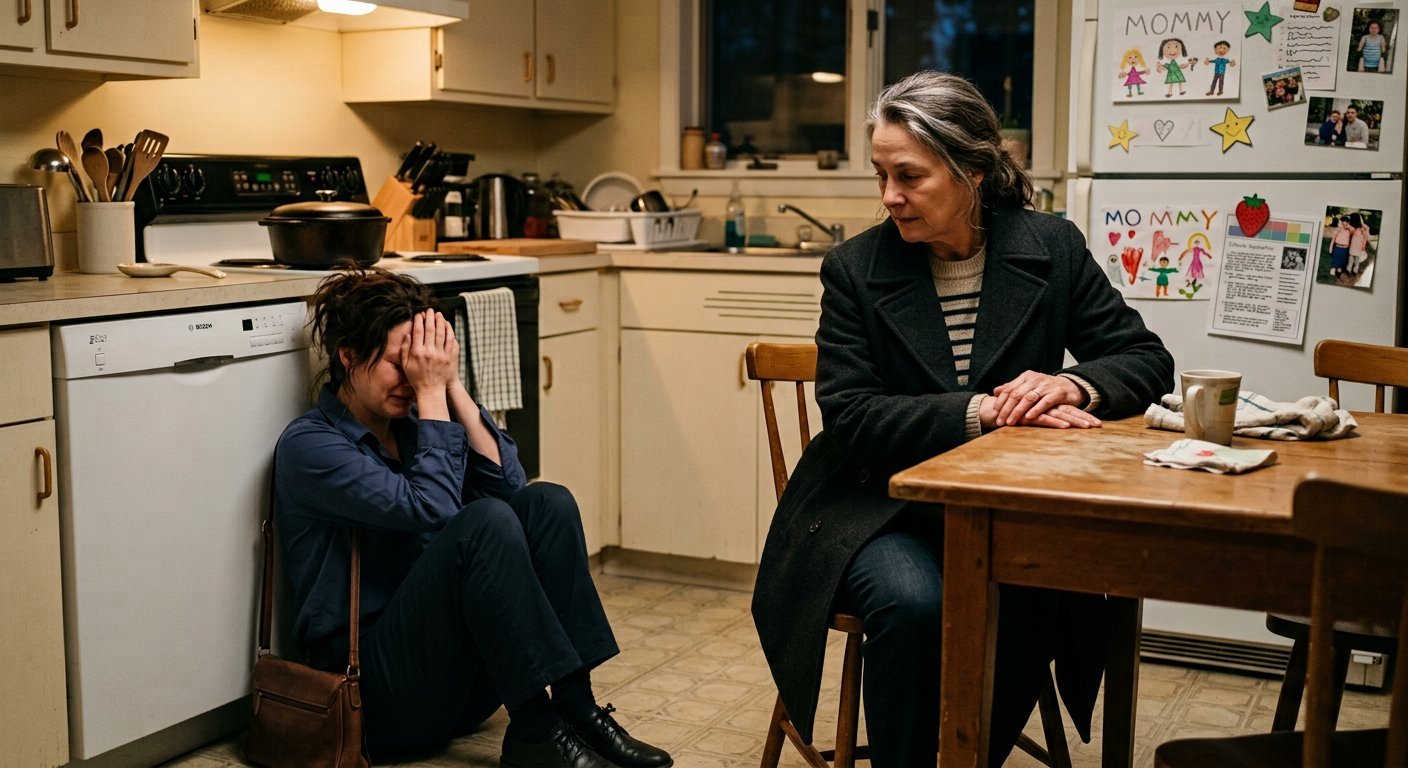
And then my forty-one-year-old daughter, who has argued in front of federal judges, sat down on her own kitchen floor with her back against the dishwasher and cried in a way I have not heard since she was nine years old.
It came out sideways, the way these things do. Not in order.
She’d hired Corrine because I had a bad stretch in August — three days where my blood pressure did something the doctor didn’t like, and I didn’t tell her, but she has the pharmacy on her insurance and she saw the new prescription. Sixty-seven years old and hauling a four-year-old up her stairs every day.
She’d meant to hire help for me. Then the money got tight and she could only afford one salary’s worth of help, and one salary’s worth of help is a nanny, and a nanny made me redundant. She hadn’t thought it through. She’d been operating at 4 a.m. on a spreadsheet.
And then she’d been too ashamed to explain it, because explaining it meant saying I’m failing at work, I’m failing my son, and I’m scared you’re going to die on my staircase. So instead she said something cruel and clean, because cruel and clean is faster than true.
“You said whatever’s best for them,” she said, from the floor. “You said it so nicely, Mom. And then you didn’t call for two months.”
I said, “You didn’t call either.”
She said, “I know.”
So here’s what we’ve done, because I am too old for a reconciliation that’s only made of feelings.
We wrote it down. At that table, that night, on the back of a school newsletter. And I typed it up properly the next week and we both signed it, and it’s on the refrigerator under a magnet shaped like a strawberry:
THE ARRANGEMENT 1. Grandma: Tue, Wed, Thu. 8am – 3pm. No stairs with children. No lifting. Not one minute past 3 without a call. 2. Corrine: Mon-Fri, 7:45 – 5:00. She is not competing with anybody. She is not replacing anybody. 3. Sunday dinner. Every Sunday. At Grandma’s. She is not driving to us. 4. Grandma is PAID. $200/wk. Not negotiable. Not a favor. Not clutter. 5. NOBODY SAYS THE NICE VERSION. If it’s a hard thing, say the hard thing. Rule 5 is the whole document. signed: Maribel R. signed: Teresa R.
Rule five is the one that matters. Rule five is thirty years of my life in nine words.
Because I want to be honest here, and this is the part that took me two months and a young girl on a doorstep to work out: I was not the wronged party in this. Not entirely. I was the one who taught that woman that love means never saying the hard thing. I said whatever’s best for them and hung up gentle, and I felt noble doing it, and what I was actually doing was the same thing she was — choosing the clean cruel version over the true one, because true is slower and true can be argued with.
She learned it from me. Thirty years of me dropping everything and never once saying this is hard, I’m tired, I need something. Then I raised a woman who couldn’t say it either, and I called it her ingratitude.
Corrine stayed. She’s good with them. She’s very good with my grandson actually — she has a way of catching the episodes before they arrive that I never had, and I’ve stopped pretending that’s not worth something. She calls me Miss Maribel and comes to Sunday dinner about twice a month, and last week she asked me how I got the char on the outside of a chile relleno, and I told her, and she wrote it down in her phone.
Thirty years I never asked for a dime. Now I get two hundred dollars in an envelope on Thursdays and I have stopped arguing about it. It turns out being paid is a different feeling than being thanked. Thanks you can withdraw. A wage is a fact.
And the phone.
I did teach her that lesson, in the end — the one I set out to teach when I put on my good coat. It just didn’t look the way I’d planned it in the car.
It looks like this: she calls me Tuesday nights now. Not to ask for anything. And when she doesn’t — when it gets to nine and the phone hasn’t gone —
I call her.
That’s the whole lesson. Sixty-seven years old and I only learned it this spring. The phone works both ways, and I spent three decades holding mine and waiting, and calling that love.