Oliver looked at me.
I forced a smile, even though my heart was racing.
“You’re not in trouble.”
He looked at the piggy bank in my hands.
Then he whispered:
“Oh.”
The officer noticed.
“You recognize this one?”
Oliver nodded.
“That’s not mine.”
My eyebrows pulled together.
“Then whose is it?”
Oliver didn’t answer.
He looked toward the street.
Across from our house, Mrs. Adele’s little yellow house was still dark.
The curtains were closed.
Her porch was empty.
I turned back to the officer.
“Please tell me what’s happening.”
He sighed.
“About an hour ago, we received a call from the electric company.”
“What does that have to do with this?”
“They said someone had paid Mrs. Adele’s overdue electric bill.”
My heart skipped.
“Oliver’s money?”
The officer shook his head.
“No.”
I stared at him.
“What do you mean, no?”
“The payment was much larger.”
“How much larger?”
He hesitated.
“Three thousand, eight hundred and forty-two dollars.”
I looked down at the piggy bank.
It suddenly felt much heavier.
“Where did that money come from?”
“That,” the officer said, “is what we’re trying to figure out.”
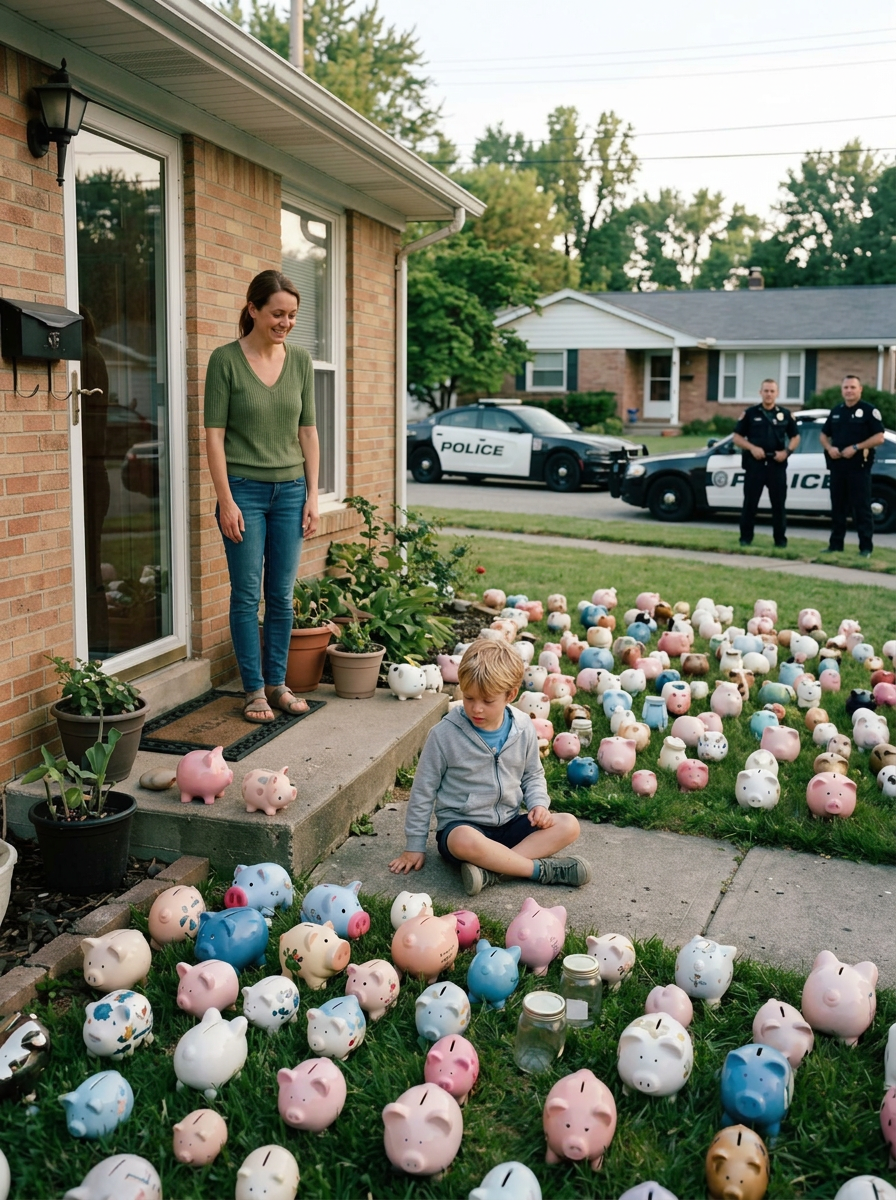
He pointed toward the yard.
“Those banks started arriving just after sunrise.”
“One at a time?”
“No.”
He gave a strange little smile.
“Apparently people were lining up.”
I looked beyond the porch.
Only then did I notice the people standing across the street.
There were more than a dozen of them.
An elderly man holding a cardboard box.
A woman with two children.
A teenager carrying a pink plastic piggy bank.
A delivery driver standing beside his van.
Even the woman who ran the bakery three blocks away was there.
They were all watching my house.
Nobody spoke.
Nobody moved.
It felt like they were waiting for something.
I looked at Oliver.
“Do you know these people?”
He shook his head.
“Some.”
“Who?”
He pointed.
“The bakery lady.”
Then another.
“Mr. Thomas.”
Another.
“The mailman.”
My confusion deepened.
“Oliver, why would they bring piggy banks here?”
He looked at me as though the answer were obvious.
“Because Mrs. Adele told them.”
The officer and I exchanged a glance.
“What did she tell them?”
Oliver shrugged.
“I don’t know.”
“You don’t know?”
He shook his head.
“She said grown-ups don’t listen unless somebody makes them.”
My skin prickled.
I looked across the street again.
Mrs. Adele’s house remained silent.
“Officer,” I said slowly, “where is Mrs. Adele?”
His expression changed.
“We’ve been trying to reach her.”
A cold feeling settled in my chest.
“What do you mean?”
“She isn’t answering her door.”
I immediately stepped off the porch.
“Is she hurt?”
“We don’t know.”
“Then why are we standing here?”
The officer put out his hand.
“We have another problem.”
He pointed at the blue piggy bank.
“Open it.”
I looked at Oliver.
He was staring at the bank.
Not frightened anymore.
Sad.
Almost like he knew what was coming.
I found a hammer in the garage.
The officer followed me into the kitchen while Oliver stood near the doorway.
I placed the piggy bank on the counter.
For a moment, nobody moved.
Then I struck it.
Crack.
The ceramic split down the middle.
Coins spilled across the countertop.
Quarters.
Dimes.
Pennies.
A few folded bills.
Nothing unusual.
The officer knelt and began sorting through the pieces.
Then he stopped.
“There.”
Tucked underneath the coins was a tiny folded piece of paper.
My heart began pounding.
I unfolded it.
There were only six words.
YOU PROMISED YOU’D NEVER FORGET US.
I looked at the officer.
“What does that mean?”
He didn’t answer.
Instead, he turned the paper over.
There was an address written on the back.
Not Mrs. Adele’s address.
Another one.
An address across town.
I recognized it immediately.
My mother had lived there.
Before she died.
I felt the room tilt.
The officer saw my face.
“You know this address?”
I couldn’t speak for several seconds.
“Yes.”
“How?”
I swallowed.
“That’s my childhood home.”
Oliver stepped closer.
“Mom?”
I turned toward him.
His little face was full of questions.
“What happened there?”
I didn’t know how to answer.
Because suddenly I was remembering things I’d spent years trying not to remember.
My mother.
Her old kitchen.
The yellow curtains.
The little wooden table where I used to do my homework.
And Mrs. Adele.
Standing in our driveway twenty-five years ago.
I hadn’t thought about that day in years.
But now I remembered.
She had been younger then.
She had held my hand while my mother cried inside the house.
And she had told me something.
Something almost identical to what she’d whispered into Oliver’s ear the night before.
The officer noticed I was shaking.
“What did she tell you?”
I looked at him.
“I don’t remember.”
But that wasn’t entirely true.
I remembered one sentence.
Just one.
“If you ever see a child helping an old woman, don’t stop him.”
I looked at Oliver.
My six-year-old son.
The boy who had emptied his entire piggy bank for an elderly woman he barely knew.
The boy who had somehow become the center of something much larger than a simple act of kindness.
I turned toward the window.
Across the street, Mrs. Adele’s curtains suddenly moved.
Someone was standing behind them.
My breath caught.
“She’s home.”
The officer immediately reached for his radio.
But before he could speak, the lights inside the yellow house flickered.
Once.
Twice.
Then every light in the house came on at once.
The porch light.
The kitchen.
The living room.
The upstairs bedroom.
All of them.
For the first time in three nights, Mrs. Adele’s house was completely illuminated.
Oliver smiled.
“She got her lights back.”
But the officer wasn’t smiling.
He was staring at the house.
Then his radio crackled.
A voice came through.
“Unit Twelve, we’ve got movement behind the residence.”
The officer looked at me.
“Stay here.”
He ran across the street.
Another officer followed.
I grabbed Oliver’s hand.
“Inside. Now.”
“But Mom—”
“Oliver.”
He looked at me and knew from my voice that I wasn’t asking.
We stepped inside.
I locked the door.
Then I heard something outside.
A car door closing.
Then another.
Then footsteps.
Not from the street.
From behind our house.
I pulled Oliver toward the kitchen.
He suddenly tugged my hand.
“Mom.”
“What?”
He pointed at the table.
There was something sitting there.
Something that hadn’t been there a minute ago.
A small wooden box.
Old.
Scratched.
With a brass latch.
My name was written across the top.
Not “Mom.”
Not my married name.
My childhood name.
The name only my mother, my father, and a handful of people from my past had ever used.
I stared at it.
Oliver whispered:
“Is that for you?”
I nodded.
My hand trembled as I reached for the latch.
But before I could open it, there was a knock at the back door.
Three slow knocks.
Then silence.
Three more.
Oliver squeezed my hand.
“Mom…”
I didn’t answer.
A voice came from the other side.
An elderly woman’s voice.
Soft.
Familiar.
And impossible.
“Open the door, sweetheart.”
My heart stopped.
It was Mrs. Adele.
I pulled the curtain aside.
She was standing outside.
Alone.
But she wasn’t wearing her winter coat anymore.
She was holding something in her hands.
Another piggy bank.
And behind her stood six people I had never seen before.
All of them elderly.
All of them holding piggy banks.
Mrs. Adele looked directly at me through the glass.
Then she said something that made my blood run cold.
“Your mother asked me to wait until Oliver was six.”
I stared at her.
“What?”
She raised the wooden box in her hand.
Then she smiled sadly.
“Because she knew exactly what kind of boy your son would become.”
My hand went to the lock.
I opened the door.
Mrs. Adele stepped inside.
And before she said another word, she looked at Oliver.
Her eyes filled with tears.
“You’re just like her.”
Oliver frowned.
“Like who?”
Mrs. Adele looked at me.
“Your grandmother.”
I couldn’t breathe.
“My mother has been dead for twenty-four years.”
“I know.”
“Then how could she know Oliver?”
Mrs. Adele’s expression softened.
“She didn’t.”
She looked down at the wooden box.
“But she knew you.”
Then she placed the box on the table.
And whispered:
“She knew that one day, you’d have a child who would remind you why she spent her entire life helping strangers.”
I stared at the box.
“What’s inside?”
Mrs. Adele didn’t answer.
Instead, she turned to Oliver.
“Would you like to open it?”
Oliver looked at me.
I nodded.
He slowly lifted the brass latch.
The lid creaked open.
Inside was a photograph.
A very old photograph.
I picked it up.
My fingers went numb.
It showed my mother standing in front of our childhood house.
Beside her was Mrs. Adele.
But there was someone else in the photograph.
A little boy.
Maybe six years old.
Standing between them.
I stared at his face.
I knew him.
I had seen that face my entire life.
It was my father.
But he was supposed to have been overseas when the photograph was taken.
And on the back of the photograph, written in my mother’s handwriting, were seven words:
“This is where the promise begins.”
I looked up at Mrs. Adele.
“What promise?”
She sat down slowly.
Then she looked toward the dozens of piggy banks outside.
“The promise your mother made.”
“What promise?”
Mrs. Adele’s eyes filled with tears.
“To make sure no child ever believed that being poor meant being alone.”
The room went silent.
Then she reached into her pocket and pulled out a folded envelope.
She handed it to me.
My name was written on it.
In my mother’s handwriting.
And underneath my name were four words:
OPEN THIS WHEN OLIVER TURNS SIX.
I looked at my son.
Then back at the envelope.
Twenty-four years after my mother’s death, she had somehow left something for my six-year-old son.
And suddenly I understood.
The piggy banks weren’t the mystery.
They were the message.
Someone had been keeping my mother’s promise all these years.
And now, for reasons I couldn’t yet understand, they had decided it was Oliver’s turn to inherit it.Part 3 — The Promise
I stared at the envelope for what felt like an eternity.
My mother’s handwriting was unmistakable.
The same looping letters.
The same little curve beneath the final letter of my name.
For twenty-four years, I had believed there were no more words left from her.
I had been wrong.
My hands trembled as I opened it.
Inside was a single sheet of paper.
There wasn’t a long letter.
Just a few paragraphs.
I read the first line.
Then I had to sit down.
“My dearest girl, if you’re reading this, then Oliver is six.”
My eyes filled with tears.
I looked at my son.
He was sitting beside Mrs. Adele, swinging his little legs beneath the chair.
My mother had never met him.
She had never held him.
Never heard him laugh.
Never seen the way he scrunched his nose when he was concentrating.
And yet somehow, she’d known his name.
I continued reading.
“You may be angry with me for leaving you with so many unanswered questions. I’m sorry. But there are some things children shouldn’t have to carry before they’re ready.”
I stopped.
Mrs. Adele lowered her eyes.
“You knew about this?”
She nodded.
“I promised your mother.”
I looked back at the letter.
“When I was young, Mrs. Adele helped our family when we had almost nothing. She brought groceries when we couldn’t afford them. She paid bills without telling anyone. She taught me something I never forgot: kindness isn’t about how much you have. It’s about whether you’re willing to share what you do have.”
My vision blurred.
I wiped my eyes and kept reading.
“One winter, when you were little, our electricity was shut off. I was ashamed. I didn’t want anyone to know. Mrs. Adele found out anyway.”
I looked at her.
She smiled through her tears.
“I remember,” she whispered.
My mother’s letter continued.
“She paid the bill. But she made me promise something in return. She asked me to help someone else when I was able. Not her. Someone else.”
I looked toward the yard.
At the piggy banks.
At all those people who had gathered outside.
And suddenly the pieces began falling into place.
My mother hadn’t simply received help.
She had passed it on.
For decades.
One person at a time.
The letter continued.
“Over the years, I started what became a little tradition. Whenever someone in our neighborhood needed help, we collected what we could. A dollar here. A quarter there. Sometimes only a few coins. We never cared about the amount.”
“We cared that nobody had to sit alone in the dark.”
I covered my mouth.
Oliver looked up at me.
“Mom, are you crying?”
I nodded.
He climbed into my lap.
My mother had always said I was too stubborn to cry.
Apparently Oliver had inherited that stubbornness too.
I kept reading.
“If you’re wondering why I asked Adele to wait until Oliver was six, it’s because six is when I first learned what kindness really looked like.”
I looked at Mrs. Adele.
She nodded slowly.
“That was your mother,” she said.
“What did she do?”
Mrs. Adele smiled.
“She was six years old. One of our neighbors had lost everything in a fire. Your mother had three dollars in her little savings jar.”
I looked at Oliver.
“Three dollars?”
“Three dollars,” Mrs. Adele said.
“She brought it to me and asked me to give it to the family.”
Oliver’s eyes widened.
“Like I gave you my piggy bank?”
Mrs. Adele smiled.
“Exactly like that.”
Oliver looked at me.
“So Grandma did it too?”
“Yes,” I whispered.
For the first time that morning, he smiled.
I looked back at the letter.
The final paragraph was shorter.
“If Oliver gives away his savings one day, don’t stop him because you’re afraid he’ll have less.”
My breath caught.
“Teach him to save, yes. Teach him to be wise, yes. But never teach him that having less money makes him less fortunate than someone who has more.”
Then the final sentence:
“If he ever chooses kindness when nobody is watching, you’ll know the promise survived.”
I couldn’t read anymore.
I folded the letter against my chest and cried.
Not the quiet tears I had shed privately after my mother died.
These were different.
They felt like twenty-four years of grief finally finding somewhere to go.
Oliver wrapped his little arms around my neck.
“Mommy?”
“Yes?”
“Is Grandma happy?”
I kissed the top of his head.
“I think she would be very proud of you.”
Mrs. Adele stood.
“There’s one more thing.”
She walked to the front door.
I followed her.
The yard was still covered in piggy banks.
But now I noticed something I hadn’t noticed before.
Every single piggy bank had a name written on it.
Some belonged to children.
Some belonged to adults.
Some belonged to people I recognized.
And some had names I didn’t know.
Mrs. Adele picked up a pink one.
“This one belongs to Emma. She’s seven.”
She picked up a blue one.
“That’s Mr. Thomas. He’s eighty-six.”
Then another.
“That’s from the bakery.”
Another.
“The mailman.”
I stared at her.
“They all brought money?”
“They brought what they could.”
“But why here?”
“Because your son gave away everything he had.”
She looked at Oliver.
“He reminded all of us what we’d forgotten.”
“What?”
“That helping someone isn’t supposed to be complicated.”
She gestured toward the street.
“Some people had ten dollars.”
“Some had five.”
“Some had fifty cents.”
“Some had nothing but an empty piggy bank.”
My eyes filled again.
“And they still brought it?”
Mrs. Adele nodded.
“Because your son taught them something without saying a word.”
At that moment, the police officer who had first arrived stepped onto the porch.
He was holding a folder.
“I owe you an explanation,” he said.
I looked at him.
“Please.”
He opened the folder.
“Last night, Mrs. Adele called us.”
She smiled apologetically.
“I may have caused a little trouble.”
“A little?” I asked.
The officer laughed.
“She told us she wanted to organize a community collection for the electricity fund. But when people started showing up this morning, we were worried someone was being scammed.”
I looked at the piggy banks.
“So the police were here because of the money?”
“Yes.”
He paused.
“And because somebody called in a report about suspicious activity.”
I glanced at Mrs. Adele.
She shrugged.
“People get nervous when an eighty-one-year-old woman receives almost four thousand dollars before breakfast.”
I laughed through my tears.
Then the officer handed me another piece of paper.
“This is the receipt from the electric company.”
I looked at it.
The original overdue balance had been paid.
But there was something else.
A credit.
Enough to keep the electricity on for several months.
I looked at Oliver.
His face lit up.
“She doesn’t have to be cold anymore.”
“No,” I said.
“She doesn’t.”
Then the officer said something I would never forget.
“You know, ma’am, I’ve been doing this job for nineteen years.”
He looked at the piggy banks.
“I’ve seen people fight over a dollar.”
He looked at Oliver.
“I’ve never seen a six-year-old give away every dollar he had without being asked.”
Oliver shrugged.
“I had more than she did.”
The officer smiled.
“That’s exactly the point.”
By noon, the street had turned into something I could hardly describe.
People kept coming.
Some brought coins.
Some brought bills.
Some brought groceries.
Someone brought blankets.
The bakery sent over two boxes of bread.
A mechanic offered to check Mrs. Adele’s furnace for free.
A woman from three streets away brought a grocery card.
Nobody called it a fundraiser.
Nobody called it charity.
Mrs. Adele simply called it:
“The Promise.”
That evening, the police cars were gone.
The crowd was gone.
The piggy banks were gone.
Except for one.
Oliver’s.
I had found it sitting on the kitchen table.
Broken.
Empty.
I picked up the two halves.
Oliver came into the room.
“Mom?”
“Yeah?”
“Can we fix it?”
I looked at him.
“You want to fix your piggy bank?”
He nodded.
“So I can save again.”
I smiled.
“For what?”
He thought about it.
Then he looked toward Mrs. Adele’s house.
“For somebody who needs it.”
I knelt down and hugged him.
And I finally understood what my mother had been trying to teach me all those years ago.
The goal wasn’t to raise a child who never struggled.
It wasn’t to make sure he always had more.
It wasn’t even to teach him how to become rich.
It was to make sure that, when he had something someone else desperately needed, he wouldn’t automatically ask:
“What will I have left?”
He would ask:
“What can I give?”
That night, I repaired his piggy bank with a strip of bright yellow tape.
Oliver placed it on his dresser.
Then he climbed into bed.
Before turning off the light, he looked at me.
“Mom?”
“Yes?”
“Do you think Grandma knew I’d do it?”
I smiled.
“No.”
He frowned.
“Then how did she know?”
I kissed his forehead.
“She didn’t know you.”
I paused.
“But she knew the kind of heart she hoped you’d have.”
He smiled.
Then he closed his eyes.
Across the street, Mrs. Adele’s porch light was still glowing.
Warm.
Bright.
No longer surrounded by darkness.
And on our kitchen table sat my mother’s letter.
Beside it was Oliver’s repaired piggy bank.
Empty.
For now.
But underneath it, I placed a handwritten note.
Not from my mother.
Not from Mrs. Adele.
From me.
It said:
“The promise continues.”
And for the first time since my mother died, I didn’t feel like her story had ended.
I realized it had simply been waiting for the next little person brave enough to carry it forward.
His name was Oliver.
He was six years old.
And he had just learned that sometimes the smallest hands can carry the biggest pieces of hope.