A text story — 12 minute read
Seven years ago, my wife passed away while giving birth. We lost the baby, too.
That’s the sentence. I’ve said it maybe two hundred times — to HR, to a landlord, to a therapist, to women on second dates who deserved to know why I got quiet in certain months. It comes out smooth now. It took about four years to get smooth.
Her name was Wren. She was thirty-one. It was an amniotic fluid embolism, which is a thing that happens to roughly one in forty thousand deliveries and which nobody can predict or prevent. She went from laughing at me for the way I was holding the ice chips to coding, in about nine minutes.
Her family blamed me. Her mother, Ondine, especially.
Not for the medicine — even in the worst of it she never said I’d killed her daughter. What she blamed me for was the pregnancy itself. Wren had a heart condition, a mild one, managed since she was nineteen, and two different doctors had said pregnancy was low-risk-but-not-no-risk, and Ondine had wanted her to adopt. We’d had one very bad Christmas about it in 2017.
So when it happened, there was already a script written, and everyone stepped into their parts. At the funeral her brother told me not to speak. Ondine looked at me across the reception like I was a piece of furniture that had been moved into the wrong room.
Then they cut contact. Completely. Blocked, unfollowed, returned mail. I stopped trying after about eighteen months, which I don’t feel good about but which I understand.
I rebuilt. That’s the boring, unglamorous truth of it. I moved forty minutes north. I got a dog, then a better job, then a hobby, then a therapist, in that order of usefulness. I’m seeing someone now — Nadia, two years, she knows everything and has been extraordinary about all of it. There are whole weeks now where Wren is a warm thing I think about rather than a hole I fall into.
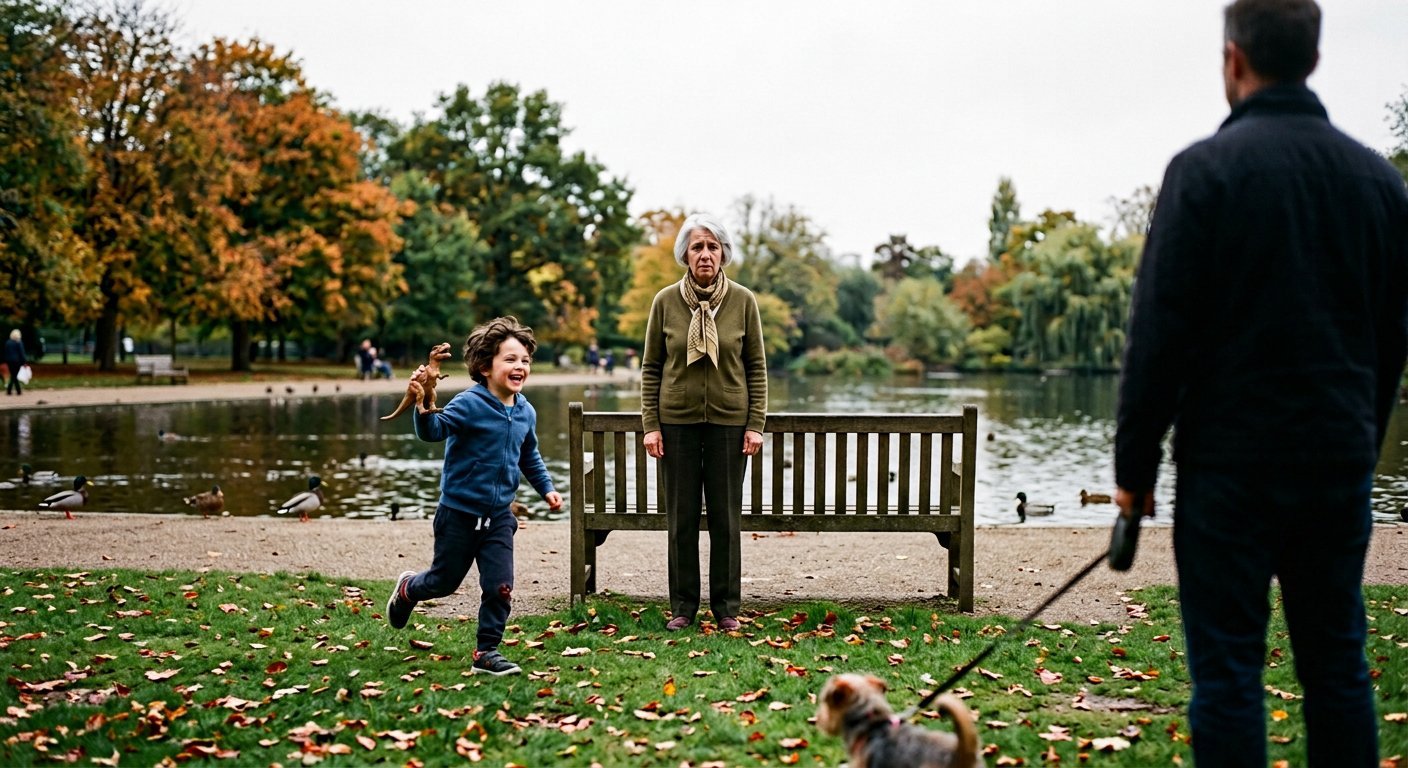
Last Sunday I was at Kessel Park with the dog, and I spotted Ondine on a bench near the little pond.
Seventy-something now. Smaller. Same posture, that very straight back she’d kept from thirty years of teaching piano.
I almost walked the other way. I want that on the record. I stood there for probably fifteen seconds doing the arithmetic of avoidance, and then something in me — four years of therapy, or just fatigue — decided that I was done crossing streets for this.
So I said hello.
She looked up. Her face did a complicated thing. She said my name, and then she said, “Oh,” in a small voice, and then she stood up like she needed to be standing for whatever was coming.
And then a boy came running across the grass yelling “Granny!”
Six years old. Maybe six and a half. Dark curls, a scraped knee, a plastic dinosaur in one fist.
He had my late wife’s exact smile.
Not similar. Not a family resemblance. Hers — the crooked one, higher on the left, where the top lip pulls slightly and shows more gum than she ever liked in photographs. I have four hundred pictures of that smile. I fell in love with it across a table at a work thing in 2011.
I went pale. I actually felt it happen, the blood dropping out of my face.
She looked at me and said:
“We should have told you. Six years ago. Every single day since, I have known we should have told you.”
Here’s what I got, on that bench, over the next forty minutes, while the boy fed ducks he was not supposed to be feeding.
Wren’s younger sister is named Halcyon — Hallie. She was twenty-four when Wren died.
And nine weeks before Wren went into labor, she and Hallie had done a thing they told nobody about. Wren was frightened. Not of dying — of the cardiologist’s phrasing, of the words “we’d advise against a second pregnancy.” She wanted a second child badly and she’d been told she’d probably only get the one shot.
So the two of them went to a fertility clinic in Cleveland and Wren froze embryos. Ours. From an IVF cycle we’d actually started back in 2016 before we conceived naturally and abandoned the process — there were four viable embryos still in storage that I had, in the fog of a good year, genuinely half-forgotten about, and Wren had quietly kept paying the annual storage fee out of her own account.
What she and Hallie did in that clinic was sign paperwork. A directive. Hallie agreed to be a gestational carrier if anything ever happened.
Wren didn’t tell me because she was going to tell me after. She was going to tell me when the baby was here and everything was fine and it was a funny story about how anxious she’d been.
Then everything was not fine.
And eleven weeks after the funeral, Hallie — twenty-four, wrecked, and holding a signed piece of paper from her dead sister — went back to that clinic alone.
His name is Wilder. Wren picked it in 2016, on a car ride, as a joke that stopped being a joke.
Hallie carried him and gave birth to him and has raised him, with Ondine, in the house Wren grew up in, forty minutes from where I’ve been living.
He is, biologically, my son.
Ondine told me the rest of it without flinching, which I’ve come to respect enormously. She said: “We told ourselves it was because you’d take him. Then we told ourselves it was because you’d moved on and it would be cruel to detonate that. Then we told ourselves it had been too long and the telling would be worse than the not telling.” She looked at the pond. “All three of those were true, and none of them were the reason. The reason is that I was so angry at you for her being dead that I wanted to keep something. And by the time I stopped being angry, I was ashamed, and shame is a much longer sentence than anger.”
I asked whether it was legal. What they did.
She said, “You should talk to a lawyer, not to me.” And then, after a moment: “The clinic had a directive with her signature and yours.”
Mine. From 2016. From the original cycle, in a stack of forms I’d signed at a laminate desk while checking my phone, one of which set out disposition in the event of death or incapacity, and which I had not thought about in nine years.
I did talk to a lawyer. Two of them. The situation is roughly this: what Hallie did was almost certainly lawful, my consent to the embryos’ use was on paper in my own handwriting, and Ohio parentage law in a gestational carrier arrangement is a thicket that would take two years and a great deal of money to fight through. I could probably establish paternity. I could probably not undo six years.
The second lawyer, who was older and blunter, asked me a question that ended the legal phase of this entirely. She said: “What do you actually want — to be his father, or to be told the truth?”
I said I wanted the truth.
She said, “You’ve got it. It cost you a Sunday. Now what?”
Here is what I know two months on.
Wilder calls Hallie “Mom.” She is his mother in every way that has ever mattered to him. She was twenty-four and grieving and she made a decision I might have made differently, and then she did the actual work — six years of it, every night of it, alone until she wasn’t.
I met her three weeks after the park. She came to a coffee shop in Medina and sat down and burst into tears before either of us said anything, and then she said, “I have rehearsed this for six years and I have nothing.” We talked for four hours. She showed me a folder on her phone she’d been keeping since he was born, labeled with my first name. Every milestone. Every photo. Twelve hundred and some pictures of a child she had assumed she would hand over eventually and never found the day to do it.
She’d written him a letter for his eighteenth birthday explaining all of it. She showed me that too.
I’m not suing anyone. I’m not taking anyone’s son.
What I’m doing is much smaller and much harder. I’ve met him twice, as “your mom’s friend Peter,” which is what we agreed on with a family therapist who is now involved and is worth every dollar. He likes dinosaurs with an intensity that borders on scholarship. He is careful with the dog. He talks constantly and about nothing and I could listen to it for a hundred years.
There’s a plan, and it’s slow, and it’s built around him rather than around what I’m owed. Sometime in the next year, at a pace a professional sets, he gets told who I am. Not to replace anything. To add something.
Nadia has been at two of the conversations. She said the thing that keeps me steady, which was: “You didn’t lose six years with him. You lost six years of *knowing*. Those aren’t the same and you’ll go insane if you treat them as the same.”
Ondine and I have coffee on Thursdays now, which is the strangest sentence in this entire account.
Last week she brought me a shoebox. Wren’s, from the closet, unopened since 2019.
Inside were the clinic papers, the storage-fee receipts going back to 2016, and a card in Wren’s handwriting, sealed, addressed to me, that she’d clearly written before going into the hospital and then never had a chance to give me because she thought she had years.
P — Don’t be mad. I did a scared thing and it made me less scared. There are four of them. If we get lucky we won’t ever need them and you can laugh at me for this. If we’re not lucky, you’ll know what to do, because you always do, even when you think you don’t. I love you the most. — W.
“You always do, even when you think you don’t.”
She was wrong about that, honestly. I’ve spent seven years mostly not knowing what to do. But I read it about once a week now, and I’ve decided to treat it as instructions rather than as a compliment.
There are three embryos still in storage in Cleveland. Ondine kept paying the fee. Of course she did.
Nobody has asked me what I want done about that yet, and I’m grateful, because I don’t know. That’s a conversation for a year from now, or five, with people who by then will have earned the right to be in the room.
For now there’s a six-year-old at a park who feeds ducks he isn’t supposed to feed, and who smiles with the left side of his mouth, and who does not yet know that I would have crossed any street in the world to avoid the bench where I found him.