PART 1
I never got married.
Not because I didn’t believe in love.
Because life handed me a different responsibility.
When I was twenty-six, my brother and his wife died in a car accident.
One moment they were here.
The next, they were gone.
And they left behind two terrified five-year-old boys.
Mason and Noah.
At the funeral, everyone promised to help.
Relatives hugged me.
Friends offered support.
People said all the right things.
“We’ll be there.”
“You won’t do this alone.”
“The boys are family.”
But after the casseroles stopped arriving and the sympathy cards stopped coming, reality set in.
One by one, everyone disappeared.
The boys still needed breakfast.
Still needed clothes.
Still needed someone to help with homework.
Someone to sit beside them when they cried for their parents.
That someone became me.
At first, I thought it would be temporary.
A few months.
Maybe a year.
Instead, it became my life.
I worked extra shifts.
Picked up overtime.
Skipped vacations.
Ignored my own dreams.
Dating slowly vanished.
My social life disappeared.
Every decision came down to one question:
What’s best for the boys?
And every time, they came first.
I never regretted it.
Not once.
Watching them grow was worth every sacrifice.
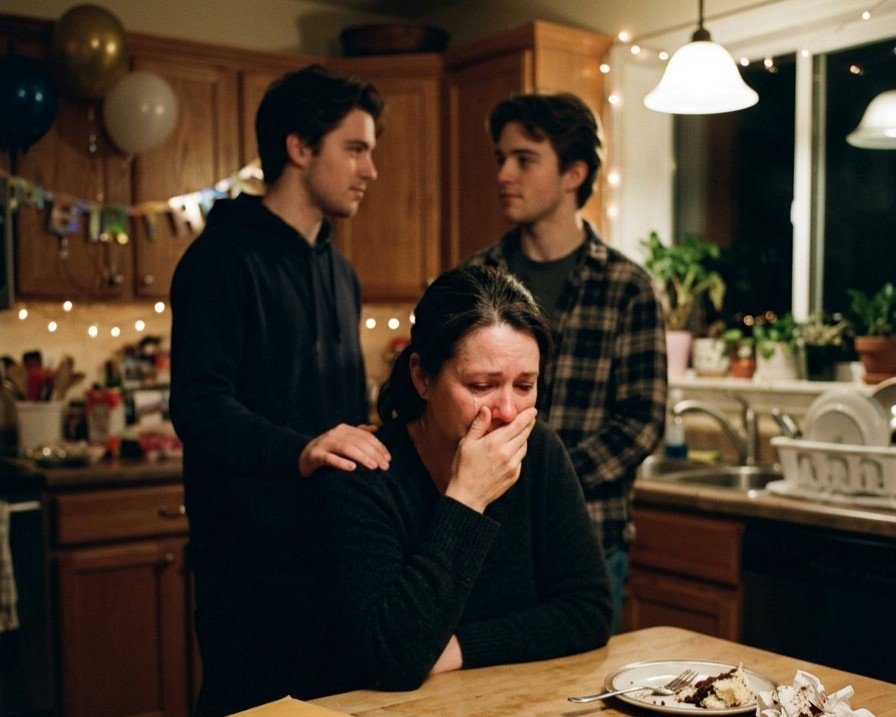
Then their eighteenth birthday arrived.
The house was full of laughter.
Friends.
Family.
Cake.
Music.
The twins were finally adults.
After the party ended and the last guest left, Mason and Noah asked me to sit down.
Something in their voices made me nervous.
I smiled.
“What is it?”
I assumed they wanted to talk about college.
Or jobs.
Or moving out.
Instead, they looked at each other.
Took a deep breath.
And Mason said:
“We’ve been planning something for years.”
I frowned.
“What are you talking about?”
Noah disappeared down the hallway and returned carrying a thick envelope.
He handed it to me.
My stomach tightened.
Inside were bank statements.
Receipts.
Legal documents.
I looked up.
Completely confused.
“What is this?”
Neither answered immediately.
Then Mason pointed to one page.
I looked down.
And froze.
It was the mortgage statement for our house.
Balance due:
$0.
I blinked.
Then looked again.
Still zero.
My hands started shaking.
“What is this?”
Noah smiled.
“It’s paid off.”
I stared at them.
Speechless.
The house still had years left on the mortgage.
Years.
There was no way.
Then they explained.
Four years earlier, they’d accidentally overheard me talking to the bank.
They learned how much debt remained.
How hard I was working.
How often I skipped things for myself so they wouldn’t have to go without.
And from that day forward, they started saving.
Everything.
Part-time jobs.
Summer jobs.
Scholarships.
Birthday money.
Graduation gifts.
Every dollar they could spare.
For four years.
Secretly.
Together.
I couldn’t stop crying.
But they weren’t finished.
Noah reached into the envelope again.
This time he pulled out another document.
A deed.
I frowned.
Then saw my name.
Only my name.
They had worked with a lawyer.
Refinanced the final balance.
And arranged everything so the home would belong entirely to me.
No liens.
No payments.
No debt.
Mine.
After thirteen years of sacrificing everything, they wanted me to have security.
For the first time in years, I couldn’t find words.
Then Mason quietly said:
“There’s one more thing.”
I laughed through tears.
“There can’t possibly be more.”
There was.
Noah handed me a small box.
Inside was a key.
Attached to it was a tag.
I stared.
“What does this open?”
The twins smiled.
“A new beginning.”
The key belonged to a small cottage near the lake.
Not purchased.
Rented.
For six months.
Apparently they remembered every time I’d talked about writing a book.
Every time I’d mentioned wanting a quiet place near the water.
Every dream I’d put on hold.
So they gave me the chance to chase one.
For once.
Just for me.
I broke down completely.
The twins hugged me.
And for a moment, all I could see were the two frightened little boys I’d tucked into bed after nightmares.
The boys who used to hold my hand crossing the street.
The boys who cried for their parents.
Now they were young men.
Strong.
Kind.
Thoughtful.
Everything I’d hoped they would become.
Then Noah whispered something I’ll never forget.
“You spent thirteen years choosing us.”
Mason nodded.
“So now it’s your turn.”
PART 2
When my brother and his wife died, people talked about the tragedy in the way people always do when loss is fresh and visible. They spoke gently. They brought food. They promised to stay close. For a little while, it almost seemed possible that grief could be managed by enough kind hands passing through the house.
Then the house grew quiet.
The twins were still five years old. They still woke up in the dark and called for parents who were not coming back. They still needed breakfast before school and clean socks in their drawers and someone to explain why the world had changed without asking their permission. Grief does not pause practical things. Children still need rides. Homework still comes home folded in backpacks. Fever still strikes at two in the morning.
That was when the real story began.
Not at the funeral. Not in the sympathy line. In the ordinary days that followed, when I stopped being the aunt who was helping for now and became the person every small emergency ran toward by instinct. At first, I truly believed it would be temporary. A few months until the family sorted itself out. Maybe a year until some better plan emerged. Instead, the better plan never came. It was just me, Mason, Noah, and the life we had to assemble with whatever strength I had left at the end of each day.
I learned the shape of the twins’ grief by repetition. Mason got quiet when he was hurting. Noah asked the same question in different forms, as if one version of it might finally produce an answer that would feel fair. They hated bedtime for a while because nighttime left too much room for memory. Some nights I sat on the floor between their beds until both of them fell asleep. Some mornings I woke up with one child pressed against either side of me because they had climbed in sometime before dawn.
I was twenty-six, and most people I knew were still deciding what cities they wanted to live in and which careers they might change to if the first one disappointed them. I was comparing overtime hours and school lunch balances. I was buying winter coats a size too large so they might last one more season.
There were sacrifices, yes, but most of them did not arrive dramatically. They arrived as a thousand tiny substitutions. I took extra shifts when I wanted rest. I picked up overtime when I wanted a weekend. I skipped vacations until they stopped feeling like a thing other adults casually planned. Dating faded because there was never enough unbroken space for it to survive.
And still, I never regretted any of it.
That was the part people always got wrong. They spoke about my life as if it had been stolen from me, as if I had only endured the boys instead of loving them. What they did not see were the quieter rewards. The first time Mason laughed without checking first whether it was allowed. The day Noah crossed the street without clutching my hand too tightly, then circled back just to slip his fingers through mine anyway. Report cards pinned to the fridge. Burned pancakes on rushed mornings. Three people slowly learning how to sound like a family in the same rooms where we had once only sounded like survivors.
By the time they were teenagers, the rawness of those first years had settled into routine, but routine is its own kind of devotion. Every decision still ran through the same filter: What’s best for the boys? If new shoes were needed, I waited another month for mine. If they wanted to join something at school, I rearranged work to make it happen. If one of them dreamed aloud, I trained myself not to answer with fear about money.
Apparently they noticed more than I knew.
That realization did not fully land until their eighteenth birthday, after the guests were gone and the paper plates had been cleared away and the house had quieted down. The whole evening had felt like a victory lap I had not expected to survive long enough to witness. Mason and Noah were healthy. They were laughing. Their friends crowded the house. Music bounced down the hallway. For a few hours, I simply watched them and thought: We made it.
Then they asked me to sit down.
Something in their tone told me this was not about college paperwork or jobs or moving out. It was too deliberate for that. Mason looked steady. Noah looked like he was trying not to grin too early. And when he went down the hall and came back with that thick envelope, my first thought was not gratitude or surprise.
It was fear.
Because adults learn to fear documents when money has been tight for too long.
I opened it expecting trouble.
What I found was the first proof that the boys I had spent thirteen years protecting had been quietly preparing to protect me back.
PART 3
The first page I saw was the mortgage statement.
Balance due: zero.
Even now, when I replay that moment, I remember the physical confusion before the emotional one. I blinked because I assumed I was reading it wrong. Then I looked again because sometimes the eye can correct what the heart refuses to accept. Still zero. My hands started shaking so badly that Mason had to steady the edge of the paper for me.
“It’s paid off,” Noah said.
The house still had years left on the mortgage. Not a few months. Not one final manageable stretch. Years. I knew every remaining year the way tired people know numbers that have stalked them for too long. I knew the calls with the bank. I knew the way my stomach tightened whenever interest rates shifted. I knew how often I had done the math and told myself I only needed to keep holding things together a little longer.
So when they told me they had paid it off, I could not fit the sentence inside my mind at first.
Then they began explaining.
Four years earlier, they had overheard me talking to the bank. I do not even remember the exact call now. That is the cruel part of adult strain: the moments that change children can feel ordinary to the person carrying them. To me, it had probably been one more tense conversation in a kitchen full of unpaid thoughts. To them, it had been the moment they understood the real cost of the life we were living.
They heard how much debt remained. They heard how hard I was working. They heard what I had tried to hide from them for years—that I was still skipping things for myself so they would not have to go without. And because they were already the kind of boys who listened harder than they let on, they did not forget.
From that day forward, they started saving.
Not in some vague teenage way where people toss spare bills into a drawer and call it a plan. They saved with purpose. Part-time jobs. Summer jobs. Scholarship money that could be preserved. Birthday money that could have gone toward clothes, electronics, or the kind of easy treats teenagers never have to justify. Graduation gifts from relatives who assumed the money would disappear into normal eighteen-year-old wants. Every dollar they could spare, they redirected toward a future I did not know they were building.
Secretly.
Together.
That part undid me as much as the paid-off house did. They had done it side by side. Not competing. Not showing off. They had taken the same quiet teamwork that got them through childhood and turned it outward, back toward me.
The envelope was thick because their love had paperwork behind it. Statements tracing deposits over time. Receipts. Copies of forms. A trail of discipline I would have admired even in strangers, let alone in the two boys whose backpacks I once checked for unfinished spelling homework.
I cried so hard I could barely read the pages.
But they were not done.
Noah reached into the envelope again and pulled out another document. I expected maybe a final payment confirmation. Instead, it was a deed. I frowned, still trying to catch up, and then I saw my name.
Only my name.
That silenced me in a different way.
They explained that they had worked with a lawyer, refinanced the final balance, and arranged everything so the house would belong entirely to me. No shared complication. No remaining debt. No liens. No monthly threat waiting in the background. The home I had held together for thirteen years was now legally, completely mine.
I looked around the room after they said it. Same sofa. Same dining table with its small scars from school projects and rushed dinners. Same walls that had heard nightmares, arguments, laughter, slammed doors, apologies, and every ordinary sound by which children become adults. I had thought my reward for surviving those years would simply be getting through them. I had never imagined security would arrive in a manila envelope handed to me by the very children I had once buckled into booster seats.
“After everything,” Mason said, “we wanted you to have something no one could take away.”
That line stayed with me.
Because that was exactly what security had always meant to me—not luxury, not even comfort at first, just the absence of fear. A front door no bank could threaten. A roof that did not depend on one more overtime shift. Space that belonged to me because I had carried other people through enough instability already.
I told them it was too much.
They both laughed at that, the same way children laugh when adults say something obviously untrue.
“It’s not enough,” Noah said.
Then Mason looked at him, and I recognized the look immediately. It was the silent twin conversation that meant there was still something waiting between them.
I had already been broken open by the house.
I was not prepared for the key.
PART 4
The box was small enough to fit in Noah’s palm.
I remember that clearly because something about its size made it seem harmless. After the envelope, after the statements and the deed, I thought whatever was inside could only be symbolic. A keepsake. A joke. Maybe something sentimental to end the night gently after the shock they had already delivered.
Instead, there was a key.
Noah set it in my hand, and for a second all I could do was stare at the metal resting across my palm. There was a tag attached, but even before they explained, I could feel that whatever it opened was not meant to add to my responsibilities.
It was meant to remove them.
“A new beginning,” they said.
The key belonged to a small cottage near the lake.
Not purchased. Rented. Six months.
That detail mattered. Bought would have been impossible, extravagant, not at all their style. Rented for six months was something else. It was practical and deliberate and even more loving because it revealed they had listened for years to the dreams I thought I had safely buried.
Apparently they remembered every time I had talked about writing a book.
Every time I had said I wanted a quiet place near the water.
The thing about setting your own dreams aside for children is that after long enough, even you stop treating them like plans. They become little passing remarks. Things you say while washing dishes or driving home from work, almost in the tone of someone talking about a person she used to know. I had not realized the twins were storing those remarks away like instructions.
I told them I could not take six months for myself.
The answer came fast, as if they had prepared for that resistance too.
“Yes, you can,” Mason said.
My instinct was to argue logistics because logistics had ruled my life for thirteen years. What about the house? What about routines? What about meals, bills, the million tiny things caretakers think of before they think of themselves? But the boys were not boys anymore, and that was the point crashing into me. They were young men. Strong. Kind. Thoughtful. More than capable of standing up inside the life we had built together.
And still, I hesitated.
Not because I did not want the cottage. I wanted it so fiercely that it almost frightened me. I hesitated because wanting something for myself had become a language I no longer spoke fluently. Duty had taken over too much ground. Care had become habit. I knew how to say yes for them. I knew how to stay, work, patch, provide, and keep going. I did not know how to accept a gift that asked me to step into quiet and ask what I wanted now.
That was the real cliff I stood at that night. Not gratitude. Permission.
The twins must have seen it on my face.
Noah stepped closer and wrapped his arms around me the same way he used to after nightmares, only now I had to lean up into the hug because he was taller than me. Mason came in too, solid and warm and steady at my other side. Suddenly I could see them as they had been and as they were at the same time—the frightened little boys I had tucked into bed, and the men who had just paid off the home that held us together.
“You spent thirteen years choosing us,” Noah whispered.
Mason nodded.
“So now it’s your turn.”
Later, long after they had gone to bed and the house had fallen quiet again, I sat alone at the kitchen table with the key in front of me. The mortgage papers were still there. The deed was still there. So was the life I had spent more than a decade building around other people’s needs. For thirteen years, I had known exactly who I was because two grieving children needed me to know.
But with that key lying under the light, another question rose up—one I had postponed so long it almost felt dangerous.
Who was I if I finally opened a door meant only for me?
PART 5
I did not answer that question all at once.
I answered it in steps.
First by believing the papers were real.
Then by letting the twins help me pack for the cottage instead of insisting I could not possibly leave.
Then by driving toward the lake with a suitcase in the back seat and a silence around me that felt unfamiliar enough to be almost sacred. I kept expecting guilt to turn me around. I kept waiting for panic to tell me I had forgotten some duty that made this trip impossible. But the farther I went, the more I understood what the boys had truly given me. Not a vacation. Not indulgence. Space.
The cottage was small, exactly as promised. Quiet. Near the water. The kind of place I had once spoken about the way tired people speak about impossible things they still secretly love. When I unlocked the door, I stood in the entryway longer than necessary because for the first time in years, no one needed anything from me in that exact moment.
It should have felt lonely.
Instead, it felt earned.
I walked through each room slowly. A table by the window. A narrow bed. A kettle in the kitchen. Just enough peace to hear myself think again.
That first night, I almost cried over the quiet. I kept listening for footsteps, for a voice calling from down the hall, for the small interruptions that had defined love for me for so long. When none came, I sat by the lake and let the silence stop feeling empty.
The boys called, of course. Not because they needed rescuing, but because love does not vanish when responsibility changes shape. They wanted to know if I had arrived safely and if I was letting the gift happen instead of apologizing it away.
So I did.
The next morning I made coffee and opened a notebook.
For a long time, I only stared at the page. Not because I had nothing to say. Because I had too much. Thirteen years of becoming a different woman than the one I expected to be. Thirteen years of duty that never felt like punishment, only love under pressure. Thirteen years of watching two grieving children grow into men who understood repayment not as obligation, but as gratitude.
The book I had once talked about so casually suddenly did not feel abstract anymore. It felt like a continuation of the same life, not a replacement for it. I had not lost myself by choosing the twins.
People always assume a woman who gives that much away must end up empty.
I did not.
I ended up here, in a cottage by the lake, holding the evidence that love can return with discipline, paperwork, memory, and a house key if that is what it takes. Mason and Noah had not given me a different life than the one I built with them. They had given me room to finally live the rest of it.
I thought about the five-year-old boys who had once cried for their parents in the dark.
I thought about the teenagers who quietly saved birthday and scholarship money while I believed I was the only one protecting our future.
I thought about the young men in the kitchen on their eighteenth birthday, waiting for me to understand that they had been paying attention all along.
Then I picked up my pen.
And for the first time in thirteen years, I chose myself without feeling I had betrayed anyone.