I had been fixing the same loose hinge on my front door for the better part of an hour, a job that should have taken ten minutes, because I could not keep my mind on it.
I would tighten one screw, test the door, and then find myself staring at nothing, the screwdriver loose in my hand.
It was a bright, ordinary summer afternoon on Oak Street, a lawnmower going somewhere down the block, and my thoughts kept drifting three years back, to my younger brother, Thomas, and to the funeral home where I had stood looking down at him in a dark suit he would have hated.
Thomas had been thirty-five.
A heart attack, on an ordinary Tuesday morning, had taken him without warning and left behind a wife, Evelyn, and two small children — Mason, who’d been three, and Daisy, just a baby.
I was thinking about all of that, screwdriver in hand, when I heard footsteps on my porch.
Small ones.
Slow, and uneven, and somehow wrong for a sunny afternoon.
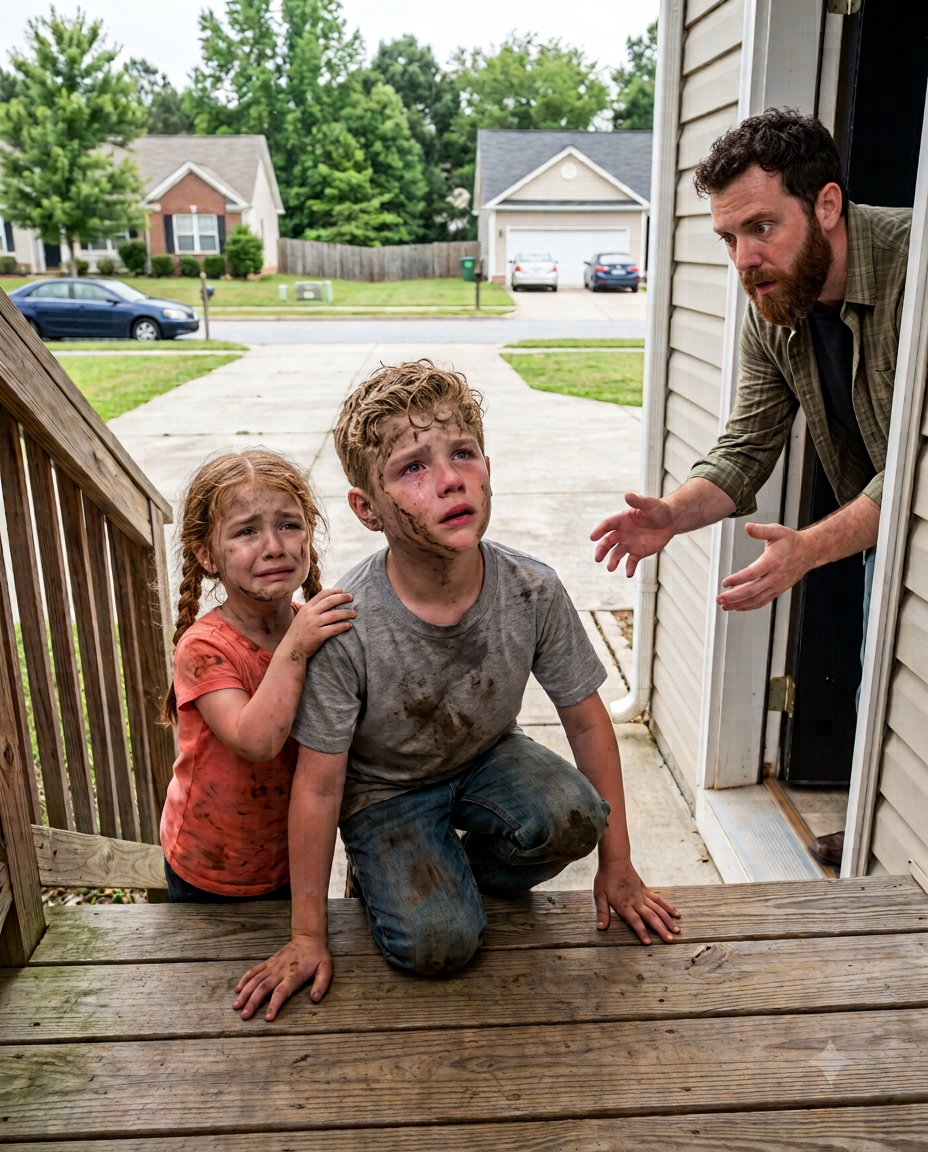
I turned, expecting a neighbor’s kid, or a package, and instead I saw my six-year-old nephew standing at the top of my steps, holding his little sister’s hand, both of them filthy and exhausted, Mason’s face gray and set with a determination no child that age should have to wear.
“Uncle Christian,” he said, and his voice cracked.
“Mommy left again.
And Daisy was so hungry, and there wasn’t any food, so I remembered your address.”
I have thought since about why I couldn’t concentrate on that hinge, why a ten-minute job had stretched into an hour of me staring at nothing.
I want to believe it was something more than coincidence — that some part of me had been uneasy for a long time, and chose that particular afternoon to surface.
Because the truth is I had been uneasy for three years, in a low, buried, deniable way.
It lived under everything, that unease, a small wrongness I kept explaining away: the way Evelyn never quite let me finish a phone call, the way the children were always asleep or sick or unavailable, the way three years had gone by and I had laid eyes on my brother’s kids a handful of times, always briefly, always managed.
I had felt it and I had swallowed it, again and again, because feeling it fully would have required me to do something, and doing something would have meant not respecting the boundaries of a grieving widow, and so I had kept the unease pressed down where it couldn’t make trouble.
And maybe, that afternoon, it wouldn’t stay down anymore.
Maybe some animal part of me had done the math the conscious part refused to, and was trying to get my attention the only way it could, by making me unable to focus on a simple screw.
I’ll never know.
But I have decided to believe it, because the alternative — that I would have gone on obliviously fixing that hinge while Mason walked his sister across town — is more than I can bear.
What I know for certain is that when I heard those small footsteps and turned around, the unease of three years and the horror of the present collapsed into a single instant of terrible clarity, and I understood, before Mason said a word, that every quiet fear I’d swallowed had been right all along.
To understand how a six-year-old came to be standing on my porch having walked his little sister across seven blocks, you have to understand the three years that came before it, and those three years began at my brother’s grave.
I loved Thomas the way you love a younger brother you half-raised — fiercely, and with a little guilt always mixed in, the sense that I should have called more, visited more, been there more.
When he died so suddenly, that guilt had nowhere to go, and it curdled into a desperate need to do right by what he’d left behind.
At the funeral, when the family gathered afterward in Evelyn’s living room, she stood in the center of the room, pale and composed, and said the thing that would shape everything.
“All I want right now,” she said softly, “is stability for Mason and Daisy.” And I believed her.
Of course I believed her.
She had just lost her husband; the children had lost their father; grief makes even simple things feel impossible, and a woman asking only for stability for her children seemed to me the most reasonable, the most admirable, thing in the world.
I decided, standing in that room, that I would give her exactly that — space, stability, whatever she needed — and that I would not be one more person making demands on a grieving young widow.
PART 2
It was a good decision, made for good reasons. It was also the exact decision she needed me to make.
I tried to help in the ways I knew how. I called every week. I bought groceries. I stood in department stores holding a little dress for Daisy or a toy truck for Mason.
And every time I offered to actually come by, Evelyn turned me away, always gently, always with a reason.
“They’re sleeping right now, Christian.” “They’re sick today, they need rest.” “It’s not a good time.”
And then, one afternoon at her front gate, she found the reason that finally made me stop.
“Seeing you reminds them too much of their father,” she told me. “It’s too hard on them, Christian.”
So I backed away, one careful step at a time, telling myself that respecting her boundaries was the loving thing to do. For three years I told myself that.
It let me sleep. And the whole time, seven blocks away, my brother’s children were not being kept from their grief. They were being kept from a witness.
She did not fool me by exploiting my carelessness. She fooled me by exploiting my care.
I got them both inside and onto the sofa. Daisy would not speak. She stared at me with wide, blank eyes, and when I asked if she was hungry she gave no answer at all.
I went to the kitchen and came back with a pitcher of water and a box of crackers, and the instant I set them down Daisy grabbed the crackers with both small hands and began shoving them into her mouth, frantic, too fast.
“Easy, sweetheart,” I said. “Slow down, you’ll choke.”
And before I could reach her, Mason — exhausted, filthy, barely upright himself — leaned over and patted his sister’s back with one thin hand.
“Eat slow, Daisy,” he murmured. “Eat slow.”
I knelt there and watched my six-year-old nephew, who had walked seven blocks and could barely hold his own head up, tending to his little sister before he would take a single cracker for himself.
They’re sleeping. They’re sick. It’s not a good time. Those had never been about protecting the children from the pain of remembering their father. They had been about keeping me from seeing.
It was Mason’s eat slow, Daisy that finished me. Not the hunger itself — it was the way my six-year-old nephew, at the absolute end of his own strength, still had one hand and one thought left over for his sister.
Watching him pat her back with the last of his strength, I made a vow, silent and total, right there on my living room floor.
He was going to get to put the roof down now.
I took out my phone, and the moment I did, Mason’s face twisted into pure panic.
“No — please, Uncle Christian, she’ll be so mad at us,” he said. “Please don’t.”
I crouched down low, so my eyes were level with his.
“Mason. Nobody is going to be mad at you. You did the exact right thing, bringing Daisy here. She’s never going to leave you alone and hungry again. I promise you that.”
I told the dispatcher my address, and that my six-year-old nephew and his three-year-old sister had walked seven blocks to my house because their mother had left them alone with no food.
While we waited, Mason never once let go of Daisy’s hand.
PART 3
They took us to the regional hospital. A doctor examined both children, and then came to find me in the waiting room.
“Mr. Palmer? I’m Dr. Aris. Your nephew and niece are going to be all right. But I need to be honest with you about what we’re seeing. Both children are significantly underweight and dehydrated. The little girl’s blood sugar was dangerously low when she came in — she hadn’t eaten properly in some time. This isn’t something that happened yesterday. These are the signs of a child who has been neglected, consistently, for a long while.”
While I had been sitting in my quiet house every evening for three years, telling myself I was respecting a grieving widow’s wishes, these two children had been seven blocks away, going hungry.
“I should have pushed harder,” I said.
“A lot of people miss it,” Dr. Aris said. “What matters now is what happens next.”
Mason and Daisy were sleeping when a police detective named Neil Blake and a child welfare specialist named Clara Higgins stepped into the hall.
“We sent officers to the house on Maple Avenue,” Detective Blake told me. “I’m going to be straight with you, Mr. Palmer — she’s in a great deal of trouble.”
“The home was not safe for children,” Clara said. “There was almost no food. The children had clearly been left unsupervised for extended periods. And there’s a financial dimension our investigators are still unpacking. When officers arrived, Mrs. Palmer was not with the children. She hadn’t been for some time.”
Thomas had left his family well provided for — a substantial life insurance payout, and monthly survivor benefits meant to keep his children fed, clothed, and stable for years.
And Evelyn had been spending almost none of it on them. The investigators had found a trail of it draining steadily away into gambling debts — online accounts, cash withdrawals — while his children went hungry seven blocks from my door.
“He died thinking she’d take care of them,” I said.
“She fooled everyone, Mr. Palmer,” Clara said. “Your brother most of all.”
Thomas was the kind of person who read the fine print, who kept a fire extinguisher in the kitchen and a spare in the garage, who had a will drawn up the week his first child was born because that was simply the responsible thing to do. I can see him doing it — sitting at his kitchen table with the paperwork, choosing the coverage, thinking this is so that no matter what happens to me, they’ll be all right. He built a wall of money around his children specifically so that his death could not touch them. The wall held. The money was there, all of it, exactly as he’d planned. The only thing his careful foresight could not account for was that the person he’d trusted to stand guard over it would be the one to tear it down. His gift to his children became her funding. He went to his grave believing he had protected them.
“What happens to Mason and Daisy now?” I asked.
“Standard procedure,” Clara said, “is temporary protective foster care—”
“No,” I said. “That’s not happening. They are not going to strangers. They are coming home with me.”
“I’m their uncle. I own a four-bedroom house on Oak Street, seven blocks from where they’ve been. I’m a licensed building contractor with a stable income and a clean record. I already lost three years with them because I trusted the wrong person. Please don’t make me lose them to a system when I’m standing right here.”
Clara Higgins looked at me for a long moment. “I’ll file for emergency kinship placement today.”
Two days later the hospital cleared them, the background check came back clean, and I carried two small bags of their things through my front door.
I had spent those two days turning my spare room into something that might feel like theirs — two new beds, a shelf of books and toys, a nightlight shaped like a moon.
But Mason did not look at the toys. He stood in the doorway, and his eyes went straight past all of it to the kitchen down the hall.
“Is there food here?”
It was not a child asking what was for dinner. It was a small boy who had learned, in his bones, that food was a thing that could simply stop.
I walked him to the kitchen and I opened the pantry, and the refrigerator, and the freezer.
“This is your house now,” I told him. “There is always going to be food here. Always. You never have to be hungry again, and you never, ever have to worry about feeding Daisy by yourself. That’s my job now.”
Mason stared into that full pantry for a long time, and then he let out a breath that seemed to come from somewhere very deep, and his shoulders came down about an inch.
It was not everything.
But it was a start.
PART 4
For the first month, neither of them would sleep in the new beds. I would tuck them in, and in the morning I would find them curled up together on the floor, Mason’s arm around his sister.
I did not force them back into the beds. Instead I brought a sleeping bag upstairs and slept on the floor in the hallway just outside their door, with the light on, so that whenever they woke in the night they could see me there.
I would find crackers and rolls hidden under Daisy’s pillow. I never scolded her for it. I just kept the pantry full.
And Mason would not eat his own dinner until Daisy had finished every bite of hers.
The most important thing I did in those early weeks was not the beds or the toys or even the food. It was lying in that hallway, night after night, taking the watch off his small shoulders and putting it onto mine.
For three years, Mason had never fully slept. Some part of a child who is the only guardian of a smaller child never gets to power all the way down. I wanted him to see me there every time he stirred, until his body finally understood that the post was filled, that he had been relieved of duty, that he was allowed — for the first time in his conscious memory — to be a child who simply sleeps because a grown-up is keeping the dark away.
There came a night when I checked on them and found Mason asleep on his back with his arms flung wide and his mouth open, dead to the world, utterly undefended. I stood in that doorway and cried, quietly, so as not to wake him.
The turn came on a gray autumn evening, about six weeks in, over a wooden train set.
Mason was on the living room rug, trying to fit two pieces together that didn’t match, and he forced them, and a little connector snapped with a sharp crack.
And my nephew came apart.
He dropped the pieces and scrambled backward across the floor and folded himself into a tight ball against the sofa, arms over his head.
“I’m sorry, I’m sorry, I didn’t mean to! Please don’t be mad — please don’t send us back! I’ll be good, I promise I’ll be good!”
I lowered myself onto the floor a few feet away, slow and calm.
“Mason. Buddy. Look at me.”
He peeked out from under his arms, trembling, braced for a punishment I finally understood he had learned to expect.
I reached over and picked up the broken piece and dropped it, casual as anything, into the trash.
“It’s a toy,” I said. “It broke. Things break, Mason. Do you know what happens in this house when something breaks?”
He shook his head.
“Nothing happens. We fix it if we can, and if we can’t, we throw it out and get another one. Nobody gets yelled at. Nobody gets sent anywhere.”
The court had not spoken yet.
Evelyn had not answered yet.
He was still waiting to find out whether a broken train could send him back.
PART 5
“And you — you are never going back anywhere, do you hear me? You live here. You and Daisy live here, with me, and that is never, ever going to change, no matter what breaks.”
A single tear ran down his face. “You’re not mad?” he whispered.
“I could never be mad at you over a train,” I said, and I opened my arms. “Come here.”
He crawled across the rug and threw his arms around my neck, and for the first time since any of this began, my brave, watchful, exhausted little nephew stopped being a guardian and let himself be a six-year-old, and he cried — really cried, years of it — into my shoulder.
“I’ve got you,” I told him. “I’ve got you both. You’re safe now, and I’m never letting go.”
After that night, something loosened in him. Daisy stopped hiding food. Mason began, for the first time, to eat his own dinner while Daisy ate hers.
Slowly, my quiet house of grief filled up with noise — arguments over the last waffle, cartoons too loud on Saturday mornings, the specific racket of two children who had finally stopped being afraid.
Sixteen months after Mason walked his sister to my porch, I sat in the gallery of the regional Superior Court and watched Evelyn answer for what she’d done.
Her lawyers had tried to build a defense out of grief. It did not survive contact with the evidence. Grief does not keep a full pantry for oneself and an empty one for one’s kids.
When the judge — a stern, measured man named Samuel Vance — read out the verdict and the sentence, for the theft of her own children’s future and the sustained neglect of their present, Evelyn showed nothing at all.
They led her out in handcuffs, and she never once looked at the gallery.
I felt only relief. Not her suffering. Just my kids, safe.
It wasn’t forgiveness; I don’t forgive her, and I don’t feel any obligation to. It was something more like indifference — the particular indifference that comes when the danger is finally past and you realize you no longer have to organize any part of yourself around the person who caused it. She was a closed door now.
The best thing that woman ever gave my family was the fifty-foot distance and the locked door of a prison cell.
I could not save my brother. But I kept my promise to what he left behind.
I drove home from the courthouse. Daisy — four now — was tearing across the front lawn in a red superhero cape. Mason, seven, sat on the porch steps in a grass-stained Little League uniform, tossing a baseball into his glove.
When I got out of the truck, Daisy came flying at me with her arms out. Mason came down the steps grinning.
“Did the judge say she can never come back?” he asked — not frightened, just checking.
“She’s never coming back, buddy,” I said. “It’s over. You don’t have to think about her anymore.”
He nodded, and glanced once at the porch steps where he’d stood exhausted sixteen months before, and then it was gone from his face, and he was just a kid again.
“Can we practice throwing before my game?” he asked.
“Yeah, buddy,” I said. “Let’s go to the park.”
I buckled Daisy into her seat and waited while Mason climbed in with his glove, and before I started the engine I glanced up through the windshield at a wide clean blue sky, and I said it to my brother the way I always do now, silently, just between us.
I’ve got them, Thomas.
They’re okay. They’re better than okay.
I kept them. They’re safe.
They’re home.