Grayson invited me to his wedding for one reason: to humiliate me in front of a hundred and eighty guests.
That was the whole of it.
He wanted me to stand at the edge of his beautiful new life and watch him marry a beautiful new woman, so that I could feel, in front of everyone who mattered to him, exactly how far he had risen and how far I had not.
In his mind I was still the same defeated, penniless woman he had thrown away seven years earlier, and he wanted to see that woman’s face when she understood what she had lost.
The wedding was held at an oceanfront estate on the Monterey Peninsula — clipped gardens, stone fountains, long tables spilling white orchids, the Pacific flat and silver behind it all.
Grayson Winslow, newly made a senior partner at a commercial real estate firm, moved through the crowd shaking hands with executives and old-money families, wearing the particular smile of a man who has finally been let into the room he always believed he belonged in.
Beside him stood Serena Sinclair, daughter of a hotel dynasty, posing for the photographers as though the wedding were also the press launch of a corporate merger, which, in a sense, it was.
Only a handful of people knew that the invitation mailed to my apartment had been his idea.
“I want her to see what she lost,” he’d told his groomsmen days before, laughing over scotch.
The sentence would have landed even worse with his friends if any of them had known the truth of what I’d actually lost, and what I hadn’t.
When Grayson had nothing, I had carried us both.
I worked morning shifts at a diner and cleaned commercial offices late into the night.
I paid down his overdue credit cards.
I loaned him the whole of my savings for his master’s program.
When his first startup was weeks from collapse, I sold the antique jewelry my grandmother had left me — the only truly valuable thing I owned — and handed him the money, and told him to go build his life, and meant it.
And then his life started to build, and the moment it did, I became something to be embarrassed about.
It happened by degrees, the way these things do.
First he began commenting on my clothes before we went out.
Then he stopped introducing me as his wife at functions, letting people assume I was a colleague, an assistant, no one.
And finally, once the wealthy clients were his and the momentum was his, he filed for divorce and left me with a fifteen-year-old sedan, a joint bank account he had already emptied, and a small rented apartment on the wrong side of the city.
He walked away certain he had shed dead weight.
He told the story, for years afterward, as the moment he’d finally freed himself from a woman who was holding him back.
I know, because the story always found its way back to me, the way his stories did.
What I understood only much later — years later, with three children asleep and a quiet apartment and time, finally, to think — was that Grayson had needed me to be small in order to feel large, and that the need had been there all along, waiting for money to make it possible.
When we had nothing, my competence was a lifeline he clung to.
The moment we had something, that same competence became an accusation, a standing reminder of the years he’d been carried, and he could not build the self-image he wanted while a witness to his smallness sat across the breakfast table.
So I had to be revised.
First into a woman with embarrassing clothes, then into a woman not worth introducing, then out of the picture entirely.
It was never really about my dresses.
It was that a man who has been rescued by someone often cannot forgive them for the rescue, and Grayson chose, as such men do, to resolve the discomfort by discarding the rescuer rather than by becoming worthy of her.
I did not know any of that in the moment.
In the moment I only knew that the man I had sold my grandmother’s jewelry to save had begun to look at me like a stain on his good coat.
Three weeks after the divorce was finalized, I found out I was pregnant.
With triplets.
For months I tried to reach Grayson.
I told myself he had a right to know, whatever had happened between us, and that a man ought to be given the chance to decide what kind of father he wanted to be.
My messages went nowhere.
PART 2
And then one frantic call was finally answered — not by Grayson, but by his mother, Delphine, who listened to about ten seconds of me before she told me, in a voice like a closing door, to stop trying to trap a man who had moved on to a better life with a fake pregnancy.
I was heartbroken, and I was frightened, and I had no money. Grayson’s family could field a legal defense team that would have buried me before I filed a single motion. I did the arithmetic that poor women have always had to do.
I stopped calling. I would raise my children alone.
I raised Elias and Tristan and Juniper on almost nothing, at first. I took in alterations. I designed window displays. I did any custom textile work anyone would give me, hunched over a single secondhand sewing machine at my kitchen table after the children were asleep.
But I was good. That was the thing Grayson had never bothered to notice — that the woman cleaning offices at night had a real and specific talent, and that talent, given even a sliver of room, grows.
The single machine became a corner of the apartment. The corner became a small boutique studio. The studio, over seven years, became a high-end commercial textile firm with clients across California, New York, and Texas, and a name that meant something in rooms Grayson would have killed to be taken seriously in.
He never knew any of it.
In his mind I was frozen in place, the poor waitress he’d discarded, still standing exactly where he’d left me. It is a particular kind of freedom, being underestimated that completely by someone. It gives you room to build an entire life he can’t see coming.
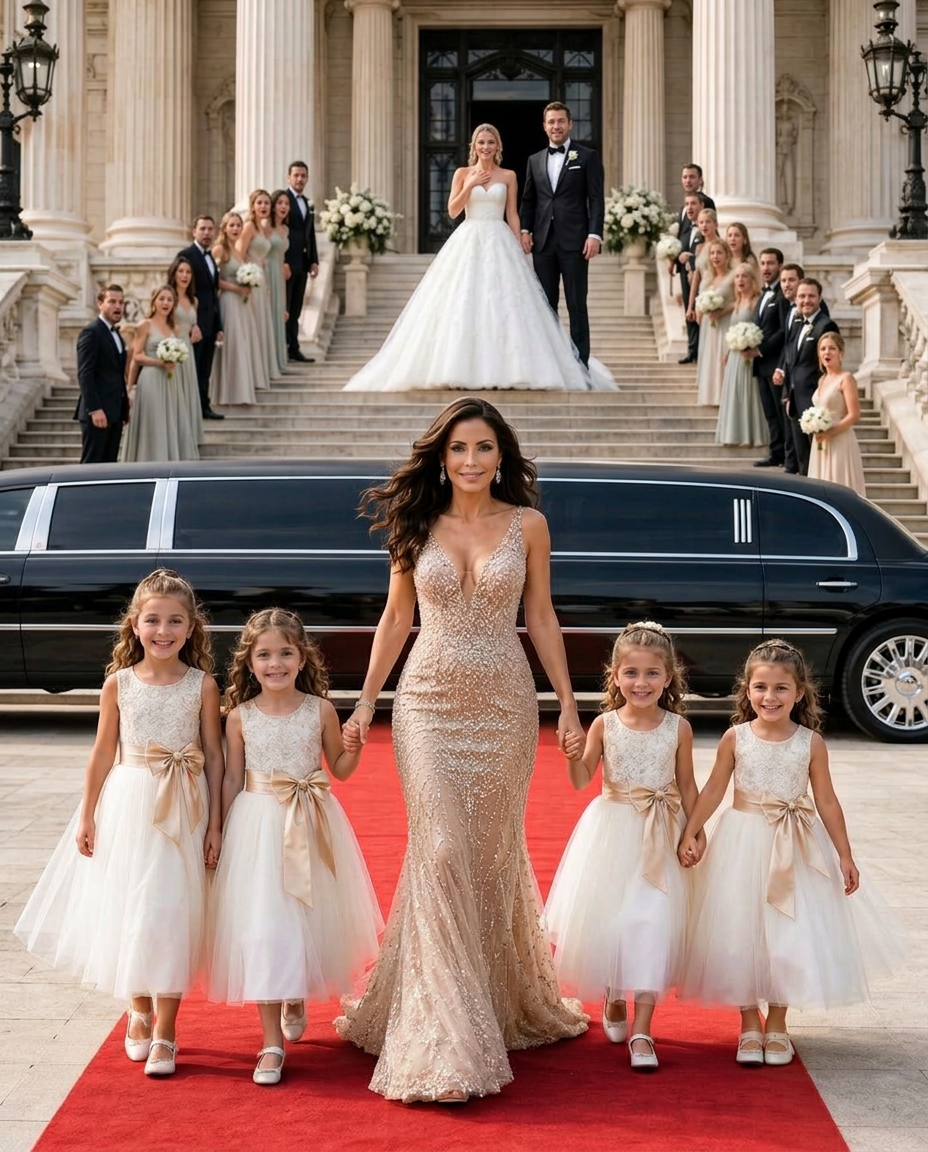
At seventeen minutes past noon, as the guests were settling into their seats, a black limousine came up the estate’s long drive and stopped at the grand stone entrance.
I had thought carefully about the car. I did not hire it to show off money. I hired it because I understood the theater of the day Grayson had built, and I intended to walk onto his stage on my own terms.
Across the lawn, I could see him adjust his cuffs, arrange his face into its smirk, and turn toward the car to savor the moment he’d been planning for weeks.
Grayson had built his whole invitation on a single false belief — that I was still the woman he’d left, and that my children did not exist.
Declining would have protected that belief forever. He thought he had summoned a defeated woman to his stage. He had, in fact, subpoenaed his own reckoning, addressed it himself, and paid for the catering.
The door opened. I stepped out first — unhurried, composed, in a dress I had designed myself.
And then, one after another, my three seven-year-old children stepped out of the car behind me.
The instant Grayson saw the first boy’s face, the smirk fell off his own. A silence went across that lawn like a change in air pressure. Because there was no mistaking them, and everyone could see it at once.
Elias had Grayson’s exact slate-gray eyes. Tristan had his dimple, the one that showed only on the left when he smiled. And Juniper — my sharp, watchful girl — had inherited his habit of raising one eyebrow whenever she doubted what an adult was telling her, and she was doing it now, at all of them.
“Who are they?” Serena asked, turning to her groom.
Grayson’s mouth opened and nothing came out of it.
So I answered for him.
“My children,” I said. “They’re seven years old.”
And across the lawn I watched Delphine’s face, and in the space of one second the last thing I had spent seven years refusing to believe became impossible to deny.
Grayson’s mother was not surprised. Not for an instant.
Everyone else on that lawn was reeling. She was already calculating.
PART 3
Grayson came at me across the grass, his face gone red.
“What kind of sick spectacle is this, Camille?”
“The kind you arrange,” I said, “when you mail a woman an invitation for the sole purpose of laughing at her.”
Serena was looking at the three children, and then back at her groom, and her voice had gone very careful.
“Grayson. Are they yours?”
Before he could shape a denial, Delphine had my arm, her manicured fingers digging in, her voice a frantic whisper against my ear.
“Not today, Camille. Please. I will pay you anything you want. Name it.”
I went still. I looked at her hand on my arm, and then at her face, and I said it quietly, so that only she could hear the full weight of it.
“So you knew.”
She tried to steer me toward the side doors of the estate, but Juniper had my other hand and would not be moved, and there were already a dozen phones up around the lawn, recording. There was no quiet exit left.
For seven years I had carried a version of the story in which no one had ever received my letters — a story in which the silence was a kind of accident. Watching Delphine’s face on that lawn, unsurprised, already bargaining, I felt that merciful story die.
Someone had received every letter. The silence had not been an accident of the world. It had been a woman’s choice, made and remade over seven years, every time she looked at that blue box and decided again to keep it shut.
Serena slid the engagement ring slowly off her finger.
“I want an answer, Grayson. Now.”
And Grayson — cornered, flushed, with a hundred and eighty people watching — swore on his life that he had never known a single thing about any pregnancy.
I opened my mouth to call him a liar and a coward. And then, to my astonishment, it was Delphine who broke.
“He didn’t know!” she cried, and the whole lawn went quiet to listen. “He didn’t know because I made sure he didn’t. I deleted your messages. I answered that phone call and told you to go away. And I kept the letters — I kept all of them.”
Grayson turned and looked at his mother the way you look at a stranger wearing a familiar face.
He truly hadn’t known. It did not make him innocent. But it rearranged, in an instant, the entire shape of the story I’d told myself about who had done what to me.
But Delphine wasn’t finished, and what came next silenced even the whispering.
“I did it,” she said, “because if those children ever surfaced, your father’s trust was written to leave them half of the entire family estate.”
Near the stone fountain, the string quartet stopped playing. The bows simply came down and went quiet, and no one told them to.
Grayson turned to face his mother fully. “What did you just say?”
Serena set her engagement ring flat on a glass cocktail table, with a small final click that carried farther than it should have.
“The wedding can wait,” she said. “The truth can’t.”
Years earlier, Grayson’s father — Ambrose Winslow, dead now four years — had quietly drafted a private trust, setting aside a large share of his personal estate and his company holdings for any grandchildren he might one day have. Ambrose had been fond of me, genuinely fond, in a way his son never managed.
When Delphine learned I was pregnant, she did not see three grandchildren. She saw a threat.
“I thought you would rebuild your life,” she wept, turning to me. “I thought the children would be better off without all this.”
“No,” I said. “You thought you would be better off.”
It was the only sentence I needed.
PART 4
Grayson looked like a man who had forgotten how to breathe. He turned, slowly, from his mother to me, and then down to the three children standing patiently at my side.
“Are they mine?” he whispered.
I met his eyes and held them.
“I didn’t come here to demand your money, Grayson, or to blow up your wedding. I came because you have spent seven years telling everyone who would listen that you left me because I was a worthless drag on your life. And our children have a right to know where they come from, and who their father is, and to hear it said out loud instead of hidden. What you do with the truth now is on your conscience, not mine.”
And then, into the silence, my son Elias tugged my hand and looked up at me, and asked the question in the plain, enormous way that only a seven-year-old can.
“Mom. Is this man our dad?”
I watched that single question go into Grayson deeper than any lawyer, any threat, any headline ever could have. He did not get the chance to answer it.
Serena crossed the lawn to us, and knelt down to the children’s eye level, and offered them a quiet, real apology for all the shouting — the only adult on that lawn who thought to speak to the children as people.
Then she stood and turned to Grayson.
“That you didn’t know they existed isn’t your fault,” she said. “Inviting their mother here today to humiliate her in front of everyone — that is.”
Grayson scrambled. It was a joke, he said, a stupid joke among friends.
Serena took out her phone. Late the night before, one of his groomsmen had shared a voice note in the group chat — Grayson, laughing, describing how he pictured me arriving that day, stepping off a city bus in a thrift-store dress for everyone to pity.
“I’m not marrying you,” she said.
What followed was not dignified. Serena’s mother wept; her father called for security; Delphine shrieked at me that I had ruined their lives; the phones kept filming.
And in the middle of all of it, Juniper started to cry.
So I stopped attending to any of them. I knelt down, and I gathered my three children into my arms, and I walked them back to the waiting car.
The spectacle Grayson had built to humiliate his ex-wife had become, in under twenty minutes, the public record of his own undoing — and I had not had to lift a finger to make it so.
I had only had to arrive.
I had rehearsed a hundred furious speeches over seven years — in the shower, at the sewing machine at two in the morning, in the car after a hard day. Standing there with the chance to deliver every one of them, I found I wanted none of it. Delphine’s own defense had already said the truest thing. All I had to do was strip the kindness off it.
The court had not spoken yet.
The blue box had not been opened yet.
He still did not know their names.
PART 5
By Sunday evening the clips were everywhere. My studio staff pointed out that a single statement would put us on national morning shows.
I told them we would issue nothing. We would not sell a single yard of fabric on the back of my children’s father humiliating himself. And above all, we would not turn Elias, Tristan, and Juniper into viral content. They were seven. They deserved to grow up as people, not as a satisfying clip.
On Monday morning I retained a top family law firm. Not to sue Grayson for millions. I retained them to build permanent legal protections around my children.
The court-ordered paternity test came back as certain as these things come: ninety-nine point nine-nine percent. When the certified report reached Grayson’s office, I heard later that he sat at his desk for over an hour without turning on his computer.
Two days later he drove to his mother’s estate, and Delphine met him at the dining table with a small blue velvet box in front of her. Inside were my four unopened letters.
The first still bore a faint ring from a coffee cup, telling him I was pregnant with triplets, that I did not want to force a reconciliation — only that he should know, so that he could choose for himself what kind of father he wanted to be. The third carried their names — Elias, Tristan, Juniper — and a small photograph of three newborns asleep in a single crib. The fourth was short. I had written that I was going to stop writing. Hope, it turned out, was too expensive.
Grayson read the fourth letter three times, in complete silence. Then he looked up at his mother and said, “You stole seven years from me.”
He closed the blue box. “And I stole her dignity,” he said, “long before you ever touched a letter.”
The rest of Grayson’s careful life came apart on its own. Serena was gone for good. The merger collapsed. He lost major clients.
The hardest part came when he asked for court-approved visitation with the children.
I agreed. But I agreed on my terms: a slow, structured integration, overseen by a child psychologist. A wedding is a performance. So is a dramatic reunion. What I did not yet know was whether he could do the unglamorous part.
Their first meeting was forty-five minutes at a family counseling center. Grayson arrived with three enormous bags of expensive toys. Elias barely looked at them. Juniper hid behind my coat.
“They don’t need you to buy them,” I told him, quietly, as we left. “They need to find out whether you’re going to show up again on Thursday.”
He showed up on Thursday. And the Thursday after that. For months it was awkward, and slow, and the children called him Grayson, and he never once complained about it.
A year after the wedding that didn’t happen, the triplets turned eight. We had the party at a public park above the water. Juice boxes. A homemade cake that leaned slightly to one side.
When it was time for the candles, Juniper realized Peanut was missing from her backpack. Grayson remembered seeing the giraffe in the back seat of his car, and he ran — full out, across the whole park — to get it, and put it in her hands.
Juniper hugged the toy, and then she hugged him around the waist, and said, into his shirt, “Thanks, Dad.”
Grayson went still, his eyes filling. I watched him from across the grass, and I did not go over to comfort him. It was no longer my job to manage that man’s heart.
We never got back together. There was no reunion, no starting over, no swelling music.
Grayson becoming a decent father is a wonderful thing for my children and I am glad of it every single day — and it does not, and never will, entitle him to me.
Those are two separate accounts. I keep them separate.
His father’s trust was restructured through the court into a protected fund for the three children’s education, and I never touched a dollar of it.
“I built my own company,” I told the attorneys. “That money is theirs.”